



Page 150 - Newest Teaching Resources

 Show filters
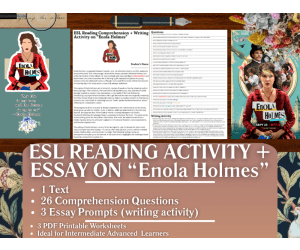
ESL Reading Comprehension + Writing Activity Worksheets - Enola Holmes
Language Development, ELA, ESL, Vocabulary, Reading, Reading Comprehension, Writing, Creative Writing, Formal Writing, Grade 7, 8, 9, 10, 11, 12, Worksheets & Printables, Worksheets, Writing Prompts
ESL Reading Comprehension + Writing Activity Worksheets on Enola Holmes This ESL - EFL Teaching Resource on "Enola Holmes" (3 PDF Worksheets Slides - Reading Comprehension + Writing Activity) can be ideal to improve Language skills in English. Ideal students for this ESL EFL TESOL Reading + Writing Activity are Foreign Students at middle and High School (7th - 12th Grade; teens) . Newcomers or any ESL Learner is also more than suitable for this ESL - EFL - TESOL - TEFL (English as a Second or Foreign Language) Activity on "Enola Holmes" (Series inspired by Sir. Arthur Conan Doyle's Detective stories "Sherlock Holmes" - origins, background and history + setting, characters and overall plot + impact and legacy). This Teaching Educational Resource Product can also be ideal for ESL EFL TESOL Centers worldwide or any English second language tutor. Intermediate Advanced English as a Second or Foreign Language (ESL - EFL - TESOL - TEFL) learners are suitable for this ESL - EFL - TESOL - TEFL Teaching Resource on "Enola Holmes" (Worksheet; 3 PDF Printable slides) In this English Second or Foreign Language (ESL - EFL - TESOL - TEFL) Reading Comprehension + Essay Writing Activity Worksheet on "Enola Holmes" (Series inspired by Sir. Arthur Conan Doyle's Detective stories "Sherlock Holmes" - origins, background and history + setting, characters and overall plot + impact and legacy), the following ESL - EFL - TESOL - TEFL (English Second or Foreign Language) activities are included: 1 text on "Enola Holmes" (Series inspired by Sir. Arthur Conan Doyle's Detective stories "Sherlock Holmes" - origins, background and history + setting, characters and overall plot + impact and legacy) 26 Comprehension Questions related to the previous text on "Enola Holmes" (with related space where students can answer to this text's comprehension questions) 3 essay prompts for a writing activity on "Enola Holmes" (writing an essay on your own personal opinion on Enola Holmes, whether you have already read or watched it or not and whether you liked it or not and why + writing an essay on another series which is known for its independent female protagonist; describing it and comparing it to Enola Holmes + writing an essay on another series which is based on an already existing film or novel; describing it and comparing it to Enola Holmes) This ESL - EFL - TESOL - TEFL ( English Second or Foreign Language ) Teaching Resource Reading + Writing Activity (essay prompts) on "Enola Holmes" (Series inspired by Sir. Arthur Conan Doyle's Detective stories "Sherlock Holmes" - origins, background and history + setting, characters and overall plot + impact and legacy) is great for Intermediate Advanced English as a second or foreign language learners (ESL- EFL - TESOL - TEFL). This English Second Language Worksheet on "Enola Holmes" (Series inspired by Sir. Arthur Conan Doyle's Detective stories "Sherlock Holmes" - origins, background and history + setting, characters and overall plot + impact and legacy) aims to train and Reading Comprehension + Writing Skills. "Learning with Alan" is a teaching resources store that aims to provide high quality teaching resources and educational materials for ESL EFL TESOL (English Second or Foreign Language) teachers, tutors and educators. It aims to support teachers, educators, and tutors in both online and offline environments, helping them achieve their teaching goals while creating a fun, stimulating atmosphere for learning English. Always remember: learning is fun, and so is English! If you want to find more ESL - EFL - TESOL - TEFL ( English Second or Foreign Language ) Teaching Resources and Educational Material click here Learning with Alan!
Author Learning with Alan
Rating
Tags ESL, English Second Language, English, Enola Holmes, Sherlock Holmes, Arthur Conan Doyle, Reading Comprehension, Writing Activity, Worksheets, Activity

Feelings Conversation Cards | 16 Sentence Starters for Speaking
Language Development, ELA, Social Emotional Learning (SEL), Special Resources, Social Skills, Not Grade Specific, Task Cards, Worksheets & Printables, Flashcards
I made these Feelings Conversation Cards for simple speaking activities about feelings and emotions. Each card gives students an easy sentence to continue, so even quieter learners usually have something they can say. The prompts are open enough for different answers, but still simple for different ages and levels. Some examples of how the cards can be used: • I’m happy when … “…when I have my birthday.” “…when I get what I want.” • I’m tired when … “…when I go to bed late.” “…when I work too much.” I mostly use cards like these for pair work, warm-up discussions, morning meetings, and small speaking groups. They also work well as quiet conversation prompts during SEL lessons. What’s inside: • 16 conversation cards • 5 printable pages • card backs included Just print the pages, cut the cards, laminate them if you’d like to use them more than once and they’re ready to use. The illustrations and soft colors were designed to keep the activity calm and welcoming, especially for students who may need a little more time or confidence to share their thoughts.
Author English with Rita
Rating
Tags Speaking Practice, Task Cards, Conversation Cards, Discussion Cards, Social Emotional Learning, SEL Activities, Sentence Starters, Printable Task Cards, Icebreaker
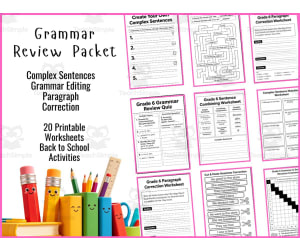
Grade 6 English Grammar Review Worksheets Pack
ELA, Grammar, Language Development, ESL, Grade 6, Worksheets & Printables, Flashcards
This Grade 6 English grammar review pack includes 20 printable worksheets designed to help students practice and strengthen their grammar skills in a simple and clear way. The worksheets focus on important grammar areas such as sentence structure, grammar editing, complex sentences, and paragraph correction. Students are given short and easy activities that help them understand how to improve their writing step by step. Teachers can use this resource in many different ways in the classroom. It is perfect for morning work, homework assignments, literacy centers, small group activities, or quick grammar review sessions. It can also be used throughout the school year whenever students need extra practice. This resource is easy to use and requires no preparation. Teachers can simply print and use it directly in class. It helps save time while still giving students meaningful practice. What’s included: 20 printable worksheets Grammar practice activities Sentence correction exercises Paragraph editing tasks Writing skill practice This resource is designed for Grade 6 students and can also be useful for middle school English language learners who need extra grammar support and review.
Author LuminaPrint
Rating
Tags Grade 6, Grammar Worksheets, English Worksheets, Back To School, Printable Worksheets, Writing Skills, Grammar Review, Middle School English, Sentence Correction

Weather & Extreme Events Prediction Worksheets
Resources for Teachers, Basic Science, Science, Inventors, Theories, Earth and Environmental Sciences, Earth Sciences, Environmental Science, Nature & Plants, Life Sciences, Grade 5, 6, 7, 8, 9, 10, 11, Workbooks, Worksheets & Printables, Worksheets, Word Searches, Teacher Tools, Lesson Plans, Quizzes and Tests, Quizzes, Tests, Assessments
Using this Complete Weather and Extreme Events Prediction Unit, you can convert your students from passive observers of weather to skilled analytical forecasters! Are you sick of units that merely scratch the surface of the science of weather? This 30-page, ready-to-go unit challenges students in middle and high school to delve into deeper levels of meteorological investigation, such as thermodynamics and tornado development. The assessment in this unit is not just a bank of worksheets - it is a complete pedagogical system that promotes critical thought, data analysis, and an in-depth understanding of the atmospheric forces at work around us. The unit is broken down into three phases, which makes it simple to implement over a two-week time frame or as separate lessons/activities. The purpose of this unit is to prepare students to effectively educate others about severe weather. 30 page unit will be broken down into two phases. Phase 1 - Core Content & Theory - 10 Pages - This includes four chapters that represent the foundation of the unit. These chapters will help to explain to students complex topics in simple terms with real-life examples (i.e., 1900 Galveston Hurricane and the 1993 Superstorm). Chapter 1 - The Engine of the Sky (Air Masses & Thermodynamics) Chapter 2 - The Structure of Storms (Cyclogenesis & Frontal Boundaries) Chapter 3 - The Mechanics of Fury (Tornadoes & Hurricanes) Chapter 4 - The Meteorologists Toolkit (Data, Models, & Human Intuition) -This phase will contain real-life examples of each of these chapters. Phase 2 - Student Workbook - 11 Pages - The student workbook contains 10 worksheets with a variety of question types (e.g. Fill-in-the-blank, Data Analysis, Scenario Analysis, & Short Response) that will test the student's knowledge of the topics discussed in phase 1. Some possible topics that the student workbook could cover are: - Instruments used to measure weather and how to read a Synoptic Map. - How thunderstorms develop and how tornadoes develop. - Tropical Cyclones and Flash Floods - How blizzards develop, heat waves develop, droughts develop, and how to model a weather event using predictive modeling software. Phase 3: Visuals and Teacher's Resources (91 pages): The ultimate resource for teachers to help save time and increase lesson effectiveness. Professional Quality Visuals: 3 professionally designed and scalable diagrams/charts covering key concepts (Atmospheric Variables, Forecast Process, and Storm Intensification), which can be used to project or print. Detailed Answer Key: All the answers for each workbook question, including explanations for scenario-based problems. Teacher Implementation Guide: A complete blueprint for success, including a detailed pedagogical rationale, a suggested 2-week pacing guide, and differentiated instruction strategies for input of both developing and advanced learners. This resource is well-suited for: Grades 7 to 10 - Earth Science Advanced/Honors Middle School Science Electives in Meteorology or Environmental Science Homeschool Co-ops and STEM Clubs Emergency Sub Plans (No Preparation Needed!). Mastering the Process of Weather Predicting and Learning how meteorologists complete their work. Download for More Information. Keywords: Weather Units, Meteorology, Extreme Weather, Earth Science, Middle School Science, High School Science, NGSS, Worksheets, Activities, Tornados, Hurricanes, Weather Prediction, STEM, Print & Go, No Prep, Sub Plans, Cyclogenesis, Climates, Teacher Resources. There are Many Reasons Why Schools/Parents Enjoy Using This Innovation: Teaches Students to Analyze the Real World: In addition to teaching students about types of clouds, this program develops their analytical abilities through collecting and analysing data; using models for interpretation; and understanding the inter-relationships between the factors that cause changes within the Earth system. Ready to Use and Saves Time: The entire unit takes two weeks to complete and is complete with a teacher’s resource guide, a pacing schedule and an answer key. This makes preparing for instruction very easy. Connects Science with Human Influence: The case studies from amazing weather events (the Joplin tornado, the Galveston hurricane) provide relevance to this type of science and illustrate how vital it is to be able to predict weather (saving lives). Allows for Differentiation for All Students: The lesson plans in the teacher resource guide have been designed with differentiated strategies to enable every child to be successful (both developing learners and advanced learners). Professionally Designed Visuals that are Easy to Understand: Each lesson in this unit is supported by visually appealing drawings and charts (professional looking) that will help make concepts such as pressure gradients and forecasting workflows tangible and concrete for all students. Student Class Targeting : Identify students based on evidence from the teacher guide or complexity of material: 1) Primary Target Group: 7th and 8th Grade Middle Schoolers taking Earth or Integrated Sciences courses. This material is high-level material and meets the systemic thinking capacity of these high schoolers. 2) Secondary Target Group: 9th and 10th Grade High School students taking introductory Earth or Environmental Science classes. This material could be used as a great “building block” or as an in-depth “review” for students who will take advanced classes their junior year. 3) Niche Target Group: Need for 6th Grade students with advanced/gifted potential for a challenging “niche” curriculum AND Home School Families with students interested in deep investigations of Meteorology The original author of this Book - Syed Hammad Rizvi - has placed restrictions on how you can use it. The Book is for your own personal use only or for use by only one classroom teacher (single use per purchase). You cannot modify, redistribute, or sell any portion of this Book to anyone else or put it on the Internet for anyone else to access. If you'd like to share this Book with other educators and/or teachers, please purchase more than one copy (i.e., additional licenses) through Teachsimple. Thank you for your cooperation with this copyright and use policy!
Author Creative Book Store
Rating
Tags ScienceTeacher, WeatherForecastingUnit, Iteachscience, Weather, Meteorology, ExtremeWeather, EarthScience, AtmosphericScience, WeatherPrediction, WeatherForecasting

modal verbs of possibility worksheet grade 4
Grammar, Language Development, ELA, Not Grade Specific, Worksheets & Printables
Introduction May , might , and could seem simple enough — until students actually have to use them. I kept seeing the same thing in my class: students who understood the concept of possibility just fine but would still mix up the modals or use them awkwardly in sentences. That's what pushed me to put this together. It's not fancy, but it gives them the repetition they need to get comfortable with all three. Objective Students practice using may , might , and could correctly in a range of sentence types and contexts, building confidence through repeated, structured exposure. What's Included 8 exercise sections — printed and ready to use Focused practice on may , might , and could as modals of possibility Activity types include: fill-in-the-blank, sentence rewriting, matching, circling modal verbs, true or false, and a short reading comprehension Answer key included Grades / Ages Best fit for Grade 4 or beginner-level English learners Format Printable PDF, non-editable No prep needed — print and hand it out Works for classwork, homework, or a grammar review session Fine for independent work or use with the whole class
Author MultiLingual Grammar Lab
Rating
Tags Modal Verbs Of Possibility , Worksheet Grade 4

ESL Vocabulary Flashcards - Directions & Orientation - Pictures
Language Development, ELA, ESL, Vocabulary, Not Grade Specific, Middle School, High School, Adult Education, Worksheets & Printables, Flashcards, Worksheets
ESL Vocabulary Flashcards - Directions & Orientation - Pictures This high quality English language teaching resource is designed for students learning English as a second or foreign language . It includes 3 printable PDF pages featuring vocabulary flashcards and worksheets centered around the theme of "Directions & Orientation" This ESL Vocabulary Flashcards on "Directions & Orientation" Worksheets Activity can be ideal for Beginner level ESL - EFL - TESOL learners, including newcomers and English language learners of all ages. 🌟 What's Included? In this ESL Vocabulary Flashcards Activity on " Directions & Orientation ", there are provided: ✅ 30 Printable Flashcards (3 Printable PDF worksheets) ✅ Essential vocabulary and phrases in English ✅ Engaging icons and emojis on select flashcards to support comprehension and vocabulary retention (not all flashcards) 🏫 Who Can Benefit from This Resource? 📌 Beginner ESL - EFL students looking to improve their English vocabulary 📌 Newcomers & English Language Learners (ESL - EFL - TESOL -TEFL) in schools, tutoring sessions, or self-study 📌 Teachers and tutors looking for fun and engaging vocabulary building activities 📌 Language centers, homeschool educators, and ESL programs 🎯 How Does this ESL Teaching Resource Help you and your Students? ✨ Strengthens essential English communication skills ✨ Provides English vocabulary (ESL - EFL - TESOL - TEFL) for better understanding ✨ Encourages engaging learning with printable flashcards that can be used in various ESL - EFL (English Second or Foreign Language) class activities Whether you're an ESL teacher or an English tutor these ESL Vocabulary Flashcards on " Directions & Orientation " are a valuable and fun resource to improve basic conversation skills in English. Start learning today and make English introductions simple, engaging, and effective ! ESL with Alan is a Teaching Resources Store whose aim is to help English as a Second or foreign Language (ESL EFL TESOL) Teachers, Educators and Tutors around the world (be it online or offline) to achieve their teaching objectives while creating an enjoyable and stimulating learning environment. Learning is fun, So should English! Always If you want to browse more of my ESL, EFL, TESOL Teaching Resources, click here right ESL with Alan!
Author Learning with Alan
Rating
Tags ESL, English Second Language, English, Vocabulary, Flashcards, Directions, Orientation, Worksheets, Printable, Activity

Biodiversity Reading Comprehension Activity
Earth Sciences, Earth and Environmental Sciences, Science, Grade 3, 4, Quizzes and Tests, Teacher Tools
Introduce students to biodiversity concepts with this informational reading comprehension activity pack. Designed for elementary learners, this resource includes printable nonfiction passages and comprehension exercises focused on plants, animals, habitats, and ecosystems. Students read informational texts about biodiversity while practicing vocabulary recognition, identifying key details, and understanding relationships between living things and their environments. The passages are written in a structured format suitable for developing readers. This resource includes comprehension questions and text-based activities that allow students to review important science vocabulary and respond to informational content. The worksheets can be used during science lessons, literacy centers, independent work, or homework assignments. Ideal for life science instruction, environmental studies, or cross-curricular reading activities, this no-prep resource supports both science learning and reading comprehension practice. What’s Included: Biodiversity nonfiction reading passages Reading comprehension questions Science vocabulary activities Printable student worksheets Student-friendly layouts for easy use Ideal For: Science and literacy integration Reading comprehension practice Ecosystem and biodiversity lessons Independent or small group work Classroom or homeschool use Provide students with structured reading comprehension activities while exploring biodiversity and environmental science concepts through printable nonfiction passages.
Author Bright Education
Rating
Tags Biodiversity, Earth Science, Ecology

ESL Reading Comprehension + Writing Activity - World Nomad Games
Language Development, ELA, ESL, Vocabulary, Reading, Reading Comprehension, Writing, Creative Writing, Formal Writing, Grade 7, 8, 9, 10, 11, 12, Worksheets & Printables, Worksheets, Writing Prompts
ESL Reading Comprehension + Writing Activity Worksheets - World Nomad Games This ESL - EFL Teaching Resource on "World Nomad Games - Central Asia" (3 PDF Worksheets Slides - Reading Comprehension + Writing Activity) can be ideal to improve Language skills in English. Ideal students for this ESL EFL TESOL Reading + Writing Activity are Foreign Students at middle and High School (7th - 12th Grade; teens) . Newcomers or any ESL Learner is also more than suitable for this ESL - EFL - TESOL - TEFL (English as a Second or Foreign Language) Activity on "World Nomad Games - Central Asia" (origins, background and history + what they consist of + popular sports and activities + impact and legacy). This Teaching Educational Resource Product can also be ideal for ESL EFL TESOL Centers worldwide or any English second language tutor. Intermediate Advanced English as a Second or Foreign Language (ESL - EFL - TESOL - TEFL) learners are suitable for this ESL EFL TESOL Teaching Resource on "World Nomad Games - Central Asia" (Worksheet; 3 PDF Printable slides) In this English Second or Foreign Language (ESL - EFL - TESOL - TEFL) Reading Comprehension + Essay Writing Activity Worksheet on "World Nomad Games - Central Asia" (origins, background and history + what they consist of + popular sports and activities + impact and legacy), the following ESL - EFL - TESOL - TEFL (English Second or Foreign Language) activities are included: 1 text on "World Nomad Games - Central Asia" (origins, background and history + what they consist of + popular sports and activities + impact and legacy) 21 Comprehension Questions related to the previous text on "World Nomad Games - Central Asia" (with related space where students can answer to this text's comprehension questions) 2 essay prompts for a writing activity on "World Nomad Games - Central Asia" (writing an essay on another traditional sport's event; describing it and comparing it to World Nomad Games + pretending to attend the World Nomad Games and to write about your imaginary experience in a page of diary) This ESL - EFL - TESOL - TEFL (English Second or Foreign Language) Teaching Resource Reading + Writing Activity (essay prompts) on "World Nomad Games - Central Asia" (origins, background and history + what they consist of + popular sports and activities + impact and legacy) is great for Intermediate Advanced English as a second or foreign language learners (ESL- EFL - TESOL - TEFL). This English Second Language Worksheet on "World Nomad Games - Central Asia" (origins, background and history + what they consist of + popular sports and activities + impact and legacy) aims to train and Reading Comprehension + Writing Skills. "Learning with Alan" is a teaching resources store that aims to provide high quality teaching resources and educational materials for ESL EFL TESOL (English Second or Foreign Language) teachers, tutors and educators. It aims to support teachers, educators, and tutors in both online and offline environments, helping them achieve their teaching goals while creating a fun, stimulating atmosphere for learning English. Always remember: learning is fun, and so is English! If you want to find more ESL - EFL - TESOL - TEFL (English Second or Foreign Language) Teaching Resources and Educational Material click here Learning with Alan!
Author Learning with Alan
Rating
Tags ESL, English Second Language, English, World Nomad Games, Nomad, Central Asia, Kyrgyzstan, Sports, Reading Comprehension, Writing Activity

Grade 5 Language Review Worksheets Back to School
STEM, ELA, Grade 5, Worksheets & Printables, Flashcards
This resource is designed for Grade 5 students and focuses on essential English Language Arts skills. It is a back to school language review packet that helps students practice and strengthen their understanding of sentence structure, compound sentences, subject verb agreement, punctuation, and editing skills. The worksheets are ideal for upper elementary learners who need extra practice at the beginning of the school year. This resource can be used in a variety of ways including classroom activities, morning work, homework, literacy centers, and independent practice. It supports teachers in reviewing important grammar and writing skills in a simple and structured way. The activities are clear, easy to follow, and designed to help students build confidence in their language abilities. This pack is suitable for Grade 5 students in elementary or upper elementary classrooms. Keywords included in this resource: Grade 5 worksheets, ELA activities, language review, back to school, sentence correction, editing practice, subject verb agreement, compound sentences, writing skills, English grammar practice, upper elementary resources, printable worksheets. Follow the review with this dialogue editing worksheet for a closer punctuation check.
Author LuminaPrint
Rating
Tags Grade 5 Worksheets , Language Review, Back To School, ELA Activities, Sentence Correction, Subject Verb Agreement, Editing Practice, English Worksheets, Upper Elementary, Writing Skills

Reading Comprehension Dinosaur | Grade 3 Reading Activities
Reading Comprehension, Reading, ELA, Grade 3, 4, Teacher Tools, Worksheets & Printables, Tests, Quizzes and Tests
Reading Comprehension Worksheets – Dinosaur Theme | Grade 3 Get a reading comprehension resource for 3rd grade on the topic of Dinosaur. What does this resource include? This resource contains 10 reading passages on dinosaur-related topics, each with 5 exercises. These include multiple-choice, true or false, vocabulary, and creative tasks. Each reading passage is unique. The dinosaur topics were carefully selected and each passage is accompanied by appropriate graphics. Additionally, answers are provided at the end of the resource to facilitate its use in elementary school. What is it suitable for? The material is suitable for English language arts classes. It is ideally suited for 3rd grade. This material is also suitable for weaker 4th-grade classes or particularly strong 2nd-grade classes. It is suitable for teachers looking for teaching materials that can be used immediately. No tedious adapting or formatting required. Simply print it out and use it directly in class. It is suitable for various teaching formats: - Independent work - Literacy centers - Small group instruction - Homework - Reading workshops - Classroom literacy rotations What topics does the reading comprehension cover? 🦖 1 The Dangerous Tyrannosaurus Rex 🦕 2 The Giant Brachiosaurus 🛡 3 The Armored Ankylosaurus ⚡ 4 The Fast Velociraptor 🦏 5 The Three-Horned Triceratops 🦴 6 The Armored Stegosaurus 🪽 7 The Flying Pteranodon 🌊 8 The Giant Spinosaurus 🐾 9 The Little Compsognathus 🌿 10 The Big Diplodocus The material is provided as a PDF file to make it easy to print and use in class. It is part of a larger series. If you like this material, you can explore reading comprehension resources on a variety of other topics in my shop that will enrich your lessons. In addition to reading comprehension, I also offer creative writing, math word problems, informational texts, and reading tests.
Author Smart Learning Classroom
Rating
Tags Reading Comprehension, Grade 3 Reading, Informational Texts, Reading Activities, Reading Passages, Independent Work, Grade 4 Reading, Vocabulary Activities, Dinosaur, Animals

Reading Comprehension Summer | Grade 3 Reading Activities
Reading Comprehension, Reading, ELA, Grade 3, 4, Teacher Tools, Worksheets & Printables, Tests, Quizzes and Tests
Reading Comprehension Worksheets – Summer Theme | Grade 3 Get a reading comprehension resource for 3rd grade on the topic of summer. What does this resource include? This resource contains 10 reading passages on summer-related topics, each with 5 exercises. These include multiple-choice, true or false, vocabulary, and creative tasks. Each reading passage is unique. The summer topics were carefully selected and each passage is accompanied by appropriate graphics. Additionally, answers are provided at the end of the resource to facilitate its use in elementary school. What is it suitable for? The material is suitable for English language arts classes. It is ideally suited for 3rd grade. This material is also suitable for weaker 4th-grade classes or particularly strong 2nd-grade classes. It is suitable for teachers looking for teaching materials that can be used immediately. No tedious adapting or formatting required. Simply print it out and use it directly in class. It is suitable for various teaching formats: - Independent work - Literacy centers - Small group instruction - Homework - Reading workshops - Classroom literacy rotations What topics does the reading comprehension cover? ☀️ 1 A Hot Summer Day 🍦 2 A Visit to the Ice Cream Shop 🏖️ 3 A Day at the Lake 🚲 4 A Summer Bike Ride 🌳 5 A Picnic in the Park ⛺ 6 Camping During Summer Vacation 🌻 7 Summer in the Garden ⚽ 8 Playing Outside 🌅 9 A Summer Evening ⭐ 10 The Best Summer Vacation The material is provided as a PDF file to make it easy to print and use in class. It is part of a larger series. If you like this material, you can explore reading comprehension resources on a variety of other topics in my shop that will enrich your lessons. In addition to reading comprehension, I also offer creative writing, math word problems, informational texts, and reading tests.
Author Smart Learning Classroom
Rating
Tags Reading Comprehension, Grade 3 Reading, Informational Texts, Reading Activities, Literacy Centers, Reading Passages, Independent Work, Grade 4 Reading, Vocabulary Activities, Summer

Reading Comprehension Spring | Grade 3 Reading Activities
Reading Comprehension, Reading, ELA, Grade 3, 4, Worksheets & Printables, Tests, Quizzes and Tests, Teacher Tools
Reading Comprehension Worksheets – Spring Theme | Grade 3 Get a reading comprehension resource for 3rd grade on the topic of spring. What does this resource include? This resource contains 10 reading passages on spring-related topics, each with 5 exercises. These include multiple-choice, true or false, vocabulary, and creative tasks. Each reading passage is unique. The spring topics were carefully selected and each passage is accompanied by appropriate graphics. Additionally, answers are provided at the end of the resource to facilitate its use in elementary school. What is it suitable for? The material is suitable for English language arts classes. It is ideally suited for 3rd grade. This material is also suitable for weaker 4th-grade classes or particularly strong 2nd-grade classes. It is suitable for teachers looking for teaching materials that can be used immediately. No tedious adapting or formatting required. Simply print it out and use it directly in class. It is suitable for various teaching formats: - Independent work - Literacy centers - Small group instruction - Homework - Reading workshops - Classroom literacy rotations What topics does the reading comprehension cover? 🌷 1 The First Flowers of Spring 🐦 2 The Return of Migrating Birds 🌞 3 A Warm Spring Day 🐝 4 Busy Bees 🥚 5 Easter in Spring 🐑 6 Baby Animals in Spring 🌱 7 The Garden in Spring 🌳 8 Spring in the Forest 🦆 9 Spring at the Lake 🚶 10 A Spring Walk The material is provided as a PDF file to make it easy to print and use in class. It is part of a larger series. If you like this material, you can explore reading comprehension resources on a variety of other topics in my shop that will enrich your lessons. In addition to reading comprehension, I also offer creative writing, math word problems, informational texts, and reading tests.
Author Smart Learning Classroom
Rating
Tags Reading Comprehension, Grade 3 Reading, Informational Texts, Reading Activities, Literacy Centers, Reading Passages, Independent Work, Grade 4 Reading, Vocabulary Activities, Spring

Creative Writing Prompts Grade 3 | Summer
Creative Writing, Writing, ELA, Grade 2, 3, 4, Writing Prompts, Worksheets & Printables
Creative Writing Prompts Grade 3 | Summer Get a creative writing prompt resource for 3rd grade on the topic of summer. What does this resource include? This resource contains 8 creative writing prompts on summer-related topics, each with sentence starters for each task, guiding questions to support ideas, word banks with helpful vocabulary, separate writing pages with plenty of space, “How to Write a Story” guide (beginning, middle, end), 3 example stories. Each reading passage is unique. The summer topics were carefully selected and each passage is accompanied by appropriate graphics. What is it suitable for? The material is suitable for English language arts classes. It is ideally suited for 3rd grade. This material is also suitable for weaker 4th-grade classes or particularly strong 2nd-grade classes. It is suitable for teachers looking for teaching materials that can be used immediately. No tedious adapting or formatting required. Simply print it out and use it directly in class. It is suitable for various teaching formats: - writing workshop - literacy centers - independent work - early finishers - homework What topics does the reading comprehension cover? 1 The Hottest Day of Summer 2 Who Took the Ice Cream? 3 Beach Adventure 4 Riding Through Summer 5 Visiting the Flowers 6 The Stormy Summer Day 7 Picnic in the Park 8 A Butterfly’s Summer Day In addition, there are two advanced-level problems (easy and hard). The material is provided as a PDF file to make it easy to print and use in class. It is part of a larger series. If you like this material, you can explore creative writing prompt resources on a variety of other topics in my shop that will enrich your lessons. In addition to creative writing prompts, I also offer reading comprehension, math word problems, informational texts, and reading tests.
Author Smart Learning Classroom
Rating
Tags Creative Writing, Writing, Writing Prompts, Grade 3, Writing Workshop, Story Writing, Grade 4, Seasons, Summer

Creative Writing Prompts Grade 3 | Spring
Creative Writing, Writing, ELA, Grade 2, 3, 4, Writing Prompts, Worksheets & Printables
Creative Writing Prompts Grade 3 | Spring Get a creative writing prompt resource for 3rd grade on the topic of spring. What does this resource include? This resource contains 8 creative writing prompts on spring-related topics, each with sentence starters for each task, guiding questions to support ideas, word banks with helpful vocabulary, separate writing pages with plenty of space, “How to Write a Story” guide (beginning, middle, end), 3 example stories. Each reading passage is unique. The spring topics were carefully selected and each passage is accompanied by appropriate graphics. What is it suitable for? The material is suitable for English language arts classes. It is ideally suited for 3rd grade. This material is also suitable for weaker 4th-grade classes or particularly strong 2nd-grade classes. It is suitable for teachers looking for teaching materials that can be used immediately. No tedious adapting or formatting required. Simply print it out and use it directly in class. It is suitable for various teaching formats: - writing workshop - literacy centers - independent work - early finishers - homework What topics does the reading comprehension cover? 1 The First Warm Day of Spring 2 A Bee Looks for Flowers 3 High Up in the Tree 4 The Colorful Spring Walk 5 A Happy Day Outside 6 A Rainy Spring Day 7 A Fluttering Adventure 8 The Tree in Spring In addition, there are two advanced-level problems (easy and hard). The material is provided as a PDF file to make it easy to print and use in class. It is part of a larger series. If you like this material, you can explore creative writing prompt resources on a variety of other topics in my shop that will enrich your lessons. In addition to creative writing prompts, I also offer reading comprehension, math word problems, informational texts, and reading tests.
Author Smart Learning Classroom
Rating
Tags Creative Writing, Writing, Writing Prompts, Grade 3, Writing Workshop, Story Writing, Grade 4, Spring, Seasons

Creative Writing Prompts Grade 3 | My Pet
Creative Writing, Writing, ELA, Grade 2, 3, 4, Writing Prompts, Worksheets & Printables
Creative Writing Prompts Grade 3 | My Pet Get a creative writing prompt resource for 3rd grade on the topic of pets. What does this resource include? This resource contains 8 creative writing prompts on pet-related topics, each with sentence starters for each task, guiding questions to support ideas, word banks with helpful vocabulary, separate writing pages with plenty of space, “How to Write a Story” guide (beginning, middle, end), 3 example stories. Each reading passage is unique. The pet topics were carefully selected and each passage is accompanied by appropriate graphics. What is it suitable for? The material is suitable for English language arts classes. It is ideally suited for 3rd grade. This material is also suitable for weaker 4th-grade classes or particularly strong 2nd-grade classes. It is suitable for teachers looking for teaching materials that can be used immediately. No tedious adapting or formatting required. Simply print it out and use it directly in class. It is suitable for various teaching formats: - writing workshop - literacy centers - independent work - early finishers - homework What topics does the reading comprehension cover? 1 My Pet’s Busy Day 2 My Pet Does Something Funny 3 My Pet’s Big Adventure 4 A Visitor Comes to My Pet 5 My Pet Has a Problem 6 My Pet’s Dream 7 My Pet Has an Argument 8 A Very Special Day In addition, there are two advanced-level problems (easy and hard). The material is provided as a PDF file to make it easy to print and use in class. It is part of a larger series. If you like this material, you can explore creative writing prompt resources on a variety of other topics in my shop that will enrich your lessons. In addition to creative writing prompts, I also offer reading comprehension, math word problems, informational texts, and reading tests.
Author Smart Learning Classroom
Rating
Tags Creative Writing, Writing, Pet, Animal, Writing Prompts, Grade 3, Writing Workshop, Story Writing, Grade 4

Reading Comprehension Spring | Grade 3 Informational Texts
Reading Comprehension, Reading, ELA, Grade 3, 4, Teacher Tools, Worksheets & Printables, Tests, Quizzes and Tests
Reading Comprehension Spring | Grade 3 Informational Texts Get a reading comprehension resource for 3rd grade on the topic of Spring. What does this resource include? This resource contains 5 informational texts on spring-related topics, each with 5 exercises. These include multiple-choice, true or false, vocabulary, and creative tasks. Each reading passage is unique. The spring topics were carefully selected and each passage is accompanied by appropriate graphics. Additionally, answers are provided at the end of the resource to facilitate its use in elementary school. This material helps students develop their reading comprehension skills while also allowing them to gain a deeper understanding of a specific topic through short informational texts. What is it suitable for? The material is suitable for English language arts classes. It is ideally suited for 3rd grade. This material is also suitable for weaker 4th-grade classes or particularly strong 2nd-grade classes. It is suitable for teachers looking for teaching materials that can be used immediately. No tedious adapting or formatting required. Simply print it out and use it directly in class. It is suitable for various teaching formats: - Independent work - test preparation - Literacy centers - Small group instruction - Homework - Reading workshops - Classroom literacy rotations What topics does the reading comprehension cover? 🧭 1 Nature Awakens 🚢 2 Warm Sunshine 🗺 3 Birds in Spring 🌎 4 Spring Rain 🚢 5 Flowers Everywhere The material is provided as a PDF file to make it easy to print and use in class. It is part of a larger series. If you like this material, you can explore informational texts on a variety of other topics in my shop that will enrich your lessons. In addition to reading comprehension, I also offer creative writing, math word problems, reading comprehension and reading tests.
Author Smart Learning Classroom
Rating
Tags Reading Comprehension, Grade 3 Reading, Informational Texts, Reading Activities, Literacy Centers, Reading Passages, Independent Work, Grade 4 Reading, Vocabulary Activities, Spring

Reading Comprehension Dogs | Grade 3 Informational Texts
Reading Comprehension, Reading, ELA, Grade 3, 4, Teacher Tools, Worksheets & Printables, Tests, Quizzes and Tests
Reading Comprehension Dogs | Grade 3 Informational Texts Get a reading comprehension resource for 3rd grade on the topic of dogs. What does this resource include? This resource contains 5 informational texts on dog-related topics, each with 5 exercises. These include multiple-choice, true or false, vocabulary, and creative tasks. Each reading passage is unique. The explorer topics were carefully selected and each passage is accompanied by appropriate graphics. Additionally, answers are provided at the end of the resource to facilitate its use in elementary school. This material helps students develop their reading comprehension skills while also allowing them to gain a deeper understanding of a specific topic through short informational texts. What is it suitable for? The material is suitable for English language arts classes. It is ideally suited for 3rd grade. This material is also suitable for weaker 4th-grade classes or particularly strong 2nd-grade classes. It is suitable for teachers looking for teaching materials that can be used immediately. No tedious adapting or formatting required. Simply print it out and use it directly in class. It is suitable for various teaching formats: - Independent work - test preparation - Literacy centers - Small group instruction - Homework - Reading workshops - Classroom literacy rotations What topics does the reading comprehension cover? 🧭 1 A New Dog Moves In 🚢 2 A Dog’s Nose 🗺 3 Playing and Learning 🌎 4 Dogs Need Exercise 🚢 5 A Dog as a Helper The material is provided as a PDF file to make it easy to print and use in class. It is part of a larger series. If you like this material, you can explore informational texts on a variety of other topics in my shop that will enrich your lessons. In addition to reading comprehension, I also offer creative writing, math word problems, reading comprehension and reading tests.
Author Smart Learning Classroom
Rating
Tags Reading Comprehension, Grade 3 Reading, Informational Texts, Reading Activities, Reading Passages, Independent Work, Grade 4 Reading, Vocabulary Activities, Dog, Dogs

Reading Comprehension Summer | Grade 3 Informational Texts
Reading Comprehension, Reading, ELA, Grade 3, 4, Teacher Tools, Worksheets & Printables, Tests, Quizzes and Tests
Reading Comprehension Summer | Grade 3 Informational Texts Get a reading comprehension resource for 3rd grade on the topic of Summer. What does this resource include? This resource contains 5 informational texts on summer-related topics, each with 5 exercises. These include multiple-choice, true or false, vocabulary, and creative tasks. Each reading passage is unique. The summer topics were carefully selected and each passage is accompanied by appropriate graphics. Additionally, answers are provided at the end of the resource to facilitate its use in elementary school. This material helps students develop their reading comprehension skills while also allowing them to gain a deeper understanding of a specific topic through short informational texts. What is it suitable for? The material is suitable for English language arts classes. It is ideally suited for 3rd grade. This material is also suitable for weaker 4th-grade classes or particularly strong 2nd-grade classes. It is suitable for teachers looking for teaching materials that can be used immediately. No tedious adapting or formatting required. Simply print it out and use it directly in class. It is suitable for various teaching formats: - Independent work - test preparation - Literacy centers - Small group instruction - Homework - Reading workshops - Classroom literacy rotations What topics does the reading comprehension cover? 🧭 1 Hot Summer Days 🚢 2 Summer Fruits 🗺 3 Shade on Hot Days 🌎 4 A Day at the Beach 🚢 5 Nature in Summer The material is provided as a PDF file to make it easy to print and use in class. It is part of a larger series. If you like this material, you can explore informational texts on a variety of other topics in my shop that will enrich your lessons. In addition to reading comprehension, I also offer creative writing, math word problems, reading comprehension and reading tests.
Author Smart Learning Classroom
Rating
Tags Reading Comprehension, Grade 3 Reading, Informational Texts, Reading Activities, Literacy Centers, Reading Passages, Independent Work, Grade 4 Reading, Vocabulary Activities, Summer
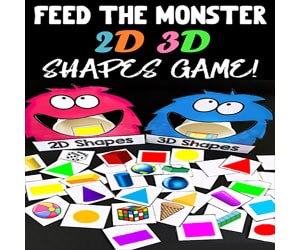
2D 3D Shapes Activities for Kindergarten - 2nd | Feed the Monster Game
Math, Early Math, Shapes, Kindergarten, Grade 1, Games, Activities
I am looking for a geometry center that my students will really want to play with. Learning about shapes can be the part of our math time with this Feed the Monster sorting activity. This activity has been tried out in classrooms and it helps young students learn about 2D and 3D shapes by playing with them. Why I will like this geometry activity: My students will like it: This game has been played many times in classrooms and it is always a success. My students will be just as excited to play with the Monster the time as they were the first time. My students will learn about shapes: It includes 28 different shapes so my students can see many examples of shapes. It has two monsters: One monster is for shapes and one is for solid shapes so my students can see the difference between them. It helps with hand-eye coordination: When my students put the shapes in the monsters mouths they are also practicing their hand-eye coordination. What is in the PDF: Two cute monsters: Big colorful pictures of the 2D. 3D Shape Monsters. 28 shape cards: different shapes like squares and circles and triangles and more. Instructions for teachers: Easy to follow guide to set it up. This activity is great for settings: Math centers: It is easy to add to our weekly math activities. Morning work: My students can start learning soon as they get to class. Small group work: I can use it to help students who are having trouble with geometry. Homeschooling: It is a way to teach math at home. It is easy to set up: I can save time planning my lessons. I just need to print it cut it out and use it. If I want it to last a time I can laminate the monsters and shape cards so I can use them again next year. Here are the details: What grade levels it is for: Kindergarten, 1st Grade, 2nd Grade. What subject it is for: Geometry and math. What format it is in: A PDF that I can download. What skills it teaches: Telling the difference, between 2D and 3D shapes recognizing shapes and sorting and categorizing. I can add Feed the Monster to my teaching activities today. My students will love learning about geometry. After the monster game, check shape matching with this 3D-shape sorting worksheet .
Author Bambolina55
Rating
Tags 2D Shapes And 3D Shapes, 2D 3D Shapes, Kindergarten Shapes, Flat Shapes , Solid Shapes, Feed The Monster, 2D 3D Shapes Games , Feed The Monster 2d 3d Shapes Game, Sorting Shapes Game, 2d 3d Shapes Sorting
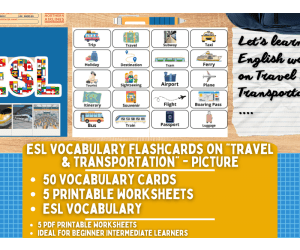
ESL Vocabulary Flashcards - Travel & Transportation - Pictures
ELA, Language Development, ESL, Vocabulary, Not Grade Specific, Middle School, High School, Adult Education, Worksheets & Printables, Flashcards, Worksheets
ESL Vocabulary Flashcards - Travel & Transportation - Pictures This high quality English language teaching resource is designed for students learning English as a second or foreign language . It includes 5 printable PDF pages featuring vocabulary flashcards and worksheets centered around the theme of "Travel & Transportation" This ESL Vocabulary Flashcards on "Travel & Transportation" Worksheets Activity can be ideal for Beginner level ESL - EFL - TESOL learners, including newcomers and English language learners of all ages. 🌟 What's Included? In this ESL Vocabulary Flashcards Activity on " Travel & Transportation ", there are provided: ✅ 50 Printable Flashcards (5 Printable PDF worksheets) ✅ Essential vocabulary and phrases in English ✅ Engaging icons and emojis on select flashcards to support comprehension and vocabulary retention (not all flashcards) 🏫 Who Can Benefit from This Resource? 📌 Beginner ESL - EFL students looking to improve their English vocabulary 📌 Newcomers & English Language Learners (ESL - EFL - TESOL -TEFL) in schools, tutoring sessions, or self-study 📌 Teachers and tutors looking for fun and engaging vocabulary building activities 📌 Language centers, homeschool educators, and ESL programs 🎯 How Does this ESL Teaching Resource Help you and your Students? ✨ Strengthens essential English communication skills ✨ Provides English vocabulary (ESL - EFL - TESOL - TEFL) for better understanding ✨ Encourages engaging learning with printable flashcards that can be used in various ESL - EFL (English Second or Foreign Language) class activities Whether you're an ESL teacher or an English tutor these ESL Vocabulary Flashcards on " Travel & Transportation " are a valuable and fun resource to improve basic conversation skills in English. Start learning today and make English introductions simple, engaging, and effective ! ESL with Alan is a Teaching Resources Store whose aim is to help English as a Second or foreign Language (ESL EFL TESOL) Teachers, Educators and Tutors around the world (be it online or offline) to achieve their teaching objectives while creating an enjoyable and stimulating learning environment. Learning is fun, So should English! Always If you want to browse more of my ESL, EFL, TESOL Teaching Resources, click here right ESL with Alan!
Author Learning with Alan
Rating
Tags ESL, English Second Language, English, Flashcards, Vocabulary, Travel, Transportation, Activity, Printable, Worksheets

Reading Comprehension Explorers | Grade 3 Reading Activities
Reading Comprehension, Reading, ELA, Grade 3, 4, Teacher Tools, Worksheets & Printables, Tests, Quizzes and Tests
Reading Comprehension Worksheets – Explorers Theme | Grade 3 Get a reading comprehension resource for 3rd grade on the topic of explorers. What does this resource include? This resource contains 10 reading passages on explorer-related topics, each with 5 exercises. These include multiple-choice, true or false, vocabulary, and creative tasks. Each reading passage is unique. The explorer topics were carefully selected and each passage is accompanied by appropriate graphics. Additionally, answers are provided at the end of the resource to facilitate its use in elementary school. What is it suitable for? The material is suitable for English language arts classes. It is ideally suited for 3rd grade. This material is also suitable for weaker 4th-grade classes or particularly strong 2nd-grade classes. It is suitable for teachers looking for teaching materials that can be used immediately. No tedious adapting or formatting required. Simply print it out and use it directly in class. It is suitable for various teaching formats: - Independent work - Literacy centers - Small group instruction - Homework - Reading workshops - Classroom literacy rotations What topics does the reading comprehension cover? 🧭 1 What Is an Explorer? 🚢 2 Christopher Columbus 🗺 3 New Routes Across the Sea 🌎 4 The Discovery of America 🚢 5 Ferdinand Magellan ❄️ 6 Explorers at the North Pole 🏔 7 Explorers in the Mountains 🌊 8 Explorers of the Seas 🔬 9 Explorers in Science 🚀 10 Explorers in Space The material is provided as a PDF file to make it easy to print and use in class. It is part of a larger series. If you like this material, you can explore reading comprehension resources on a variety of other topics in my shop that will enrich your lessons. In addition to reading comprehension, I also offer creative writing, math word problems, informational texts, and reading tests.
Author Smart Learning Classroom
Rating
Tags Reading Comprehension, Grade 3 Reading, Explorers, Informational Texts, Reading Activities, Literacy Centers, Reading Passages, Independent Work, Grade 4 Reading, Vocabulary Activities
Life Cycle & Plant Science Observation Journals
Science, Life Sciences, Nature & Plants, Earth Sciences, Earth and Environmental Sciences, Environmental Science, Geology, Research, Resources for Teachers, Classroom Management, Homeschool Curriculum, Grade 1, 2, 3, 4, 5, 6, Worksheets & Printables, Workbooks, Worksheets, Word Searches, Teacher Tools, Lesson Plans, Quizzes and Tests, Quizzes, Tests, Assessments
Turn your elementary science class into a dynamic botany lab with this complete and ready to use Plant Life Cycle and Science Observation Unit! This complete resource is specifically designed for students in the 2nd, 3rd, and 4th grades, and it provides everything you need to complete a challenging, experiential investigation of the plant kingdom, beyond traditional worksheets. Your students will be excited to move from being passive observers to being active scientists, as this entire unit is based on a constructionist learning model. By creating Plant Science Observation Journals, students will have the opportunity to measure, draw pictures, create hypotheses, and document their findings through each stage of the life cycle of the plant. The four major stages of development (germination, photosynthesis, pollination) will be fully addressed through hands-on experiences. THE 40-PAGE RESOURCE INCLUDES THE FOLLOWING ELEMENTS: PHASE 1: Teacher's Guide for Core Content & Theory - A deep-dive into the botanical theory and pedagogy behind the unit and includes interesting case studies, such as the Methuselah Palm (estimated to be 2000 years old), which will help teachers teach this unit confidently. PHASE 2: Student Workbook with 10 Activities - The student activities are organized sequentially to build upon previously learned materials. The following activities are included within the student workbook: Seed Anatomy and Germination Photosynthesis Factory Root Systems and Soil Science Transport Highway (Stems, Xylem, Phloem) Leaves and Transpiration Flower Anatomy Pollinators and Ecological Partnerships Seed Dispersal and Plant Adaptation and Survival Tactics Final Activity: The Botanist's Field Journal - Students will apply all they have learned about plants to a plant they will observe and describe using their Field Journal as a reference. Stage 3: Reference Material and Key Visuals Printable visual anchors – Clear diagrams with good contrast showing the life cycle of flowering plants, the process of photosynthesis and the anatomy of seeds. These would be great for display in the classroom or for student folders. 4-week teacher's guide to use the unit – This is a step by step overview of how to introduce this unit to your class and also includes Journaling Tips as well as Differentiation Strategies for English Language Learners and advanced students. Comprehensive Answer key – A complete answer to each of the activities included in the unit. This makes assessments simple and clear. This unit is suitable for public school teachers and parents teaching their children at home, as well as science curriculum developers who want a high-quality, exciting and standards-compliant (NGSS) science resource. KEYWORDS: Plant life cycle Plant science Botany Observation journal Photosynthesis Germination Pollination Seed dispersal STEM NGSS Elementary Science 2nd grade 3rd grade 4th grade Home school Science unit Printable worksheets Teacher guide Answer key. Why do teachers and parents love it?: This is not simply a series of worksheets but an entire 40-page curriculum unit with everything included. By using this curriculum unit, teachers and parents are able to save countless hours of research and preparation. The curriculum goes beyond basic memorization and gives students actual scientific skills that they will use their whole lives. Through the use of observation and measuring (i.e., the roots of the plant), making hypotheses, and journaling, students learn to think like scientists. The teacher guide includes specific strategies for helping both English language learners and advanced/gifted students, so the curriculum can be used in any classroom. The content is scientifically accurate and uses the proper terms (e.g., cotyledon, gravitropism), and the hands-on activities, real-world case studies, and clear diagrams will keep students engaged. Audience for the Classes: The classes are designed for students who are in Primary Grades 3-4. There are forty-two pages of instructional material in the PDF that detail content, vocabulary and an education guide for these grade levels. The worksheets are appropriate and the content will encourage student achievement and challenge their ability level. Students can also be successful completing the theoretical components at some level to improve their educational growth from their beginning point. The students who are in Grade 1 will be able to use this unit with more instruction from their teachers, also as a grade level review and will be able to compete with but at an acceptable level. The differentiation guide that is included in the PDF will enable the teacher to supports all the students to be successful. Copyright and Terms of Use: Copyright initiated by Syed Hammad Rizvi, meaning only the user can use this resource in a personal manner or in one classroom. No one may change, distribute, or sell to anyone (including on the Internet) any part of this resource. If you would like to share this resource with other educators, you can purchase additional licenses through Teachsimple. Thank you for abiding by these terms of use. This product is sincerely created by Syed Hammad Rizvi
Author Creative Book Store
Rating
Tags Science, STEM, Biology, Education, LifeScience, NatureStudy, PlantScience, Botany, PlantLifeCycle, LifeCycleOfAPlant

Keyboard Typing Challenge Pack - DIGITAL TASK CARDS CERTIFICATES ICT
ELA, Language Development, Montessori, Special Resources, Life Skills, Homeschool Curriculum, Homeschool Templates, Grade 3, 4, 5, 6, 7, Activities, Centers, Assessments, Teacher Tools, Worksheets & Printables
Develop your learners keyboard typing skills with this Keyboard Typing Challenge Pack. This complete set is designed for Grades 3, 4, 5 and 6 perfect for practicing over all keyboard typing skills, typing accuracy, finger placement, and typing speed. What’s Inside: ✔ 100 Colored Typing Challenge Cards - typing practice that can be printed and used for individual or group activities as well as games and challenges ✔ 100 Black & White Typing Challenge Cards (printer-friendly) - black and white version of the cards ✔ 8 Ready-to-Print Typing Certificates ✔ 8 Editable Typing Certificates (customizable for your class) ✔ 1 Colored Typing Progress Tracker ✔ 1 Black & White Typing Progress Tracker This jam-packed resource is dynamic and complete with typing practice, typing challenge task cards, progress tracker and performance certificates that can be used in your ICT classes, computer laboratory activities, and even perfect for your ELA and ELL classes.
Author It's Teacher L
Rating
Tags Keyboard Typing, Digital, Typing Practice, Reading Comprehension, ELA, ELL, Life Skills, Posters, Typing Mat

Multicultural Feelings & Emotions Clipart | Build-a-Face SEL Mega Set
Life Studies, Special Resources, Life Skills, Not Grade Specific, Classroom Decor, Door Decor, Bulletin Boards
This collection provides a rich variety of facial expressions capturing the wide range of human emotions, from plain boredom to sheer excitement. Crafting Expressive Faces With Ease This product enables students to construct expressive faces using a mix of photorealistic images and line drawings centered on individual features. It acts as a versatile tool to engage students effectively in either group instruction or individual assignment, serving both public schooling classroom and homeschooling setup. Core emotions: Anger, Calmness, Excitement, Happiness, Sadness Nuanced feelings: Being scared or nervous Physical states: Feeling sick or sleepy Incorporating Life Skills Learning For Students Of All Grade Levels This resource equips children with the ability to accurately identify various emotional cues including obvious ones like surprise or subtle confusion thereby fostering social interaction abilities along with personal emotional intelligence development. Art teachers can also leverage these distinctive face-constructing illustrations as references for students attempting realistic human image creation. Digital Accessibility, Reusability And Convenience In JPG Format Give your students the tools to express themselves with this versatile Multicultural Feelings Clipart Set! It's not a collection of faces, it's a whole "Build-a-Face" kit for Social-Emotional Learning (SEL), counseling, and morning meetings. Different skin tones and the ability to mix and match eyes and mouths on blank faces allows you to create thousands of unique expressions to represent every student in your classroom. ✨ The Best SEL Toolkit Includes: This set includes high resolution (300 DPI) versions with bright colors and clean line art for: 12 Pre-Made Expressive Faces: Angry, Bored, Calm, Excited, Happy, Sad, Scared, Nervous, Sick, Sleepy, Surprised and Confused. Diverse Representation: A spectrum of skin tones so that every child feels represented. DIY 'Build-a-Face' Parts: * Blank Faces: Ready to be customized. Separate Eyes & Mouths: Individual Black & White Graphics to create your own expressions or for "Guess the Emotion" matching games. Best For: SEL Centers: Make “How am I feeling today?” check-in boards. Special Education & Speech Therapy: Great for students who need visual cues to identify social cues. TPT Sellers: Create your own worksheets, digital Boom Cards, or interactive drag-and-drop activities. Multicultural Classrooms: Authentic Diversity for Diverse Student Populations Technical Details: High Resolution: 300 DPI for sharp prints. PNG files with transparent backgrounds (perfect for layering in PowerPoint, Keynote or Canva). Commercial Use: For Personal and Commercial Use! Please see the included Terms of Use for information on how to credit my shop.
Author Teacher's Clipart
Rating
Tags Empathy Education, Facial Expressions, Emotional Intelligence, Art Integration, Life Skills