



5,803 products added recently
Page 159 - Newest Teaching Resources

 Show filters
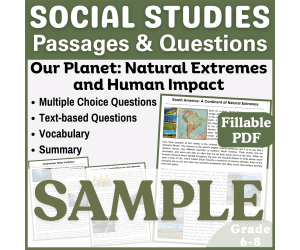
Reading Comprehension Passage: South Amerinca (Fillable PDF Sample)
ELA, Reading, Reading Comprehension, Strategies, Resources for Teachers, Social Studies, Geography, Grade 6, 7, 8, 9, Writing Prompts, Worksheets & Printables, Centers, Activities, Teacher Tools, Assessments, Quizzes and Tests, Quizzes, Tests
This is a ONE PASSAGE SAMPLE. The following is the description of the FULL resource and the downloading links: Social Studies Reading Comprehension Passages and Questions: Our Planet: Natural Extremes and Human Impact (Fillable PDF) This resource introduces a collection of Social Studies reading comprehension passages with questions about Our Planet: Natural Extremes and Human Impact. The passages are carefully designed to bridge the gap between social studies and literacy through strengthening reading comprehension and sparking knowledge curiosity in middle school students. Each passage blends English Language Arts skills with accurate social studies content . Ideal for interdisciplinary learning in ELA and Social Studies. Suitable for Grade 9 review, too! These worksheets are designed as fillable PDFs , which means students can type their answers directly into the document on any computer or tablet . Each page includes highlighted text fields that show them exactly where to type! What Is Included in this Collection? There are three informational passages (with full answer keys): Remaking Plastic: Turning Waste into Useful Materials Underwater Noise Pollution South America: A Continent of Natural Extremes For Each Passage, students will have multiple tasks to complete as follow: 5 multiple-choice questions targeting main idea, key details, inference, vocabulary in context, and use of evidence 5 vocabulary matching items with clear, student-friendly definitions 5 text-based questions that require citing specific lines or facts 1 summary prompt that asks students to condense central ideas accurately Available Formats for this Resource PDF Word Docs Google Docs For more Social Studies Reading Passages, check the following Links: Ancient Civilizations PDF Fillable PDF Word Docs Google Docs Early Empires and Trade Networks PDF Fillable PDF Word Docs Google Docs The Founding of the United States PDF Fillable PDF Word Docs Google Docs Language, Culture, and Meaning PDF Fillable PDF Word Docs Google Docs Psychology and Society PDF Fillable PDF Word Docs Google Docs Global Festivals and Traditions PDF Fillable PDF Word Docs Google Docs Extreme Environments and People PDF Fillable PDF Word Docs Google Docs Food, Culture, and Preservation PDF Fillable PDF Word Docs Google Docs Global Food Customs PDF Fillable PDF Word Docs Google Docs Media, Communication, and Popular Culture PDF Fillable PDF Word Docs Google Docs Human Impact on the Environment PDF Fillable PDF Word Docs Google Docs Civic Action and Social Change PDF Fillable PDF Word Docs Google Docs Fashion, Society, and Power PDF Fillable PDF Word Docs Google Docs People, Places, and Unusual Histories PDF Fillable PDF Word Docs Google Docs How to Use These PDFs Click on the highlighted area to start typing your answer. Move to the next question by clicking in the next highlighted box. When you are finished, close the document and select SAVE so your answers stay recorded. If you want to keep a blank copy for later, choose Save As and give your completed version a new name. Product Details Length: 15 pages total Grades: 6–8, also suitable for Grade 9 review Use cases: close reading, stations, homework, intervention, test prep, and sub plans Why Teachers Choose This Set Authentic social studies content paired with rigorous literacy practice Consistent task structure across all passages for easier planning and smoother student routines Clear, age-appropriate writing that builds confidence without oversimplifying Use this set to reinforce ELA skills in social studies, to add literacy to your lessons, and to support independent work. The passages strengthen main idea, evidence use, vocabulary in context, inference, cause and effect, and summary writing. With ready-to-use assessments and complete answer keys, you can provide focused practice that is simple to run and fast to review.
Author EduNation Creative Store
Rating
Tags Middle School, Reading Comprehension, Reading Strategies, ELA, Centers, Reading Passage, Assessments, Vocabulary, Social Studies, Geography
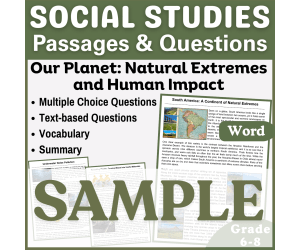
Reading Comprehension Passage: South America (SAMPLE Word)
ELA, Reading, Reading Comprehension, Strategies, Resources for Teachers, Social Studies, Geography, Grade 6, 7, 8, 9, Writing Prompts, Worksheets & Printables, Centers, Activities, Teacher Tools, Assessments, Quizzes and Tests, Quizzes, Tests
This is a ONE PASSAGE SAMPLE. The following is the description of the FULL resource and the downloading links: Social Studies Reading Comprehension Passages and Questions: Our Planet: Natural Extremes and Human Impact (Word) This resource introduces a collection of Social Studies reading comprehension passages with questions about Our Planet: Natural Extremes and Human Impact. The passages are carefully designed to bridge the gap between social studies and literacy through strengthening reading comprehension and sparking knowledge curiosity in middle school students. Each passage blends English Language Arts skills with accurate social studies content . Ideal for interdisciplinary learning in ELA and Social Studies. Suitable for Grade 9 review, too! What Is Included in this Collection? There are three informational passages (with full answer keys): Remaking Plastic: Turning Waste into Useful Materials Underwater Noise Pollution South America: A Continent of Natural Extremes For Each Passage, students will have multiple tasks to complete as follow: 5 multiple-choice questions targeting main idea, key details, inference, vocabulary in context, and use of evidence 5 vocabulary matching items with clear, student-friendly definitions 5 text-based questions that require citing specific lines or facts 1 summary prompt that asks students to condense central ideas accurately Available Formats for this Resource PDF Fillable PDF Google Docs For more Social Studies Reading Passages, check the following Links: Ancient Civilizations PDF Fillable PDF Word Docs Google Docs Early Empires and Trade Networks PDF Fillable PDF Word Docs Google Docs The Founding of the United States PDF Fillable PDF Word Docs Google Docs Language, Culture, and Meaning PDF Fillable PDF Word Docs Google Docs Psychology and Society PDF Fillable PDF Word Docs Google Docs Global Festivals and Traditions PDF Fillable PDF Word Docs Google Docs Extreme Environments and People PDF Fillable PDF Word Docs Google Docs Food, Culture, and Preservation PDF Fillable PDF Word Docs Google Docs Global Food Customs PDF Fillable PDF Word Docs Google Docs Media, Communication, and Popular Culture PDF Fillable PDF Word Docs Google Docs Human Impact on the Environment PDF Fillable PDF Word Docs Google Docs Civic Action and Social Change PDF Fillable PDF Word Docs Google Docs Fashion, Society, and Power PDF Fillable PDF Word Docs Google Docs People, Places, and Unusual Histories PDF Fillable PDF Word Docs Google Docs Product Details Length: 15 pages total Grades: 6–8, also suitable for Grade 9 review Use cases: close reading, stations, homework, intervention, test prep, and sub plans Why Teachers Choose This Set Authentic social studies content paired with rigorous literacy practice Consistent task structure across all passages for easier planning and smoother student routines Clear, age-appropriate writing that builds confidence without oversimplifying Use this set to reinforce ELA skills in social studies, to add literacy to your lessons, and to support independent work. The passages strengthen main idea, evidence use, vocabulary in context, inference, cause and effect, and summary writing. With ready-to-use assessments and complete answer keys, you can provide focused practice that is simple to run and fast to review.
Author EduNation Creative Store
Rating
Tags Middle School, Reading Comprehension, Reading Strategies, ELA, Centers, Reading Passage, Assessments, Vocabulary, Social Studies, Geography
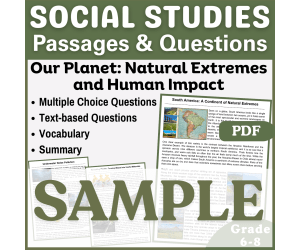
Reading Comprehension Passage: South America (SAMPLE PDF)
ELA, Reading, Reading Comprehension, Strategies, Resources for Teachers, Social Studies, Geography, Grade 6, 7, 8, 9, Writing Prompts, Worksheets & Printables, Centers, Activities, Teacher Tools, Assessments, Quizzes and Tests, Quizzes, Tests
This is a ONE PASSAGE SAMPLE. The following is the description of the FULL resource and the downloading links: Social Studies Reading Comprehension Passages and Questions: Our Planet: Natural Extremes and Human Impact (PDF) This resource introduces a collection of Social Studies reading comprehension passages with questions about Our Planet: Natural Extremes and Human Impact. The passages are carefully designed to bridge the gap between social studies and literacy through strengthening reading comprehension and sparking knowledge curiosity in middle school students. Each passage blends English Language Arts skills with accurate social studies content . Ideal for interdisciplinary learning in ELA and Social Studies. Suitable for Grade 9 review, too! What Is Included in this Collection? There are three informational passages (with full answer keys): Remaking Plastic: Turning Waste into Useful Materials Underwater Noise Pollution South America: A Continent of Natural Extremes For Each Passage, students will have multiple tasks to complete as follow: 5 multiple-choice questions targeting main idea, key details, inference, vocabulary in context, and use of evidence 5 vocabulary matching items with clear, student-friendly definitions 5 text-based questions that require citing specific lines or facts 1 summary prompt that asks students to condense central ideas accurately Available Formats for this Resource Fillable PDF Word Docs Google Docs For more Social Studies Reading Passages, check the following Links: Ancient Civilizations PDF Fillable PDF Word Docs Google Docs Early Empires and Trade Networks PDF Fillable PDF Word Docs Google Docs The Founding of the United States PDF Fillable PDF Word Docs Google Docs Language, Culture, and Meaning PDF Fillable PDF Word Docs Google Docs Psychology and Society PDF Fillable PDF Word Docs Google Docs Global Festivals and Traditions PDF Fillable PDF Word Docs Google Docs Extreme Environments and People PDF Fillable PDF Word Docs Google Docs Food, Culture, and Preservation PDF Fillable PDF Word Docs Google Docs Global Food Customs PDF Fillable PDF Word Docs Google Docs Media, Communication, and Popular Culture PDF Fillable PDF Word Docs Google Docs Human Impact on the Environment PDF Fillable PDF Word Docs Google Docs Civic Action and Social Change PDF Fillable PDF Word Docs Google Docs Fashion, Society, and Power PDF Fillable PDF Word Docs Google Docs People, Places, and Unusual Histories PDF Fillable PDF Word Docs Google Docs Product Details Length: 15 pages total Grades: 6–8, also suitable for Grade 9 review Use cases: close reading, stations, homework, intervention, test prep, and sub plans Why Teachers Choose This Set Authentic social studies content paired with rigorous literacy practice Consistent task structure across all passages for easier planning and smoother student routines Clear, age-appropriate writing that builds confidence without oversimplifying Use this set to reinforce ELA skills in social studies, to add literacy to your lessons, and to support independent work. The passages strengthen main idea, evidence use, vocabulary in context, inference, cause and effect, and summary writing. With ready-to-use assessments and complete answer keys, you can provide focused practice that is simple to run and fast to review.
Author EduNation Creative Store
Rating
Tags Middle School, Reading Comprehension, Reading Strategies, ELA, Centers, Reading Passage, Assessments, Vocabulary, Social Studies, Geography

ESL Reading Comprehension + Essay - The Mandalorian - Star Wars
ELA, Language Development, ESL, Vocabulary, Reading, Reading Comprehension, Creative Writing, Writing, Formal Writing, Grade 7, 8, 9, 10, 11, 12, Worksheets & Printables, Worksheets, Writing Prompts
ESL Reading Comprehension + Writing Activity Worksheets - The Mandalorian - Star Wars Universe This ESL - EFL Teaching Resource on "The Mandalorian - Star Wars Universe" (3 PDF Worksheets Slides; Reading Comprehension + Writing Activity) can be ideal to improve Language skills in English. Ideal students for this ESL EFL TESOL Reading + Writing Activity are Foreign Students at middle and High School (7th - 12th Grade; teens) . Newcomers or any ESL Learner is also more than suitable for this ESL - EFL - TESOL - TEFL (English as a Second or Foreign Language) Activity on "The Mandalorian - Star Wars Universe" (origins, background, history and evolution + setting + overall plot + Din Djarin and Grogu + legacy, popularity and success). This Teaching Educational Resource Product can also be ideal for ESL EFL TESOL Centers worldwide or any English second language tutor. Intermediate Advanced English as a Second or Foreign Language (ESL - EFL - TESOL - TEFL) learners are suitable for this ESL EFL TESOL Teaching Resource on "The Mandalorian - Star Wars Universe" (Worksheet; 3 PDF Printable slides) In this English Second or Foreign Language (ESL - EFL - TESOL - TEFL) Reading Comprehension + Essay Writing Activity Worksheet on "The Mandalorian - Star Wars Universe" (origins, background, history and evolution + setting + overall plot + Din Djarin and Grogu + legacy, popularity and success), the following ESL - EFL - TESOL - TEFL (English Second or Foreign Language) activities are included: 1 text on "The Mandalorian - Star Wars Universe" (origins, background, history and evolution + setting + overall plot + Din Djarin and Grogu + legacy, popularity and success) 27 Comprehension Questions related to the previous text on "The Mandalorian - Star Wars Universe" (with related space where students can answer to this text's comprehension questions) 3 essay prompts for a writing activity on "The Mandalorian - Star Wars Universe" (writing an essay on your own personal opinion on the Mandalorian; whether you have ever watched it or not and whether you liked it or not and why + writing an essay on another TV series which has become an international sensation; describing it and comparing it to The Mandalorian + pretending to go on an adventure with Din Djarin and Grogu and writing a page of diary on this imaginary experience) This ESL - EFL - TESOL - TEFL (English Second or Foreign Language) Teaching Resource Reading + Writing Activity (essay prompts) on "The Mandalorian - Star Wars Universe" (origins, background, history and evolution + setting + overall plot + Din Djarin and Grogu + legacy, popularity and success) is great for Intermediate Advanced English as a second or foreign language learners (ESL- EFL - TESOL - TEFL). This English Second Language Worksheet on "The Mandalorian - Star Wars Universe" (origins, background, history and evolution + setting + overall plot + Din Djarin and Grogu + legacy, popularity and success) aims to train and Reading Comprehension + Writing Skills. "Learning with Alan" is a teaching resources store that aims to provide high quality teaching resources and educational materials for ESL EFL TESOL (English Second or Foreign Language) teachers, tutors and educators. It aims to support teachers, educators, and tutors in both online and offline environments, helping them achieve their teaching goals while creating a fun, stimulating atmosphere for learning English. Always remember: learning is fun, and so is English! If you want to find more ESL - EFL - TESOL - TEFL (English Second or Foreign Language) Teaching Resources and Educational Material click here Learning with Alan!
Author Learning with Alan
Rating
Tags ESL, English Second Language, English, Star Wars, The Mandalorian, TV Series, Reading Comprehension, Writing Activity, Activity, Worksheets

Human Body Systems Workbook for Kids | Anatomy Science Printable PDF
Science, Life Sciences, Human Body, Not Grade Specific, Worksheets & Printables, Teacher Tools, Workbooks, Worksheets
Make learning about the human body fun for kids. This Human Body Systems Workbook for Kids is a tool. It is easy to use and understand. The Human Body Systems Workbook for Kids is perfect for kids who are homeschooled or for kids who learn in a classroom. The Human Body Systems Workbook for Kids has lots of pictures and diagrams that help kids learn about the system, the brain and the respiratory system. The Human Body Systems Workbook for Kids is designed to be fun and interactive. It has pictures and fun activities that kids will enjoy. What you get with the Human Body Systems Workbook for Kids: ✔ The Human Body Systems Workbook for Kids has twelve pages of activities. ✔ The Human Body Systems Workbook for Kids has activities that teach kids about the system. ✔ The Human Body Systems Workbook for Kids has pages that teach kids about the brain and nervous system. ✔ The Human Body Systems Workbook for Kids has worksheets that teach kids about the system and lungs. ✔ The Human Body Systems Workbook for Kids has pages that help kids review what they learned. ✔ The Human Body Systems Workbook for Kids has explanations that're easy for kids to understand. ✔ The Human Body Systems Workbook for Kids is a printable PDF. The Human Body Systems Workbook for Kids is great for: Homeschool Science Elementary and Middle School Anatomy lessons Classroom activities Kids who like to learn on their Printable science activities People love the Human Body Systems Workbook for Kids because: ⭐ It has pictures that are easy to understand. ⭐ It is fun and educational. ⭐ It makes kids curious. Want to learn more. ⭐ It is great for kids who learn by looking at pictures. ⭐ It is easy to print and use. The Human Body Systems Workbook for Kids makes learning about the human body fun. It is a tool for kids to learn about the Human Body Systems in a way that is fun and easy to remember. The Human Body Systems Workbook, for Kids is a way for kids to learn about the human body.
Author BrightPrintsNY
Rating
Tags Human Body Systems, Anatomy Workbook, , Homeschool Science, Human Body Activities, Science Printable, , Anatomy For Kids, Body Systems Worksheet, Human Anatomy Pdf, , Science Workbook

Numbers 1–20 Trace, Cut & Paste Worksheet Bundle
Math, Calculus, Number Lines, Pre-K, Elementary, Early Learning, Homeschool Resources, Activities, Centers, Teacher Tools, Worksheets & Printables, Workbooks, Worksheets
Let your little mathematicians have an enjoyable learning experience with these Numbers 1-20 Trace, Cut & Paste Worksheets. Created especially for kids who are just discovering numbers, this fun bundle of activities will ensure learning is easy and enjoyable. Your child will gain many advantages by using these fun trace, cut and paste activities. ✨ ✔ Numbers 1-20 worksheets included ✔ Trace, count, cut & paste activities ✔ Fine motor development activities ✔ Best for preschool and pre-k kids ✔ Printables in pdf format ✔ Instant download available ✔ Homeschool and classroom-friendly 📚 Some of the concepts practiced in these worksheets include: Number writing and number recognition skills Counting items and identifying quantities Cutting activities and hand-eye coordination Developing independent learning skills Math-readiness concepts through play activities 🎯 These worksheets are perfect for: Preschool learning activities Homeschool lessons Daycare learning centers Kindergarten preparatory work Quiet book ideas and busy binder activities Printable math practices for kids
Author BrightPrintsNY
Rating
Tags Preschool Math Printable, Kindergarten Readiness Activity, Homeschool Learning Pack, Fine Motor Skills Printable, Montessori-inspired Educational Activity, Numbers 1–20, Tracing Numbers, Preschool Worksheets

Earth’s Movements & Internal Structure Clipart | Geology Science Clip
Science, Earth and Environmental Sciences, Earth Sciences, Not Grade Specific, Worksheets & Printables, Worksheets
Bring your Earth Science lessons to life with this comprehensive Earth’s Movements and Plate Tectonics Clip Art Bundle . Specially designed for upper elementary, middle school, and high school science teachers—as well as TpT sellers—this set takes abstract geological concepts and turns them into clear, engaging visuals your students will actually understand. Whether you are designing a digital quiz on Google Slides, creating interactive science notebooks, or building a commercial geography resource to sell, these crisp diagrams are your new secret weapon. What’s Included in This Bundle? This pack includes high-resolution PNG images (300 DPI with transparent backgrounds) , making it effortless to drop them into worksheets, presentations, or posters. Every diagram comes in full color (perfect for anchor charts and slides) and black-and-white line art (ideal for printer-friendly worksheets and coloring activities): Plate Tectonic Boundaries: Detailed visuals showing Convergent, Divergent, and Transform boundaries. Fault Lines: Clear illustrations of how the Earth shifts and cracks. World Map of Plate Boundaries: Both color and line art versions to help students visualize global tectonic plates. Earth’s Internal Structure: Includes both fully labeled diagrams (great for direct instruction) and unlabeled versions (perfect for quizzes, tests, and active recall assessments). How You Can Use These Graphics: For Your Classroom: Create matching games, science station activities, digital task cards, or visual exam questions that accommodate diverse learning styles. For Your TpT Store: Build eye-catching product covers, thumbnails, or include them directly inside your commercial science curriculum. Flexible Terms of Use (Commercial & Personal) TpT Sellers & Creators: Yes! You can absolutely use these graphics in your commercial educational resources. All I ask is that the images are flattened/secured in a PDF or digital format so they cannot be extracted, and that you credit my store. Personal Classroom Use: Feel free to use these year after year with your own students, whether in a traditional classroom, a homeschool co-op, or online learning. Teacher Tip: Use the unlabeled Earth layer diagrams as a digital "drag-and-drop" labeling activity on Boom Cards or Google Slides to save yourself hours of grading time! Make your geology unit the easiest one you teach this year. Click the "Preview" button to see the quality of these graphics, and follow my store for more middle school science clip art!
Author Teacher's Clipart
Rating
Tags Earth's Movements, Earth Sciences, Plate Tectonics, Fault Lines, Internal Structure
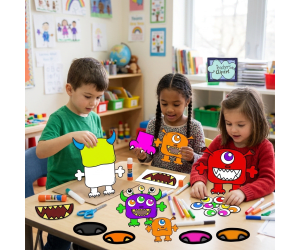
Build-a-Monster Clipart: Creative Character Creator Set
Creative Arts, Art, Not Grade Specific, Activities, Crafts
Let your students’ imagination run wild with this versatile Build-a-Monster clip art! Whether you’re making “roll-a-monster” games, teaching body parts, or designing fun Halloween activities, this set has everything you need to build unique, friendly creatures. This pack features both vibrant color and clean black-and-white line art, making it great for use in digital resources and printable coloring worksheets. ✨ What's in this Set? You will receive 14 high quality PNG images (7 color & 7 B&W) with transparent background: 1 Complete Monster: A "ready to use" character. Body parts of monster: Mouth (with fun monster teeth! Nose Eye of Big Monster Furry Ear Clawed foot Scaly hand Innovative Uses for This Set: Anatomy & Body Parts: An entertaining approach to teaching "head, shoulders, knees, and toes" with a monster twist! Math Centers: "Roll a Dice" games in which children build their monster according to the number they roll. Make worksheets that require kids to place "two eyes" or "three hands" on the body of a monster. TPT Seller Resources: Boom Cards and Google Slides can be used as "movable clip art" in digital games. Technical Information: For superior printing quality, all photos are 300 DPI. The line art versions are ideal for making coloring activities and conserving ink!
Author Teacher's Clipart
Rating
Tags Build , Monster, Create A Monster Activity

Polka Dot Coloring Alphabet & Numbers | Classroom Decor DIY
ELA, Language Development, Pre-Reading, Kindergarten, Preschool, Grade 1, 2, 3, Classroom Decor, Word Walls, Door Decor, Bulletin Boards, Banners
Get ready to color these versatile decorated letters to repurpose your classroom supplies! Looking for the perfect way to decorate bulletin boards or create interactive phonics worksheets? This set of Black and White Polka Dot Alpha Letters and Numbers is made with creative teachers and TPT sellers in mind. They come as a blank canvas, so they are perfect for saving ink or letting your students get creative with crayons and markers! Includes: Full Alphabet. Uppercase letters A-Z in bold "dots design". 0-9 Numbers. Use matching digits for dates, counting activities or birthday displays. High Resolution Files: Sharp, clear blackline art (300 DPI) that prints beautifully even when enlarged. Great for: Classroom Decor: Make your own banners, welcome signs and name tags. Education Resources: Create alphabet coloring pages, center activities, or math worksheets. Sellers: Feel free to use these in your own commercial products as "movable pieces" or decorative elements (check my TOU!). Interactive Notebooks: Students color the headers for increased engagement. Instant Download Download these free printable files and begin creating today. Say goodbye to boring fonts—give your materials a professional, hand-drawn look with zero effort!
Author Teacher's Clipart
Rating
Tags Letters, Numbers, Alphabet

Animal Cell Organelles – Labeled & Blank Diagrams Clipart
Science, Life Sciences, Biology, Grade 1, 2, 3, 4, 5, 6, 7, Activities, Classroom Decor
It doesn't have to be difficult to comprehend how a cell functions internally. A fundamental idea in any life science or biology curriculum, this Animal Cell Organelles handout provides students with a clear, high-resolution diagram that makes it simpler to comprehend and recognize the main structures present inside an animal cell. Two copies of the same intricate illustration are included in the collection. While the blank version pushes students to remember and apply what they've studied, making it excellent for independent practice, tests, or interactive scientific notebooks, the labeled diagram serves well as a study aid or reference chart in the classroom. The nucleus and nucleolus, mitochondria, ribosomes, Golgi apparatus, smooth and rough endoplasmic reticulum, lysosomes, vacuoles, cell membrane, and cytoplasm are all included. Students may concentrate on learning organelle names and locations without experiencing visual overload thanks to the layout's simplicity and cleanliness. This resource works well in a variety of teaching contexts; it prints neatly as a handout, looks good in digital presentations, and blends in nicely with more general biology courses that cover cell theory and cell structure. It works well with middle school science, beginning high school biology, homeschool curricula, and anatomy classes for students in grades 5 through 9. Having a precise, well-organized visual reference significantly improves students' confidence when studying for a test or when they are first exposed to animal cells. It works well with middle school science, beginning high school biology, homeschool curricula, and anatomy classes for students in grades 5 through 9. Having a well-organized, correct visual reference significantly influences how confidently students interact with the information, whether they are studying for an exam or seeing animal cells for the first time.
Author Teacher's Clipart
Rating
Tags Animal, Cell , Organelles, Animal Cell Organelles Labeled, Animal Cell Simple, Animal Cell With Organelles Labeled

Oregon Trail & California Trail Map Clipart - Westward Expansion Maps
Social Studies, History, History: USA, Not Grade Specific, Teacher Tools, Classroom Decor
This Oregon Trail and California Trail map set recreates the pioneers' journey with authentic detail. This clipart bundle is created specifically for Social Studies teachers and TpT sellers who need a neat, professional way to illustrate the different routes of the Western Trails and the important landmarks along the trails. The set includes a detailed map of the western territories of the United States, showing the principal routes from Independence, Missouri, to the Willamette Valley and Sacramento. What is included in this set? 1 Full-Color Map: Shows the Oregon Trail with a bold red line and the California Trail with a separate pink/purple line, so students can clearly see where the trails diverged at Fort Hall. 1 Black & White Line Art Map: High contrast greyscale/line art version, great for student handouts, coloring activities, or ink-saving printables. Labeled Key Landmarks: Features 15+ historically significant stops such as: Where we start: Independence, MO. Landmarks: Chimney Rock, Scotts Bluff, Independence Rock, South Pass. The Forts: Fort Kearny, Fort Laramie, Fort Bridger, Fort Hall, Fort Boise, and Fort Vancouver. The Destinations: Oregon City, The Dalles, Whitman's Mission, Astoria, Sacramento (Donner Pass) and San Francisco. Features of the Product: High Resolution: 300 DPI for sharp printing and clear display on screen. Comparative Routes: Clearly shows the common route through Nebraska and Wyoming before the trails split. Historically Accurate: State borders and landmarks are placed for a realistic backdrop to 19th century Westward Expansion. Commercial Use Friendly: Great for creating your own TpT products, worksheets and digital resources. Education Use Cases: Gold Rush vs. Oregon Trail Compare the destinations and motivations of the "Forty-Niners" vs. pioneer families. Geography Skills: Have the students find the states that the trails went through in modern times (Kansas, Nebraska, Wyoming, Idaho, Oregon, etc.) Interactive Lessons: Use as a base map for Google Slides and have students "drop a pin" on landmarks as they read through a diary of a pioneer. Oregon Trail Map, California Trail, Westward Expansion Clipart, Gold Rush Map, Pioneer History, Manifest Destiny, Fort Laramie, Chimney Rock, Donner Pass, US History Maps, Social Studies Graphics, B&W Map Clipart, Commercial Use.
Author Teacher's Clipart
Rating
Tags Oregon , Oregon Trail, Western Expansion, Simple Oregon Map, Map Of The Oregon Trail, Oregon Trail Graphics
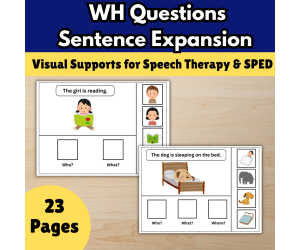
Speech Therapy WH Questions ,Visual Choices Sentence Expansion
ELA, Pre-K, Activities
This resource includes visual WH-question worksheets, picture cards, and visual answer choices designed to support language development. Perfect for targeting who, what, when, where, and why questions with visual supports in speech therapy, SPED, and language intervention settings. What’s Included 23 visual sentence expansion pages Each page features: A simple sentence paired with a real-life photo WH questions (Who, What, When, Where, or Why — varies by page) Visual answer choices with icons and picture supports Designed for individual practice, small groups, or independent work. Why Teachers Love This Supports sentence expansion using visual cues Great for speech therapy and language sessions Helps students answer WH questions with increased confidence Ideal for nonverbal and minimally verbal learners No prep required — simply print and use How to Use Students will: Look at the picture Read or listen to the sentence Answer WH questions using the visual choices provided Perfect For Speech Therapy Special Education (SPED) ESL / ELL learners Autism support classrooms Early elementary language intervention
Author Smart Minds
Rating
Tags Wh Questions, Reading Comprehension, Speech Therapy Activities, Special Education Visual Schedule, Autism Worksheets , Picture Choices, Listening & Reading Comprehension Passages
The Fall of Rome Reading Passages & Questions | Social Studies Workshe
Reading Comprehension, Reading, ELA, History, Social Studies, Grade 4, 5, Centers, Activities, Assessments, Teacher Tools
Engaging and Informative! Bring history to life with this reading comprehension resource focused on the Fall of Rome. Designed for middle school and upper elementary students, this activity helps learners strengthen reading comprehension, vocabulary, and critical thinking skills while exploring the decline of one of the greatest empires in world history. Through five high-interest informational reading passages, students will examine the major causes of Rome’s decline, including weak leadership, economic problems, military struggles, barbarian invasions, the division of the empire, and the fall of Rome in 476 CE. Each passage includes comprehension questions that encourage close reading, historical analysis, and deeper understanding of cause-and-effect relationships in history. This resource features a clear and student-friendly format that supports independent learning and classroom instruction. It is perfect for bell work, social studies lessons, literacy centers, homework assignments, substitute plans, small-group activities, independent practice, and homeschool learning. Ideal for Grades 5–9, ESL and ELL learners, intervention groups, and world history enrichment activities. File type: PDF
Author Sadigitalart
Rating
Tags The Fall Of Rome , Social Studies , Passages & Questions, Social Studies Worksheet , History
Ellis Island Reading Comprehension passage & Question Worksheet | Immi
Reading Comprehension, Reading, ELA, History: USA, History, Social Studies, Grade 4, 5, Centers, Activities, Assessments, Teacher Tools
Engaging and Informative! Help students explore the history of immigration in the United States with this Ellis Island reading comprehension resource designed for upper elementary and middle school learners. Through five engaging informational passages, students will strengthen reading comprehension and critical thinking skills while learning about the experiences of immigrants arriving at Ellis Island. Students will learn about the purpose of Ellis Island, the immigration process, the daily experiences of immigrants, challenges families faced, and the impact Ellis Island had on American history. Each passage includes comprehension questions that encourage close reading, vocabulary development, and historical understanding. This resource features a clear and student-friendly layout that supports both independent learning and classroom instruction. It is perfect for social studies lessons, literacy centers, homework assignments, substitute plans, morning work, test preparation, small-group activities, and homeschool learning. Ideal for Grades 4–8, ESL and ELL learners, intervention groups, and history enrichment activities. The ready-to-print PDF format makes preparation quick and convenient for busy teachers and parents. File type: PDF
Author Sadigitalart
Rating
Tags Immigration, Ellis Island Reading, H*us History, Passage & Question, U.S. Immigration
Daylight Saving Time History Reading Comprehension Worksheet | Spring
Reading Comprehension, Reading, ELA, History, Social Studies, Grade 4, 5, Centers, Activities, Assessments, Teacher Tools
Engaging and Educational! Help students explore the history and purpose of Daylight Saving Time with this reading comprehension resource designed for upper elementary and middle school learners. Through five high-interest informational passages, students will strengthen reading comprehension and critical thinking skills while learning about an important real-world topic. Students will discover the origins of Daylight Saving Time, why it was created, how it affects daily life, the scientific and economic debates surrounding it, and why some places choose not to observe it. Each passage includes comprehension questions that encourage students to analyze information, improve vocabulary, and practice close reading skills. This resource features a clear and student-friendly layout that supports both independent learning and classroom instruction. It is perfect for literacy centers, social studies lessons, homework assignments, substitute plans, morning work, test preparation, small-group instruction, and homeschool learning. Ideal for Grades 4–8, ESL and ELL learners, intervention groups, and informational text practice activities. File type: PDF
Author Sadigitalart
Rating
Tags Daylight Saving Time , Spring & Fall, Saving Time History Reading, History Reading Comprehension

ESL Vocabulary Flashcards - Home & Furniture - Pictures
ELA, Language Development, ESL, Vocabulary, Not Grade Specific, Middle School, High School, Adult Education, Worksheets & Printables, Flashcards, Worksheets
ESL Vocabulary Flashcards - Home & Furniture - Pictures This high-quality English language teaching resource is designed for students learning English as a second or foreign language . It includes 3 printable PDF pages featuring vocabulary flashcards and worksheets centered around the theme of "Home & Furniture" This ESL Vocabulary Flashcards on "Home & Furniture" Worksheets Activity can be ideal for Beginner level ESL - EFL - TESOL learners, including newcomers and English language learners of all ages. 🌟 What's Included? In this ESL Vocabulary Flashcards Activity on " Home & Furniture ", there are provided: ✅ 68 Printable Flashcards (7 Printable PDF worksheets) ✅ Essential vocabulary and phrases in English ✅ Engaging icons and emojis on select flashcards to support comprehension and vocabulary retention (not all flashcards) 🏫 Who Can Benefit from This Resource? 📌 Beginner ESL - EFL students looking to improve their English vocabulary 📌 Newcomers & English Language Learners (ESL - EFL - TESOL -TEFL) in schools, tutoring sessions, or self-study 📌 Teachers and tutors looking for fun and engaging vocabulary building activities 📌 Language centers, homeschool educators, and ESL programs 🎯 How Does this ESL Teaching Resource Help you and your Students? ✨ Strengthens essential English communication skills ✨ Provides English vocabulary (ESL - EFL - TESOL - TEFL) for better understanding ✨ Encourages engaging learning with printable flashcards that can be used in various ESL - EFL (English Second or Foreign Language) class activities Whether you're an ESL teacher or an English tutor these ESL Vocabulary Flashcards on " Home & Furniture " are a valuable and fun resource to improve basic conversation skills in English. Start learning today and make English introductions simple, engaging, and effective ! ESL with Alan is a Teaching Resources Store whose aim is to help English as a Second or foreign Language (ESL EFL TESOL) Teachers, Educators and Tutors around the world (be it online or offline) to achieve their teaching objectives while creating an enjoyable and stimulating learning environment. Learning is fun, So should English! Always If you want to browse more of my ESL, EFL, TESOL Teaching Resources, click here right ESL with Alan!
Author Learning with Alan
Rating
Tags ESL, English Second Language, English, Home, Furniture, Flashcards, Vocabulary, Picture, Activity, Worksheets

Colonization of America Reading Passages & Questions Worksheet U.S. Hi
Reading Comprehension, Reading, ELA, History, Social Studies, History: USA, Grade 4, 5, Centers, Activities, Assessments, Teacher Tools
Engaging and Informative! Bring the early history of America to life with this reading comprehension resource focused on the Colonization of America. Designed for upper elementary and middle school learners, this activity helps students strengthen reading comprehension, vocabulary, and critical thinking skills while exploring important events from early American history. Through five nonfiction reading passages, students will learn why colonists came to America, the history of the Jamestown settlement, daily life in the colonies, relationships between Native Americans and colonists, and the development of colonial government and self-rule. Each passage includes comprehension questions that encourage students to analyze historical information and improve text analysis skills. The resource features a clear and student-friendly layout that supports both independent learning and classroom instruction. It is perfect for social studies lessons, literacy centers, homework assignments, substitute plans, morning work, small-group activities, and homeschool learning. Ideal for Grades 4–8, ESL and ELL learners, intervention groups, and history enrichment activities. File type: PDF
Author Sadigitalart
Rating
Tags Colonization Of America , Us History, U.S. History, Worksheet U.S.
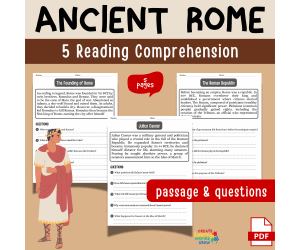
Ancient Rome Reading Passages Comprehension Questions | Civilizations
Reading Comprehension, Reading, ELA, History: Ancient, History, Social Studies, Grade 4, 5, Centers, Activities, Assessments, Teacher Tools
Engaging and Educational! Bring Ancient Rome to life with this reading comprehension resource designed for upper elementary and middle school learners. Through five high-interest informational passages, students will explore the history, government, culture, and daily life of Ancient Rome while strengthening reading comprehension and critical thinking skills. Students will learn about the founding of Rome, the Roman Republic, Julius Caesar, the Colosseum, and everyday life in Ancient Roman society. Each passage includes comprehension questions that encourage students to analyze information, improve vocabulary, and deepen their understanding of world history. The resource features a clear and student-friendly format that supports both independent learning and classroom instruction. It is perfect for social studies lessons, literacy centers, homework assignments, substitute plans, morning work, small-group activities, and homeschool learning. Ideal for Grades 4–8, ESL and ELL learners, intervention groups, and history enrichment activities. The ready-to-print PDF format makes preparation simple and convenient for busy teachers and parents. File type: PDF
Author Sadigitalart
Rating
Tags Ancient Rome , Civilizations Worksheet, Rome Reading

Ancient Mesopotamia Reading Passages Questions | History Civilizations
Reading Comprehension, Reading, ELA, History: Ancient, History, Social Studies, Grade 4, 5, Centers, Activities, Assessments, Teacher Tools
Engaging and Informative! Explore the fascinating world of Ancient Mesopotamia with this reading comprehension resource designed for upper elementary and middle school students. Through five high-interest informational passages, students will discover the history, inventions, culture, and daily life of one of the world’s earliest civilizations while strengthening important reading comprehension and critical thinking skills. Students will learn about the Cradle of Civilization, the achievements of the Sumerians, Hammurabi’s Code, farming and irrigation systems, and everyday life in Mesopotamia. Each passage includes comprehension questions that encourage vocabulary development, text analysis, and historical understanding in a student-friendly format. This resource supports informational text standards and works perfectly for social studies lessons, literacy centers, homework assignments, substitute plans, morning work, independent practice, small-group instruction, and homeschool learning. Ideal for Grades 4–6, ESL and ELL learners, intervention groups, and history enrichment activities. The ready-to-print PDF format makes preparation simple and convenient for busy teachers and parents. File type: PDF
Author Sadigitalart
Rating
Tags Ancient Mesopotamia, HISTORY, Civilization, Mesopotamia Reading , Civilizations Worksheet

Ancient Greece Peloponnesian War Reading Comprehension Worksheet Greek
Reading Comprehension, Reading, ELA, History: Ancient, History, Social Studies, Grade 4, 5, Centers, Activities, Assessments, Teacher Tools
Engaging and Educational! Introduce students to the history and major events of the Peloponnesian War with this reading comprehension resource designed for upper elementary and middle school learners. Students will explore the conflict between Athens and Sparta while building reading comprehension, vocabulary, and critical thinking skills. Through five informational reading passages, students will learn about the causes of the Peloponnesian War, the strengths of Athens and Sparta, the devastating plague in Athens, the Sicilian Expedition, and the fall of Athens at the end of the war. Each passage includes comprehension questions that encourage students to analyze historical events, improve text analysis skills, and deepen their understanding of Ancient Greek history. The resource features a clear and student-friendly layout that supports both independent learning and classroom instruction. It is perfect for social studies lessons, literacy centers, homework assignments, substitute plans, morning work, small-group activities, and homeschool learning. Ideal for Grades 4–8, ESL and ELL learners, intervention groups, and history enrichment activities. File type: PDF
Author Sadigitalart
Rating
Tags Peloponnesian War , Ancient Greece, Worksheet Greek, History
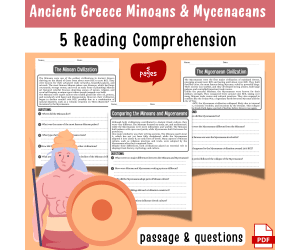
Ancient Greece Minoans & Mycenaeans Reading Comprehension & Question W
Reading Comprehension, Reading, ELA, History: Ancient, History, Social Studies, Grade 4, 5, Centers, Activities, Assessments, Teacher Tools
Engaging and Informative! Take students on a journey through the ancient civilizations of the Minoans and Mycenaeans with this reading comprehension resource designed for upper elementary and middle school learners. Students will explore the history, culture, achievements, and lasting influence of these early Greek societies while strengthening important reading comprehension and critical thinking skills. Through five informational reading passages, students will learn about Minoan trade and art, Mycenaean warriors and fortresses, the similarities and differences between the two civilizations, the mystery behind the collapse of the Minoans, and the lasting legacy these societies had on Ancient Greece. Each passage includes comprehension questions that encourage vocabulary development, text analysis, and historical understanding. This resource features a clear and student-friendly format that supports independent learning and classroom instruction. It is perfect for social studies lessons, literacy centers, homework, substitute plans, morning work, small-group activities, and homeschool learning. Ideal for Grades 4–8, ESL and ELL learners, and history enrichment activities. File type: PDF
Author Sadigitalart
Rating
Tags Ancient Greece, Comprehension & Question, Reading , Minoans & Mycenaeans, History , Minoan Civilization, Culture, Greek Societies
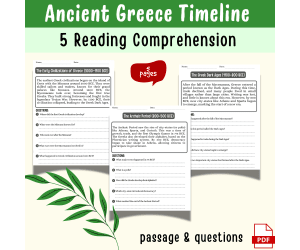
Ancient Greece Timeline Reading Comprehension & Question Worksheet Gre
Reading Comprehension, Reading, ELA, History: Ancient, History, Social Studies, Grade 4, 5, Centers, Activities, Assessments, Teacher Tools
this file Engaging and Educational! Take students on a journey through the fascinating history of Ancient Greece with this reading comprehension resource focused on the major periods of Greek civilization. Designed for upper elementary and middle school learners, this activity helps students strengthen reading comprehension and critical thinking skills while exploring important events and cultures from Ancient Greece. Students will learn about the Minoans, Mycenaeans, the Archaic Period, Classical Greece, and the Hellenistic Age through five informational reading passages. Each passage includes comprehension questions that encourage students to analyze information, improve vocabulary, and deepen their understanding of world history. The resource features a clear and student-friendly format that supports both independent learning and classroom instruction. It is perfect for social studies lessons, literacy centers, homework, substitute plans, morning work, small-group instruction, and homeschool learning. Ideal for Grades 4–8, ESL and ELL learners, intervention groups, and history enrichment activities. File type: PDF
Author Sadigitalart
Rating
Tags Greece Timeline , Worksheet Greek, Minoans And Mycenaeans, Social Studies, History

Ancient Greece : Sparta Reading Comprehension & Question Worksheet Gre
Reading Comprehension, Reading, ELA, History: Ancient, History, Social Studies, Grade 4, 5, Centers, Activities, Assessments, Teacher Tools
Engaging and Informative! Take students on a journey through Ancient Greece with this reading comprehension resource focused on the powerful city-state of Sparta. Designed for upper elementary and middle school learners, this activity helps students strengthen reading comprehension and critical thinking skills while exploring Spartan history, culture, and military traditions. Students will learn about the origins of Sparta, the training of Spartan warriors, the roles of women in Spartan society, the lives of the helots, and Sparta’s involvement in major wars. Each informational passage includes comprehension questions that encourage students to analyze information, improve vocabulary, and deepen their understanding of Ancient Greek civilization. The resource features a clear and student-friendly format that supports both independent learning and classroom instruction. It is ideal for social studies lessons, literacy centers, homework, substitute plans, morning work, small-group activities, and homeschool learning. Perfect for Grades 4–8, ESL and ELL learners, intervention groups, and history enrichment activities. File type: PDF
Author Sadigitalart
Rating
Tags Ancient Greece, Sparta Reading, Worksheet Greek, History Of Sparta
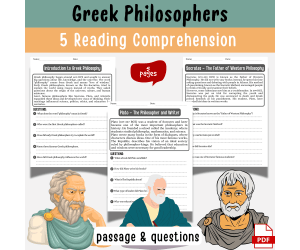
Greek Philosophers Reading Comprehension passage & Question Worksheet
History: Ancient, History, Social Studies, Reading, ELA, Reading Comprehension, Grade 4, 5, Assessments, Teacher Tools, Centers, Activities
Engaging and Educational! Introduce students to the influential thinkers of Ancient Greece with this reading comprehension resource focused on Socrates, Plato, and Aristotle. Designed for upper elementary and middle school learners, this activity helps students build reading comprehension and critical thinking skills while exploring the foundations of Greek philosophy. Students will learn about the origins of philosophy, the teachings of Socrates, Plato’s ideas and writings, Aristotle’s scientific approach, and the lasting influence of Greek philosophy on modern society. Each informational passage includes comprehension questions that encourage students to analyze ideas, strengthen vocabulary, and improve historical understanding. The resource features a clear and student-friendly format that supports independent learning and classroom instruction. It is perfect for social studies lessons, literacy centers, homework assignments, substitute plans, morning work, small-group instruction, and homeschool learning. Ideal for Grades 4–8, ESL and ELL learners, intervention groups, and history enrichment activities. File type: PDF number of pages / 5
Author Sadigitalart
Rating
Tags Greek Philosophers , Sociql Studies, Worksheet Greek, Reading Comprehension, Passage & Question