



3,911 products added recently
Page 511 - Newest Teaching Resources

 Show filters

Phonic Worksheets for Early Years/Intervention - Growing Bundle
Special Resources, ELA, Special Education Needs (SEN), Language Development, Pre-Reading, Phonics, Reading, Spelling, Kindergarten, Preschool, Grade 1, 2, Teacher Tools, Lesson Plans, Worksheets & Printables, Worksheets, Activities, Games
This is a pack of Bumper Pack of 14 (to date) books of phonic worksheets for the digraphs: L blends, CK, SH, CH, TH, OO, EE, OR, AR, A-E, I-E, O-E, U-E, AI and EA especially designed for those with special needs, including those with dyslexia or who may be suspected of being dyslexic but will work equally well with young learners in Kindergarten/EYFS/Y1. These sheets are LETRS and UK GOV requirements aligned. These worksheets also align with the most popular phonic programmes, including RWI and Letters and Sounds. What is included? PDF's of worksheets each covering the sounds: L Blends. CK, SH, CH, TH, OO, EE, OR, AR, A-E, I-E, O-E, U-E, AI and EA, all following my special method devised as I privately tutor children of all ages with profound special needs. Over 180+ Worksheets: Your phonics lessons covered! Tracking, fluency triangles, spelling, reading, games, comprehension exercises....and more! Some sounds contain print-and-go games to make learning fun. AR and A-E each contain a board game. Who are these worksheets for? I have written them for pupils who struggle with processing information - especially sounds. This includes children who are DYSLEXIC or have ANY other kind of processing disorder. Such children may have failed with other methods of teaching phonics. Such pupils need activities that: ·are highly structured - one tiny step at a time building on the one before using only a limited number of words to start with and only using words that the child has already learnt to sound out, with no nasty surprises. ·Have only a little on each pageas these pupils tire easily. What makes these worksheets special? I have a powerful three-step process which I use with my special needs pupils, which is worked out over the course of the 12 worksheets: 1. See it!where we focus on becoming aware of the new sound in words. This involves first hearing the new sound in words and then seeing it in words (tracking). 2. Sound-it-out!Having learnt to see the new sound in words, we learn to sound out these words to read and write them. We begin by usingsound-it-out boxesfor reading and spelling which help the child to segment the word prior to blending the sounds together. Once the child can read and write individual words, we work on fluency by building familiarity with the common words in the new sound family. Once the child can sound the words out to read and spell confidently, we move on to recognising them/using them in longer reading and dictation passages, as soon as the child is able. I provide 2 reading passages with comprehension exercises and one dictation passage, with a page in the workbook dedicated to it, with room for a picture, which again cements understanding. 3. Write it! Incorporated into the above two steps, we constantly write the new sound. This adds a multi-sensory dimension to our work - we see with our eyes, we sound it with our mouth parts and voice, and then we move by writing. All three steps work together to help the child feel in control of his/her learning and to become a successful, confident learner. We finish each sound (except the Consonant L-Blends) with a dictation which culminates our work before we move on to the next sound. I try to give this a week after we finish the book, to act as revision. The dictation: Read this passage to your pupil, who should write it. Have the child read his/her work and check for errors. Make sure the writing is completely accurate before saying the child has finished, including full stops and capital letters correctly used. Flashcards are included in most books. Phonic Games are also included for AR and A-E to make learning more fun! What is included? 10 PDFs totalling 150 + worksheets each covering the sounds: CK, SH, CH, TH, OO, EE, OR, AR, A-E, I-E, O-E, U-E, AI and EA, 2 PDF games for AR and A-E in full colour and black and white
Author Lilibette's Resources
Tags Phonic Worksheets, Phonic Games, Speical Needs, Special Needs, Ee Phonics, Or Phonics, Ar Phonics, A-e Phonics, Split Digraph Phonics
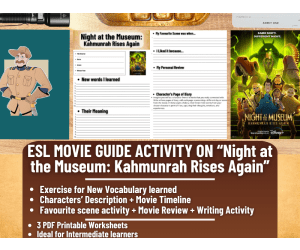
ESL Movie Guide - Night at the Museum: Kahmunrah Rises Again
ELA, Language Development, ESL, Writing, Creative Writing, Grade 6, 7, 8, 9, Worksheets & Printables, Writing Prompts, Worksheets
ESL Movie Guide Worksheets on "Night at the Museum: Kahmunrah Rises Again" This ESL teaching resource is a 3-page printable PDF movie guide for "Night at the Museum: Kahmunrah Rises Again" (2022 Disney+ film set at the American Museum of Natural History in New York City, USA, with characters such as Theodore Roosevelt, Joan of Arc and way more) designed to support English as a Second Language (ESL) learners. This resource can be great for post-movie activities and is ideal for Middle School and High School students, ranging from 6th to 9th grade. It's a versatile tool suitable for newcomers and any English language learners, making it an excellent choice to use in ESL classrooms, language centers, or by tutors worldwide. This "Night at the Museum: Kahmunrah Rises Again" (2022 Disney+ film set at the American Museum of Natural History in New York City, USA, with characters such as Theodore Roosevelt, Joan of Arc and way more) movie guide is ideal for intermediate ESL students. It provides a structured way for learners to engage with the film while developing their English language skills. The guide includes several activities that encourage students to interact with the movie's content in meaningful ways: A section for general information about "Night at the Museum: Kahmunrah Rises Again" (2022 Disney+ film set at the American Museum of Natural History in New York City, USA, with characters such as Theodore Roosevelt, Joan of Arc and way more) such as the film's director, genre, and other key details. A space for new vocabulary learned while watching the movie, helping students expand their English lexicon. A part dedicated to describing the main characters, allowing students to practice descriptive language and character analysis. A movie timeline activity where students arrange scenes from the film in chronological order, enhancing their understanding of the narrative structure. A section for students to describe their favorite scene from the movie and explain why they liked it, fostering personal connection and critical thinking. A movie review segment where students can express their opinions about the film, practicing persuasive and evaluative writing. A creative writing task where students imagine themselves as one of the characters and write three diary entries from that character’s perspective, encouraging deeper engagement with the characters and plot. This "Night at the Museum: Kahmunrah Rises Again" (2022 Disney+ film set at the American Museum of Natural History in New York City, USA, with characters such as Theodore Roosevelt, Joan of Arc and way more) movie guide is designed to create an enjoyable and stimulating learning experience for intermediate ESL learners. Learning with Alan is a Teaching Resources Store whose aim is to help English as a Second or foreign Language (ESL EFL) Teachers, Educators and Tutors around the world (be it online or offline) to achieve their teaching objectives while creating an enjoyable and stimulating learning environment. Never Forget! Learning is fun, So should English! Always If you want to browse more of my ESL, EFL, TESOL Teaching Resources, click here Learning with Alan!
Author Learning with Alan
Tags ESL, English Second Language, English, Movie Guides, Films, Animated Films, Museums, New York City, Disney, Worksheets

u-e Phonic Worksheets for Early Years/Intervention
Special Resources, ELA, Language Development, Phonics, Reading, Spelling, Kindergarten, Preschool, Grade 1, 2, Activities, Games, Worksheets & Printables, Worksheets
This is a pack of 23 phonic worksheets for the Split Vowel U-E (as in true and tune) specially designed for those with special needs, including those with dyslexia or who may be suspected of being dyslexic but will work equally well with young learners in Kindergarten/EYFS/Y1. A pack of 23 worksheets with a variety of exercises to help build phonemic awareness and reading fluency. These sheets are LETRS and UK GOV requirements aligned. These worksheets also align with the most popular phonic programmes, including RWI and Letters and Sounds. What is included? 30 worksheets for the sound EA taking pupils from hearing the sounds in words to reading and spelling them at word and sentence level. all following my special method devised as I privately tutor children of all ages with profound special needs. Your phonics lessons are covered! Tracking, fluency triangles, spelling, reading, games, comprehension exercises....and more! Who are these worksheets for? I have written them for pupils who struggle with processing information - especially sounds. This includes children who are DYSLEXIC or have ANY other kind of processing disorder. Such children may have failed with other methods of teaching phonics. Such pupils need activities that: ·are highly structured - one tiny step at a time building on the one before using only a limited number of words to start with and only using words that the child has already learnt to sound out, with no nasty surprises. ·Have only a little on each pageas these pupils tire easily. What makes these worksheets special? I have a powerful three-step process which I use with my special needs pupils, which is worked out over the course of the 23 worksheets: 1. See it!where we focus on becoming aware of the new sound in words. This involves first hearing the new sound in words and then seeing it in words (tracking). 2. Sound-it-out!Having learnt to see the new sound in words, we learn to sound out these words to read and write them. We begin by usingsound-it-out boxesfor reading and spelling which help the child to segment the word prior to blending the sounds together. Once the child can read and write individual words, we work on fluency by building familiarity with the common words in the new sound family. Once the child can sound the words out to read and spell confidently, we move on to recognising them/using them in longer reading and dictation passages, as soon as the child is able. I provide 2 reading passages with comprehension exercises and one dictation passage, with a page in the workbook dedicated to it, with room for a picture, which again cements understanding. 3. Write it! Incorporated into the above two steps, we constantly write the new sound. This adds a multi-sensory dimension to our work - we see with our eyes, we sound it with our mouth parts and voice, and then we move by writing. All three steps work together to help the child feel in control of his/her learning and to become a successful, confident learner. We finish each sound with a dictation which culminates our work before we move on to the next sound. I try to give the dictation a week after we finish the work on the EA sound to act as revision. The dictation: Read this passage to your pupil, who should write it. Have the child read his/her work and check for errors. Make sure the writing is completely accurate before saying the child has finished, including full stops and capital letters correctly used. Flashcards are included of some common EA words. What is included? 1 PDF with flashcards and 23 worksheets
Author Lilibette's Resources
Tags Magic E, Phonic Worksheets, Special Needs, Phonic Games, Print N Play Phonic Game, Split Digraph U-e, U-e , Long Vowels

OR Phonic Worksheets for Early Years/Intervention
Special Resources, ELA, Special Education Needs (SEN), Language Development, Phonics, Reading, Vocabulary, Spelling, Writing, Grade 1, 2, 3, Worksheets & Printables, Worksheets
This is a pack of 12 phonic worksheets for the sound OR (as in short) specially designed for those with special needs, including those with dyslexia or who may be suspected of being dyslexic but will work equally well with young learners in Kindergarten/EYFS/Y1. A pack of 12 worksheets with a variety of exercises to help build phonemic awareness and reading fluency. These sheets are LETRS and UK GOV requirements aligned. These worksheets also align with the most popular phonic programmes, including RWI and Letters and Sounds. What is included? 12 worksheets for the sound OR taking pupils from hearing the sounds in words to reading and spelling them at word and sentence level. all following my special method devised as I privately tutor children of all ages with profound special needs. Your phonics lessons are covered! Tracking, fluency triangles, spelling, reading, games, comprehension exercises....and more! Who are these worksheets for? I have written them for pupils who struggle with processing information - especially sounds. This includes children who are DYSLEXIC or have ANY other kind of processing disorder. Such children may have failed with other methods of teaching phonics. Such pupils need activities that: ·are highly structured - one tiny step at a time building on the one before using only a limited number of words to start with and only using words that the child has already learnt to sound out, with no nasty surprises. ·Have only a little on each pageas these pupils tire easily. What makes these worksheets special? I have a powerful three-step process which I use with my special needs pupils, which is worked out over the course of the 12 worksheets: 1. See it!where we focus on becoming aware of the new sound in words. This involves first hearing the new sound in words and then seeing it in words (tracking). 2. Sound-it-out!Having learnt to see the new sound in words, we learn to sound out these words to read and write them. We begin by usingsound-it-out boxesfor reading and spelling which help the child to segment the word prior to blending the sounds together. Once the child can read and write individual words, we work on fluency by building familiarity with the common words in the new sound family. Once the child can sound the words out to read and spell confidently, we move on to recognising them/using them in longer reading and dictation passages, as soon as the child is able. I provide 2 reading passages with comprehension exercises and one dictation passage, with a page in the workbook dedicated to it, with room for a picture, which again cements understanding. 3. Write it! Incorporated into the above two steps, we constantly write the new sound. This adds a multi-sensory dimension to our work - we see with our eyes, we sound it with our mouth parts and voice, and then we move by writing. All three steps work together to help the child feel in control of his/her learning and to become a successful, confident learner. We finish each sound with a dictation which culminates our work before we move on to the next sound. I try to give the dictation a week after we finish the work on the EA sound to act as revision. The dictation: Read this passage to your pupil, who should write it. Have the child read his/her work and check for errors. Make sure the writing is completely accurate before saying the child has finished, including full stops and capital letters correctly used. Flashcards are included of some common OR words. What is included? 1 PDF with flashcards and 12 OR worksheets
Author Lilibette's Resources
Tags Or Worksheets, Or For Special Needs, Special Needs Phonics, Dyslexia Phonic Worksheets, Phonic Worksheets For Dyslexics, Or Digraph Worksheets, Or Phonics

CK Phonic Worksheets
Special Resources, ELA, Special Education Needs (SEN), Language Development, Phonics, Reading, Spelling, Kindergarten, Preschool, Grade 1, 2, 3, Worksheets & Printables, Worksheets
This is a pack of 42 Phonic worksheets to teach the digraph 'ck', plus flashcards and a 2 no-prep GAMES! These worksheets are designed to be worked in order as they start by developing the child's phonemic awareness of the new sound in words, and progress to reading and spelling words with the new sound, to reading passages and writing a short dictation. These sheets are LETRS and UK GOV requirements aligned. These worksheets can be used with other phonic programmes provided that the pupil has the necessary phonic knowledge to complete them This pack of CK phonic worksheets presumes that children can bland CVC words and have a working knowledge of consonant blends, but may still need support to read and spell using them. These ckWorksheets can help all children in the class succeed, even the lower third and those with special needs, as their highly structured nature helps to reduce the burden on the working memory which leads to less frustration for the child. What makes these worksheets special? I have a powerful three-step process which I use with my special needs pupils, which is worked out over the course of the worksheets: 1. See it!where we focus on becoming aware of the new sound in words. This involves first hearing the new sound in words and then seeing it in words (tracking). 2. Sound-it-out!Having learnt to see the new sound in words, we learn to sound out these words to read and write them. We begin by usingsound-it-out boxesfor reading and spelling which help the child to segment the word prior to blending the sounds together. Once the child can read and write individual words, we work on fluency by building familiarity with the common words in the new sound family. Once the child can sound the words out to read and spell confidently, we move on to recognising them/using them in longer reading and dictation passages, as soon as the child is able. There are fluency triangles as well as 2 reading passages with comprehension exercises and one dictation passage, with a page in the workbook dedicated to it, with room for a picture, which again cements understanding. 3. Write it! Incorporated into the above two steps, we constantly write the new sound. This adds a multi-sensory dimension to our work - we see with our eyes, we sound it with our mouth parts and voice, and then we move by writing. All three steps work together to help the child feel in control of his/her learning and to become a successful, confident learner. We finish each sound with a dictation which culminates our work before we move on to the next sound. I try to give this a week after we finish the book, to act as revision. The dictation: Read this passage to your pupil, who should write it. Have the child read his/her work and check for errors. Make sure the writing is completely accurate before saying the child has finished, including full stops and capital letters correctly used. Two fun, no-prep games close the unit of work making learning fun and providing a non-threatening way for children to consolidate their learning. Flashcards are included with space to make more if appropriate. What is included in the pack: A front cover 42 Activities based on the 'Sound it out' principles. A dictation Flashcards 2 Games This is one of a series. Find more in my store.
Author Lilibette's Resources
Tags Ee Worksheets, Ee Activities, Ee Special Needs, Dyslexia, Processing Disorder, Ee , Ee Phonics, Ee Digraph, Special Needs
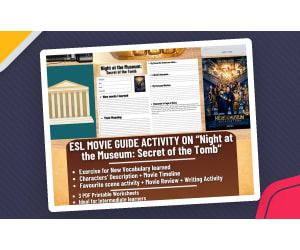
ESL Movie Guide Worksheets on Night at the Museum: Secret of the Tomb
ELA, Language Development, ESL, Writing, Creative Writing, Grade 6, 7, 8, 9, Worksheets & Printables, Writing Prompts, Worksheets
ESL Movie Guide Worksheets on "Night at the Museum: Secret of the Tomb" This ESL teaching resource is a 3-page printable PDF movie guide for "Night at the Museum: Secret of the Tomb" (2014 film set at the British Museum, in London, United Kingdom, with characters such as Theodore Roosevelt, Sir Lancilot and way more) designed to support English as a Second Language (ESL) learners. This resource can be great for post-movie activities and is ideal for Middle School and High School students, ranging from 6th to 9th grade. It's a versatile tool suitable for newcomers and any English language learners, making it an excellent choice to use in ESL classrooms, language centers, or by tutors worldwide. This "Night at the Museum: Secret of the Tomb" (2014 film set at the British Museum, in London, United Kingdom, with characters such as Theodore Roosevelt, Sir Lancilot and way more) movie guide is ideal for intermediate ESL students. It provides a structured way for learners to engage with the film while developing their English language skills. The guide includes several activities that encourage students to interact with the movie's content in meaningful ways: A section for general information about "Night at the Museum: Secret of the Tomb" (2014 film set at the British Museum, in London, United Kingdom, with characters such as Theodore Roosevelt, Sir Lancilot and way more) such as the film's director, genre, and other key details. A space for new vocabulary learned while watching the movie, helping students expand their English lexicon. A part dedicated to describing the main characters, allowing students to practice descriptive language and character analysis. A movie timeline activity where students arrange scenes from the film in chronological order, enhancing their understanding of the narrative structure. A section for students to describe their favorite scene from the movie and explain why they liked it, fostering personal connection and critical thinking. A movie review segment where students can express their opinions about the film, practicing persuasive and evaluative writing. A creative writing task where students imagine themselves as one of the characters and write three diary entries from that character’s perspective, encouraging deeper engagement with the characters and plot. This "Night at the Museum: Secret of the Tomb" (2014 film set at the British Museum, in London, United Kingdom, with characters such as Theodore Roosevelt, Sir Lancilot and way more) movie guide is designed to create an enjoyable and stimulating learning experience for intermediate ESL learners. Learning with Alan is a Teaching Resources Store whose aim is to help English as a Second or foreign Language (ESL EFL) Teachers, Educators and Tutors around the world (be it online or offline) to achieve their teaching objectives while creating an enjoyable and stimulating learning environment. Never Forget! Learning is fun, So should English! Always If you want to browse more of my ESL, EFL, TESOL Teaching Resources, click here Learning with Alan!
Author Learning with Alan
Tags ESL, English Second Language, English, Worksheets, Printable, Movie Guides, Films, Activity, Museum, London

ESL Movie Guide - "Night at the Museum: Battle of the Smithsonian"
ELA, Language Development, ESL, Writing, Creative Writing, Grade 6, 7, 8, 9, Worksheets & Printables, Writing Prompts, Worksheets
ESL Movie Guide Worksheets on "Night at the Museum: Battle of the Smithsonian" This ESL teaching resource is a 3-page printable PDF movie guide for "Night at the Museum: Battle of the Smithsonian" (2009 film set at the Smithsonian in Washington DC with characters such as Theodore Roosevelt, Napoleon, Amelia Earhart, Al Capone, Ivan the Terrible and way more) designed to support English as a Second Language (ESL) learners. This resource can be great for post-movie activities and is ideal for Middle School and High School students, ranging from 6th to 9th grade. It's a versatile tool suitable for newcomers and any English language learners, making it an excellent choice to use in ESL classrooms, language centers, or by tutors worldwide. This "Night at the Museum: Battle of the Smithsonian" (2009 film set at the Smithsonian in Washington DC with characters such as Theodore Roosevelt, Napoleon, Amelia Earhart, Al Capone, Ivan the Terrible and way more) movie guide is ideal for intermediate ESL students. It provides a structured way for learners to engage with the film while developing their English language skills. The guide includes several activities that encourage students to interact with the movie's content in meaningful ways: A section for general information about "Night at the Museum: Battle of the Smithsonian" (2009 film set at the Smithsonian in Washington DC with characters such as Theodore Roosevelt, Napoleon, Amelia Earhart, Al Capone, Ivan the Terrible and way more) such as the film's director, genre, and other key details. A space for new vocabulary learned while watching the movie, helping students expand their English lexicon. A part dedicated to describing the main characters, allowing students to practice descriptive language and character analysis. A movie timeline activity where students arrange scenes from the film in chronological order, enhancing their understanding of the narrative structure. A section for students to describe their favorite scene from the movie and explain why they liked it, fostering personal connection and critical thinking. A movie review segment where students can express their opinions about the film, practicing persuasive and evaluative writing. A creative writing task where students imagine themselves as one of the characters and write three diary entries from that character’s perspective, encouraging deeper engagement with the characters and plot. This "Night at the Museum: Battle of the Smithsonian" (2009 film set at the Smithsonian in Washington DC with characters such as Theodore Roosevelt, Napoleon, Amelia Earhart, Al Capone, Ivan the Terrible and way more) movie guide is designed to create an enjoyable and stimulating learning experience for intermediate ESL learners. Learning with Alan is a Teaching Resources Store whose aim is to help English as a Second or foreign Language (ESL EFL) Teachers, Educators and Tutors around the world (be it online or offline) to achieve their teaching objectives while creating an enjoyable and stimulating learning environment. Never Forget! Learning is fun, So should English! Always If you want to browse more of my ESL, EFL, TESOL Teaching Resources, click here Learning with Alan!
Author Learning with Alan
Tags ESL, English, English Second Language, Movie Guides, Films, Washington DC, Museum, Worksheets, Activity, Printable
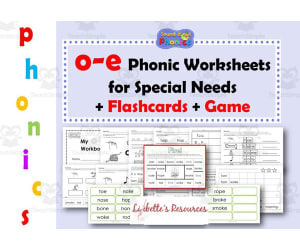
o-e Phonic Worksheets for Early Years/Intervention
Special Resources, ELA, Language Development, Phonics, Reading, Spelling, Kindergarten, Preschool, Grade 1, 2, Activities, Worksheets & Printables, Worksheets
This is a pack of 12 phonic worksheets for the Long Vowel O-E (as in rope) specially designed for those with special needs, including those with dyslexia or who may be suspected of being dyslexic but will work equally well with young learners in Kindergarten/EYFS/Y1. A pack of 12 worksheets with a variety of exercises to help build phonemic awareness and reading fluency. These sheets are LETRS and UK GOV requirements aligned. These worksheets also align with the most popular phonic programmes, including RWI and Letters and Sounds. What is included? 12 worksheets for the sound O-E taking pupils from hearing the sounds in words to reading and spelling them at word and sentence level. all following my special method devised as I privately tutor children of all ages with profound special needs. Your phonics lessons covered! Tracking, fluency triangles, spelling, reading, games, comprehension exercises....and more! Who are these worksheets for? I have written them for pupils who struggle with processing information - especially sounds. This includes children who are DYSLEXIC or have ANY other kind of processing disorder. Such children may have failed with other methods of teaching phonics. Such pupils need activities that: ·are highly structured - one tiny step at a time building on the one before using only a limited number of words to start with and only using words that the child has already learnt to sound out, with no nasty surprises. ·Have only a little on each pageas these pupils tire easily. What makes these worksheets special? I have a powerful three-step process which I use with my special needs pupils, which is worked out over the course of the 12 worksheets: 1. See it!where we focus on becoming aware of the new sound in words. This involves first hearing the new sound in words and then seeing it in words (tracking). 2. Sound-it-out!Having learnt to see the new sound in words, we learn to sound out these words to read and write them. We begin by usingsound-it-out boxesfor reading and spelling which help the child to segment the word prior to blending the sounds together. Once the child can read and write individual words, we work on fluency by building familiarity with the common words in the new sound family. Once the child can sound the words out to read and spell confidently, we move on to recognising them/using them in longer reading and dictation passages, as soon as the child is able. I provide 2 reading passages with comprehension exercises and one dictation passage, with a page in the workbook dedicated to it, with room for a picture, which again cements understanding. 3. Write it! Incorporated into the above two steps, we constantly write the new sound. This adds a multi-sensory dimension to our work - we see with our eyes, we sound it with our mouth parts and voice, and then we move by writing. All three steps work together to help the child feel in control of his/her learning and to become a successful, confident learner. We finish each sound with a dictation which culminates our work before we move on to the next sound. I try to give the dictation a week after we finish the work on the EA sound to act as revision. The dictation: Read this passage to your pupil, who should write it. Have the child read his/her work and check for errors. Make sure the writing is completely accurate before saying the child has finished, including full stops and capital letters correctly used. Flashcards are included of some common O-E words. What is included? 1 PDF with flashcards and 12 O-E worksheets
Author Lilibette's Resources
Tags Magic E, Phonic Worksheets, Special Needs, Phonic Games, Print N Play Phonic Game, Split Digraph O-e, O-e Worsheets, Silent E, Split Digraph O-e, Phonics O-e

AI Phonic Worksheets for Early Years/Intervention/Special Needs
Special Resources, ELA, Language Development, Phonics, Reading, Spelling, Kindergarten, Preschool, Grade 1, 2, Activities, Games, Worksheets & Printables, Worksheets
This is a pack of 18 phonic worksheets for the Long Vowel AI (as in rain) specially designed for those with special needs, including those with dyslexia or who may be suspected of being dyslexic but will work equally well with young learners in Kindergarten/EYFS/Y1. A pack of 18 AI worksheets with a variety of exercises to help build phonemic awareness and reading fluency. These sheets are LETRS and UK GOV requirements aligned. These worksheets also align with the most popular phonic programmes, including RWI and Letters and Sounds. What is included? 30 worksheets for the sound AI taking pupils from hearing the sounds in words to reading and spelling them at word and sentence level. all following my special method devised as I privately tutor children of all ages with profound special needs. Your phonics lessons are covered! Tracking, fluency triangles, spelling, reading, games, comprehension exercises....and more! 2 PDF games to send home for extra practice included! Who are these worksheets for? I have written them for pupils who struggle with processing information - especially sounds. This includes children who are DYSLEXIC or have ANY other kind of processing disorder. Such children may have failed with other methods of teaching phonics. Such pupils need activities that: ·are highly structured - one tiny step at a time building on the one before using only a limited number of words to start with and only using words that the child has already learnt to sound out, with no nasty surprises. ·Have only a little on each pageas these pupils tire easily. What makes these worksheets special? I have a powerful three-step process which I use with my special needs pupils, which is worked out over the course of the 18 worksheets: 1. See it!where we focus on becoming aware of the new sound in words. This involves first hearing the new sound in words and then seeing it in words (tracking). 2. Sound-it-out!Having learnt to see the new sound in words, we learn to sound out these words to read and write them. We begin by usingsound-it-out boxesfor reading and spelling which help the child to segment the word prior to blending the sounds together. Once the child can read and write individual words, we work on fluency by building familiarity with the common words in the new sound family. Once the child can sound the words out to read and spell confidently, we move on to recognising them/using them in longer reading and dictation passages, as soon as the child is able. I provide 2 reading passages with comprehension exercises and one dictation passage, with a page in the workbook dedicated to it, with room for a picture, which again cements understanding. 3. Write it! Incorporated into the above two steps, we constantly write the new sound. This adds a multi-sensory dimension to our work - we see with our eyes, we sound it with our mouth parts and voice, and then we move by writing. All three steps work together to help the child feel in control of his/her learning and to become a successful, confident learner. We finish each sound with a dictation which culminates our work before we move on to the next sound. I try to give the dictation a week after we finish the work on the EA sound to act as revision. The dictation: Read this passage to your pupil, who should write it. Have the child read his/her work and check for errors. Make sure the writing is completely accurate before saying the child has finished, including full stops and capital letters correctly used. Flashcards are included of some common AI words. What is included? 1 PDF with flashcards, 2 easy-prep AI games and 30 worksheets
Author Lilibette's Resources
Tags Phonic Worksheets, Special Needs, Phonic Games, Print N Play Phonic Game, Dyslexia, Vowel Teams, Spelling Ai Words, Ai Worksheets, Learn To Read Ai Words, Long A

EA Phonic Worksheets for Early Years/Intervention/Special Needs
Special Resources, ELA, Language Development, Phonics, Reading, Spelling, Kindergarten, Preschool, Grade 1, 2, Activities, Games, Worksheets & Printables, Worksheets
This is a pack of 30 phonic worksheets for the Long Vowel EA (as in eat) specially designed for those with special needs, including those with dyslexia or who may be suspected of being dyslexic but will work equally well with young learners in Kindergarten/EYFS/Y1. A pack of 30 worksheets with a variety of exercises to help build phonemic awareness and reading fluency. These sheets are LETRS and UK GOV requirements aligned. These worksheets also align with the most popular phonic programmes, including RWI and Letters and Sounds. What is included? 30 worksheets for the sound EA taking pupils from hearing the sounds in words to reading and spelling them at word and sentence level. all following my special method devised as I privately tutor children of all ages with profound special needs. Your phonics lessons covered! Tracking, fluency triangles, spelling, reading, games, comprehension exercises....and more! 2 PDF games to send home for extra practice included! Who are these worksheets for? I have written them for pupils who struggle with processing information - especially sounds. This includes children who are DYSLEXIC or have ANY other kind of processing disorder. Such children may have failed with other methods of teaching phonics. Such pupils need activities that: ·are highly structured - one tiny step at a time building on the one before using only a limited number of words to start with and only using words that the child has already learnt to sound out, with no nasty surprises. ·Have only a little on each pageas these pupils tire easily. What makes these worksheets special? I have a powerful three-step process which I use with my special needs pupils, which is worked out over the course of the 30 worksheets: 1. See it!where we focus on becoming aware of the new sound in words. This involves first hearing the new sound in words and then seeing it in words (tracking). 2. Sound-it-out!Having learnt to see the new sound in words, we learn to sound out these words to read and write them. We begin by usingsound-it-out boxesfor reading and spelling which help the child to segment the word prior to blending the sounds together. Once the child can read and write individual words, we work on fluency by building familiarity with the common words in the new sound family. Once the child can sound the words out to read and spell confidently, we move on to recognising them/using them in longer reading and dictation passages, as soon as the child is able. I provide 2 reading passages with comprehension exercises and one dictation passage, with a page in the workbook dedicated to it, with room for a picture, which again cements understanding. 3. Write it! Incorporated into the above two steps, we constantly write the new sound. This adds a multi-sensory dimension to our work - we see with our eyes, we sound it with our mouth parts and voice, and then we move by writing. All three steps work together to help the child feel in control of his/her learning and to become a successful, confident learner. We finish each sound with a dictation which culminates our work before we move on to the next sound. I try to give the dictation a week after we finish the work on the EA sound to act as revision. The dictation: Read this passage to your pupil, who should write it. Have the child read his/her work and check for errors. Make sure the writing is completely accurate before saying the child has finished, including full stops and capital letters correctly used. Flashcards are included of some common EA words. What is included? 1 PDF with flashcards, 2 easy-prep games and 30 worksheets
Author Lilibette's Resources
Tags Phonic Worksheets, Special Needs, Phonic Games, Print N Play Phonic Game, Ea Worksheets, Dyslexia, Spelling EA Words, Learn To Read EA Words, Long E, Vowel Teams
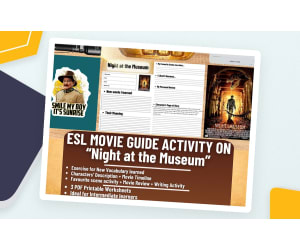
ESL Movie Guide Worksheets on "Night at the Museum"
ELA, Language Development, ESL, Writing, Creative Writing, Grade 6, 7, 8, 9, Worksheets & Printables, Writing Prompts, Worksheets
ESL Movie Guide Worksheets on "Night at the Museum" This ESL teaching resource is a 3-page printable PDF movie guide for "Night at the Museum" (2006 film set at the American Natural History Museum in New York City with characters such as Theodore Roosevelt, Attila the Hun and way more) designed to support English as a Second Language (ESL) learners. This resource can be great for post-movie activities and is ideal for Middle School and High School students, ranging from 6th to 9th grade. It's a versatile tool suitable for newcomers and any English language learners, making it an excellent choice to use in ESL classrooms, language centers, or by tutors worldwide. This "Night at the Museum" (2006 film set at the American Natural History Museum in New York City with characters such as Theodore Roosevelt, Attila the Hun and way more) movie guide is ideal for intermediate ESL students. It provides a structured way for learners to engage with the film while developing their English language skills. The guide includes several activities that encourage students to interact with the movie's content in meaningful ways: A section for general information about "Night at the Museum" (2006 film set at the American Natural History Museum in New York City with characters such as Theodore Roosevelt, Attila the Hun and way more) such as the film's director, genre, and other key details. A space for new vocabulary learned while watching the movie, helping students expand their English lexicon. A part dedicated to describing the main characters, allowing students to practice descriptive language and character analysis. A movie timeline activity where students arrange scenes from the film in chronological order, enhancing their understanding of the narrative structure. A section for students to describe their favorite scene from the movie and explain why they liked it, fostering personal connection and critical thinking. A movie review segment where students can express their opinions about the film, practicing persuasive and evaluative writing. A creative writing task where students imagine themselves as one of the characters and write three diary entries from that character’s perspective, encouraging deeper engagement with the characters and plot. This "Night at the Museum" (2006 film set at the American Natural History Museum in New York City with characters such as Theodore Roosevelt, Attila the Hun and way more) movie guide is designed to create an enjoyable and stimulating learning experience for intermediate ESL learners. Learning with Alan is a Teaching Resources Store whose aim is to help English as a Second or foreign Language (ESL EFL) Teachers, Educators and Tutors around the world (be it online or offline) to achieve their teaching objectives while creating an enjoyable and stimulating learning environment. Never Forget! Learning is fun, So should English! Always If you want to browse more of my ESL, EFL, TESOL Teaching Resources, click here Learning with Alan!
Author Learning with Alan
Tags ESL, English Second Language, English, Movie Guides, Films, New York City, Museum, Worksheets, Printable, Activity

Reading Handwriting Short Story Differentiated Levels 2
ELA, Reading, Reading Comprehension, Handwriting, Writing, Grade 2, 3, 4, Centers, Activities, Workbooks, Worksheets & Printables
Strengthen your students’ reading skills and boost their handwriting confidence with this Differentiated Short Story of three ( 3 ) progressive levels . This versatile resource ensures that every student in your classroom has the opportunity to engage with a similar material, providing an environment of peer-to-peer learning . Ideal for targeted instruction, these stories work nicely in small group settings and literacy stations . They promote independent learning and can serve as a valuable resource for sub plans . Each level includes both READING and HANDWRITING practice through tracing the text, for students to enhance their motor skills . This pdf resource encourages students to create and illustrate their own printed books, with a front and back cover . This can ignite their imagination and pride in their work . As they read and understand the content, they are more likely to participate in discussions, share their ideas, and develop connections with their teacher and classmates . Also, the exposure to rich new adjusted vocabulary enhances students’ language development . Whether implemented in small reading groups, during whole class lessons, or as part of independent work, these differentiated passages offer flexibility in your teaching strategy . They are specifically designed to effectively address a variety of learning styles and abilities, enabling you to tailor your teaching approach to meet the various needs of your students . This resource facilitates differentiated instruction but also promotes a supportive and inclusive classroom atmosphere, where every student feels valued and capable of achieving literacy success . For more P D F materials and educational and therapy resources on language, special education, numeracy, basic math and pictorial / manipulative approach to teaching and learning, you can click WORDS ASIDE Included : one file with 5 4 pdf pages of a leveled short story to use through elementary grades .
Author WORDS ASIDE
Tags Short Stories, Leveled Reading, Booklet, Mini Book, Literature Circle, Independent Work, Homework, Handwriting, Elementary Reading, Literacy Skills
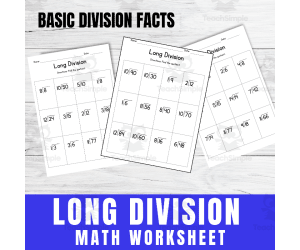
Long Division Worksheet With Basic Division Facts!!
Multiplication and Division, Math, Division, Multiplication, Grade 1, 2, 3, 4, 5, Teacher Tools
Long Division Worksheet With Basic Division Facts!! The Long Division worksheet is an excellent aid for public school educators and home-school teachers. Can be use on Any grade or even homeschooling worksheet! What’s Included: 20 long division problems with basic division facts Tips and instructions to help solve problems. 4 Math's on each Page Total 5 pages PDF file Included Key Features About This Worksheet: Clear step-by-step practice for dividing with basic words Simple, printable design for easy use. US Letter Size 8.5*11 Size Worksheet Classroom Usage: Seamless integration into math lessons via presentations during group discussions or reinforcement during smaller group or one-on-one sessions. Homeschool Usage: Serve as revision materials or part of homework tasks encouraging independent study. The Long Division Worksheet keeps students engaged and makes learning challenging math concepts enjoyable. It's simple and easy to use, allowing teachers to seamlessly include it in their lessons without interrupting their schedule. This makes it a valuable and appealing addition to any teaching toolkit.
Author Perfect_Printables
Tags Long Division Woksheet, Long Division Math, Math Worksheet Printable, Division Multiplication , Homeschooling, Study Worksheet
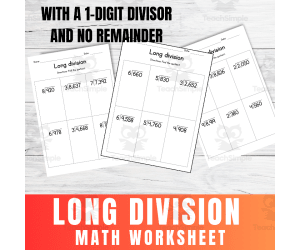
Long Division Worksheet With a 1-Digit Divisor and No Remainder
Division, Multiplication and Division, Math, Multiplication, Grade 3, 4, 5, 6, Teacher Tools
Long Division Worksheet with a 1-Digit Divisor and No Remainder The Long Division worksheet is an excellent aid for public school educators and home-school teachers. Can be use on Any grade or even homeschooling worksheet! What’s Included: 20 long division problems with 2-digit divisors. Tips and instructions to help solve problems. 4 Math's on each Page Total 5 pages PDF file Included Key Features About This Worksheet: Clear step-by-step practice for dividing with a 1-Digit Divisor and No Remainder Simple, printable design for easy use. US Letter Size 8.5*11 Size Worksheet Classroom Usage: Seamless integration into math lessons via presentations during group discussions or reinforcement during smaller group or one-on-one sessions. Homeschool Usage: Serve as revision materials or part of homework tasks encouraging independent study. The Long Division Worksheet keeps students engaged and makes learning challenging math concepts enjoyable. It's simple and easy to use, allowing teachers to seamlessly include it in their lessons without interrupting their schedule. This makes it a valuable and appealing addition to any teaching toolkit.
Author Perfect_Printables
Tags Long Division Worksheet , 1-Digit Divisor And No Remainder, Math Worksheet

Long Division Worksheet By 2 Digit
Division, Multiplication and Division, Math, Multiplication, Grade 4, 5, 6, Teacher Tools
The Long Division Math Worksheet is an excellent aid for public school educators and home-school teachers. Crafted to support third to sixth grade pupils, this resource leverages visual and auditory elements for a comprehensive understanding of long division. What’s Included: 20 long division problems with 2-digit divisors. Tips and instructions to help solve problems. 4 Math's on each Page Key Features About This Worksheet: Clear step-by-step practice for dividing by 2-digit numbers. Simple, printable design for easy use. US Letter Size 8.5*11 Size Worksheet Classroom Usage: Seamless integration into math lessons via presentations during group discussions or reinforcement during smaller group or one-on-one sessions. Homeschool Usage: Serve as revision materials or part of homework tasks encouraging independent study. The Long Division Worksheet keeps students engaged and makes learning challenging math concepts enjoyable. It's simple and easy to use, allowing teachers to seamlessly include it in their lessons without interrupting their schedule. This makes it a valuable and appealing addition to any teaching toolkit.
Author Perfect_Printables
Tags Long Division Worksheet, Division Multiplication , Long Division, Math Curriculum , Visual Learning
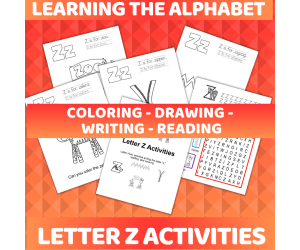
Letter Z Activities - Zebra, Zigzag, Zipper, and Zoo
Common Core, Pre-Reading, Language Development, ELA, Kindergarten, Preschool, Coloring Pages, Worksheets, Worksheets & Printables, Activities
All kids have to learn the alphabet before they can start reading. I like to create fun activities to make learning fun for students. These activities can be used with preschoolers, pre-readers, kindergarteners, and anyone (special needs, those struggling to read) at any age. Even if your students aren't learning their alphabet, they may still enjoy coloring the pages and practicing their penmanship. In addition to four different coloring pages, students will also have the opportunity to find the hidden Z through a letter hunt activity. Short sentences are on the coloring pages to help students practice reading or learning to read. The sentences are in the form of a question that gives children the opportunity to think about their answers. Thus, critical thinking skills will be developed. These are simple activities that can be completed easily as part of a typical school day. They can also supplement your regular language arts, reading, and writing curriculum. Coloring is also considered a creative endeavor, and crafty children will enjoy coloring the pictures as well as answering the questions. Kids can also cut the pictures out to practice their scissor skills. There are a total of 6 pages of activities and coloring pages in a downloadable, printable pdf form.
Author Homeschooling Dietitian Mom
Tags #letter Z Activities, Letter Identification Games, Writing Letters, Bulletin Board Letters, Abc Coloring Pages, Cute Coloring Page, Easy Coloring Pages, Word Search
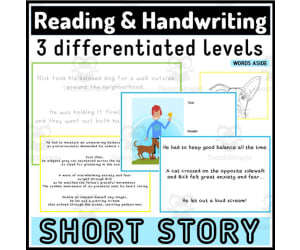
Reading Handwriting Short Story Differentiated Levels
ELA, Reading, Reading Comprehension, Handwriting, Writing, Grade 2, 3, 4, Centers, Activities, Workbooks, Worksheets & Printables
Strengthen your students’ reading skills and boost their handwriting confidence with this Differentiated Short Story of three ( 3 ) progressive levels . This versatile resource ensures that every student in your classroom has the opportunity to engage with a similar material, providing an environment of peer-to-peer learning . Ideal for targeted instruction, these stories work nicely in small group settings and literacy stations . They promote independent learning and can serve as a valuable resource for sub plans . Each level includes both READING and HANDWRITING practice through tracing the text, for students to enhance their motor skills . This pdf resource encourages students to create and illustrate their own printed books, with a front and back cover . This can ignite their imagination and pride in their work . As they read and understand the content, they are more likely to participate in discussions, share their ideas, and develop connections with their teacher and classmates . Also, the exposure to rich new adjusted vocabulary enhances students’ language development . Whether implemented in small reading groups, during whole class lessons, or as part of independent work, these differentiated passages offer flexibility in your teaching strategy . They are specifically designed to effectively address a variety of learning styles and abilities, enabling you to tailor your teaching approach to meet the various needs of your students . This resource facilitates differentiated instruction but also promotes a supportive and inclusive classroom atmosphere, where every student feels valued and capable of achieving literacy success . For more P D F materials and educational and therapy resources on language, special education, numeracy, basic math and pictorial / manipulative approach to teaching and learning, you can click WORDS ASIDE Included : one file with 5 4 pdf pages of a leveled short story to use through elementary grades .
Author WORDS ASIDE
Tags Short Stories, Leveled Reading, Booklet, Mini Book, Literature Circle, Independent Work, Homework, Handwriting, Elementary Reading, Literacy Skills
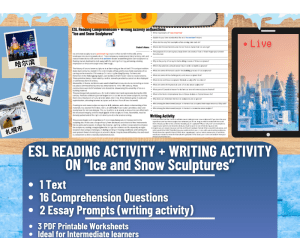
ESL Reading Comprehension + Writing Activity - Ice and Snow Sculptures
ELA, Language Development, ESL, Reading, Reading Comprehension, Writing, Creative Writing, Formal Writing, Grade 7, 8, 9, 10, 11, 12, Worksheets & Printables, Writing Prompts, Worksheets
ESL Reading Comprehension + Writing Activity Worksheet - Ice and Snow Sculptures This ESL EFL (English Second or Foreign Language) Teaching Resource on "Ice and Snow Sculptures" (3 PDF Slides; Reading Comprehension + Writing Activity) can be ideal to train Language skills in English. Suitable participants for this ESL EFL TESOL Reading + Writing Activity are Foreign Students at middle and High School (7th-12th Grade; teens). Newcomers or any ESL Learner is also more than suitable for this ESL EFL TESOL Activity on "Ice and Snow Sculptures" (its origins and history + how they are made + famous winter festivals around the world, such as in Harbin in China, Sapporo in Japan and Québec in Canada). This Teaching Educational Resource Product can also be ideal for ESL EFL Centers worldwide or any English second language tutor. This ESL EFL TESOL Teaching Resource on "Ice and Snow Sculptures" (Worksheet; 3 PDF Printable slides) can be ideal for intermediate English as a Second or Foreign Language (ESL EFL) Learners. Within this English Second or Foreign Language Reading Comprehension + Essay Writing Activity Worksheet on "Ice and Snow Sculptures" (its origins and history + how they are made + famous winter festivals around the world, such as in Harbin in China, Sapporo in Japan and Québec in Canada), ESL EFL TESOL teachers can find the following activities: 1 text on "Ice and Snow Sculptures" (its origins and history + how they are made + famous winter festivals around the world, such as in Harbin in China, Sapporo in Japan and Québec in Canada) 16 Questions (with space for answers) 2 Essay Prompts (writing an essay on "ice and snow sculptures and whether you would ever like to admire them + imagining to organize an "ice and snow sculptures festical" and to describe it) This ESL, EFL (English Second or Foreign Language) Teaching Resource Reading + Writing Activity on "Ice and Snow Sculptures" (its origins and history + how they are made + famous winter festivals around the world, such as in Harbin in China, Sapporo in Japan and Québec in Canada) is great for Intermediate English as a second or foreign language learners (ESL- EFL). This English Second Language Worksheet on "Ice and Snow Sculptures" (its origins and history + how they are made + famous winter festivals around the world, such as in Harbin in China, Sapporo in Japan and Québec in Canada) aims to train and Reading Comprehension + Writing Skills. "Learning with Alan" is dedicated to provide high-quality teaching resources and educational materials for ESL EFL TESOL teachers. It aims to support teachers, educators, and tutors in both online and offline environments, helping them achieve their teaching goals while creating a fun, stimulating atmosphere for learning English. Always remember: learning is fun, and so is English! If you want to browse more PDF ESL, EFL, TESOL Teaching Resources and Educational Material click here Learning with Alan!
Author Learning with Alan
Tags ESL, English Second Language, English, Reading Comprehension, Writing Activity, Worksheets, Printable, Winter, Snow, Ice

Telling Time to the Half Hour Worksheets
Math, Time, Kindergarten, Grade 1, Worksheets & Printables, Worksheets
Start learning to tell time on an analog clock with these telling time to the half hour posters and worksheets. Students will get to practice telling time by reading an analog clock and by drawing the hour and minute hands on a clock to represent the time. What is Included: There is a clock poster page that labels the hour hand and the minute hand. There is a clock poster page that shows all the clocks for times to the hour with labels. There are two worksheets where students will write the time shown on the analog clock. There are two worksheets where students will draw the hour hand and the minute hand to show the time on the analog clock. There is one worksheet where students will draw the missing hour or minute hand to correctly complete each clock. The clean, simple nature of these worksheets will allow students to learn to tell time to the half hour without extra distractions. The poster pages provide students will a reference page to look back to if they find their assignment confusing, or if they need further reference to solve one of the problems. When to Use: Morning Work - These worksheets make a great addition to your morning work routine while students are learning to tell time. Homework - These worksheets are an easy way to give extra practice for students to work on at home with their parents. Independent Work - These worksheets are great independent practice for students to complete within the classroom. Sub Plans - These worksheets can be easily added to any sub plans for an easy activity to assign and keep students engaged. Skills Assessed: Students will practice telling time to the half hour on an analog clock, by recognizing the time the clock says and by drawing the arms of the clock to show the correct time.
Author The Connett Connection
Tags Telling Time, Analog Clocks, Telling Time To The Half Hour, Telling Time Worksheets
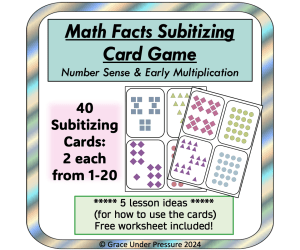
Mental Math Games: Number Sense Subitizing Flash Cards 5 Ways!
Math, Early Math, Counting, Numbers, Multiplication and Division, Multiplication, Kindergarten, Grade 1, 2, 3, Centers, Activities, Games
This unique set of 40 subitizing flashcards encourages your students to practice a vital mental math skill: subitizing, which is instantly recognizing how many there are in small groups of items and then using that knowledge for counting larger numbers! It’s a fun way to also practice early multiplication skills and learn math facts- by mentally counting equal groups in a visual display. Finally, it's an easy and simple routine to foster students' number sense. It makes a great math centre to use all year long in multiple ways! There are two unique cards for each number value from 1-20: 40 cards in all! Ways to Use: 1) Traditional Flashcards: Hold up a flashcard and ask your student to let you know how many items there are using their mental counting skills. 2) Memory Game: Spread mixed-up pairs of cards facedown on the table (you could use from 5-20 pairs, based on your students’ ages and abilities). Students will take turns, flip two cards over, and look for pairs of cards that have the same value. They continue playing as you would a standard memory matching game. 3) Line Them Up: Have your students work individually or in pairs to line up one set of cards with values from 1-20. 4) One More, One Less: One student shows a single card. Their partner can search through the rest of the cards to find one that is worth one more and a card that is worth one less. 5) Explain Your Counting: Have your students use the included worksheet to explain how they mentally count the items on one of the cards. For example, "I see 4 groups of 4 and one more." What's Included: 12 Page PDF- Ready to Print and Use! Teacher Instructions (for five different games and activities) Student Worksheet for "Explain Your Counting" 10 Pages of Flashcards
Author Grace Under Pressure
Tags Mental Math Game, Mental Math Games, Number Sense, Subitizing, Math Flash Cards, Counting, Math Center, Math Centre, Math Game, Math Facts
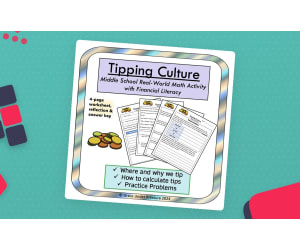
Percent Word Problems – Tipping & Gratuities Math
Life Studies, Home Economics, Special Resources, Life Skills, Math, Multiplication, Multiplication and Division, Percentages, Money, Grade 6, 7, 8, 9, Worksheets & Printables, Word Problems, Teacher Tools, Lesson Plans
Tipping is becoming more and more common and the amount you are expected to tip is increasing too. Make sure your students understand what tipping is and how to calculate a tip- useful life skills! Here’s a ready-to-print real-life percent math lesson for middle school students (in grades 6-9) or special education or life skills classes in a high school setting. Teach your class all about tipping culture and tips in both Canada and the United States. Why do people tip or give certain people a gratuity? What places do we tip? What places do we not? Has tipping been increasing recently ("tip-flation")? Show students how the math skills and concepts that they have been learning in class (percentages, decimals, division, fractions) can be useful in their everyday lives! How to Use: 1. The first page is a handout that you complete with your students (with fill-in-the-blanks) to teach them the ins and outs of tipping: where and when you do it, etc. 2. The second page teaches students two simple methods of calculating tips (using well-known percentage benchmarks OR multiplying the price by a percentage written in decimal form). Encourage your students to determine a third method they could use. 3. After that, there are 7 practice word problems of realistic tipping situations that your students can complete. From tipping for a meal to paying at a salon, or even calculating tax AND tip together, your students will get a lot of real-life practice completing these problems in small groups or own their own. 4. To finish, you can have a class discussion about tipping in general and what your students think about our system. What's Included: 6 Page PDF - Teacher Instructions - Handout with Fill-in-the-Blanks about Tipping - 3-Page Worksheet and Written Reflection - COMPLETE ANSWER KEY INCLUDED If you want more practice working with tips try these two products: Fractions for Calculating Taxes, Tips and Sales Percents for Calculating Taxes, Tips, and Sales
Author Grace Under Pressure
Rating
Tags Percent Word Problems, Tip, Tipping, Gratuity, How To Tip, How To Calculate A Tip, Financial Literacy, Life Skills, Personal Finance, Word Problems

Telling Time to the Hour Worksheets
Math, Time, Kindergarten, Grade 1, Worksheets & Printables, Worksheets
Start learning to tell time on an analog clock with these telling time to the hour posters and worksheets. Students will get to practice telling time by reading an analog clock and by drawing the hour and minute hands on a clock to represent the time. What is Included: There is a clock poster page that labels the hour hand and the minute hand. There is a clock poster page that shows all the clocks for times to the hour with labels. There are two worksheets where students will write the time shown on the analog clock. There are two worksheets where students will draw the hour hand and the minute hand to show the time on the analog clock. There is one worksheet where students will draw the missing hour or minute hand to correctly complete each clock. The clean, simple nature of these worksheets will allow students to learn to tell time to the hour without extra distractions. The poster pages provide students will a reference page to look back to if they find their assignment confusing, or if they need further reference to solve one of the problems. When to Use: Morning Work - These worksheets make a great addition to your morning work routine while students are learning to tell time. Homework - These worksheets are an easy way to give extra practice for students to work on at home with their parents. Independent Work - These worksheets are great independent practice for students to complete within the classroom. Sub Plans - These worksheets can be easily added to any sub plans for an easy activity to assign and keep students engaged. Skills Assessed: Students will practice telling time to the hour on an analog clock, by recognizing the time the clock says and by drawing the arms of the clock to show the correct time.
Author The Connett Connection
Tags Telling Time, Telling Time To The Hour, Analog Clocks
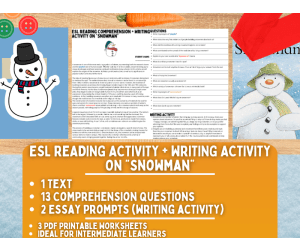
ESL Reading Comprehension + Writing Activity Worksheets on "Snowman"
ELA, Language Development, ESL, Reading, Reading Comprehension, Writing, Creative Writing, Formal Writing, Grade 7, 8, 9, 10, 11, 12, Worksheets & Printables, Writing Prompts, Worksheets
ESL Reading Comprehension + Writing Activity Worksheets on "Snowman" This ESL EFL (English Second or Foreign Language) Teaching Resource on "Snowman" (3 PDF Slides; Reading Comprehension + Writing Activity) can be ideal to train Language skills in English. Suitable participants for this ESL EFL TESOL Reading + Writing Activity are Foreign Students at middle and High School (7th-12th Grade; teens). Newcomers or any ESL Learner is also more than suitable for this ESL EFL TESOL Activity on "Snowman" (its origins + how to build it + variations around the world of this winter character). This Teaching Educational Resource Product can also be ideal for ESL EFL Centers worldwide or any English second language tutor. This ESL EFL TESOL Teaching Resource on "Snowman" (Worksheet; 3 PDF Printable slides) can be ideal for intermediate English as a Second or Foreign Language (ESL EFL) Learners. Within this English Second or Foreign Language Reading Comprehension + Essay Writing Activity Worksheet on "Snowman" (its origins + how to build it + variations around the world of this winter character), ESL EFL TESOL teachers can find the following activities: 1 text on "Snowman" (its origins + how to build it + variations around the world of this winter character) 13 Questions (with space for answers) 2 Essay Prompts (writing an essay on snowmen and whether you like to build them or not + pretending to build a personalized snowman and describing it ) This ESL, EFL (English Second or Foreign Language) Teaching Resource Reading + Writing Activity on "Snowman" (its origins + how to build it + variations around the world of this winter character) is great for Intermediate English as a second or foreign language learners (ESL- EFL). This English Second Language Worksheet on "Snowman" (its origins + how to build it + variations around the world of this winter character) aims to train and Reading Comprehension + Writing Skills. "Learning with Alan" is dedicated to provide high-quality teaching resources and educational materials for ESL EFL TESOL teachers. It aims to support teachers, educators, and tutors in both online and offline environments, helping them achieve their teaching goals while creating a fun, stimulating atmosphere for learning English. Always remember: learning is fun, and so is English! If you want to browse more PDF ESL, EFL, TESOL Teaching Resources and Educational Material click here Learning with Alan!
Author Learning with Alan
Tags ESL, English Second Language, English, Reading Comprehension, Writing Activity, Worksheets, Printable, Winter, Snowman, Snow
Life Cycle of an Alligator | Large Reptiles Unit Study With Fun Facts!
Animals, Life Sciences, Science, Biology, Preschool, Kindergarten, Homeschool Curriculum, Grade 1, 2, 3, 4, Coloring Pages, Worksheets, Worksheets & Printables, Flashcards
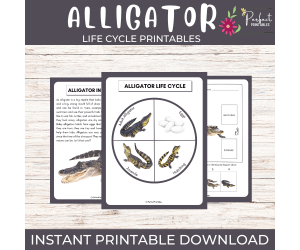
Dive into the amazing life cycle of an alligator, one of the most powerful reptiles in nature. This simple and engaging worksheet is perfect for helping students learn about how these incredible animals grow and live. What’s Inside the Alligator Life Cycle Worksheet? Alligator Overview: A short description of what makes alligators special, where they live, and how they help their environment. Life Cycle Diagram: A clear and labeled chart showing each stage of an alligator’s life, from egg to adult. Cut-and-Paste Activity: A fun way for kids to organize and sequence the life stages of an alligator. Flashcards: Visual tools to help students remember the steps of the life cycle. Bonus Coloring Page: A creative activity to color an alligator for kids This Worksheet is Perfect For: Science lessons about reptiles or large animals. Homeschool studies on wildlife and ecosystems. Classroom centers and hands-on activities. Units about predators and their life cycles. Learning Goals: Learn the stages of an alligator’s life, from egg to full-grown adult. Understand how alligators adapt to their habitats and why they are important. Build sequencing and problem-solving skills through interactive activities. This resource is a great mix of science and creativity. It’s designed to make learning about alligators fun, simple, and memorable for kids!
Author Perfect_Printables
Tags Animals Life Cycle , Life Cycle Printable, Alligator Unit Study Worksheet, Alligator Life Cycle, Flashcards, Coloring Pages