



5,119 products added recently
Page 78 - Newest Teaching Resources

 Show filters
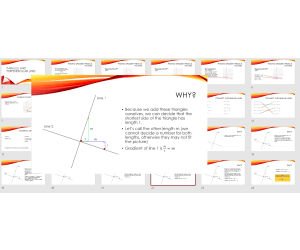
Parallel and perpendicular lines PowerPoint includes proof
Math, Algebra, Geometry, Graphing, Grade 9, 10, 11, Presentations, Teacher Tools
This PowerPoint starts by reminding students of concepts gradient, perpendicular and parallel. There are couple questions in the middle to check the understanding of perpendicular and parallel before proceeding to the proof, which is the beef of this presentation. The proof is, why will the gradients of two perpendicular lines multiply to -1. The proof is introduced step by step using pictures. To have a full lesson, you would need to add some questions/worksheet to the end. This presentation is fully editable Microsoft PowerPoint. The right age group is middle school. Common core standard is HSG.GPE.B.5 (Expressing geometric properties with equations) however be aware that this is a bit more formal approach than a purely graphical explanation would be. So, students need to be somewhat ready to understand a bit of abstraction like "this line represents any random line" and so on. Outline: Finding gradient from a picture (5 pages), finding constant from a picture, collecting the equation, parallel lines (5 pages), perpendicular lines and gradients (example), proof that gradients of two perpendicular lines multiply to -1. (8 pages). In total 24 slides.
Author TheBrightestKid
Rating
Tags Perpendicular, Parallel, Proof, Gradient, Reciprocal Gradient

OW (cow): Phonics Workbook Reading Made Simple
Phonics, Language Development, ELA, Spelling, Kindergarten, Worksheets & Printables, Worksheets, Teacher Tools
Reading Made Simple — Free OW (cow) Phonics Workbook These little workbooks have been a quiet favourite with families using Reading Made Simple for some time now. Each one focuses on a single sound and prints on just one sheet of A4 paper — double-sided, folded in half to make a neat A5 booklet that children can hold and work through at their own pace. They are entirely optional. The phonics programme works perfectly well without them, but many parents and teachers find them a useful companion — either as structured practice or simply as a source of ideas to dip into when needed. Tested by real children: One 5-year-old user is quoted as having said, 'The worksheet is the best bit of my lessons!' Other parents have noted that their child likes the worksheet because 'they think it is easy'. When learning is broken down into small, achievable steps, with no curve balls to throw them off track, every child can say, 'I can read!' When I hear these reviews, I know that I have succeeded in my aim to write a phonics curriculum that can help children of all abilities learn to read and spell. These little workbooks are just one small part of what there is to offer. Please do check out the website for more information. Each workbook offers a gentle mix of activities built around the target sound. Children will read short passages that practise the new sound alongside words from sounds already taught, track and identify the sound within words to support both reading and spelling, practise spelling and sentence writing, and work through simple editing exercises where they spot and correct mistakes. These small editing tasks are particularly worthwhile — they encourage children to look carefully at words rather than guessing from context. The workbooks are particularly well-suited to younger children just beginning their phonics journey, and to older children with special educational needs who are still building their foundational reading and spelling skills. That said, they will not suit every child. Some will find them too long, others too straightforward. Use your own judgement — pick the activities that fit, leave the rest, or set them aside entirely. There is no obligation and no right or wrong way to use them. To print: print double-sided, flipping on the short edge. Fold in half to create your A5 booklet. The answer page at the back is optional. One sheet of paper. One sound. Everything a child needs to practise, consolidate and grow in confidence.
Author Lilibette's Resources
Rating
Tags Phonics Worksheet, Reading Made Simple, Phonics, Free Phonics Worksheets, Free Phonic Worksheets, Ow Wprksheet, Ow Worksheets, Ow Cow Worksheets
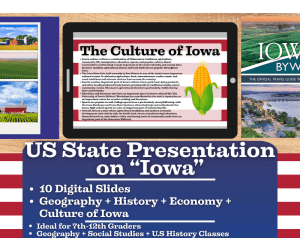
US State Presentation on Iowa
Social Studies, Economics, First Peoples (Native), Geography, History: USA, History, Middle School, Not Grade Specific, High School, Teacher Tools, Presentations, Lesson Plans
US State Presentation on Iowa Bring the United States to life in your classroom with this engaging US State Presentation on Iowa , a ready-to-use digital resource designed for Geography, Social Studies, and US History classes from 7th grade through 12th grade . This presentation provides students with a clear, structured introduction to one US state while combining essential geographical, historical, economic, and cultural information in an accessible format. This US State Presentation on Iowa , includes: The resource begins with a general introduction to the state , helping students understand its location, identity, and importance within the United States. Students then explore the state's borders and neighboring states , making it easier to place it within the broader geography of the country. A general data section introduces key facts such as population, area, population density, capital city, and other essential statistics , providing a useful foundation for further study. A paragraph that explores the history of this US state , highlighting important events, periods, people, and developments that have shaped its identity. This section is particularly useful for US History lessons because it allows students to connect state-level history with major events and themes in American history. A Geography section examines the state's physical characteristics, including its territory, landscapes, natural features, environment, and climate. Students can discover how mountains, rivers, plains, forests, coastlines, deserts, or other geographical characteristics have influenced settlement and human activity. A presentation also introduces the state's economy , explaining its major economic sectors, industries, natural resources, agricultural activities, and other economic strengths. This provides an excellent opportunity to connect geography with economics and understand why particular industries have developed in different parts of the United States. A dedicated section focuses on the capital city , introducing its importance as a political and administrative center. Students can also learn about other important cities , discovering major urban centers and their roles in business, transportation, education, culture, tourism, or industry. A paragraoh that explores culture , giving students an opportunity to learn about traditions, food, music, celebrations, landmarks, historical heritage, and other characteristics that contribute to the state's unique identity. This digital US State Presentation on Iowa is ideal for classroom instruction, student research, geography units, US History lessons, Social Studies activities, state studies, homework, review activities, and independent learning. Its organized structure makes it suitable for middle school and high school students , while its broad range of topics encourages students to view a state from multiple perspectives. Whether you are teaching a unit on the United States, American Geography, US History, state studies, or regional culture , this resource offers a convenient and engaging way to help students explore the diversity and complexity of the United States. Perfect for: Geography Classes, Social Studies Classes, US History Classes, Middle School, High School, Grades 7–12, State Studies, American Studies, Homeschooling, Student Research, and Digital Learning. Learning with Alan is an educational resource store created to help teachers, educators, and tutors reach their teaching goals while building a fun, engaging, and stimulating learning environment . Because learning should always be meaningful—and fun! 🎓✨ If you want to browse more of my Teaching Resources, click here Learning with Alan!!
Author Learning with Alan
Rating
Tags US State, Iowa, USA, United States Of America, Lesson, Introduction, Activity, Presentastion, Social Studies, Geography
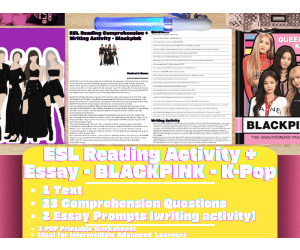
ESL Reading Comprehension + Writing Activity - Blackpink - K-Pop
ELA, Language Development, ESL, Vocabulary, Reading Comprehension, Reading, Creative Writing, Writing, Formal Writing, Middle School, Not Grade Specific, High School, Adult Education, Worksheets, Worksheets & Printables, Writing Prompts
ESL Reading Comprehension + Writing Activity Worksheets - Blackpink - K-Pop This ESL - EFL Teaching Resource on " Blackpink - K Pop Girl Group " ( 3 PDF Worksheets Slides - Reading Comprehension + Writing Activity ) can be ideal to improve Language skills in English. Ideal students for this ESL EFL TESOL Reading + Writing Activity are Foreign Students at middle and High School ( 7th - 12th Grade; teens ) . Newcomers or any ESL Learner is also more than suitable for this ESL - EFL - TESOL - TEFL ( English as a Second or Foreign Language ) Activity on " Blackpink - K Pop Girl Group " ( origins, backgroud and evolution + most famous songs + style and themes + legacy, popularity and success ). This Teaching Educational Resource Product can also be ideal for ESL EFL TESOL Centers worldwide or any English second language tutor. Intermediate Advanced English as a Second or Foreign Language ( ESL - EFL - TESOL - TEFL ) learners are suitable for this ESL - EFL - TESOL - TEFL Teaching Resource on " Blackpink - K Pop Girl Group " ( Worksheet; 3 PDF Printable slides ) In this English Second or Foreign Language ( ESL - EFL - TESOL - TEFL ) Reading Comprehension + Essay Writing Activity Worksheet on " Blackpink - K Pop Girl Group " ( origins, backgroud and evolution + most famous songs + style and themes + legacy, popularity and success ), the following ESL - EFL - TESOL - TEFL ( English Second or Foreign Language ) activities are included: 1 text on " Blackpink - K Pop Girl Group " ( origins, backgroud and evolution + most famous songs + style and themes + legacy, popularity and success ) 23 Comprehension Questions related to the previous text on " Blackpink - K Pop Girl Group " ( with related space where students can answer to this text's comprehension questions ) 2 essay prompt for a writing activity on " Blackpink - K Pop Girl Group " ( writing an essay on another music group; describing them and comparing them to Blackpink + pretending to spend a day with Blackpink and writing about this imaginary experience in a page of diary ) This ESL - EFL - TESOL - TEFL ( English Second or Foreign Language ) Teaching Resource Reading + Writing Activity ( essay prompts ) on " Blackpink - K Pop Girl Group " ( origins, backgroud and overall biography + most famous songs + style and themes + legacy, popularity and success ) is great for Intermediate Advanced English as a second or foreign language learners ( ESL- EFL - TESOL - TEFL ). This English Second Language Worksheet on " Blackpink - K Pop Girl Group " ( origins, backgroud and evolution + most famous songs + style and themes + legacy, popularity and success ) aims to train and Reading Comprehension + Writing Skills. " Learning with Alan " is a teaching resources store that aims to provide high quality teaching resources and educational materials for ESL - EFL - TESOL ( English Second or Foreign Language ) teachers, tutors and educators. It aims to support teachers, educators, and tutors in both online and offline environments, helping them achieve their teaching goals while creating a fun, stimulating atmosphere for learning English. Always remember: learning is fun, and so is English! If you want to find more ESL - EFL - TESOL - TEFL ( English Second or Foreign Language ) Teaching Resources and Educational Material click here Learning with Alan!
Author Learning with Alan
Rating
Tags ESL, English Second Language, English, Reading Comprehension, Writing Activity, K-Pop, South Korea, Blackpink, Music, Activity

AR Phonic Worksheets for Early Years/Intervention/ SpEd
Special Resources, ELA, Special Education Needs (SEN), Language Development, Phonics, Reading, Spelling, Preschool, Kindergarten, Grade 1, Worksheets & Printables, Worksheets, Workbooks
This is a pack of 12 Phonic worksheets to teach the digraph AR, specially designed for those with special needs, including those with dyslexia or who may be suspected of being dyslexic, but will work equally well with young learners in Kindergarten/EYFS/Y1. They can be made into a fun workbook. These sheets are LETRS and UK GOV requirements aligned. These worksheets also align with most popular phonic programmes, including gRWI and Letters and Sounds. Who are the AR worksheets for? I have written them for pupils who struggle with processing information - especially sounds. This includes children who are DYSLEXIC or have ANY other kind of processing disorder. Such children may have failed with other methods of teaching phonics. Such pupils need activities that: ·are highly structured - one tiny step at a time building on the one before using only a limited number of words to start with and only using words that the child has already learnt to sound out, with no nasty surprises. ·Have only a little on each pageas these pupils tire easily. What makes these worksheets special? I have a powerful three-step process which I use with my special needs pupils, which is worked out over the course of the 12 worksheets: 1. See it!where we focus on becoming aware of the new sound in words. This involves first hearing the new sound in words and then seeing it in words (tracking). 2. Sound-it-out!Having learnt to see the new sound in words, we learn to sound out these words to read and write them. We begin by usingsound-it-out boxesfor reading and spelling which help the child to segment the word prior to blending the sounds together. Once the child can read and write individual words, we work on fluency by building familiarity with the common words in the new sound family. Once the child can sound the words out to read and spell confidently, we move on to recognising them/using them in longer reading and dictation passages, as soon as the child is able. I provide 2 reading passages with comprehension exercises and one dictation passage, with a page in the workbook dedicated to it, with room for a picture, which again cements understanding. 3. Write it! Incorporated into the above two steps, we constantly write the new sound. This adds a multi-sensory dimension to our work - we see with our eyes, we sound it with our mouth parts and voice, and then we move by writing. All three steps work together to help the child feel in control of his/her learning and to become a successful, confident learner. We finish each sound with a dictation which culminates our work before we remove on to the next sound. I try to give this a week after we finish the book, to act as revision. The dictation: Read this passage to your pupil, who should write it. Have the child read his/her work and check for errors. Make sure the writing is completely accurate before saying the child has finished, including full stops and capital letters correctly used. Flashcards are included with space to make more if appropriate. What is included in the pack: A front cover 12 Activities based on the 'Sound it out' principles. A dictation Flashcards
Author Lilibette's Resources
Rating
Tags Ar Worksheets, Ar Phonic Worksheets, Ar Digraph Worksheets, Special Needs Phonic Worksheets, Special Needs, Ar, Phonics, Ar Digraph, Home School

AR Phonics Worksheets | R-Controlled Vowel AR | Differentiated | SOR
Common Core, Reading, ELA, Phonics, Language Development, Reading Comprehension, Spelling, Kindergarten, Grade 1, 2, Worksheets & Printables, Worksheets
AR Phonics Worksheets | R-Controlled Vowel AR | Differentiated | SOR – 57 Fully Differentiated Phonics Resources Fifty-seven worksheets teaching the AR digraph, suitable for all abilities in the class. These resources work for young learners and older pupils with special educational needs. The systematic approach suits all children, including those children suspected of being dyslexic or those requiring explicit, structured teaching. Suitable for intervention work. What's included Each worksheet is differentiated at two or three levels. The teaching sequence moves from phonemic awareness through to reading comprehension. Reading passages use controlled vocabulary—a small core of AR words repeated to build fluency without overwhelming the learner. Layout is kept simple to reduce cognitive load. The teaching sequence The worksheets cover the full learning arc: phonemic awareness work, writing practice, nine different word-level activities, and three reading passages at three difficulty levels with comprehension exercises. Activities include spelling tasks, letter ordering, read-and-match exercises, rhyming work, differentiated word searches, hunt-the-AR activities, and word fluency practice. Design features Instructions are clear. Layout is uncluttered. Words are double-spaced to support tracking. The structure is fully systematic—each worksheet builds on what came before. How it works Word-level activities use a broad range of AR words to establish pattern recognition. Reading passages, however, draw from a much smaller set. This vocabulary control means children can develop reading fluency without encountering too many unfamiliar words at once. They learn to blend widely, but read from a narrower stock until fluency is secure. Using the resource Match worksheet difficulty to the pupil's current reading ability, not their age. Some children will move through easier levels quickly. Others need longer at each stage. Both paths are appropriate. The aim is secure understanding before moving forward. This is a complete teaching sequence in one resource. Fifty-seven worksheets. Fully differentiated. Systematic phonics teaching from phonemic awareness through to reading comprehension. Print and teach.
Author Lilibette's Resources
Rating
Tags AR Worksheets, R Controlled, R Controlled Worksheets, Phonics, Phonics Worksheets, Printables, Intervention, SOR
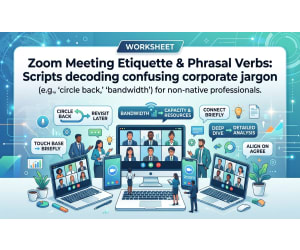
Zoom Meeting Etiquette & Phrasal Verbs
Science, Technology, Computer Science, Engineering, Research, Resources for Teachers, Classroom Management, Community Building, ELA, Reading, Homeschool Curriculum, Homeschool Templates, Grade 9, 10, 11, 12, Worksheets & Printables, Workbooks, Worksheets, Word Searches, Teacher Tools, Lesson Plans, Quizzes and Tests, Quizzes, Tests, Assessments
Unlock Your Professional Potential: Master Corporate Jargon & Zoom Etiquette for Non-Native English Speakers Are you a non-native English-speaking professional feeling lost in a sea of confusing corporate jargon during Zoom meetings? Do phrases like "circle back," "bandwidth," and "push back" leave you feeling uncertain and slow to respond? You're not alone, and this comprehensive guide is the solution you've been searching for. This is not just another vocabulary list. This is a complete, 39-page curriculum designed to transform you from a passive listener into a confident, assertive, and fluent communicator in the modern digital workplace. We decode the "unspoken rules" of Anglo-American corporate culture, giving you the exact scripts and understanding needed to thrive. What's Inside This All-in-One Resource? Part 1: The Corporate Playbook: A detailed guide that breaks down the most confusing phrasal verbs and idioms. Learn why and when to use them through real-world case studies, etiquette guides, and clear explanations of their function in virtual meetings. Part 2: The Student Workbook: Ten rigorous worksheets with over 80 practice questions to solidify your learning. Move from theory to application with fill-in-the-blank exercises that simulate authentic corporate scenarios. Part 3: Teacher & Visual Resources: An invaluable section for both independent learners and educators. It includes: High-Resolution Visual Diagrams: Easily understandable flowcharts and spectrums to visualize concepts like "bandwidth" and "delay strategies." A Comprehensive Answer Key: Check your work and deepen your understanding with complete solutions to every question. A Full Teacher Implementation Guide: A complete, 90-minute masterclass lesson plan, pedagogical philosophy, and role-playing scenarios perfect for corporate trainers, business English tutors, and university instructors. This resource is perfect for Business English students, ESL/EFL learners, corporate trainers, and any professional aiming to boost their career by mastering the nuances of workplace communication. Stop just surviving in meetings—start leading them. Keywords: Business English, Corporate Jargon, Phrasal Verbs, ESL for Professionals, English for Work, Zoom Etiquette, Idioms for Business, Non-Native Speaker, EFL, TESOL, Professional Development, Communication Skills, Adult Education, Corporate Training, Business. Why Teachers/Managers Love It: Comprehensive & Zero-Prep: This is a complete, ready-to-use curriculum, not just a worksheet. With a teacher's guide, lesson plan, student workbook, and answer key included, it saves educators dozens of hours of prep time. Focuses on Real-World Confidence: It goes beyond vocabulary memorization to teach pragmatic fluency. The guide explains the cultural context and provides actionable scripts, empowering professionals to communicate with confidence and authority immediately. Highly Professional & Engaging: The clean design, sophisticated content, and clear visual aids (like the strategy matrix and flowcharts) make the material engaging and reflect a high standard of quality that professionals expect. Adaptable for Various Learning Formats: The resource is perfectly structured for self-study, one-on-one tutoring, small group workshops, or a full 90-minute virtual masterclass, making it incredibly versatile. Builds Critical Career Skills: This resource doesn't just teach English; it teaches the socio-linguistic skills essential for navigating corporate culture, negotiating, disagreeing politely, and demonstrating leadership—skills that directly lead to career advancement. Target Audience: Which Students to Target : Based on the sophisticated language, professional context, and pedagogical structure, target the following groups: Adult ESL/EFL Learners (Intermediate to Advanced): Specifically, those who are already in or are aiming for a professional career in an English-speaking corporate environment. This is not for beginners. University Students: Students in International Business, MBA, or Communications programs, especially non-native English speakers who will be entering the global workforce. Corporate Professionals: Non-native English speakers who have recently been promoted, changed jobs, or work in a multinational company and need to improve their communication and confidence. Business English Tutors and Teachers: This is a perfect "turnkey" curriculum for them to use with their private students. Corporate Trainers and HR Departments: Companies that hire international talent could use this as a valuable training and onboarding resource to help new employees integrate. This material is highly specialized for a professional context. Copyright/Terms of Use: This Book was copyrighted by Syed Hammad Rizvi. This resource is for personal and single classroom use only. You may not alter, redistribute, or sell any part of this resource. In other words, you may not put it on the Internet where it could be publicly found and downloaded. If you want to share this resource with colleagues, please purchase additional licenses from Teachsimple. Thank you for respecting these terms of use. This product is happily brought to you by Syed Hammad Rizvi
Author Creative Book Store
Rating
Tags LearnEnglish, ProfessionalDevelopment, CommunicationSkills, Business, CareerGrowth, EnglishLearning, DigitalDownload, SoftSkills, BusinessEnglish, CorporateJargon
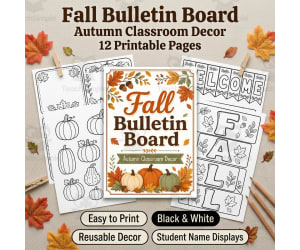
Fall Bulletin Board Decor | Autumn Classroom Display Printable
Creative Arts, Kindergarten, Grade 1, 2, 3, 4, 5, Classroom Decor, Activities, Worksheets & Printables
Create a warm, welcoming autumn classroom display with this easy-to-print Fall Bulletin Board decor set! Designed with clean black-and-white artwork and versatile seasonal pieces, this resource gives teachers a simple way to refresh a classroom door, hallway, or bulletin board for fall. What's Included A coordinating fall bulletin-board title Large printable lettering for an easy-to-read display Seasonal leaf, pumpkin, acorn, and nature-inspired decorative elements Student-name display pieces Coordinating accent pieces for building a cohesive classroom display Black-and-white designs that are printer-friendly and easy to color or leave as-is Skills Developed Fine-motor practice through coloring and cutting Creative expression Classroom community and student ownership Visual organization and presentation Perfect For Fall classroom decorating Bulletin boards and classroom doors Hallway displays Student-name displays Autumn classroom themes Back-to-school seasonal refreshes Why Teachers Love It The clean printable design keeps preparation simple while giving teachers plenty of flexibility to create a display that fits their classroom. Use the pieces together for a coordinated autumn board or select individual elements for smaller decorating projects. Print, cut, arrange, and display for an inviting fall classroom atmosphere.
Author TeachTrend Studio
Rating
Tags Classroom Decor; Bulletin Board Ideas; Posters; Printables; Seasonal; Autumn

Nature Scavenger Hunts | Indoor Outdoor Seasonal Science Activity
Reading, ELA, Nature & Plants, Life Sciences, Science, Kindergarten, Preschool, Grade 1, 2, Activities, Teacher Tools, Worksheets & Printables
Turn nature exploration into an engaging literacy and science experience with this printable Nature Scavenger Hunts resource! Designed for PreK–2nd grade learners, these easy-to-use scavenger hunts encourage children to observe, identify, describe, and discuss the world around them while getting active and engaged. Use the hunts indoors, outdoors, at school, during nature walks, or as seasonal classroom activities. The black-and-white format is printer-friendly and easy to photocopy, while the clear layouts give young learners plenty of room to check, circle, draw, and record their discoveries. What's Included • A colorful cover page • Indoor observation scavenger hunt • Outdoor nature scavenger hunt • Spring exploration hunt • Summer exploration hunt • Fall exploration hunt • Winter exploration hunt • Picture-supported observation activities • Simple check-and-find activities • Nature observation recording page • Seasonal comparison activity • Final nature discovery reflection Skills Developed • Reading and word recognition • Science observation skills • Nature and seasonal awareness • Vocabulary development • Visual discrimination • Critical thinking • Oral language and discussion • Beginning recording and drawing skills Perfect For • Science centers • Literacy centers • Nature walks • Outdoor learning • Indoor recess • Seasonal classroom activities • Early finishers • Small-group instruction • Homeschool learning • Spring, summer, fall, and winter exploration Why Teachers Love It These low-prep scavenger hunts give young learners a meaningful reason to read, observe, move, and talk about what they discover. The simple visual structure makes the activities accessible for emerging readers while allowing teachers to use the same resource across different seasons and learning environments. Print the pages and go, or place reusable copies in protective sleeves for repeated classroom use. This flexible nature-themed resource makes an easy addition to elementary reading and science activities throughout the year.
Author TeachTrend Studio
Rating
Tags Activities; Printables; Student Practice; Worksheets; Spring; Winter

CK Decodable, 4 Video Lessons, Matching Worksheets | Struggling Reader
Special Resources, ELA, Special Education Needs (SEN), Language Development, Phonics, Reading, Kindergarten, Preschool, Grade 1, Literacy Readers, Teacher Tools
What's Included: A decodable reading book about the CK sound, plus a PowerPoint, 4 video lessons, and 35 worksheets—all designed to help struggling readers build real phonics skills. Who Needs This? I wrote this for students who know their letter sounds but still can't read fluently. Maybe your child has dyslexia, processing difficulties, or just gets confused by all those tricky "oddball" words that don't follow the rules. If reading feels like a constant battle, this systematic approach might be exactly what helps. How It Works: This is the first book in a series that teaches one sound at a time—slowly and thoroughly. We focus on just 10 words per sound over two weeks, giving children with processing difficulties the repetition they desperately need. The books must be read in order because each one builds on what came before. I've kept the pictures minimal on purpose. Too many pictures let kids guess instead of actually reading the words. The font is large, the spacing is generous, and the same words appear again and again—not to be boring, but to help those words stick. The worksheets: The 35 worksheets aren't busywork. They develop phonemic awareness, tracking, blending, and segmenting—the foundational skills struggling readers often miss. Students practice recognising words until they become automatic. The Story: Jack lives in the pre-Iron Age in his stick-and-mud hut. His adventures are simple but engaging—perfect for older kids who've outgrown baby books but still need accessible text. The Background: I've spent 30 years teaching phonics to children with severe learning difficulties—in schools, as a tutor, and with homeschoolers. These books weren't created in a university. They were tested on real kids with real struggles, including the 8-year-old with severe dyslexia who helped illustrate them. This program follows the Science of Reading and LETRS principles because those approaches actually work. Who Can Use This? Parents, tutors, teaching assistants, homeschoolers, and intervention programs. If you're working with a struggling reader, these materials can help. Fair Warning: The characters hunt for food in these stories—it's historically accurate for the time period.
Author Lilibette's Resources
Rating
Tags Decodable Reading Books, Phonic Reading Scheme, Download And Print Decodable Readers, Reading Fluency, Oo Decodable Book, Guided Rading, CK Phonics, Remedial Phonics

Fall Writing Prompts | Autumn Writing Paper for 1st & 2nd Grade
ELA, Grade 1, 2, Worksheets & Printables, Teacher Tools, Activities
Make fall writing practice easy, meaningful, and engaging with this ready-to-use collection of fall writing prompts and autumn writing paper designed for 1st and 2nd grade writers. Students explore familiar seasonal ideas while practicing complete sentences, descriptive details, sequencing, and personal expression. What's Included 10 unique fall-themed writing pages Kid-friendly autumn writing prompts Simple black-and-white seasonal illustrations Guided vocabulary support on selected prompts Generous primary writing lines Space for students to add a drawing A mix of narrative, descriptive, opinion, and personal-response writing opportunities A student-friendly writing checklist for reviewing finished work Skills Developed Generating ideas from visual and written prompts Writing complete sentences Adding descriptive details Using seasonal vocabulary Organizing simple ideas Expressing opinions and personal experiences Revising writing with a simple checklist Perfect For Use these fall writing worksheets for morning work, writing centers, independent practice, homework, early-finisher activities, seasonal ELA lessons, or additional writing practice. Why Teachers Love It The predictable page structure keeps students focused on writing while the seasonal theme makes practice feel fresh and inviting. Black-and-white interiors are economical to print and provide plenty of room for student writing and illustrations. Bring seasonal writing into your classroom with these fall writing prompts, autumn writing worksheets, and fall writing paper for 1st and 2nd grade .
Author TeachTrend Studio
Rating
Tags Printables; Student Practice; Worksheets; Independent Work; Seasonal; Autumn

Chemistry Bell Ringers Unit 4 - 45 Daily Warm-Ups (Grades 9-12)
Chemistry, Science, Grade 9, 10, 11, 12, Worksheets, Worksheets & Printables
These chemistry bell-ringers give high school students a calm, consistent way to begin class. Unit 4 gathers 45 short prompts on solutions, acids & bases, energy, rates & nuclear, arranged as nine weekly pages a teacher can hand out each Monday and collect on Friday. Each day asks something different. Monday introduces a term and asks students to use it, not just recite it. Tuesday supplies two or three sentences of real chemistry and a question that can only be answered by reading them. Wednesday poses an analysis problem or a short calculation, worked the way a chemist would work it. Thursday is a quick multiple-choice check a teacher can scan in seconds. Friday asks for a claim supported by evidence, which is the reasoning skill the standards care most about and the one students get the least practice with. That variety keeps a daily routine from going stale while still reinforcing solutions and solubility, concentration and molarity, acids and bases, pH and neutralization, exothermic and endothermic reactions, reaction rates and collision theory, equilibrium and Le Chatelier's principle, oxidation and reduction, and an introduction to nuclear chemistry. The quantitative prompts were written deliberately so that every answer resolves to a clean number, which keeps a warm-up to five minutes and keeps the key beyond dispute. Everything is print-first: a clean PDF that copies well, uses little ink, prints two-sided so a full week fits on one sheet, and needs no student accounts, devices, or logins. A complete answer key covers all 45 prompts, and a standards page lists the NGSS high school physical science codes and the CCSS literacy in science codes the set actually addresses. Designed for grades 9-12, the prompts work as a daily opener while attendance is taken, as an exit slip at the end of the period, as spiral review before a test, or as ready-made work to leave for a substitute. Teachers who want the whole course can buy the full-year set of 180 prompts, of which this unit is one quarter.
Author Response Resources
Rating
Tags Chemistry Bell Ringers, Chemistry Warm Ups, High School Chemistry Bell Ringers, Daily Chemistry Warm Ups, Chemistry Do Now, Chemistry Bell Work, Chemistry Exit Slips, Science Entry Ticket, No Prep Chemistry, Chemistry Daily Starter

Chemistry Bell Ringers Unit 3 - 45 Daily Warm-Ups (Grades 9-12)
Chemistry, Science, Grade 9, 10, 11, 12, Worksheets, Worksheets & Printables
These chemistry bell-ringers give high school students a calm, consistent way to begin class. Unit 3 gathers 45 short prompts on reactions, the mole, stoichiometry & gases, arranged as nine weekly pages a teacher can hand out each Monday and collect on Friday. Each day asks something different. Monday introduces a term and asks students to use it, not just recite it. Tuesday supplies two or three sentences of real chemistry and a question that can only be answered by reading them. Wednesday poses an analysis problem or a short calculation, worked the way a chemist would work it. Thursday is a quick multiple-choice check a teacher can scan in seconds. Friday asks for a claim supported by evidence, which is the reasoning skill the standards care most about and the one students get the least practice with. That variety keeps a daily routine from going stale while still reinforcing chemical equations and conservation of mass, balancing, the five reaction types, the mole and molar mass, mole conversions and percent composition, stoichiometry and mole ratios, limiting reactants, percent yield, and the gas laws. The quantitative prompts were written deliberately so that every answer resolves to a clean number, which keeps a warm-up to five minutes and keeps the key beyond dispute. Everything is print-first: a clean PDF that copies well, uses little ink, prints two-sided so a full week fits on one sheet, and needs no student accounts, devices, or logins. A complete answer key covers all 45 prompts, and a standards page lists the NGSS high school physical science codes and the CCSS literacy in science codes the set actually addresses. Designed for grades 9-12, the prompts work as a daily opener while attendance is taken, as an exit slip at the end of the period, as spiral review before a test, or as ready-made work to leave for a substitute. Teachers who want the whole course can buy the full-year set of 180 prompts, of which this unit is one quarter.
Author Response Resources
Rating
Tags Chemistry Bell Ringers, Chemistry Warm Ups, High School Chemistry Bell Ringers, Daily Chemistry Warm Ups, Chemistry Do Now, Chemistry Bell Work, Chemistry Exit Slips, Science Entry Ticket, No Prep Chemistry, Chemistry Daily Starter

Chemistry Bell Ringers Unit 2 - 45 Daily Warm-Ups (Grades 9-12)
Chemistry, Science, Grade 9, 10, 11, 12, Worksheets, Worksheets & Printables
These chemistry bell-ringers give high school students a calm, consistent way to begin class. Unit 2 gathers 45 short prompts on electrons, the periodic table & bonding, arranged as nine weekly pages a teacher can hand out each Monday and collect on Friday. Each day asks something different. Monday introduces a term and asks students to use it, not just recite it. Tuesday supplies two or three sentences of real chemistry and a question that can only be answered by reading them. Wednesday poses an analysis problem or a short calculation, worked the way a chemist would work it. Thursday is a quick multiple-choice check a teacher can scan in seconds. Friday asks for a claim supported by evidence, which is the reasoning skill the standards care most about and the one students get the least practice with. That variety keeps a daily routine from going stale while still reinforcing energy levels and line spectra, electron configuration and orbitals, valence electrons and Lewis dot structures, groups, periods and families, periodic trends in radius, ionization energy and electronegativity, ionic and covalent bonding, naming compounds and writing formulas, and VSEPR geometry and molecular polarity. The quantitative prompts were written deliberately so that every answer resolves to a clean number, which keeps a warm-up to five minutes and keeps the key beyond dispute. Everything is print-first: a clean PDF that copies well, uses little ink, prints two-sided so a full week fits on one sheet, and needs no student accounts, devices, or logins. A complete answer key covers all 45 prompts, and a standards page lists the NGSS high school physical science codes and the CCSS literacy in science codes the set actually addresses. Designed for grades 9-12, the prompts work as a daily opener while attendance is taken, as an exit slip at the end of the period, as spiral review before a test, or as ready-made work to leave for a substitute. Teachers who want the whole course can buy the full-year set of 180 prompts, of which this unit is one quarter.
Author Response Resources
Rating
Tags Chemistry Bell Ringers, Chemistry Warm Ups, High School Chemistry Bell Ringers, Daily Chemistry Warm Ups, Chemistry Do Now, Chemistry Bell Work, Chemistry Exit Slips, Science Entry Ticket, No Prep Chemistry, Chemistry Daily Starter

Chemistry Bell Ringers Unit 1 - 45 Daily Warm-Ups (Grades 9-12)
Chemistry, Science, Grade 9, 10, 11, 12, Worksheets, Worksheets & Printables
These chemistry bell-ringers give high school students a calm, consistent way to begin class. Unit 1 gathers 45 short prompts on matter, measurement & the atom, arranged as nine weekly pages a teacher can hand out each Monday and collect on Friday. Each day asks something different. Monday introduces a term and asks students to use it, not just recite it. Tuesday supplies two or three sentences of real chemistry and a question that can only be answered by reading them. Wednesday poses an analysis problem or a short calculation, worked the way a chemist would work it. Thursday is a quick multiple-choice check a teacher can scan in seconds. Friday asks for a claim supported by evidence, which is the reasoning skill the standards care most about and the one students get the least practice with. That variety keeps a daily routine from going stale while still reinforcing the states of matter and the particle model, elements, compounds and mixtures, physical and chemical change, SI measurement and density, significant figures, accuracy and precision, dimensional analysis, early atomic theory and the gold-foil experiment, atomic structure and mass number, and isotopes and average atomic mass. The quantitative prompts were written deliberately so that every answer resolves to a clean number, which keeps a warm-up to five minutes and keeps the key beyond dispute. Everything is print-first: a clean PDF that copies well, uses little ink, prints two-sided so a full week fits on one sheet, and needs no student accounts, devices, or logins. A complete answer key covers all 45 prompts, and a standards page lists the NGSS high school physical science codes and the CCSS literacy in science codes the set actually addresses. Designed for grades 9-12, the prompts work as a daily opener while attendance is taken, as an exit slip at the end of the period, as spiral review before a test, or as ready-made work to leave for a substitute. Teachers who want the whole course can buy the full-year set of 180 prompts, of which this unit is one quarter.
Author Response Resources
Rating
Tags Chemistry Bell Ringers, Chemistry Warm Ups, High School Chemistry Bell Ringers, Daily Chemistry Warm Ups, Chemistry Do Now, Chemistry Bell Work, Chemistry Exit Slips, Science Entry Ticket, No Prep Chemistry, Chemistry Daily Starter
Chemistry Bell Ringers FULL YEAR - 180 Daily Warm-Ups (Grades 9-12)
Chemistry, Science, Grade 9, 10, 11, 12, Worksheets, Worksheets & Printables
This is a full year of chemistry bell-ringers - 180 short daily prompts that give high school students a steady, five-minute way to begin class. The set spans an entire course. It opens with the states of matter and the particle model, the difference between elements, compounds and mixtures, physical and chemical change, SI measurement and density, significant figures, accuracy and precision, and dimensional analysis, then moves through early atomic theory, the gold-foil experiment, atomic structure and isotopes. The second quarter covers energy levels and line spectra, electron configuration, valence electrons and Lewis dot structures, the organization of the periodic table, periodic trends, ionic and covalent bonding, naming compounds and writing formulas, and VSEPR geometry and polarity. The third covers chemical equations and conservation of mass, balancing, reaction types, the mole and molar mass, percent composition, stoichiometry, limiting reactants, percent yield and the gas laws. The final quarter covers solutions and solubility, molarity, acids and bases, pH and neutralization, exothermic and endothermic reactions, reaction rates and collision theory, equilibrium and Le Chatelier's principle, oxidation and reduction, and nuclear chemistry. Prompts are arranged into 36 weekly pages, each holding five days of work a teacher can hand out on Monday and collect on Friday. Every week rotates through the same five kinds of thinking: a vocabulary term used rather than recited, a short reading with a question that requires reading it, an analysis problem or a short calculation, a quick multiple-choice check, and a question that asks students to state a claim and back it with evidence. That last one is the reasoning skill the standards weight most heavily and the one students practice least, so it appears every single Friday for 36 weeks. Chemistry is a subject where a wrong key is worse than no key, so every quantitative prompt in this set was written to resolve to a clean value - a density of 8 grams per cubic centimetre, a molar mass of 44.01, two moles from 88 grams, four moles of ammonia from six of hydrogen, a percent yield of 80.0. Students get real practice with the procedure without a five-minute warm-up turning into a ten-minute arithmetic exercise. Everything is print-first: one clean PDF that copies well, uses little ink, prints two-sided so a full week fits on a single sheet, and needs no student accounts, devices, or logins. A complete answer key covers all 180 prompts, and a standards page lists the NGSS high school physical science codes and the CCSS literacy in science and technical subjects codes the set actually addresses - each one earned by a recurring prompt slot rather than claimed in general. Built for grades 9-12, it works as a daily opener while attendance is taken, as an exit slip at the end of the period, as spiral review before an exam, or as ready-made work to leave for a substitute teacher on short notice.
Author Response Resources
Rating
Tags Chemistry Bell Ringers, Chemistry Warm Ups, High School Chemistry Bell Ringers, Daily Chemistry Warm Ups, Chemistry Do Now, Chemistry Bell Work, Chemistry Exit Slips, Science Entry Ticket, No Prep Chemistry, Chemistry Daily Starter
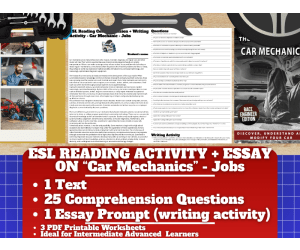
ESL Reading Comprehension + Writing Activity Worksheets - Car Mechanic
ELA, Language Development, ESL, Vocabulary, Reading, Reading Comprehension, Creative Writing, Writing, Formal Writing, Not Grade Specific, Middle School, High School, Adult Education, Worksheets & Printables, Worksheets, Writing Prompts
ESL Reading Comprehension + Writing Activity Worksheets - Car Mechanic - Jobs This ESL - EFL Teaching Resource on " Car Mechanic - Jobs " (3 PDF Worksheets Slides - Reading Comprehension + Writing Activity) can be ideal to improve Language skills in English. Ideal students for this ESL EFL TESOL Reading + Writing Activity are Foreign Students at middle and High School ( 7th - 12th Grade; teens ) . Newcomers or any ESL Learner is also more than suitable for this ESL - EFL - TESOL - TEFL (English as a Second or Foreign Language) Activity on " Car Mechanic - Jobs " ( Introduction + origins and history of this profession + experience and education needed + various types of this job + what it consists of + interviews ). This Teaching Educational Resource Product can also be ideal for ESL EFL TESOL Centers worldwide or any English second language tutor. Intermediate Advanced English as a Second or Foreign Language ( ESL - EFL - TESOL - TEFL ) learners are suitable for this ESL - EFL - TESOL - TEFL Teaching Resource on " Car Mechanic - Jobs " (Worksheet; 3 PDF Printable slides) In this English Second or Foreign Language ( ESL - EFL - TESOL - TEFL ) Reading Comprehension + Essay Writing Activity Worksheet on " Car Mechanic - Jobs " ( Introduction + origins and history of this profession + experience and education needed + various types of this job + what it consists of + interviews ), the following ESL - EFL - TESOL - TEFL ( English Second or Foreign Language ) activities are included: 1 text on " Car Mechanic - Jobs " ( Introduction + origins and history of this profession + experience and education needed + various types of this job + what it consists of + interviews ) 25 Comprehension Questions related to the previous text on " Car Mechanic - Jobs " ( with related space where students can answer to this text's comprehension questions ) 1 essay prompt for a writing activity on " Car Mechanic - Jobs " ( writing an essay on your own personal opinion on this job and whether you would ever like to become a Car Mechanic or not and why ) This ESL - EFL - TESOL - TEFL ( English Second or Foreign Language ) Teaching Resource Reading + Writing Activity ( essay prompts ) on " Car Mechanic - Jobs " ( Introduction + origins and history of this profession + experience and education needed + various types of this job + what it consists of + interviews ) is great for Intermediate Advanced English as a second or foreign language learners ( ESL- EFL - TESOL - TEFL ). This English Second Language Worksheet on " Car Mechanic - Jobs " ( Introduction + origins and history of this profession + experience and education needed + various types of this job + what it consists of + interviews ) aims to train and Reading Comprehension + Writing Skills. "Learning with Alan" is a teaching resources store that aims to provide high quality teaching resources and educational materials for ESL - EFL - TESOL ( English Second or Foreign Language ) teachers, tutors and educators. It aims to support teachers, educators, and tutors in both online and offline environments, helping them achieve their teaching goals while creating a fun, stimulating atmosphere for learning English. Always remember: learning is fun, and so is English! If you want to find more ESL - EFL - TESOL - TEFL ( English Second or Foreign Language ) Teaching Resources and Educational Material click here Learning with Alan!
Author Learning with Alan
Rating
Tags ESL, English Second Language, English, Reading Comprehension, Writing Activity, Car Mechanic, Jobs, Worksheets, Printable, Activity

US State Presentationon on Indiana
Economics, Social Studies, First Peoples (Native), Geography, History, History: USA, Not Grade Specific, High School, Middle School, Teacher Tools, Presentations, Lesson Plans
US State Presentationon on Indiana Bring the United States to life in your classroom with this engaging US State Presentation on Indiana , a ready-to-use digital resource designed for Geography, Social Studies, and US History classes from 7th grade through 12th grade . This presentation provides students with a clear, structured introduction to one US state while combining essential geographical, historical, economic, and cultural information in an accessible format. This US State Presentation on Indiana , includes: The resource begins with a general introduction to the state , helping students understand its location, identity, and importance within the United States. Students then explore the state's borders and neighboring states , making it easier to place it within the broader geography of the country. A general data section introduces key facts such as population, area, population density, capital city, and other essential statistics , providing a useful foundation for further study. A paragraph that explores the history of this US state , highlighting important events, periods, people, and developments that have shaped its identity. This section is particularly useful for US History lessons because it allows students to connect state-level history with major events and themes in American history. A Geography section examines the state's physical characteristics, including its territory, landscapes, natural features, environment, and climate. Students can discover how mountains, rivers, plains, forests, coastlines, deserts, or other geographical characteristics have influenced settlement and human activity. A presentation also introduces the state's economy , explaining its major economic sectors, industries, natural resources, agricultural activities, and other economic strengths. This provides an excellent opportunity to connect geography with economics and understand why particular industries have developed in different parts of the United States. A dedicated section focuses on the capital city , introducing its importance as a political and administrative center. Students can also learn about other important cities , discovering major urban centers and their roles in business, transportation, education, culture, tourism, or industry. A paragraoh that explores culture , giving students an opportunity to learn about traditions, food, music, celebrations, landmarks, historical heritage, and other characteristics that contribute to the state's unique identity. This digital US State Presentation on Indiana is ideal for classroom instruction, student research, geography units, US History lessons, Social Studies activities, state studies, homework, review activities, and independent learning. Its organized structure makes it suitable for middle school and high school students , while its broad range of topics encourages students to view a state from multiple perspectives. Whether you are teaching a unit on the United States, American Geography, US History, state studies, or regional culture , this resource offers a convenient and engaging way to help students explore the diversity and complexity of the United States. Perfect for: Geography Classes, Social Studies Classes, US History Classes, Middle School, High School, Grades 7–12, State Studies, American Studies, Homeschooling, Student Research, and Digital Learning. Learning with Alan is an educational resource store created to help teachers, educators, and tutors reach their teaching goals while building a fun, engaging, and stimulating learning environment . Because learning should always be meaningful—and fun! 🎓✨ If you want to browse more of my Teaching Resources, click here Learning with Alan!!
Author Learning with Alan
Rating
Tags Social Studies, Geography, Indiana, USA, US State, US History, Lesson, Introduction, Presentation, United States Of America

Surgical Instruments Bingo Game | Common Veterinary & Medical Tools
Montessori, Health, P.E. & Health, Career, Life Studies, Grade 9, 10, 11, 12, Games, Activities
Help students learn and recognize common surgical instruments with these 36 Surgical Instruments Flashcards! Students can explore medical tools and surgical equipment while building healthcare vocabulary, visual recognition, and medical knowledge. I like using these flashcards during medical terminology lessons, nursing studies, surgical technology courses, healthcare education, anatomy and physiology units, classroom centers, and independent study. They provide a simple visual way for learners to identify and review commonly used surgical instruments. What You Will Get This printable Surgical Instruments Flashcards resource includes 36 medical instrument cards for vocabulary building and visual recognition. What's Included in this Resource? • 36 surgical instruments flashcards • Medical tool identification cards • Surgical equipment vocabulary • Instrument name recognition practice • Visual medical vocabulary • Student-friendly printable cards • Great for independent or small-group learning This resource is perfect for: • Medical terminology • Surgical technology courses • Nursing education • Healthcare career education • Anatomy and physiology studies • Medical vocabulary practice • Classroom centers • Independent study Why you will love this? • Includes 36 surgical instrument flashcards • Easy to print and use • Builds medical and healthcare vocabulary • Helps learners recognize common surgical instruments • Supports visual learning and terminology practice • Great for classroom instruction, review, or independent study These 36 Surgical Instruments Flashcards are a practical visual resource for learners studying medical terminology, surgical instruments, healthcare careers, and medical equipment.
Author Perfect_Printables
Rating
Tags Surgical Instruments, Medical Tools, Surgical Tools, Medical Terminology, Healthcare Vocabulary, Surgical Equipment, Nursing Education, Medical Tools Activity, Surgical Instrument Bingo

36 Surgical Instruments Flashcards | Medical Tools Flashcards
Montessori, Health, P.E. & Health, Career, Life Studies, Grade 9, 10, 11, 12, Flashcards, Worksheets & Printables, Task Cards
Help students learn and recognize common surgical instruments with these 36 Surgical Instruments Flashcards! Students can explore medical tools and surgical equipment while building healthcare vocabulary, visual recognition, and medical knowledge. I like using these flashcards during medical terminology lessons, nursing studies, surgical technology courses, healthcare education, anatomy and physiology units, classroom centers, and independent study. They provide a simple visual way for learners to identify and review commonly used surgical instruments. What You Will Get This printable Surgical Instruments Flashcards resource includes 36 medical instrument cards for vocabulary building and visual recognition. What's Included in this Resource? • 36 surgical instruments flashcards • Medical tool identification cards • Surgical equipment vocabulary • Instrument name recognition practice • Visual medical vocabulary • Student-friendly printable cards • Great for independent or small-group learning This resource is perfect for: • Medical terminology • Surgical technology courses • Nursing education • Healthcare career education • Anatomy and physiology studies • Medical vocabulary practice • Classroom centers • Independent study Why you will love this? • Includes 36 surgical instrument flashcards • Easy to print and use • Builds medical and healthcare vocabulary • Helps learners recognize common surgical instruments • Supports visual learning and terminology practice • Great for classroom instruction, review, or independent study These 36 Surgical Instruments Flashcards are a practical visual resource for learners studying medical terminology, surgical instruments, healthcare careers, and medical equipment.
Author Perfect_Printables
Rating
Tags Surgical Instruments, Medical Tools, Surgical Instrument Flashcards, Medical Flashcards, Surgical Tools, Medical Terminology, Healthcare Vocabulary, Surgical Equipment, Nursing Education
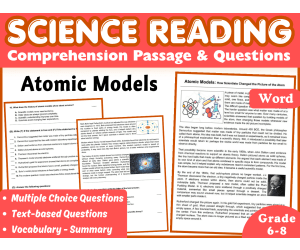
Atomic Models: Physical Science Reading Comprehension Passage (Word)
Science, ELA, Reading, Reading Comprehension, Strategies, Resources for Teachers, Common Core, Language Development, Physics, Grade 6, 7, 8, 9, 10, Writing Prompts, Worksheets & Printables, Centers, Activities, Teacher Tools, Assessments, Quizzes and Tests, Quizzes, Tests, Literacy Readers
Physical Science Reading Comprehension Passage and Questions for Middle School: Atomic Models (Word Document) This resource explores how scientists’ understanding of the atom changed over time as new evidence became available . Students follow the development of atomic models from Democritus’s early idea of indivisible particles to Dalton’s solid-sphere model, Thomson’s discovery of the electron, Rutherford’s nuclear model, Bohr’s energy levels, and the modern electron-cloud model . It emphasizes how scientific models are revised when new experiments and discoveries provide better evidence . It also introduces important ideas such as electrons, the nucleus, empty space within atoms, energy levels, electron clouds, and probability . This passage is designed to bridge the gap between science and literacy by strengthening reading comprehension while sparking scientific curiosity in middle school students. It blends English Language Arts skills with accurate science content, helping students build background knowledge, understand key concepts, use evidence from the text, and explain scientific ideas clearly. This resource supports science classroom practice while also reinforcing important literacy skills such as main idea, vocabulary, comprehension, and summarizing. Ideal for interdisciplinary learning in ELA and Science. Suitable for Grade 9 review, too! Student Tasks for The Passage: 10 multiple-choice questions targeting main idea, key details, science concepts, comparison, and real-world applications 10 True/False statements to check understanding and address common misconceptions 5 text-based short-answer questions that require students to explain important ideas from the passage 5 vocabulary matching items with clear, student-friendly definitions 1 summary prompt that asks students to condense the central ideas accurately Full answer key for every section Available Formats for this Resource PDF Fillable PDF Google Docs Product Details Length: 7 pages total Grades: 6–8, also suitable for Grade 9 review Use cases: close reading, stations, homework, intervention, test prep, and sub plans Standards support: Reinforces informational-text skills and supports NGSS-style sense-making by helping students read scientific explanations, connect evidence to key concepts, interpret real-world examples, and explain cause-and-effect relationships in science. Other Science Reading Collections and Topics You May Find in the Store: 1. Astronomy & Space Science 2. Volcanoes, Rocks, & Mountains 3. Rock Cycle, Soil, & Sinkholes 4. Mars, Glaciers, & Antarctica 5. Water Cycle, Acid Rain, & Wastewater 6. Insects, Animals, & Ecosystems 7. Bioluminescence & Insects 8. Animal Skin, Cats, & T. Rex 9. Human Body and Senses 10. Health & Applied Bioscience 11. Waves, Light, & Imaging 12. Electricity & Energy 13. Motion & Materials 14. Chemistry and Materials Science 15. Electromagnetism 16. Acids and Bases 17. Gas Laws 18. Biotechnology 19. Periodic Trends 20. Protists and Fungi 21. Microevolution 22. Blood 23. Chemical Bonding 24. Magnets 25. Muscles 26. Nuclear Chemistry 27. Electromagnetic Devices 28. Epigenetics 29. The Law of Conservation of Mass 30. Atomic Models 31. Isotopes and Ions 32. Light 33. Human-Environment Interaction 34. Theory of Evolution 35. Photosynthesis 36. Origins of Life and Early Earth 37. Gene Expression and Regulation 38. Thermochemistry 39. Allergies 40. Coevolution 41. Birth to Adulthood 42. Cells 43. Entropy and Free Energy 44. The Human Brain 45. Mixtures and Solutions 46. Invertebrates 47. Zoo Animals 48. Biochemistry 49. Animal Behavior 50. Population Ecology ...and many more engaging science reading passages that cover intriguing and important topics designed to spark curiosity and support student learning. Use this passage to reinforce ELA skills in science, to add literacy to your lessons, and to support independent work. The passages strengthen main idea, evidence use, vocabulary in context, inference, cause and effect, and summary writing. With ready-to-use assessments and complete answer keys, you can provide focused practice that is simple to run and fast to review.
Author EduNation Creative Store
Rating
Tags Middle School, Reading Comprehension, Reading Strategies, ELA, Centers, Reading Passage, Assessments, Vocabulary, Physical Science, Physics
Atomic Models: Physical Science Reading Comprehension (Fillable PDF)
Science, ELA, Reading, Reading Comprehension, Strategies, Resources for Teachers, Common Core, Language Development, Physics, Grade 6, 7, 8, 9, 10, Writing Prompts, Worksheets & Printables, Centers, Activities, Teacher Tools, Assessments, Quizzes and Tests, Quizzes, Tests, Literacy Readers
Physical Science Reading Comprehension Passage and Questions for Middle School: Atomic Models (Fillable PDF) This resource explores how scientists’ understanding of the atom changed over time as new evidence became available . Students follow the development of atomic models from Democritus’s early idea of indivisible particles to Dalton’s solid-sphere model, Thomson’s discovery of the electron, Rutherford’s nuclear model, Bohr’s energy levels, and the modern electron-cloud model . It emphasizes how scientific models are revised when new experiments and discoveries provide better evidence . It also introduces important ideas such as electrons, the nucleus, empty space within atoms, energy levels, electron clouds, and probability . This passage is designed to bridge the gap between science and literacy by strengthening reading comprehension while sparking scientific curiosity in middle school students. It blends English Language Arts skills with accurate science content, helping students build background knowledge, understand key concepts, use evidence from the text, and explain scientific ideas clearly. This resource supports science classroom practice while also reinforcing important literacy skills such as main idea, vocabulary, comprehension, and summarizing. Ideal for interdisciplinary learning in ELA and Science. Suitable for Grade 9 review, too! This passage is designed as a fillable PDF , which means students can type their answers directly into the document on any computer or tablet . Each page includes highlighted text fields that show them exactly where to type! Student Tasks for The Passage: 10 multiple-choice questions targeting main idea, key details, science concepts, comparison, and real-world applications 10 True/False statements to check understanding and address common misconceptions 5 text-based short-answer questions that require students to explain important ideas from the passage 5 vocabulary matching items with clear, student-friendly definitions 1 summary prompt that asks students to condense the central ideas accurately Full answer key for every section Available Formats for this Resource PDF Word Docs Google Docs Product Details Length: 7 pages total Grades: 6–8, also suitable for Grade 9 review Use cases: close reading, stations, homework, intervention, test prep, and sub plans Standards support: Reinforces informational-text skills and supports NGSS-style sense-making by helping students read scientific explanations, connect evidence to key concepts, interpret real-world examples, and explain cause-and-effect relationships in science. Other Science Reading Collections and Topics You May Find in the Store: 1. Astronomy & Space Science 2. Volcanoes, Rocks, & Mountains 3. Rock Cycle, Soil, & Sinkholes 4. Mars, Glaciers, & Antarctica 5. Water Cycle, Acid Rain, & Wastewater 6. Insects, Animals, & Ecosystems 7. Bioluminescence & Insects 8. Animal Skin, Cats, & T. Rex 9. Human Body and Senses 10. Health & Applied Bioscience 11. Waves, Light, & Imaging 12. Electricity & Energy 13. Motion & Materials 14. Chemistry and Materials Science 15. Electromagnetism 16. Acids and Bases 17. Gas Laws 18. Biotechnology 19. Periodic Trends 20. Protists and Fungi 21. Microevolution 22. Blood 23. Chemical Bonding 24. Magnets 25. Muscles 26. Nuclear Chemistry 27. Electromagnetic Devices 28. Epigenetics 29. The Law of Conservation of Mass 30. Atomic Models 31. Isotopes and Ions 32. Light 33. Human-Environment Interaction 34. Theory of Evolution 35. Photosynthesis 36. Origins of Life and Early Earth 37. Gene Expression and Regulation 38. Thermochemistry 39. Allergies 40. Coevolution 41. Birth to Adulthood 42. Cells 43. Entropy and Free Energy 44. The Human Brain 45. Mixtures and Solutions 46. Invertebrates 47. Zoo Animals 48. Biochemistry 49. Animal Behavior 50. Population Ecology ...and many more engaging science reading passages that cover intriguing and important topics designed to spark curiosity and support student learning. Use this passage to reinforce ELA skills in science, to add literacy to your lessons, and to support independent work. The passages strengthen main idea, evidence use, vocabulary in context, inference, cause and effect, and summary writing. With ready-to-use assessments and complete answer keys, you can provide focused practice that is simple to run and fast to review.
Author EduNation Creative Store
Rating
Tags Middle School, Reading Comprehension, Reading Strategies, ELA, Centers, Reading Passage, Assessments, Vocabulary, Physical Science, Physics
Atomic Models: Physical Science Reading Comprehension Passage (PDF)
Science, ELA, Reading, Reading Comprehension, Strategies, Resources for Teachers, Common Core, Language Development, Physics, Grade 6, 7, 8, 9, 10, Writing Prompts, Worksheets & Printables, Centers, Activities, Teacher Tools, Assessments, Quizzes and Tests, Quizzes, Tests, Literacy Readers
Physical Science Reading Comprehension Passage and Questions for Middle School: Atomic Models (PDF) This resource explores how scientists’ understanding of the atom changed over time as new evidence became available . Students follow the development of atomic models from Democritus’s early idea of indivisible particles to Dalton’s solid-sphere model, Thomson’s discovery of the electron, Rutherford’s nuclear model, Bohr’s energy levels, and the modern electron-cloud model . It emphasizes how scientific models are revised when new experiments and discoveries provide better evidence . It also introduces important ideas such as electrons, the nucleus, empty space within atoms, energy levels, electron clouds, and probability . This passage is designed to bridge the gap between science and literacy by strengthening reading comprehension while sparking scientific curiosity in middle school students. It blends English Language Arts skills with accurate science content, helping students build background knowledge, understand key concepts, use evidence from the text, and explain scientific ideas clearly. This resource supports science classroom practice while also reinforcing important literacy skills such as main idea, vocabulary, comprehension, and summarizing. Ideal for interdisciplinary learning in ELA and Science. Suitable for Grade 9 review, too! Student Tasks for The Passage: 10 multiple-choice questions targeting main idea, key details, science concepts, comparison, and real-world applications 10 True/False statements to check understanding and address common misconceptions 5 text-based short-answer questions that require students to explain important ideas from the passage 5 vocabulary matching items with clear, student-friendly definitions 1 summary prompt that asks students to condense the central ideas accurately Full answer key for every section Available Formats for this Resource Fillable PDF Word Docs Google Docs Product Details Length: 7 pages total Grades: 6–8, also suitable for Grade 9 review Use cases: close reading, stations, homework, intervention, test prep, and sub plans Standards support: Reinforces informational-text skills and supports NGSS-style sense-making by helping students read scientific explanations, connect evidence to key concepts, interpret real-world examples, and explain cause-and-effect relationships in science. Other Science Reading Collections and Topics You May Find in the Store: 1. Astronomy & Space Science 2. Volcanoes, Rocks, & Mountains 3. Rock Cycle, Soil, & Sinkholes 4. Mars, Glaciers, & Antarctica 5. Water Cycle, Acid Rain, & Wastewater 6. Insects, Animals, & Ecosystems 7. Bioluminescence & Insects 8. Animal Skin, Cats, & T. Rex 9. Human Body and Senses 10. Health & Applied Bioscience 11. Waves, Light, & Imaging 12. Electricity & Energy 13. Motion & Materials 14. Chemistry and Materials Science 15. Electromagnetism 16. Acids and Bases 17. Gas Laws 18. Biotechnology 19. Periodic Trends 20. Protists and Fungi 21. Microevolution 22. Blood 23. Chemical Bonding 24. Magnets 25. Muscles 26. Nuclear Chemistry 27. Electromagnetic Devices 28. Epigenetics 29. The Law of Conservation of Mass 30. Atomic Models 31. Isotopes and Ions 32. Light 33. Human-Environment Interaction 34. Theory of Evolution 35. Photosynthesis 36. Origins of Life and Early Earth 37. Gene Expression and Regulation 38. Thermochemistry 39. Allergies 40. Coevolution 41. Birth to Adulthood 42. Cells 43. Entropy and Free Energy 44. The Human Brain 45. Mixtures and Solutions 46. Invertebrates 47. Zoo Animals 48. Biochemistry 49. Animal Behavior 50. Population Ecology ...and many more engaging science reading passages that cover intriguing and important topics designed to spark curiosity and support student learning. Use this passage to reinforce ELA skills in science, to add literacy to your lessons, and to support independent work. The passages strengthen main idea, evidence use, vocabulary in context, inference, cause and effect, and summary writing. With ready-to-use assessments and complete answer keys, you can provide focused practice that is simple to run and fast to review.
Author EduNation Creative Store
Rating
Tags Middle School, Reading Comprehension, Reading Strategies, ELA, Centers, Reading Passage, Assessments, Vocabulary, Physical Science, Physics

Law of Conservation of Mass: Science Reading Comprehension (Word)
Science, ELA, Reading, Reading Comprehension, Strategies, Resources for Teachers, Common Core, Language Development, Physics, Grade 6, 7, 8, 9, 10, Writing Prompts, Worksheets & Printables, Centers, Activities, Teacher Tools, Assessments, Quizzes and Tests, Quizzes, Tests, Literacy Readers
Physical Science Reading Comprehension Passage and Questions for Middle School: Law of Conservation of Mass (Word Document) The engaging passage is about the Law of Conservation of Mass and how matter can seem to disappear or appear during changes even though the total amount of matter remains the same. It uses very concrete examples, especially a burning candle, burning wood, rusting iron, baking, and melting ice , to show how matter can change form, move into gases, combine with oxygen, or change state without actually vanishing. It also introduces reactants and products , explains why chemical equations must be balanced , and briefly connects the law to Antoine Lavoisier’s measurements . This passage is designed to bridge the gap between science and literacy by strengthening reading comprehension while sparking scientific curiosity in middle school students. It blends English Language Arts skills with accurate science content, helping students build background knowledge, understand key concepts, use evidence from the text, and explain scientific ideas clearly. This resource supports science classroom practice while also reinforcing important literacy skills such as main idea, vocabulary, comprehension, and summarizing. Ideal for interdisciplinary learning in ELA and Science. Suitable for Grade 9 review, too! Student Tasks for The Passage: 10 multiple-choice questions targeting main idea, key details, science concepts, comparison, and real-world applications 10 True/False statements to check understanding and address common misconceptions 5 text-based short-answer questions that require students to explain important ideas from the passage 5 vocabulary matching items with clear, student-friendly definitions 1 summary prompt that asks students to condense the central ideas accurately Full answer key for every section Available Formats for this Resource PDF Fillable PDF Google Docs Product Details Length: 7 pages total Grades: 6–8, also suitable for Grade 9 review Use cases: close reading, stations, homework, intervention, test prep, and sub plans Standards support: Reinforces informational-text skills and supports NGSS-style sense-making by helping students read scientific explanations, connect evidence to key concepts, interpret real-world examples, and explain cause-and-effect relationships in science. Other Science Reading Collections and Topics You May Find in the Store: 1. Astronomy & Space Science 2. Volcanoes, Rocks, & Mountains 3. Rock Cycle, Soil, & Sinkholes 4. Mars, Glaciers, & Antarctica 5. Water Cycle, Acid Rain, & Wastewater 6. Insects, Animals, & Ecosystems 7. Bioluminescence & Insects 8. Animal Skin, Cats, & T. Rex 9. Human Body and Senses 10. Health & Applied Bioscience 11. Waves, Light, & Imaging 12. Electricity & Energy 13. Motion & Materials 14. Chemistry and Materials Science 15. Electromagnetism 16. Acids and Bases 17. Gas Laws 18. Biotechnology 19. Periodic Trends 20. Protists and Fungi 21. Microevolution 22. Blood 23. Chemical Bonding 24. Magnets 25. Muscles 26. Nuclear Chemistry 27. Electromagnetic Devices 28. Epigenetics 29. The Law of Conservation of Mass 30. Atomic Models 31. Isotopes and Ions 32. Light 33. Human-Environment Interaction 34. Theory of Evolution 35. Photosynthesis 36. Origins of Life and Early Earth 37. Gene Expression and Regulation 38. Thermochemistry 39. Allergies 40. Coevolution 41. Birth to Adulthood 42. Cells 43. Entropy and Free Energy 44. The Human Brain 45. Mixtures and Solutions 46. Invertebrates 47. Zoo Animals 48. Biochemistry 49. Animal Behavior 50. Population Ecology ...and many more engaging science reading passages that cover intriguing and important topics designed to spark curiosity and support student learning. Use this passage to reinforce ELA skills in science, to add literacy to your lessons, and to support independent work. The passages strengthen main idea, evidence use, vocabulary in context, inference, cause and effect, and summary writing. With ready-to-use assessments and complete answer keys, you can provide focused practice that is simple to run and fast to review.
Author EduNation Creative Store
Rating
Tags Middle School, Reading Comprehension, Reading Strategies, ELA, Centers, Reading Passage, Assessments, Vocabulary, Physical Science, Physics