


9,555 products added recently
Page 804 - Newest Teaching Resources

 Show filters

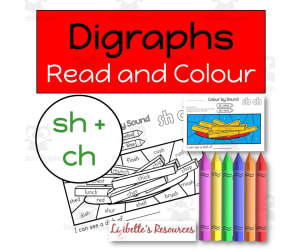
Digraphs Sh + CH: Read and Colour
Special Resources, ELA, Language Development, Phonics, Reading, Kindergarten, Preschool, Worksheets & Printables, Worksheets
This fun, Read and Color worksheet for SH/CH words is an excellent means of encouraging children to become familiar with new digraphs, especially SH and CH which many children confuse. The child will need to scan th words to find those that begin with SH and those that begin with CH and then decode the words. What is included in the pack? One PDF sheet for the TH digraph. What do the worksheets involve? An adult should instruct pupils as to how to colour-code the crayons, by the code given. An adult will need to help with this as the children are not expected to be able to read the colour names. The child should then read the words to an adult (you will want to ensure they get it correct the first time and not make mistakes). The child colour the picture, reading the words and checking against the code to see which colour to each shape. Children can easily work on the sheet unaided once they have been instructed and the words colour-coded, although, with children with special needs, it is strongly suggested that an adult works with the child for maximum benefit. How to use As each new blend is introduced the teacher has several aims: The child should be thoroughly familiar with the new digraph - to recognise it wherever it is seen; To be able to track the new digraph in words; To be able to decode words containing the new digraph easily To distinguish a digraph from other similar digraphs This fun read and colour activity provides help for all four! Pupils will need as much practice as they can to achieve thefour things listed above and for some children, this can be tedious; the teacher must think of creative ways to give as much repetition as needed and to keep the child engaged. This fun Read and Colour sheet is ideal as a new way to engage the child: the child will be reading and re-reading and in doing so may even become familiar with the words, which will aid reading fluency. Who are the initial blends Find and colour worksheets for? Young learners Those with a special need Due to their non-babyish nature, they can be successfully used with older ESL/EFL pupils. Answer keys: An answer key is not necessary for this activity.
Author Lilibette's Resources
Tags Read And Colour, Colour By Sound, Phonic Workheets, Digraphs, Special Needs, Sh Digraph, Ch Digraph, Sh And Ch

Digraphs SH: Read and Colour
Special Resources, ELA, Language Development, Phonics, Reading, Kindergarten, Preschool, Worksheets & Printables, Worksheets
This fun, Read and Color worksheet for SH words is an excellent means of encouraging children to become familiar with a new digraph. The child will be scanning the picture for each word as it is coloured and colouring according to the code given. The child will be thrilled by the finished picture! What is included in the pack? One PDF sheet for the SH digraph. What do the worksheets involve? An adult should instruct pupils as to how to colour-code the words, by the code given. An adult will need to help with this as the children are not expected to be able to read the colour names. The child should then read the words to an adult (you will want to ensure they get it correct the first time and not make mistakes). The child colours the picture, reading the words and checking against the code to see which colour to each shape. Children can easily work on the sheet unaided once they have been instructed and the words colour-coded, although, with children with special needs, it is strongly suggested that an adult works with the child for maximum benefit. How to use As each new blend is introduced the teacher has several aims: The child should be thoroughly familiar with the new digraph - to recognise it wherever it is seen; To be able to track the new digraph in words; To be able to decode words containing the new digraph easily. This fun read and colour activity provides help for all three! Pupils will need as much practice as they can to achieve the three things listed above and for some children, this can be tedious; the teacher must think of creative ways to give as much repetition as needed and to keep the child engaged. This fun Read and Colour sheet is ideal as a new way to engage the child: the child will be reading and re-reading and in doing so may even become familiar with the words, which will aid reading fluency. Who are the initial blends Find and colour worksheets for? Young learners Those with a special need Due to their non-babyish nature, they can be successfully used with older ESL/EFL pupils. Answer keys: An answer key is not necessary for this activity.
Author Lilibette's Resources
Tags Read And Colour, Colour By Sound, Phonic Workheets, Digraphs, Special Needs, Digraph TH, Digraph Workhseets

Digraphs TH: Read and Colour
Special Resources, ELA, Language Development, Phonics, Reading, Kindergarten, Preschool, Worksheets & Printables, Worksheets
This fun, Read and Color worksheet for TH words is an excellent means of encouraging children to become familiar with a new digraph. The child will be scanning the picture for each word as it is coloured and colouring according to the code given. The child will be thrilled by the finished picture! What is included in the pack? One PDF sheet for the TH digraph. What do the worksheets involve? An adult should instruct pupils as to how to colour-code the words, by the code given. An adult will need to help with this as the children are not expected to be able to read the colour names. The child should then read the words to an adult (you will want to ensure they get it correct the first time and not make mistakes). The child colours the picture, reading the words and checking against the code to see which colour to each shape. Children can easily work on the sheet unaided once they have been instructed and the words colour-coded, although, with children with special needs, it is strongly suggested that an adult works with the child for maximum benefit. How to use As each new blend is introduced the teacher has several aims: The child should be thoroughly familiar with the new digraph - to recognise it wherever it is seen; To be able to track the new digraph in words; To be able to decode words containing the new digraph easily. This fun read and colour activity provides help for all three! Pupils will need as much practice as they can to achieve the three things listed above and for some children, this can be tedious; the teacher must think of creative ways to give as much repetition as needed and to keep the child engaged. This fun Read and Colour sheet is ideal as a new way to engage the child: the child will be reading and re-reading and in doing so may even become familiar with the words, which will aid reading fluency. Who are the initial blends Find and colour worksheets for? Young learners Those with a special need Due to their non-babyish nature, they can be successfully used with older ESL/EFL pupils. Answer keys: An answer key is not necessary for this activity.
Author Lilibette's Resources
Tags Digraph TH, Th Worksheets, Read And Colour, Colour By Sound, Phonic Workheets, Digraphs, Special Needs

informational Reading: Spring: Science Reading Passages Magazine Style
ELA, Reading, Science, Life Sciences, Nature & Plants, Animals, Basic Science, Biology, Preschool, Grade 1,
The Informational Easy Reader Science Passages: Spring contains 4 spring-related, easy-to-read science articles in magazine format for ages 6 to 8, but which are also suitable for older special needs children. Help children develop a love of reading while stimulating their minds to learn about the world around them! Help children to take learning outside the classroom. For some, you may light a spark that will encourage a hobby, or even lead to a child becoming an eminent scientist! This is a product that you can use to suit your own purpose! Children love to see how they can read REAL information. For some children, factual information is more of a stimulus to read than fiction. Try it on your reluctant readers and see! This volume contains articles on the following: Spring showers: Find out what they are and why the plants love them! Blackbirds: Learn about blackbirds and their nesting habits Spring Butterflies: Find out which butterflies to look for and how to identify them The Pond in April: Learn of three easy-to-see pond creatures Plus how to make butterflies - a fun activity to follow up These science articles/passages have many uses: As a home-education nature study curriculum, Charlotte Mason style For Nature study As an information book - there is a front cover and contents page like a real book. As reading comprehension passages to support autumn project/topic work. You are free to make your own reading comprehension worksheets based on these articles. To stimulate early readers to read - the text is broken into small chunks which encourages early readers to tackle longer texts. To encourage older struggling readers - the format is reader-friendly and the colour photos bring learning to life. Send home to consolidate classwork and for parents to enjoy learning alongside children (many parents are amazed at how much they learn from these articles too!) Many other uses - only limited by your imagination To facilitate the teaching of 'Informational text' Standards Suitable for use in the UK. For use by: Parents Teachers Home-educators Private tutors Anyone! What does the Informational Easy Reader Science Passages: Autumn contain? 1 PDF e-book. There are four double-page articles, in full colour, plus double-page instructions for making a moss terrarium. Print as a book or as individual articles, either on A3 paper, or each page separately on A4 paper.
Author Lilibette's Resources
Tags Reading Comprehension, Science, Reading Comprehension Passages, Informational Easy Reader, Reluctant Readers, Spring, Informational Reading, Nature Study, Homeschool, Charlotte Mason Nature Study

ESL Chat: "Can you...?" Board Game
Special Resources, ELA, Language Development, ESL, Grammar, Not Grade Specific, Activities, Games
Looking for something to help your ESL students? This is a perfect pair work activity that can help your students increase their speaking skill in a super fun way! Enhance your students' grammar, comprehension, and speaking skills with this board game! With 30 unique and interesting questions, this resource fosters engaging dialogue and meaningful practice. Instructions Pair Work Activity: "Can you...?" Objective: Practice the grammar structure "Can you...?" through interactive pair work. Materials Needed: Pair Work cards with various "Can you...?" scenarios. Timer Step 1: Assign student pairs and provide each pair with a card. Step 2: Teach the Structure: Briefly introduce the grammar structure "Can you...?" to the students. Provide examples and encourage students to form their own sentences using the structure. Step 3: Pair Work Activity: Both students take turns answering the question using "Do you prefer A or B?" and provide a reason for their choice. Dependent upon level, encourage students to engage in a meaningful conversation and ask follow-up questions. Monitoring: Circulate among the pairs to monitor their progress and provide assistance as necessary. Offer feedback on grammar, pronunciation, and fluency. Activity End: Students perform the task until the end of allotted time or they finish their cards. Tips: Encourage students to elaborate on their answers and provide reasons for their preferences. Emphasize the importance of active listening and encouraging their partner to speak. Provide positive reinforcement and praise correct usage of the grammar structure.
Author Chat Toolbox
Tags Esl, Games, Actvities, Efl, Ell, Literacy, Reading, Speaking, Conversation
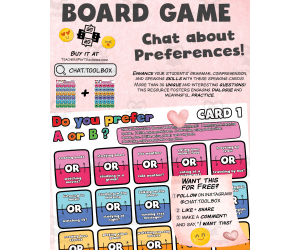
ESL Chat: Preferences using "Do you prefer A or B?" Board Game
ELA, Language Development, ESL, Not Grade Specific, Activities, Games
Looking for something to help your ESL students? This is a perfect pair work activity that can help your students increase their speaking skill in a super fun way! Enhance your students' grammar, comprehension, and speaking skills with this board game! With 30 unique and interesting questions on each card, this resource fosters engaging dialogue and meaningful practice. Instructions Pair Work Activity: "Do You Prefer A or B?" Objective: Practice the grammar structure "Do you prefer A or B?" through interactive pair work. Materials Needed: Pair Work cards with various "Do you prefer A or B?" scenarios. Timer Step 1: Assign student pairs and provide each pair with a card. Step 2: Teach the Structure: Briefly introduce the grammar structure "Do you prefer A or B?" to the students. Provide examples and encourage students to form their own sentences using the structure. Step 3: Pair Work Activity: Both students take turns answering the question using "Do you prefer A or B?" and provide a reason for their choice. Dependent upon level, encourage students to engage in a meaningful conversation and ask follow-up questions. Monitoring: Circulate among the pairs to monitor their progress and provide assistance as necessary. Offer feedback on grammar, pronunciation, and fluency. Activity End: Students perform the task until the end of allotted time or they finish their cards. Tips: Encourage students to elaborate on their answers and provide reasons for their preferences. Emphasize the importance of active listening and encouraging their partner to speak. Provide positive reinforcement and praise correct usage of the grammar structure.
Author Chat Toolbox
Tags Esl, Ell, Literacy, Speaking, Communication, Reading, Cards, Learning, English
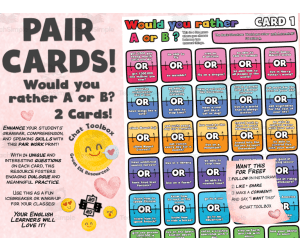
ESL Chat: Preferences, "Would you rather A or B?" Board Game
ELA, Language Development, ESL, Not Grade Specific, Activities, Games
Would you rather buy this print right now and solve all your problems or scroll a lot looking for something better? Stop scrolling here! This pair work activity will help your young learners increase their speaking skill in a super fun way! Enhance your learners' grammar, comprehension, and speaking skills with this activity! With 30 interesting questions on each card, this resource provides engaging dialogue and meaningful speaking practice. Instructions Pair Work Activity: "Would you rather A or B?" Objective: Practice the grammar pattern "Would you rather A or B?" through interactive pair work. Materials Required: Pair Work cards with various "Would you rather A or B?" scenes. Timer First 1: Assign student pairs and provide each pair with a card. Second 2: Teach the Pattern: Briefly introduce the grammar pattern "Would you rather A or B?" to your students. Give examples and encourage students to form their own sentences using the pattern. Third 3: Work in Pairs: Sstudents take turns answering the question using "Would you rather A or B?" and provide a reason for their choice. Dependent upon level, support students to engage in a meaningful conversation and ask follow-up questions. Monitoring: Walk among the pairs to monitor their progress and provide help if necessary. Give feedback on grammar, pronunciation, and fluency. Activity End: Learners perform the activity until the end of allotted time or they finish their cards. Tips: Encourage learners to elaborate on their answers and provide reasons for their preferences. Tell the importance of active listening and encouraging their partner to speak. Provide positive feedback and praise correct usage of the grammar pattern.
Author Chat Toolbox
Tags Esl, Ell, English Language, Zoom, Literacy, Online Lesson, Handout, Pair Work, Grammar

Coping Skills Bingo Counseling Game | Social Emotional Activity
Special Resources, Social Emotional Learning (SEL), Life Skills, Grade 1, 2, 3, 4, 5, Activities, Games
Are you wanting a counseling game that will spice up your coping skills lessons in your counseling sessions? This Coping Skills Bingo Game is perfect for keeping engagement high in your sessions while also teaching your students all about different coping skills! This coping skills activity is the perfect counseling activity. With 46 different calming strategies, students will have a chance to practice calming down their big feelings while getting to play a classic game with a fun twist! This coping skills game includes calling cards that state the skill and then students are encouraged to practice that skill if they have it on their board! This bingo game also includes 30 bingo cards with different types of grids to support students with different attention spans and skill levels so you can differentiate how you would like! What is Included: ⭐ 10 3x3 Bingo Cards ⭐ 10 4x4 Bingo Cards ⭐ 10 5x5 Bingo Cards ⭐ 46 Different Coping Skills ⭐ Ink-Friendly Copy Why Is It A Must-Have?: ❤️ Helps students identify & practice different coping skills ❤️ Helps expand different calming strategies for students ❤️ Increases engagement in your sessions ❤️ Perfect For Different Types of Learners Some Ideas for Use Are: ⭐ Individual Lessons ⭐ Small Groups ⭐ Whole Class Lessons Help your students expand their coping skills toolbox, identify the coping skills that work for them, and grow to love social emotional learning with this bingo game!
Author The Feelings and Friends Teacher
Tags Coping Skills, Coping Skills Activity, Coping Skills Game, Coping Skills Bingo, Counseling Games, Counseling Activities, Calming Strategies, Bingo Game, Social Emotional Learning Activities
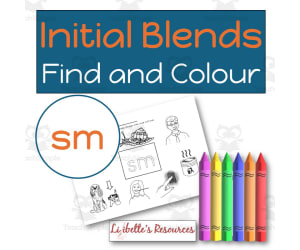
SM Blend Find and Colour Phonics Worksheet to Develop Phonemic
Special Resources, ELA, Special Education Needs (SEN), Language Development, Phonics, Kindergarten, Preschool, Worksheets & Printables, Worksheets
This SM fun, Find and Color worksheet for initial blends is excellent for acquainting children orally with initial consonant blends and helping them develop the necessary phonemic awareness in preparation for more advanced blending work, involving four phonemes. What is included in the pack? One PDF sheet for the SM blend. This is a sample of our pack of 20 activities covering common initial blends which can be found here in one PDF file: less clutter on your computer! What do the worksheets involve? Pupils are instructed to combine the two letters on the worksheet and then look for objects that start with that consonant blend. Then, these items ought to be coloured, leaving the others uncoloured. Children can easily work on the sheet unaided once they have been instructed, although, with those children with special needs, it is strongly suggested that an adult works with the child for maximum benefit. How to use The introduction of the concept of initial blends needs to be done thoroughly. When I work with children, especially those with a special need, I first like to teach children to blend two consonant letters. Then I work on developing the children's phonemic awareness: that being the ability to hear two consonant letters blended at the beginning of a word, easily. This is difficult for some pupils and takes a lot of practice. These worksheets can assist by first encouraging students to blend the two consonant letters and then by helping them to hear the blend at the start of a word. As often as you can, practice blending the letters in each initial blend and encourage the students to follow suit. I find that modelling is key at this stage. Who are the initial blends Find and colour worksheets for? Young learners Those with a special need Due to their non-babyish nature, they can be successfully used with older ESL/EFL pupils. Answer keys: The answer key is included on the sheet, in small print.
Author Lilibette's Resources
Tags Initial Blends, Consonant Blends, Initial Consonant Blends, S Blends, Phonemic Awareness, Phonic Workssheets, Sm Blend

GL Blend Find and Colour Phonics Worksheet to Develop Phonemic
Special Resources, ELA, Special Education Needs (SEN), Language Development, Phonics, Kindergarten, Preschool, Worksheets & Printables, Worksheets
This GL fun, Find and Color worksheet for initial blends is excellent for acquainting children orally with initial consonant blends and helping them develop the necessary phonemic awareness in preparation for more advanced blending work, involving four phonemes. What is included in the pack? One PDF sheet for the GL blend. This is a sample of our pack of 20 activities covering common initial blends which can be found here in one PDF file: less clutter on your computer! What do the worksheets involve? Pupils are instructed to combine the two letters on the worksheet and then look for objects that start with that consonant blend. Then, these items ought to be coloured, leaving the others uncoloured. Children can easily work on the sheet unaided once they have been instructed, although, with those children with special needs, it is strongly suggested that an adult works with the child for maximum benefit. How to use The introduction of the concept of initial blends needs to be done thoroughly. When I work with children, especially those with a special need, I first like to teach children to blend two consonant letters. Then I work on developing the children's phonemic awareness: that being the ability to hear two consonant letters blended at the beginning of a word, easily. This is difficult for some pupils and takes a lot of practice. These worksheets can assist by first encouraging students to blend the two consonant letters and then by helping them to hear the blend at the start of a word. As often as you can, practice blending the letters in each initial blend and encourage the students to follow suit. I find that modelling is key at this stage. Who are the initial blends Find and colour worksheets for? Young learners Those with a special need Due to their non-babyish nature, they can be successfully used with older ESL/EFL pupils. Answer keys: The answer key is included on the sheet, in small print.
Author Lilibette's Resources
Tags Initial Blends, Consonant Blends, Initial Consonant Blends, Phonemic Awareness, Phonic Workssheets, L Blends, Gl Blend

PL Blend Find and Colour Phonics Worksheet to Develop Phonemic
Special Resources, ELA, Special Education Needs (SEN), Language Development, Phonics, Kindergarten, Preschool, Worksheets & Printables, Worksheets
This PL fun, Find and Color worksheet for initial blends is excellent for acquainting children orally with initial consonant blends and helping them develop the necessary phonemic awareness in preparation for more advanced blending work, involving four phonemes. What is included in the pack? One PDF sheet for the PL blend. This is a sample of our pack of 20 activities covering common initial blends which can be found here in one PDF file: less clutter on your computer! What do the worksheets involve? Pupils are instructed to combine the two letters on the worksheet and then look for objects that start with that consonant blend. Then, these items ought to be coloured, leaving the others uncoloured. Children can easily work on the sheet unaided once they have been instructed, although, with those children with special needs, it is strongly suggested that an adult works with the child for maximum benefit. How to use The introduction of the concept of initial blends needs to be done thoroughly. When I work with children, especially those with a special need, I first like to teach children to blend two consonant letters. Then I work on developing the children's phonemic awareness: that being the ability to hear two consonant letters blended at the beginning of a word, easily. This is difficult for some pupils and takes a lot of practice. These worksheets can assist by first encouraging students to blend the two consonant letters and then by helping them to hear the blend at the start of a word. As often as you can, practice blending the letters in each initial blend and encourage the students to follow suit. I find that modelling is key at this stage. Who are the initial blends Find and colour worksheets for? Young learners Those with a special need Due to their non-babyish nature, they can be successfully used with older ESL/EFL pupils. Answer keys: The answer key is included on the sheet, in small print.
Author Lilibette's Resources
Tags Initial Blends, Consonant Blends, Initial Consonant Blends, Phonemic Awareness, Phonic Workssheets, L Blends, FL Blend

FL Blend Find and Colour Phonics Worksheet to Develop Phonemic
Special Resources, ELA, Special Education Needs (SEN), Language Development, Phonics, Kindergarten, Preschool, Worksheets & Printables, Worksheets
This FL fun, Find and Color worksheet for initial blends is excellent for acquainting children orally with initial consonant blends and helping them develop the necessary phonemic awareness in preparation for more advanced blending work, involving four phonemes. What is included in the pack? One PDF sheet for the FL blend. This is a sample of our pack of 20 activities covering common initial blends which can be found here in one PDF file: less clutter on your computer! What do the worksheets involve? Pupils are instructed to combine the two letters on the worksheet and then look for objects that start with that consonant blend. Then, these items ought to be coloured, leaving the others uncoloured. Children can easily work on the sheet unaided once they have been instructed, although, with those children with special needs, it is strongly suggested that an adult works with the child for maximum benefit. How to use The introduction of the concept of initial blends needs to be done thoroughly. When I work with children, especially those with a special need, I first like to teach children to blend two consonant letters. Then I work on developing the children's phonemic awareness: that being the ability to hear two consonant letters blended at the beginning of a word, easily. This is difficult for some pupils and takes a lot of practice. These worksheets can assist by first encouraging students to blend the two consonant letters and then by helping them to hear the blend at the start of a word. As often as you can, practice blending the letters in each initial blend and encourage the students to follow suit. I find that modelling is key at this stage. Who are the initial blends Find and colour worksheets for? Young learners Those with a special need Due to their non-babyish nature, they can be successfully used with older ESL/EFL pupils. Answer keys: The answer key is included on the sheet, in small print.
Author Lilibette's Resources
Tags Initial Blends, Consonant Blends, Initial Consonant Blends, Phonemic Awareness, Phonic Workssheets, L Blends, FL Blend

CL Blend Find and Colour Phonics Worksheet to Develop Phonemic
Special Resources, ELA, Special Education Needs (SEN), Language Development, Phonics, Kindergarten, Preschool, Worksheets & Printables, Worksheets
This CL fun, Find and Color worksheet for initial blends is excellent for acquainting children orally with initial consonant blends and helping them develop the necessary phonemic awareness in preparation for more advanced blending work, involving four phonemes. What is included in the pack? One PDF sheet for the CL blend. This is a sample of our pack of 20 activities covering common initial blends which can be found here in one PDF file: less clutter on your computer! What do the worksheets involve? Pupils are instructed to combine the two letters on the worksheet and then look for objects that start with that consonant blend. Then, these items ought to be coloured, leaving the others uncoloured. Children can easily work on the sheet unaided once they have been instructed, although, with those children with special needs, it is strongly suggested that an adult works with the child for maximum benefit. How to use The introduction of the concept of initial blends needs to be done thoroughly. When I work with children, especially those with a special need, I first like to teach children to blend two consonant letters. Then I work on developing the children's phonemic awareness: that being the ability to hear two consonant letters blended at the beginning of a word, easily. This is difficult for some pupils and takes a lot of practice. These worksheets can assist by first encouraging students to blend the two consonant letters and then by helping them to hear the blend at the start of a word. As often as you can, practice blending the letters in each initial blend and encourage the students to follow suit. I find that modelling is key at this stage. Who are the initial blends Find and colour worksheets for? Young learners Those with a special need Due to their non-babyish nature, they can be successfully used with older ESL/EFL pupils. Answer keys: The answer key is included on the sheet, in small print.
Author Lilibette's Resources
Tags Initial Blends, Consonant Blends, Initial Consonant Blends, Phonemic Awareness, Phonic Workssheets, L Blends, CL Blend

ST Blend Find and Colour Phonics Worksheet to Develop Phonemic
Special Resources, ELA, Special Education Needs (SEN), Language Development, Phonics, Kindergarten, Preschool, Worksheets & Printables, Worksheets
This ST fun, Find and Color worksheet for initial blends is STupendous for acquainting children orally with initial consonant blends and helping them develop the necessary phonemic awareness in preparation for more advanced blending work, involving four phonemes. What is included in the pack? One PDF sheet for the ST blend. This is a sample of our pack of 20 activities covering common initial blends which can be found here in one PDF file: less clutter on your computer! What do the worksheets involve? Pupils are instructed to combine the two letters on the worksheet and then look for objects that start with that consonant blend. Then, these items ought to be coloured, leaving the others uncoloured. Children can easily work on the sheet unaided once they have been instructed, although, with those children with special needs, it is strongly suggested that an adult works with the child for maximum benefit. How to use The introduction of the concept of initial blends needs to be done thoroughly. When I work with children, especially those with a special need, I first like to teach children to blend two consonant letters. Then I work on developing the children's phonemic awareness: that being the ability to hear two consonant letters blended at the beginning of a word, easily. This is difficult for some pupils and takes a lot of practice. These worksheets can assist by first encouraging students to blend the two consonant letters and then by helping them to hear the blend at the start of a word. As often as you can, practice blending the letters in each initial blend and encourage the students to follow suit. I find that modelling is key at this stage. Who are the initial blends Find and colour worksheets for? Young learners Those with a special need Due to their non-babyish nature, they can be successfully used with older ESL/EFL pupils. Answer keys: The answer key is included on the sheet, in small print.
Author Lilibette's Resources
Tags Initial Blends, Consonant Blends, Initial Consonant Blends, S Blends, Phonemic Awareness, Phonic Workssheets, St Blend
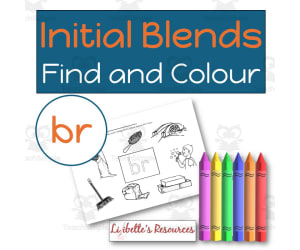
BR Blend Find and Colour Phonics Worksheet to Develop Phonemic
Special Resources, ELA, Special Education Needs (SEN), Language Development, Phonics, Kindergarten, Preschool, Worksheets & Printables, Worksheets
This BR fun, Find and Color worksheet for initial blends is BRilliant for acquainting children orally with initial consonant blends and helping them develop the necessary phonemic awareness in preparation for more advanced blending work, involving four phonemes. What is included in the pack? One PDF sheet for the BR blend. This is a sample of our pack of 20 activities covering common initial blends which can be found here in one PDF file: less clutter on your computer! What do the worksheets involve? Pupils are instructed to combine the two letters on each worksheet and then look for objects that start with that consonant blend. Then, these items ought to be coloured, leaving the others uncoloured. Children can easily work on the sheets unaided once they have been instructed, although, with those children with special needs, it is strongly suggested that an adult works with the child for maximum benefit. How to use The introduction of the concept of initial blends needs to be done thoroughly. When I work with children, especially those with a special need, I first like to teach children to blend two consonant letters. Then I work on developing the children's phonemic awareness: that being the ability to hear two consonant letters blended at the beginning of a word, easily. This is difficult for some pupils and takes a lot of practice. These worksheets can assist by first encouraging students to blend the two consonant letters and then by helping them to hear the blend at the start of a word. As often as you can, practice blending the letters in each initial blend and encourage the students to follow suit. I find that modelling is key at this stage. Who are the initial blends Find and colour worksheets for? Young learners Those with a special need Due to their non-babyish nature, they can be successfully used with older ESL/EFL pupils. Answer keys: The answer key is included on the sheet, in small print.
Author Lilibette's Resources
Tags Initial Blends, Consonant Blends, Initial Consonant Blends, Phonemic Awareness, Phonic Workssheets, Br Blend, Br Initial Blend, R Blends

TR Blend Find and Colour Phonics Worksheet to Develop Phonemic
Special Resources, ELA, Special Education Needs (SEN), Language Development, Phonics, Kindergarten, Preschool, Worksheets & Printables, Worksheets
This TR fun, Find and Color worksheet for initial blends is TRemendous for acquainting children orally with initial consonant blends and helping them develop the necessary phonemic awareness in preparation for more advanced blending work, involving four phonemes. What is included in the pack? One PDF sheet for the TR blend. This is a sample of our pack of 20 activities covering common initial blends which can be found here in one PDF file: less clutter on your computer! What do the worksheets involve? Pupils are instructed to combine the two letters on the worksheet and then look for objects that start with that consonant blend. Then, these items ought to be coloured, leaving the others uncoloured. Children can easily work on the sheet unaided once they have been instructed, although, with those children with special needs, it is strongly suggested that an adult works with the child for maximum benefit. How to use The introduction of the concept of initial blends needs to be done thoroughly. When I work with children, especially those with a special need, I first like to teach children to blend two consonant letters. Then I work on developing the children's phonemic awareness: that being the ability to hear two consonant letters blended at the beginning of a word, easily. This is difficult for some pupils and takes a lot of practice. These worksheets can assist by first encouraging students to blend the two consonant letters and then by helping them to hear the blend at the start of a word. As often as you can, practice blending the letters in each initial blend and encourage the students to follow suit. I find that modelling is key at this stage. Who are the initial blends Find and colour worksheets for? Young learners Those with a special need Due to their non-babyish nature, they can be successfully used with older ESL/EFL pupils. Answer keys: The answer key is included on the sheet, in small print.
Author Lilibette's Resources
Tags Initial Blends, Consonant Blends, Initial Consonant Blends, Phonemic Awareness, Phonic Workssheets, R Blends, Tr Blend

SP Blend Find and Colour Phonics Worksheet to Develop Phonemic
Special Resources, ELA, Special Education Needs (SEN), Language Development, Phonics, Kindergarten, Preschool, Worksheets & Printables, Worksheets
This SP fun, Find and Color worksheet for initial blends is SPlendid for acquainting children orally with initial consonant blends and helping them develop the necessary phonemic awareness in preparation for more advanced blending work, involving four phonemes. What is included in the pack? One PDF sheet for the SP blend. What do the worksheets involve? Pupils are instructed to combine the two letters on each worksheet and then look for objects that start with that consonant blend. Then, these items ought to be coloured, leaving the others uncoloured. Children can easily work on the sheets unaided once they have been instructed, although, with those children with special needs, it is strongly suggested that an adult works with the child for maximum benefit. How to use The introduction of the concept of initial blends needs to be done thoroughly. When I work with children, especially those with a special need, I first like to teach children to blend two consonant letters. Then I work on developing the children's phonemic awareness: that being the ability to hear two consonant letters blended at the beginning of a word, easily. This is difficult for some pupils and takes a lot of practice. These worksheets can assist by first encouraging students to blend the two consonant letters and then by helping them to hear the blend at the start of a word. As often as you can, practice blending the letters in each initial blend and encourage the students to follow suit. I find that modelling is key at this stage. Who are the initial blends Find and colour worksheets for? Young learners Those with a special need Due to their non-babyish nature, they can be successfully used with older ESL/EFL pupils. Answer keys: The answer key is included on the sheet, in small print.
Author Lilibette's Resources
Tags Initial Blends, Consonant Blends, Initial Consonant Blends, S Blends, Phonemic Awareness, Phonic Workssheets, Sp Blend
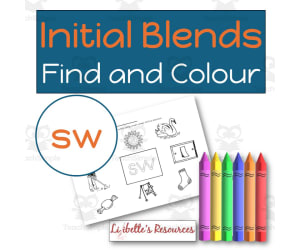
SW Blend Find and Colour Phonics Worksheet to Develop Phonemic
Special Resources, ELA, Special Education Needs (SEN), Language Development, Phonics, Kindergarten, Preschool, Worksheets & Printables, Worksheets
This SW fun, Find and Color worksheet for initial blends is excellent for acquainting children orally with initial consonant blends and helping them develop the necessary phonemic awareness in preparation for more advanced blending work, involving four phonemes. What is included in the pack? One PDF sheet for the SW blend. What do the worksheets involve? Pupils are instructed to combine the two letters on each worksheet and then look for objects that start with that consonant blend. Then, these items ought to be coloured, leaving the others uncoloured. Children can easily work on the sheets unaided once they have been instructed, although, with those children with special needs, it is strongly suggested that an adult works with the child for maximum benefit. How to use The introduction of the concept of initial blends needs to be done thoroughly. When I work with children, especially those with a special need, I first like to teach children to blend two consonant letters. Then I work on developing the children's phonemic awareness: that being the ability to hear two consonant letters blended at the beginning of a word, easily. This is difficult for some pupils and takes a lot of practice. These worksheets can assist by first encouraging students to blend the two consonant letters and then by helping them to hear the blend at the start of a word. As often as you can, practice blending the letters in each initial blend and encourage the students to follow suit. I find that modelling is key at this stage. Who are the initial blends Find and colour worksheets for? Young learners Those with a special need Due to their non-babyish nature, they can be successfully used with older ESL/EFL pupils. Answer keys: The answer key is included on the sheet, in small print.
Author Lilibette's Resources
Tags Initial Blends, Consonant Blends, Initial Consonant Blends, S Blends, Phonemic Awareness, Phonic Workssheets

SK Blend Find and Colour Phonics Worksheet to Develop Phonemic
Special Resources, ELA, Special Education Needs (SEN), Language Development, Phonics, Kindergarten, Preschool, Worksheets & Printables, Worksheets
This SK fun, Find and Color worksheet for initial blends is excellent for acquainting children orally with initial consonant blends and helping them develop the necessary phonemic awareness in preparation for more advanced blending work, involving four phonemes. What is included in the pack? One PDF sheet for the SK blend. This is a sample of our pack of 20 activities covering common initial blends which can be found here in one PDF file: less clutter on your computer! What do the worksheets involve? Pupils are instructed to combine the two letters on the worksheet and then look for objects that start with that consonant blend. Then, these items ought to be coloured, leaving the others uncoloured. Children can easily work on the sheet unaided once they have been instructed, although, with those children with special needs, it is strongly suggested that an adult works with the child for maximum benefit. How to use The introduction of the concept of initial blends needs to be done thoroughly. When I work with children, especially those with a special need, I first like to teach children to blend two consonant letters. Then I work on developing the children's phonemic awareness: that being the ability to hear two consonant letters blended at the beginning of a word, easily. This is difficult for some pupils and takes a lot of practice. These worksheets can assist by first encouraging students to blend the two consonant letters and then by helping them to hear the blend at the start of a word. As often as you can, practice blending the letters in each initial blend and encourage the students to follow suit. I find that modelling is key at this stage. Who are the initial blends Find and colour worksheets for? Young learners Those with a special need Due to their non-babyish nature, they can be successfully used with older ESL/EFL pupils. Answer keys: The answer key is included on the sheet, in small print.
Author Lilibette's Resources
Tags Initial Blends, Consonant Blends, Initial Consonant Blends, S Blends, Phonemic Awareness, Phonic Workssheets, SK Blend

FR Blend Find and Colour Phonics Worksheet to Develop Phonemic
Special Resources, ELA, Special Education Needs (SEN), Language Development, Phonics, Kindergarten, Preschool, Worksheets & Printables, Worksheets
This FR fun, Find and Color worksheet for initial blends is excellent for acquainting children orally with initial consonant blends and helping them develop the necessary phonemic awareness in preparation for more advanced blending work, involving four phonemes. What is included in the pack? One PDF sheet for the FR blend. This is a sample of our pack of 20 activities covering common initial blends which can be found here in one PDF file: less clutter on your computer! What do the worksheets involve? Pupils are instructed to combine the two letters on the worksheet and then look for objects that start with that consonant blend. Then, these items ought to be coloured, leaving the others uncoloured. Children can easily work on the sheet unaided once they have been instructed, although, with those children with special needs, it is strongly suggested that an adult works with the child for maximum benefit. How to use The introduction of the concept of initial blends needs to be done thoroughly. When I work with children, especially those with a special need, I first like to teach children to blend two consonant letters. Then I work on developing the children's phonemic awareness: that being the ability to hear two consonant letters blended at the beginning of a word, easily. This is difficult for some pupils and takes a lot of practice. These worksheets can assist by first encouraging students to blend the two consonant letters and then by helping them to hear the blend at the start of a word. As often as you can, practice blending the letters in each initial blend and encourage the students to follow suit. I find that modelling is key at this stage. Who are the initial blends Find and colour worksheets for? Young learners Those with a special need Due to their non-babyish nature, they can be successfully used with older ESL/EFL pupils. Answer keys: The answer key is included on the sheet, in small print.
Author Lilibette's Resources
Tags Initial Blends, Consonant Blends, Initial Consonant Blends, Phonemic Awareness, Phonic Workssheets, R Blends, Fr Blend

PR Blend Find and Colour Phonics Worksheet to Develop Phonemic
Special Resources, ELA, Special Education Needs (SEN), Language Development, Phonics, Kindergarten, Preschool, Worksheets & Printables, Worksheets
This PR fun, Find and Color worksheet for initial blends is excellent for acquainting children orally with initial consonant blends and helping them develop the necessary phonemic awareness in preparation for more advanced blending work, involving four phonemes. What is included in the pack? One PDF sheet for the PR blend. This is a sample of our pack of 20 activities covering common initial blends which can be found here in one PDF file: less clutter on your computer! What do the worksheets involve? Pupils are instructed to combine the two letters on the worksheet and then look for objects that start with that consonant blend. Then, these items ought to be coloured, leaving the others uncoloured. Children can easily work on the sheet unaided once they have been instructed, although, with those children with special needs, it is strongly suggested that an adult works with the child for maximum benefit. How to use The introduction of the concept of initial blends needs to be done thoroughly. When I work with children, especially those with a special need, I first like to teach children to blend two consonant letters. Then I work on developing the children's phonemic awareness: that being the ability to hear two consonant letters blended at the beginning of a word, easily. This is difficult for some pupils and takes a lot of practice. These worksheets can assist by first encouraging students to blend the two consonant letters and then by helping them to hear the blend at the start of a word. As often as you can, practice blending the letters in each initial blend and encourage the students to follow suit. I find that modelling is key at this stage. Who are the initial blends Find and colour worksheets for? Young learners Those with a special need Due to their non-babyish nature, they can be successfully used with older ESL/EFL pupils. Answer keys: The answer key is included on the sheet, in small print.
Author Lilibette's Resources
Tags Initial Blends, Consonant Blends, Initial Consonant Blends, Phonemic Awareness, Phonic Workssheets, R Blends, Pr Blend

DR Blend Find and Colour Phonics Worksheet to Develop Phonemic
Special Resources, ELA, Special Education Needs (SEN), Language Development, Phonics, Kindergarten, Preschool, Worksheets & Printables, Worksheets
This DR fun, Find and Color worksheet for initial blends is excellent for acquainting children orally with initial consonant blends and helping them develop the necessary phonemic awareness in preparation for more advanced blending work, involving four phonemes. What is included in the pack? One PDF sheet for the DR blend. This is a sample of our pack of 20 activities covering common initial blends which can be found here in one PDF file: less clutter on your computer! What do the worksheets involve? Pupils are instructed to combine the two letters on each worksheet and then look for objects that start with that consonant blend. Then, these items ought to be coloured, leaving the others uncoloured. Children can easily work on the sheets unaided once they have been instructed, although, with those children with special needs, it is strongly suggested that an adult works with the child for maximum benefit. How to use The introduction of the concept of initial blends needs to be done thoroughly. When I work with children, especially those with a special need, I first like to teach children to blend two consonant letters. Then I work on developing the children's phonemic awareness: that being the ability to hear two consonant letters blended at the beginning of a word, easily. This is difficult for some pupils and takes a lot of practice. These worksheets can assist by first encouraging students to blend the two consonant letters and then by helping them to hear the blend at the start of a word. As often as you can, practice blending the letters in each initial blend and encourage the students to follow suit. I find that modelling is key at this stage. Who are the initial blends Find and colour worksheets for? Young learners Those with a special need Due to their non-babyish nature, they can be successfully used with older ESL/EFL pupils. Answer keys: The answer key is included on the sheet, in small print.
Author Lilibette's Resources
Tags Initial Blends, Consonant Blends, Initial Consonant Blends, Phonemic Awareness, Phonic Workssheets, R Blends, Dr Blend

CR Blend Find and Colour Phonics Worksheet to Develop Phonemic
Special Resources, ELA, Special Education Needs (SEN), Language Development, Phonics, Kindergarten, Preschool, Worksheets & Printables, Worksheets
This CR fun, Find and Color worksheet for initial blends is excellent for acquainting children orally with initial consonant blends and helping them develop the necessary phonemic awareness in preparation for more advanced blending work, involving four phonemes. What is included in the pack? One PDF sheet for the CR blend. What do the worksheets involve? Pupils are instructed to combine the two letters on each worksheet and then look for objects that start with that consonant blend. Then, these items ought to be coloured, leaving the others uncoloured. Children can easily work on the sheets unaided once they have been instructed, although, with those children with special needs, it is strongly suggested that an adult works with the child for maximum benefit. How to use The introduction of the concept of initial blends needs to be done thoroughly. When I work with children, especially those with a special need, I first like to teach children to blend two consonant letters. Then I work on developing the children's phonemic awareness: that being the ability to hear two consonant letters blended at the beginning of a word, easily. This is difficult for some pupils and takes a lot of practice. These worksheets can assist by first encouraging students to blend the two consonant letters and then by helping them to hear the blend at the start of a word. As often as you can, practice blending the letters in each initial blend and encourage the students to follow suit. I find that modelling is key at this stage. Who are the initial blends Find and colour worksheets for? Young learners Those with a special need Due to their non-babyish nature, they can be successfully used with older ESL/EFL pupils. Answer keys: The answer key is included on the sheet, in small print.
Author Lilibette's Resources
Tags Initial Blends, Consonant Blends, Initial Consonant Blends, Phonemic Awareness, Phonic Workssheets, R Blends, Initial R Blends, Cr Blend

GR Blend Find and Colour Phonics Worksheet to Develop Phonemic
Special Resources, ELA, Special Education Needs (SEN), Language Development, Phonics, Kindergarten, Preschool, Worksheets & Printables, Worksheets
This Find and Color worksheet for the GR initial blends is GReat FUN and excellent for acquainting children orally with initial consonant blends and helping them develop the necessary phonemic awareness in preparation for more advanced blending work, involving four phonemes. What is included in the pack? One PDF sheet for the GR blend. This is a sample of our pack of 20 activities covering common initial blends which can be found here in one PDF file: less clutter on your computer! What do the worksheets involve? Pupils are instructed to combine the two letters on the worksheet and then look for objects that start with that consonant blend. Then, these items ought to be coloured, leaving the others uncoloured. Children can easily work on the sheet unaided once they have been instructed, although, with those children with special needs, it is strongly suggested that an adult works with the child for maximum benefit. How to use The introduction of the concept of initial blends needs to be done thoroughly. When I work with children, especially those with a special need, I first like to teach children to blend two consonant letters. Then I work on developing the children's phonemic awareness: that being the ability to hear two consonant letters blended at the beginning of a word, easily. This is difficult for some pupils and takes a lot of practice. These worksheets can assist by first encouraging students to blend the two consonant letters and then by helping them to hear the blend at the start of a word. As often as you can, practice blending the letters in each initial blend and encourage the students to follow suit. I find that modelling is key at this stage. Who are the initial blends Find and colour worksheets for? Young learners Those with a special need Due to their non-babyish nature, they can be successfully used with older ESL/EFL pupils. Answer keys: The answer key is included on the sheet, in small print.
Author Lilibette's Resources
Tags Initial Blends, Consonant Blends, Initial Consonant Blends, Phonemic Awareness, Phonic Workssheets, R Blends, Gr Blend