



5,119 products added recently
Page 83 - Newest Teaching Resources

 Show filters
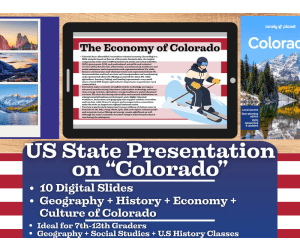
US State Presentation - Colorado
Social Studies, Economics, Geography, History: USA, History, Not Grade Specific, Middle School, High School, Adult Education, Teacher Tools, Presentations, Lesson Plans
US State Presentation - Colorado Bring the United States to life in your classroom with this engaging US State Presentation on Colorado , a ready-to-use digital resource designed for Geography, Social Studies, and US History classes from 7th grade through 12th grade . This presentation provides students with a clear, structured introduction to one US state while combining essential geographical, historical, economic, and cultural information in an accessible format. This US State Presentation on Colorado , includes: The resource begins with a general introduction to the state , helping students understand its location, identity, and importance within the United States. Students then explore the state's borders and neighboring states , making it easier to place it within the broader geography of the country. A general data section introduces key facts such as population, area, population density, capital city, and other essential statistics , providing a useful foundation for further study. A paragraph that explores the history of this US state , highlighting important events, periods, people, and developments that have shaped its identity. This section is particularly useful for US History lessons because it allows students to connect state-level history with major events and themes in American history. A Geography section examines the state's physical characteristics, including its territory, landscapes, natural features, environment, and climate. Students can discover how mountains, rivers, plains, forests, coastlines, deserts, or other geographical characteristics have influenced settlement and human activity. A presentation also introduces the state's economy , explaining its major economic sectors, industries, natural resources, agricultural activities, and other economic strengths. This provides an excellent opportunity to connect geography with economics and understand why particular industries have developed in different parts of the United States. A dedicated section focuses on the capital city , introducing its importance as a political and administrative center. Students can also learn about other important cities , discovering major urban centers and their roles in business, transportation, education, culture, tourism, or industry. A paragraoh that explores culture , giving students an opportunity to learn about traditions, food, music, celebrations, landmarks, historical heritage, and other characteristics that contribute to the state's unique identity. This digital US State Presentation on Colorado is ideal for classroom instruction, student research, geography units, US History lessons, Social Studies activities, state studies, homework, review activities, and independent learning. Its organized structure makes it suitable for middle school and high school students , while its broad range of topics encourages students to view a state from multiple perspectives. Whether you are teaching a unit on the United States, American Geography, US History, state studies, or regional culture , this resource offers a convenient and engaging way to help students explore the diversity and complexity of the United States. Perfect for: Geography Classes, Social Studies Classes, US History Classes, Middle School, High School, Grades 7–12, State Studies, American Studies, Homeschooling, Student Research, and Digital Learning. Learning with Alan is an educational resource store created to help teachers, educators, and tutors reach their teaching goals while building a fun, engaging, and stimulating learning environment . Because learning should always be meaningful—and fun! 🎓✨ If you want to browse more of my Teaching Resources, click here Learning with Alan!!
Author Learning with Alan
Rating
Tags Social Studies, Geography, US History, USA, United States Of America, Colorado, Lesson, Introduction, Presentation, History

Whole Body Listening Posters with Real Pictures
Life Skills, Special Resources, Social Emotional Learning (SEL), Reading, ELA, Writing, Kindergarten, Preschool, Grade 1, Worksheets, Worksheets & Printables, Activities
Make listening expectations clear, concrete, and easy for young learners to remember with these Whole Body Listening Posters with real-picture visuals. Designed for PreK, Kindergarten, and 1st grade, this classroom visual support set helps children connect specific body parts and behaviors with active, respectful listening. Each poster focuses on one simple listening behavior using clear, age-appropriate language and an authentic real-life classroom image. The consistent black-and-white design keeps the posters easy to read, printer-friendly, and suitable for a wide range of classroom decor styles. What’s Included: 1 premium color cover page 9 whole body listening posters featuring eyes, ears, mouth, hands, feet, body, brain, and heart 1 classroom listening checklist poster 1 thank-you page Skills Developed: Active listening Following directions Speaking and listening awareness Self-monitoring Classroom routine independence Understanding visual and informational cues Perfect For: Morning meeting Carpet time Read-alouds Small-group instruction Classroom discussions Back-to-school routines Classroom behavior refreshers Visual supports for young learners Why Teachers Love It: The posters use simple language, realistic visual examples, and consistent formatting to make classroom expectations easy to introduce and revisit. Display the complete set together or use individual posters as quick reminders during lessons and routines. Simply print and display in your classroom, learning space, or listening area. These Whole Body Listening classroom posters provide a clear visual reference students can return to throughout the school year while supporting positive listening habits and classroom routines.
Author TeachTrend Studio
Rating
Tags Posters, Printables, Classroom Management, Visual Supports, Back To School, Social Skills

Whole Body Listening Activities | Posters, Worksheets & Mini Reader
Reading, ELA, Writing, Science, Social Emotional Learning (SEL), Special Resources, Kindergarten, Preschool, Grade 1, 2, Worksheets & Printables, Teacher Tools, Activities
Help young learners understand that good listening is something they do with more than just their ears. This Whole Body Listening resource gives Preschool through 2nd Grade students clear visual reminders, hands-on practice, and simple reading and writing activities for building active listening and self-regulation skills. Students explore what whole body listening can look like in different classroom moments using easy-to-understand visuals and age-appropriate language. The resource combines display posters, guided practice, sorting and drawing activities, scenario-based thinking, and a student mini reader for repeated review. What's Included 1 premium full-color cover 1 teacher quick-start page 1 whole body listening overview poster 7 individual listening-skill posters 6 student practice worksheets 6-page black-and-white mini reader 1 premium thank-you page Skills Developed Active listening Attention and self-regulation Social awareness Following directions Identifying helpful listening behaviors Speaking and listening vocabulary Reading simple informational text Drawing and writing about classroom expectations Perfect For Back-to-school routines Morning meetings SEL lessons Classroom expectations Whole-group instruction Small groups School counseling Social skills practice Reading and writing connections Independent review Why Teachers Love It The consistent visuals make whole body listening easy for young children to understand and revisit. Black-and-white interior pages are printer-friendly, while the variety of posters, practice activities, and mini reader pages supports repeated instruction without repeating the same task. Simply print the posters for classroom display, introduce one listening skill at a time, and use the student pages and mini reader to reinforce the learning. Bring active listening, classroom readiness, and social-emotional learning together with this Whole Body Listening resource designed especially for Preschool, Kindergarten, 1st Grade, and 2nd Grade classrooms.
Author TeachTrend Studio
Rating
Tags Posters, Worksheets, Printables, Social Skills, Visual Supports, Guided Reading Books
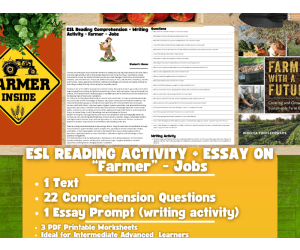
ESL Reading Comprehension + Writing Activity Worksheets - Farmer - Job
ELA, Language Development, ESL, Vocabulary, Reading, Reading Comprehension, Creative Writing, Writing, Formal Writing, Not Grade Specific, Middle School, High School, Adult Education, Worksheets & Printables, Worksheets, Writing Prompts
ESL Reading Comprehension + Writing Activity Worksheets - Farmer - Jobs This ESL - EFL Teaching Resource on " Farmer - Jobs " (3 PDF Worksheets Slides - Reading Comprehension + Writing Activity) can be ideal to improve Language skills in English. Ideal students for this ESL EFL TESOL Reading + Writing Activity are Foreign Students at middle and High School ( 7th - 12th Grade; teens ) . Newcomers or any ESL Learner is also more than suitable for this ESL - EFL - TESOL - TEFL (English as a Second or Foreign Language) Activity on " Farmer - Jobs " ( Introduction + origins and history of this profession + experience and education needed + various types of this job + what it consists of + interviews ). This Teaching Educational Resource Product can also be ideal for ESL EFL TESOL Centers worldwide or any English second language tutor. Intermediate Advanced English as a Second or Foreign Language ( ESL - EFL - TESOL - TEFL ) learners are suitable for this ESL - EFL - TESOL - TEFL Teaching Resource on " Farmer - Jobs " (Worksheet; 3 PDF Printable slides) In this English Second or Foreign Language ( ESL - EFL - TESOL - TEFL ) Reading Comprehension + Essay Writing Activity Worksheet on " Farmers - Jobs " ( Introduction + origins and history of this profession + experience and education needed + various types of this job + what it consists of + interviews ), the following ESL - EFL - TESOL - TEFL ( English Second or Foreign Language ) activities are included: 1 text on " Farmer - Jobs " ( Introduction + origins and history of this profession + experience and education needed + various types of this job + what it consists of + interviews ) 22 Comprehension Questions related to the previous text on " Farmer - Jobs " ( with related space where students can answer to this text's comprehension questions ) 1 essay prompt for a writing activity on " Farmer - Jobs " ( writing an essay on your own personal opinion on this job and whether you would ever like to become a Farmer or not and why ) This ESL - EFL - TESOL - TEFL ( English Second or Foreign Language ) Teaching Resource Reading + Writing Activity ( essay prompts ) on " Farmer - Jobs " ( Introduction + origins and history of this profession + experience and education needed + various types of this job + what it consists of + interviews ) is great for Intermediate Advanced English as a second or foreign language learners ( ESL- EFL - TESOL - TEFL ). This English Second Language Worksheet on " Farmer - Jobs " ( Introduction + origins and history of this profession + experience and education needed + various types of this job + what it consists of + interviews ) aims to train and Reading Comprehension + Writing Skills. "Learning with Alan" is a teaching resources store that aims to provide high quality teaching resources and educational materials for ESL - EFL - TESOL ( English Second or Foreign Language ) teachers, tutors and educators. It aims to support teachers, educators, and tutors in both online and offline environments, helping them achieve their teaching goals while creating a fun, stimulating atmosphere for learning English. Always remember: learning is fun, and so is English! If you want to find more ESL - EFL - TESOL - TEFL ( English Second or Foreign Language ) Teaching Resources and Educational Material click here Learning with Alan!
Author Learning with Alan
Rating
Tags ESL, English Second Language, English, Reading Comprehension, Writing Activity, Worksheets, Farmer, Farm, Agriculture, Activity

ESL Grammar Activity Worksheets - Passive
ELA, Language Development, ESL, Grammar, Middle School, Not Grade Specific, High School, Adult Education, Worksheets & Printables, Worksheets
ESL Grammar Activity Worksheets - Passive Make learning English grammar simple and engaging with this English Second or Foreign Language Teaching Resource focused on the essential Passive . This printable ESL Grammar Activity includes easy to follow explanations, grammar exercises, and an answer key, making it an excellent resource for beginner English learners. Designed for Beginner ESL - EFL - TESOL - TEFL students , this teaching resource is ideal for newcomers, English language learners, and students who are beginning to build their English grammar foundations. The activities provide learners with an opportunity to understand and practise the Passive in a clear and accessible way. This ESL Passive Grammar Activity can be used in a variety of educational settings. It is suitable for ESL classrooms, English language learning centers, tutoring sessions, homeschool lessons, and individual study . Teachers and ESL tutors can use the worksheets as part of a grammar lesson, for independent practice, revision, homework, or additional classroom activities. The printable PDF format makes this resource convenient and ready to use. Simply print the worksheets and provide your students with focused grammar practice without the need for extensive preparation. What Is Included? This ESL Passive Grammar Activity Worksheets includes: 1 Introduction to the topic 1 Clear Grammar Explanation Grammar Exercises for student practice Answer Key for easy correction and assessment Whether you are teaching English as a Second Language ( ESL ) or English as a Foreign Language ( EFL ) , this resource is a practical way to help beginner students develop confidence with Passive Give your students structured, accessible, and printable English grammar practice with this Passive ESL Worksheet Activity ! ESL with Alan is a Teaching Resources Store whose aim is to help English as a Second or foreign Language ( ESL - EFL - TESOL - TEFL ) Teachers, Educators and Tutors around the world ( be it online or offline ) to achieve their teaching objectives while creating an enjoyable and stimulating learning environment. Learning is fun, So should English! Always If you want to browse more of my ESL, EFL, TESOL Teaching Resources, click here right ESL with Alan!
Author Learning with Alan
Rating
Tags ESL, English Second Language, English, Grammar, Verbs, Passive, Activity, Printable, Worksheets, Exercises

ESL Grammar Activity Worksheets - Conditionals
ELA, Language Development, ESL, Grammar, Not Grade Specific, Middle School, Homeschool Resources, Adult Education, Worksheets & Printables, Worksheets
ESL Grammar Activity Worksheets - Conditionals Make learning English grammar simple and engaging with this English Second or Foreign Language Teaching Resource focused on the essential Conditionals . This printable ESL Grammar Activity includes easy to follow explanations, grammar exercises, and an answer key, making it an excellent resource for beginner English learners. Designed for Beginner ESL - EFL - TESOL - TEFL students , this teaching resource is ideal for newcomers, English language learners, and students who are beginning to build their English grammar foundations. The activities provide learners with an opportunity to understand and practise the Conditionals in a clear and accessible way. This ESL Conditionals Grammar Activity can be used in a variety of educational settings. It is suitable for ESL classrooms, English language learning centers, tutoring sessions, homeschool lessons, and individual study . Teachers and ESL tutors can use the worksheets as part of a grammar lesson, for independent practice, revision, homework, or additional classroom activities. The printable PDF format makes this resource convenient and ready to use. Simply print the worksheets and provide your students with focused grammar practice without the need for extensive preparation. What Is Included? This ESL Conditionals Grammar Activity Worksheets includes: 1 Introduction to the topic 1 Clear Grammar Explanation Grammar Exercises for student practice Answer Key for easy correction and assessment Whether you are teaching English as a Second Language ( ESL ) or English as a Foreign Language ( EFL ) , this resource is a practical way to help beginner students develop confidence with Conditionals Give your students structured, accessible, and printable English grammar practice with this Conditionals ESL Worksheet Activity ! ESL with Alan is a Teaching Resources Store whose aim is to help English as a Second or foreign Language ( ESL - EFL - TESOL - TEFL ) Teachers, Educators and Tutors around the world ( be it online or offline ) to achieve their teaching objectives while creating an enjoyable and stimulating learning environment. Learning is fun, So should English! Always If you want to browse more of my ESL, EFL, TESOL Teaching Resources, click here right ESL with Alan!
Author Learning with Alan
Rating
Tags ESL, English Second Language, English, Grammar, Conditionals, Verbs, Verbal Tenses, Exercises, Activity, Worksheets
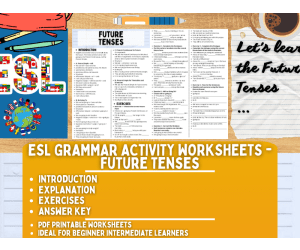
ESL Grammar Activity Worksheets - Future Tenses
Language Development, ELA, ESL, Grammar, Middle School, Not Grade Specific, High School, Adult Education, Worksheets & Printables, Worksheets
ESL Grammar Activity Worksheets - Future Tenses Make learning English grammar simple and engaging with this English Second or Foreign Language Teaching Resource focused on the essential Future Tenses . This printable ESL Grammar Activity includes easy to follow explanations, grammar exercises, and an answer key, making it an excellent resource for beginner English learners. Designed for Beginner ESL - EFL - TESOL - TEFL students , this teaching resource is ideal for newcomers, English language learners, and students who are beginning to build their English grammar foundations. The activities provide learners with an opportunity to understand and practise the Future Tenses in a clear and accessible way. This ESL Future Tenses Grammar Activity can be used in a variety of educational settings. It is suitable for ESL classrooms, English language learning centers, tutoring sessions, homeschool lessons, and individual study . Teachers and ESL tutors can use the worksheets as part of a grammar lesson, for independent practice, revision, homework, or additional classroom activities. The printable PDF format makes this resource convenient and ready to use. Simply print the worksheets and provide your students with focused grammar practice without the need for extensive preparation. What Is Included? This ESL Future Tenses Grammar Activity Worksheets includes: 1 Introduction to the topic 1 Clear Grammar Explanation Grammar Exercises for student practice Answer Key for easy correction and assessment Whether you are teaching English as a Second Language ( ESL ) or English as a Foreign Language ( EFL ) , this resource is a practical way to help beginner students develop confidence with Future Tenses Give your students structured, accessible, and printable English grammar practice with this Future Tenses ESL Worksheet Activity ! ESL with Alan is a Teaching Resources Store whose aim is to help English as a Second or foreign Language ( ESL - EFL - TESOL - TEFL ) Teachers, Educators and Tutors around the world ( be it online or offline ) to achieve their teaching objectives while creating an enjoyable and stimulating learning environment. Learning is fun, So should English! Always If you want to browse more of my ESL, EFL, TESOL Teaching Resources, click here right ESL with Alan!
Author Learning with Alan
Rating
Tags ESL, English Second Language, English, Grammar, Verbs, Future Tenses, Worksheets, Printable, Exercises, Activity

US State Presentation on California
Social Studies, Economics, Geography, History: USA, History, Middle School, Not Grade Specific, High School, Teacher Tools, Lesson Plans, Presentations
US State Presentation on California Bring the United States to life in your classroom with this engaging US State Presentation on California , a ready-to-use digital resource designed for Geography, Social Studies, and US History classes from 7th grade through 12th grade . This presentation provides students with a clear, structured introduction to one US state while combining essential geographical, historical, economic, and cultural information in an accessible format. This US State Presentation on California , includes: The resource begins with a general introduction to the state , helping students understand its location, identity, and importance within the United States. Students then explore the state's borders and neighboring states , making it easier to place it within the broader geography of the country. A general data section introduces key facts such as population, area, population density, capital city, and other essential statistics , providing a useful foundation for further study. A paragraph that explores the history of this US state , highlighting important events, periods, people, and developments that have shaped its identity. This section is particularly useful for US History lessons because it allows students to connect state-level history with major events and themes in American history. A Geography section examines the state's physical characteristics, including its territory, landscapes, natural features, environment, and climate. Students can discover how mountains, rivers, plains, forests, coastlines, deserts, or other geographical characteristics have influenced settlement and human activity. A presentation also introduces the state's economy , explaining its major economic sectors, industries, natural resources, agricultural activities, and other economic strengths. This provides an excellent opportunity to connect geography with economics and understand why particular industries have developed in different parts of the United States. A dedicated section focuses on the capital city , introducing its importance as a political and administrative center. Students can also learn about other important cities , discovering major urban centers and their roles in business, transportation, education, culture, tourism, or industry. A paragraoh that explores culture , giving students an opportunity to learn about traditions, food, music, celebrations, landmarks, historical heritage, and other characteristics that contribute to the state's unique identity. This digital US State Presentation on California is ideal for classroom instruction, student research, geography units, US History lessons, Social Studies activities, state studies, homework, review activities, and independent learning. Its organized structure makes it suitable for middle school and high school students , while its broad range of topics encourages students to view a state from multiple perspectives. Whether you are teaching a unit on the United States, American Geography, US History, state studies, or regional culture , this resource offers a convenient and engaging way to help students explore the diversity and complexity of the United States. Perfect for: Geography Classes, Social Studies Classes, US History Classes, Middle School, High School, Grades 7–12, State Studies, American Studies, Homeschooling, Student Research, and Digital Learning. Learning with Alan is an educational resource store created to help teachers, educators, and tutors reach their teaching goals while building a fun, engaging, and stimulating learning environment . Because learning should always be meaningful—and fun! 🎓✨ If you want to browse more of my Teaching Resources, click here Learning with Alan!!
Author Learning with Alan
Rating
Tags Social Studies, Geography, California, US History, USA, United States Of America, Lesson, Introduction, Presentation, History

US State Presentation on Arkansas
Social Studies, Economics, First Peoples (Native), Geography, History, History: USA, Not Grade Specific, Middle School, High School, Teacher Tools, Lesson Plans, Presentations
US State Presentation on Arkansas Bring the United States to life in your classroom with this engaging US State Presentation on Arkansas , a ready-to-use digital resource designed for Geography, Social Studies, and US History classes from 7th grade through 12th grade . This presentation provides students with a clear, structured introduction to one US state while combining essential geographical, historical, economic, and cultural information in an accessible format. This US State Presentation on Arkansas , includes: The resource begins with a general introduction to the state , helping students understand its location, identity, and importance within the United States. Students then explore the state's borders and neighboring states , making it easier to place it within the broader geography of the country. A general data section introduces key facts such as population, area, population density, capital city, and other essential statistics , providing a useful foundation for further study. A paragraph that explores the history of this US state , highlighting important events, periods, people, and developments that have shaped its identity. This section is particularly useful for US History lessons because it allows students to connect state-level history with major events and themes in American history. A Geography section examines the state's physical characteristics, including its territory, landscapes, natural features, environment, and climate. Students can discover how mountains, rivers, plains, forests, coastlines, deserts, or other geographical characteristics have influenced settlement and human activity. A presentation also introduces the state's economy , explaining its major economic sectors, industries, natural resources, agricultural activities, and other economic strengths. This provides an excellent opportunity to connect geography with economics and understand why particular industries have developed in different parts of the United States. A dedicated section focuses on the capital city , introducing its importance as a political and administrative center. Students can also learn about other important cities , discovering major urban centers and their roles in business, transportation, education, culture, tourism, or industry. A paragraoh that explores culture , giving students an opportunity to learn about traditions, food, music, celebrations, landmarks, historical heritage, and other characteristics that contribute to the state's unique identity. This digital US State Presentation on Arkansas is ideal for classroom instruction, student research, geography units, US History lessons, Social Studies activities, state studies, homework, review activities, and independent learning. Its organized structure makes it suitable for middle school and high school students , while its broad range of topics encourages students to view a state from multiple perspectives. Whether you are teaching a unit on the United States, American Geography, US History, state studies, or regional culture , this resource offers a convenient and engaging way to help students explore the diversity and complexity of the United States. Perfect for: Geography Classes, Social Studies Classes, US History Classes, Middle School, High School, Grades 7–12, State Studies, American Studies, Homeschooling, Student Research, and Digital Learning. Learning with Alan is an educational resource store created to help teachers, educators, and tutors reach their teaching goals while building a fun, engaging, and stimulating learning environment . Because learning should always be meaningful—and fun! 🎓✨ If you want to browse more of my Teaching Resources, click here Learning with Alan!!
Author Learning with Alan
Rating
Tags Social Studies, Geography, US History, Arkansas, Presentation, Lesson, Introduction, USA, United States Of America, History
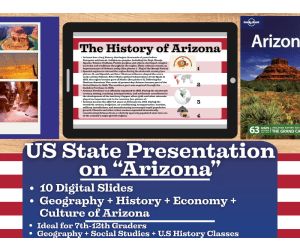
US State Presentation on Arizona
Social Studies, First Peoples (Native), Economics, Geography, History, History: USA, Middle School, Not Grade Specific, High School, Lesson Plans, Teacher Tools, Presentations
US State Presentation on Arizona Bring the United States to life in your classroom with this engaging US State Presentation on Arizona , a ready-to-use digital resource designed for Geography, Social Studies, and US History classes from 7th grade through 12th grade . This presentation provides students with a clear, structured introduction to one US state while combining essential geographical, historical, economic, and cultural information in an accessible format. This US State Presentation - Arizona , includes: The resource begins with a general introduction to the state , helping students understand its location, identity, and importance within the United States. Students then explore the state's borders and neighboring states , making it easier to place it within the broader geography of the country. A general data section introduces key facts such as population, area, population density, capital city, and other essential statistics , providing a useful foundation for further study. A paragraph that explores the history of this US state , highlighting important events, periods, people, and developments that have shaped its identity. This section is particularly useful for US History lessons because it allows students to connect state-level history with major events and themes in American history. A Geography section examines the state's physical characteristics, including its territory, landscapes, natural features, environment, and climate. Students can discover how mountains, rivers, plains, forests, coastlines, deserts, or other geographical characteristics have influenced settlement and human activity. A presentation also introduces the state's economy , explaining its major economic sectors, industries, natural resources, agricultural activities, and other economic strengths. This provides an excellent opportunity to connect geography with economics and understand why particular industries have developed in different parts of the United States. A dedicated section focuses on the capital city , introducing its importance as a political and administrative center. Students can also learn about other important cities , discovering major urban centers and their roles in business, transportation, education, culture, tourism, or industry. A paragraoh that explores culture , giving students an opportunity to learn about traditions, food, music, celebrations, landmarks, historical heritage, and other characteristics that contribute to the state's unique identity. This digital US State Presentation on Arizona is ideal for classroom instruction, student research, geography units, US History lessons, Social Studies activities, state studies, homework, review activities, and independent learning. Its organized structure makes it suitable for middle school and high school students , while its broad range of topics encourages students to view a state from multiple perspectives. Whether you are teaching a unit on the United States, American Geography, US History, state studies, or regional culture , this resource offers a convenient and engaging way to help students explore the diversity and complexity of the United States. Perfect for: Geography Classes, Social Studies Classes, US History Classes, Middle School, High School, Grades 7–12, State Studies, American Studies, Homeschooling, Student Research, and Digital Learning. Learning with Alan is an educational resource store created to help teachers, educators, and tutors reach their teaching goals while building a fun, engaging, and stimulating learning environment . Because learning should always be meaningful—and fun! 🎓✨ If you want to browse more of my Teaching Resources, click here Learning with Alan!!
Author Learning with Alan
Rating
Tags Social Studies, Geography, Arizona, USA, United States Of America, US History, Presentation, Lesson, Introduction, Native People

Blank Clock Templates
Math, Time, Kindergarten, Grade 1, 2, 3, Worksheets & Printables
This item is an 8-page PDF document that includes four different styles of blank clocks in two sizes- small (12 per page) and large (one per page). The four types are- 1) blank clocks with all 12 numerals included, 2.) blank clocks with the 12, 3, 6, and 9 included, 3.) blank clocks with no numerals (just 12 evenly spaced-out dots for students to write in the correct numerals), and 4.) completely blank clocks with no markings except a center dot, on which students will need to write the numerals in themselves for a spatial challenge. These blank clocks can be used in a variety of ways. The teacher can call out a time and students can draw the hands to show that time. Students can use the clocks to show the time of day at which they do certain regular activities. Students can work in partners and say times to each other that the partner shows with clock hands. Many more possibilities!
Author Monaco Lane Curriculum for Early Literacy
Rating
Tags Time, Telling Time, Clocks, Clock, Blank Clock, Clock Template, Blank Clock Template
Eons Life and Death on Pangea All 6 Episodes Bundle Worksheets
Earth Sciences, Earth and Environmental Sciences, Science, Environmental Science, Grade 8, 9, 10, 11, 12, Worksheets, Worksheets & Printables
This is the complete worksheet set for Eons: Life and Death on Pangea (PBS, 2026): a fill-in-the-blank worksheet for every one of the 6 episodes, gathered in a single download. Each worksheet tracks its episode in the order the film presents it, so students write as they watch and finish each day with an organized record they can revise from. Built for Earth Science, the set gives you a ready spine for a multi-day unit: assign one episode per class period, pull a few to cover a planned absence, or work through the whole series in a homeschool study. It suits Earth Science and Geology classrooms (grades 8-12) running a full deep-time unit - geologic time, plate tectonics, the Paleozoic, tectonic uplift, and mass extinction, and Biology and Life Science classes teaching evolution, common ancestry, herbivory and food webs, and the synapsid path from Permian therapsids to the first mammals. Every episode includes its own answer key, and the keys are grouped together at the back so you can print just the student pages for a class set. The layout is clean and low-ink throughout, designed to print two-sided. Episodes covered: The Formation of Pangea, How Eating Plants Shaped Life, Rise and Fall of an Ancient Reef, A Tale of Tusks and Saber Teeth, That Time Almost Everything Died, and Who Survived the Great Dying. A self-grading digital version is included as well. The last page of the PDF carries a "make a copy" link for each of the 6 episode quizzes; one click drops a ready-made copy into your own Google Drive, where you can assign it through Google Classroom or simply by link. The questions match the printable worksheet, every item is multiple choice so grading is fully automatic, and scores appear under the form's Responses tab the moment a student submits. Use the printable set, the digital quizzes, or both. If the set saves you prep time, a quick rating wherever you downloaded it helps other teachers find it. Questions or a correction are welcome at contact@responseresources.studio .
Author Response Resources
Rating
Tags Eons, PBS Eons, Life And Death On Pangea, Pangea, Permian, Carboniferous, Great Dying, Permian Extinction, Mass Extinction, Geologic Time Scale

5 FREE Initial Sounds Worksheets: t
Language Development, ELA, Phonics, Kindergarten, Preschool, Worksheets & Printables, Worksheets
5 Initial Sounds Worksheets: t A pack of 5 worksheets to help children learn to recognise the letter ' t ' by both its shape and its sound, while also building correct letter formation from the very start. Each worksheet approaches the sound from a slightly different angle, so the child gets plenty of repetition without it ever feeling repetitive. Worksheet 1 asks the child to read a row of letters, tracing each one and saying the sound aloud, before naming a set of pictures and writing the initial sound underneath each - bringing sound, shape and word together in one simple task. Worksheet 2 has the child trace a large, chunky version of the letter, then hunt through a group of jumbled letters to find every occurrence of the target letter, tracing and saying the sound each time they spot one - a lovely way to sharpen visual discrimination alongside letter recognition. Worksheets 3 to 5 build on this foundation with a variety of engaging activities - among them, listening for the target sound among a set of pictures and colouring only those that begin with it, matching the letter to pictures that share its sound, and a hands-on cut-and-stick activity where the child finds, names and sticks down the pictures that begin with the sound, saying it aloud as they go. Throughout the pack, correct pencil hold and letter formation are encouraged, with directional arrows and starting dots to guide the child. What is included: 1 PDF containing 5 worksheets. Printing and paper Print on A4 paper, or reduce to A5 if preferred. More This pack is one of a full set covering every initial sound, so you can build up your own complete collection one sound at a time, or move steadily through the alphabet alongside your phonics teaching. Find them in Lilibette's Resources Store
Author Lilibette's Resources
Rating
Tags Intial Sounds, Initial Sounds Worksheets, Learn To Read, Phonics Worksheets, Initial Sounds T, Beginning Sounds T

5 FREE Initial Sounds Worksheets: s
Language Development, ELA, Phonics, Kindergarten, Preschool, Worksheets & Printables, Worksheets
5 Initial Sounds Worksheets: s A pack of 5 worksheets to help children learn to recognise the letter ' s ' by both its shape and its sound, while also building correct letter formation from the very start. Each worksheet approaches the sound from a slightly different angle, so the child gets plenty of repetition without it ever feeling repetitive. Worksheet 1 asks the child to read a row of letters, tracing each one and saying the sound aloud, before naming a set of pictures and writing the initial sound underneath each - bringing sound, shape and word together in one simple task. Worksheet 2 has the child trace a large, chunky version of the letter, then hunt through a group of jumbled letters to find every occurrence of the target letter, tracing and saying the sound each time they spot one - a lovely way to sharpen visual discrimination alongside letter recognition. Worksheets 3 to 5 build on this foundation with a variety of engaging activities - among them, listening for the target sound among a set of pictures and colouring only those that begin with it, matching the letter to pictures that share its sound, and a hands-on cut-and-stick activity where the child finds, names and sticks down the pictures that begin with the sound, saying it aloud as they go. Throughout the pack, correct pencil hold and letter formation are encouraged, with directional arrows and starting dots to guide the child. What is included: 1 PDF containing 5 worksheets. Printing and paper Print on A4 paper, or reduce to A5 if preferred. More This pack is one of a full set covering every initial sound, so you can build up your own complete collection one sound at a time, or move steadily through the alphabet alongside your phonics teaching. Find them in Lilibette's Resources Store
Author Lilibette's Resources
Rating
Tags Intial Sounds, Initial Sounds Worksheets, Learn To Read, Phonics Worksheets, Initial Sounds S, Beginning Sounds S
5 FREE Initial Sounds Worksheets: r
Language Development, ELA, Phonics, Kindergarten, Preschool, Worksheets & Printables, Worksheets
5 Initial Sounds Worksheets: qu A pack of 5 worksheets to help children learn to recognise the letter ' r ' by both its shape and its sound, while also building correct letter formation from the very start. Each worksheet approaches the sound from a slightly different angle, so the child gets plenty of repetition without it ever feeling repetitive. Worksheet 1 asks the child to read a row of letters, tracing each one and saying the sound aloud, before naming a set of pictures and writing the initial sound underneath each - bringing sound, shape and word together in one simple task. Worksheet 2 has the child trace a large, chunky version of the letter, then hunt through a group of jumbled letters to find every occurrence of the target letter, tracing and saying the sound each time they spot one - a lovely way to sharpen visual discrimination alongside letter recognition. Worksheets 3 to 5 build on this foundation with a variety of engaging activities - among them, listening for the target sound among a set of pictures and colouring only those that begin with it, matching the letter to pictures that share its sound, and a hands-on cut-and-stick activity where the child finds, names and sticks down the pictures that begin with the sound, saying it aloud as they go. Throughout the pack, correct pencil hold and letter formation are encouraged, with directional arrows and starting dots to guide the child. What is included: 1 PDF containing 5 worksheets. Printing and paper Print on A4 paper, or reduce to A5 if preferred. More This pack is one of a full set covering every initial sound, so you can build up your own complete collection one sound at a time, or move steadily through the alphabet alongside your phonics teaching. Find them in Lilibette's Resources Store
Author Lilibette's Resources
Rating
Tags Intial Sounds, Initial Sounds Worksheets, Learn To Read, Phonics Worksheets, Initial Sounds R, Beginning Sounds R

5 FREE Initial Sounds Worksheets: qu
Language Development, ELA, Phonics, Kindergarten, Preschool, Worksheets & Printables, Worksheets
5 Initial Sounds Worksheets: qu A pack of 5 worksheets to help children learn to recognise the letter ' qu ' by both its shape and its sound, while also building correct letter formation from the very start. Each worksheet approaches the sound from a slightly different angle, so the child gets plenty of repetition without it ever feeling repetitive. Worksheet 1 asks the child to read a row of letters, tracing each one and saying the sound aloud, before naming a set of pictures and writing the initial sound underneath each - bringing sound, shape and word together in one simple task. Worksheet 2 has the child trace a large, chunky version of the letter, then hunt through a group of jumbled letters to find every occurrence of the target letter, tracing and saying the sound each time they spot one - a lovely way to sharpen visual discrimination alongside letter recognition. Worksheets 3 to 5 build on this foundation with a variety of engaging activities - among them, listening for the target sound among a set of pictures and colouring only those that begin with it, matching the letter to pictures that share its sound, and a hands-on cut-and-stick activity where the child finds, names and sticks down the pictures that begin with the sound, saying it aloud as they go. Throughout the pack, correct pencil hold and letter formation are encouraged, with directional arrows and starting dots to guide the child. What is included: 1 PDF containing 5 worksheets. Printing and paper Print on A4 paper, or reduce to A5 if preferred. More This pack is one of a full set covering every initial sound, so you can build up your own complete collection one sound at a time, or move steadily through the alphabet alongside your phonics teaching. Find them in Lilibette's Resources Store
Author Lilibette's Resources
Rating
Tags Intial Sounds, Initial Sounds Worksheets, Learn To Read, Phonics Worksheets, Initial Sounds Qu, Beginning Sounds Qu
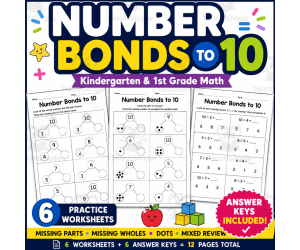
printable number bonds to 10 worksheets with Answer Key
Resources for Teachers, Not Grade Specific, Worksheets & Printables
Build early math skills with these Number Bonds to 10 Worksheets , designed to help students practice composing and decomposing numbers in a clear, visual way. This printable math resource includes 6 student worksheets and 6 separate answer key pages , for a total of 12 pages . Students practice number bonds through a variety of activities, including finding a missing part , finding two parts that make a whole , finding the missing whole , counting dots to complete number bonds, choosing the correct missing part from multiple choices, and completing a mixed number bonds review . What’s Included: 6 Number Bonds to 10 practice worksheets 6 separate answer key pages Missing part practice Find both parts Missing whole practice Dot-counting number bonds Choose the missing part Mixed missing parts and wholes 12 total pages These number bonds worksheets are useful for reinforcing early addition, part-part-whole relationships, number sense, and addition facts within 10. The simple, student-friendly format makes the activities suitable for Kindergarten and 1st Grade math practice , independent work, morning work, math centers, homework, review, or extra practice. Digital printable resource — 6 worksheets + 6 separate answer keys = 12 pages total.
Author Smart Learning Press
Rating 5
Tags Printable Number Bonds To 10 Worksheets, Number Bonds To 10
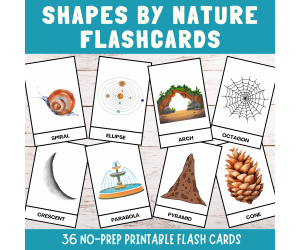
Shapes in nature flashcards, geometric shapes nature forms identifying
Language Development, ELA, Vocabulary, Montessori, Geography, Social Studies, Earth Sciences, Earth and Environmental Sciences, Science, Kindergarten, Preschool, Grade 1, 2, 3, 4, 5, Flashcards, Worksheets & Printables, Task Cards
Help young learners discover geometric shapes in the natural world with these engaging Shapes in Nature Flashcards! Students can identify common shapes and explore how geometric forms appear in plants, animals, rocks, natural objects, and other elements of nature while building early math and observation skills. I like using these flashcards during shapes and geometry lessons, nature studies, outdoor learning, math centers, preschool activities, and homeschool learning. They provide a simple and visual way for children to connect familiar geometric shapes with real-world examples from nature. What You Will Get This printable shapes in nature flashcard resource gives students a fun and visual way to identify geometric shapes and observe natural forms. What's Included in this Resource? • Shapes in nature flashcards • Geometric shape identification cards • Nature form picture cards • Shape recognition activities • Visual matching and identification practice • Student-friendly printable cards • Great for independent or small-group learning This resource is perfect for: • Shapes and geometry lessons • Nature studies • Early math activities • Outdoor learning • Math centers • Preschool and kindergarten activities • Shape recognition practice • Homeschool learning Why you will love this? • Easy to print and use • Builds early shape recognition skills • Connects geometry with the natural world • Encourages observation and visual discrimination • Helps students identify shapes in real-world examples • Great for math centers and hands-on learning These Shapes in Nature Flashcards are a fun way for young learners to explore geometric shapes, observe natural forms, and connect early geometry concepts with the world around them.
Author Perfect_Printables
Rating
Tags 3 Part Cards, Montessori Cards, Shapes In Nature, Shape Flashcards, Geometric Shapes, Nature Shapes, Shape Recognition, Nature Activities, Identifying Shapes

Travel Essentials vocabulary flashcards Travel Vacation 3 parts Cards
ESL, Language Development, ELA, Vocabulary, Montessori, Life Skills, Special Resources, Kindergarten, Preschool, Grade 1, 2, 3, 4, 5, Flashcards, Worksheets & Printables, Task Cards
Help young learners explore travel and vacation vocabulary with these engaging 3-part Montessori-inspired flashcards! Students can learn to recognize common travel essentials, vacation items, and travel-related words while building vocabulary, visual recognition, and communication skills. I like using these cards during travel and vacation units, Montessori-inspired activities, ESL lessons, life skills instruction, classroom centers, and homeschool learning. The 3-part format gives students a hands-on way to match pictures, words, and vocabulary while learning about familiar travel essentials. What You Will Get This printable travel vocabulary resource gives students a visual and hands-on way to learn and review common travel and vacation vocabulary. What's Included in this Resource? • Travel essentials 3-part cards • Travel and vacation vocabulary • Picture and word matching cards • Travel item recognition activities • Montessori-inspired learning cards • Visual vocabulary practice • Student-friendly printable cards • Great for independent or small-group learning This resource is perfect for: • Travel and vacation units • Montessori-inspired activities • ESL vocabulary lessons • Travel vocabulary practice • Life skills activities • Classroom centers • Preschool and kindergarten learning • Homeschool learning Why you will love this? • Easy to print and use • Builds practical travel vocabulary • Helps students recognize common travel essentials • Supports visual learning and language development • Encourages matching, recognition, and vocabulary practice • Great for independent work, small groups, and classroom centers These Travel Essentials Vocabulary Flashcards are a fun and practical way for young learners to explore travel and vacation vocabulary, recognize common travel items, and develop language skills through hands-on 3-part Montessori-inspired cards.
Author Perfect_Printables
Rating
Tags Travel Vocabulary, Travel Flashcards, Vacation Activities, Travel Essentials, 3 Part Cards, Montessori Cards, Travel Vocabulary Cards, Vacation Vocabulary, Esl Travel Vocabulary, Travel Activities
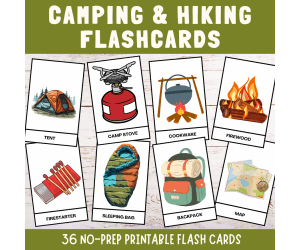
Camping & Hiking Flashcards: Outdoor activities Cards for ESL
ESL, Language Development, ELA, Vocabulary, Life Skills, Special Resources, Kindergarten, Preschool, Grade 1, 2, 3, 4, 5, Flashcards, Worksheets & Printables, Task Cards
Help students learn common camping, hiking, and outdoor activity vocabulary with these engaging flashcards! Students can explore outdoor activities, camping gear, hiking items, and nature-related words while building vocabulary, communication, and recognition skills. I like using these flashcards during ESL lessons, outdoor activity units, camping and hiking themes, life skills instruction, special education activities, classroom centers, and homeschool learning. They provide a simple and visual way for students to learn, identify, and talk about familiar outdoor activities and vocabulary. What You Will Get This printable camping and hiking flashcard resource gives students a visual way to learn and review outdoor activity vocabulary. What's Included in this Resource? • Camping vocabulary flashcards • Hiking vocabulary cards • Outdoor activity picture cards • Camping gear and equipment vocabulary • Nature and outdoor vocabulary • Visual vocabulary recognition practice • Student-friendly printable cards • Great for independent or small-group learning This resource is perfect for: • ESL vocabulary lessons • Special education activities • Camping and hiking units • Outdoor activities lessons • Life skills instruction • Vocabulary development • Classroom centers • Homeschool learning Why you will love this? • Easy to print and use • Builds practical outdoor vocabulary • Helps students recognize common camping and hiking activities and items • Supports visual learning and communication • Useful for ESL and special education learners • Great for vocabulary practice, classroom centers, and small groups These Camping & Hiking Flashcards are a simple and engaging way for students to explore outdoor activities, learn camping and hiking vocabulary, and strengthen communication and vocabulary skills through visual learning.
Author Perfect_Printables
Rating
Tags Camping Flashcards, Hiking Flashcards, Outdoor Activities, Camping Activity, Hiking Activity, Esl Vocabulary, Special Education, Hiking Vocabulary, Outdoor Vocabulary, Life Skills

Hobbies Vocabularies Flashcards | Montessori Cards For Early Learners
Career, Life Studies, Vocabulary, Language Development, ELA, Kindergarten, Preschool, Grade 1, 2, 3, 4, 5, Flashcards, Worksheets & Printables, Task Cards
Help young learners explore common hobbies and favorite activities with these engaging vocabulary flashcards! Students can learn to recognize different hobbies while building vocabulary, communication, visual recognition, and early language skills. I like using these flashcards during early learning lessons, Montessori-inspired activities, vocabulary practice, classroom centers, morning work, and homeschool learning. They provide a simple and visual way for children to learn, identify, and talk about hobbies and activities they enjoy. What You Will Get This printable hobbies vocabulary flashcard resource gives early learners a fun and visual way to explore everyday hobbies and activities. What's Included in this Resource? • Hobbies vocabulary flashcards • Hobby and activity picture cards • Visual vocabulary practice • Hobby recognition activities • Montessori-inspired learning cards • Student-friendly printable cards • Great for independent or small-group learning This resource is perfect for: • Early learners • Montessori-inspired activities • Vocabulary development • Language learning • Hobbies and interests lessons • Classroom centers • Preschool and kindergarten activities • Homeschool learning Why you will love this? • Easy to print and use • Builds everyday vocabulary • Helps children recognize and name different hobbies • Encourages communication and conversation • Supports visual learning and vocabulary development • Great for independent practice and classroom centers These Hobbies Vocabulary Flashcards are a simple and engaging way for early learners to discover different hobbies, build everyday vocabulary, and talk about activities they enjoy through visual learning.
Author Perfect_Printables
Rating
Tags Hobbies Vocabulary, Montessori Cards, Hobby Flashcards, Language Activities, Kids Activities, Early Learning, Hobby Activity
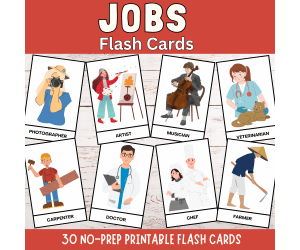
Jobs profession occupation flashcards career community helpers cards
Special Resources, Career, Life Studies, Social Studies, Kindergarten, Preschool, Grade 1, 2, 3, 4, 5, Flashcards, Worksheets & Printables, Task Cards
Help students learn about different jobs, professions, occupations, and community helpers with these engaging vocabulary flashcards! Students can explore a variety of careers and the people who work in their communities while building vocabulary, recognition, and career awareness skills. I like using these flashcards during community helpers units, career education lessons, social studies activities, job and occupation studies, classroom centers, and homeschool learning. They provide a simple and visual way for students to learn, match, and review career-related vocabulary. What You Will Get This printable jobs and occupations flashcard resource gives students a visual way to learn and review career and community helper vocabulary. What's Included in this Resource? • Jobs and professions flashcards • Occupation vocabulary cards • Career-themed picture cards • Community helper cards • Job and career recognition activities • Visual vocabulary practice • Student-friendly printable cards • Great for independent or small-group learning This resource is perfect for: • Community helpers units • Career education • Jobs and occupations lessons • Social studies activities • Career awareness activities • Vocabulary practice • Classroom centers • Homeschool learning Why you will love this? • Easy to print and use • Builds career and occupation vocabulary • Helps students recognize different jobs and professions • Introduces students to people who contribute to their communities • Supports visual learning and vocabulary development • Great for classroom centers and small-group activities These Jobs, Professions & Occupations Flashcards are a fun and simple way for students to explore careers, recognize community helpers, and build important job-related vocabulary through visual learning activities.
Author Perfect_Printables
Rating
Tags Jobs Flashcards, Careers, Occupations, Professions, Community Helpers, Job Vocabulary, Career Activity, Community Helper Activity, Occupation Activities, Career Vocabulary

Maintaining a Healthy Lifestyle Flashcards | 3-Part Health & Wellness
Life Skills, Special Resources, Social Emotional Learning (SEL), Health, P.E. & Health, Kindergarten, Preschool, Grade 1, 2, 3, 4, 5, Flashcards, Worksheets & Printables, Task Cards
Help students learn about healthy lifestyle choices with these engaging 3-Part Health & Wellness Flashcards! Students can explore everyday healthy habits, wellness concepts, and lifestyle choices while building health vocabulary and practical life skills. I like using these flashcards during health education lessons, wellness units, healthy habits studies, life skills instruction, classroom centers, and homeschool learning. The 3-part format provides a simple and visual way for students to learn, match, and review important health and wellness vocabulary. What You Will Get This printable healthy lifestyle flashcard resource gives students a hands-on way to learn and review health and wellness vocabulary. What's Included in this Resource? • 3-part healthy lifestyle flashcards • Healthy habits vocabulary • Health and wellness picture cards • Matching and recognition activities • Everyday healthy lifestyle concepts • Student-friendly printable cards • Great for independent or small-group learning This resource is perfect for: • Health education lessons • Healthy lifestyle units • Health and wellness activities • Healthy habits studies • Life skills instruction • Classroom centers • Vocabulary practice • Homeschool learning Why you will love this? • Easy to print and use • Builds health and wellness vocabulary • Encourages recognition of healthy lifestyle choices • Supports practical life skills learning • Provides hands-on matching and vocabulary practice • Great for independent work, small groups, or classroom centers These Maintaining a Healthy Lifestyle Flashcards are a simple and engaging way for students to explore healthy habits, learn health and wellness vocabulary, and practice recognizing positive lifestyle choices through a 3-part flashcard activity.
Author Perfect_Printables
Rating
Tags Health Education, Life Skills Activity, Self Care Activity, Personal Care, Life Skills, Healthy Lifestyle, Healthy Lifestyle Activity, Personal Health Activity, Health Flashcards, Personal Health Flashcards

Personal Hygiene Vocabulary flashcard Daily Care Grooming Activity
Life Skills, Special Resources, Social Emotional Learning (SEL), Kindergarten, Preschool, Grade 1, 2, 3, 4, 5, Flashcards, Worksheets & Printables, Task Cards
Help students learn important personal hygiene and daily grooming vocabulary with these engaging flashcards! Students can explore everyday hygiene routines, personal care items, and grooming habits while building practical life skills and health vocabulary. I like using these flashcards during health education lessons, personal hygiene units, life skills instruction, daily routine activities, classroom centers, and homeschool learning. They provide a simple and visual way for students to recognize common personal care vocabulary and talk about healthy daily habits. What You Will Get This printable personal hygiene vocabulary flashcard resource gives students a visual way to learn and review everyday personal care and grooming terms. What's Included in this Resource? • Personal hygiene vocabulary flashcards • Daily care and grooming vocabulary • Personal care item recognition • Hygiene routine vocabulary • Student-friendly flashcard designs • Printable format for classroom or home use • Great for vocabulary review and learning centers This resource is perfect for: • Personal hygiene lessons • Health education • Life skills activities • Daily routine lessons • Grooming and self-care vocabulary • Special education life skills instruction • Classroom centers • Homeschool learning Why you will love this? • Easy to print and use • Builds practical hygiene vocabulary • Helps students recognize everyday personal care items and routines • Supports health and life skills learning • Encourages discussion about daily care and grooming • Great for independent practice, small groups, or classroom centers These Personal Hygiene Vocabulary Flashcards are a simple and engaging way for students to learn about daily care, grooming, personal hygiene, and practical self-care vocabulary through visual learning activities. Keywords:
Author Perfect_Printables
Rating
Tags Personal Hygiene, Health Education, Life Skills Activity, Hygiene Flashcards, Grooming Activities, Personal Health, Self Care Activity, Personal Care, Hygiene Vocabulary, Life Skills