3rd Grade Math Assessment | Beginning of Year Diagnostic



About This Product
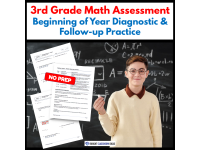
Start third grade with clearer data and a focused plan using this Grade 3 beginning of year math assessment. This visual third grade math diagnostic identifies strengths, skill gaps, and readiness across 14 essential strands—then connects results directly to targeted follow-up practice.
With 39 questions covering place value, operations, multiplication and division foundations, fractions, graphs, and more, this resource helps you move from assess → analyze → group → reteach.
What’s Included
This third grade math assessment bundle provides a complete beginning-of-year diagnostic system:
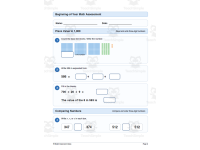
✅ 39-question Student Math Assessment
✅ 14 essential math skill strands
✅ Clear, visual student-friendly layout
✅ Complete answer key for all 39 questions
✅ Teacher “what to look for” notes
✅ Common-error and misconception guidance
✅ 39-point scoring system
✅ Secure, Developing, and Emerging score bands
✅ One-page quick-grading answer grid
✅ Step-by-step administration guide
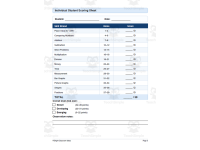
✅ Individual student scoring sheet
✅ Whole-class tracking grid
✅ Small-group planning guidance
✅ Standards alignment
✅ Reteaching roadmap
✅ 14 targeted follow-up practice pages
✅ Fresh practice problems different from assessment items
✅ Teacher answer strip for every practice page
The answer key includes correct responses plus brief teacher notes designed to turn student errors into useful instructional information.
How It Works in the Classroom
Use this Grade 3 beginning of year math assessment during the first week or two of school to see which second-grade skills students bring into third grade.
There is no time limit, and the assessment can be split into two shorter sittings. Students can show their thinking through regrouping marks, arrays, jottings, and number lines.
Use this resource for:
⭐ Beginning-of-year math assessment
⭐ Back-to-school math diagnostic
⭐ Third grade math pre-assessment
⭐ Second-grade skills review
⭐ Small-group planning
⭐ Math intervention
⭐ Skill-based differentiation
⭐ Targeted reteaching
⭐ Independent follow-up practice
⭐ Student support planning
After scoring, transfer results to the individual student sheet and whole-class tracking grid. The grid organizes performance across all 14 strands, helping you quickly spot shared needs and form skill-based groups.
Then print only the follow-up practice pages each student or group needs. Part 4 includes one focused worksheet for every assessed strand, with fresh problems rather than repeated assessment questions.
Standards & Learning Goals
This third grade math diagnostic assessment checks readiness across 14 essential strands:
🔢 Place value to 1,000
⚖️ Comparing three-digit numbers
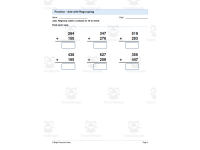
➕ Multi-digit addition
➖ Multi-digit subtraction
📖 Word problems
✖️ Foundations of multiplication
➗ Foundations of division
💰 Money and change
🕒 Telling time and elapsed time
📏 Measurement
📊 Bar graphs
⭐ Picture graphs
🔷 2D and 3D shapes
🍕 Fractions as equal parts
Students work with base-ten blocks, expanded form, digit value, comparing and ordering numbers, regrouping, one-step and two-step word problems, arrays, equal groups, repeated addition, equal sharing, money, change, analog clocks, elapsed time, rulers, scaled graphs, shape attributes, and fractions of wholes and sets.
The included standards map provides illustrative Grade 2–3 Common Core references, including:
2.NBT.A.1
2.NBT.A.4
2.NBT.B.7
3.NBT.A.1–2
2.OA.A.1
2.OA.C.4
3.OA.A.1–2
3.OA.D.8
2.MD.A.1
2.MD.C.7–8
2.MD.D.10
3.MD.A.1
3.MD.B.3–4
2.G.A.1
2.G.A.3
3.G.A.1
3.NF.A.1
Because a beginning-of-year Grade 3 diagnostic naturally checks end-of-second-grade mastery and readiness for third-grade content, the alignment intentionally spans both grade levels.
Why Teachers Love It
✨ See more than a total score. Results are broken down by skill strand for clearer instructional decisions.
✨ Save valuable planning time. The answer key, quick-grading grid, scoring sheet, and class tracker simplify your assessment workflow.
✨ Build purposeful small groups. Group students by shared needs instead of relying only on overall scores.
✨ Spot important misconceptions. Teacher notes help identify place-value confusion, regrouping errors, operation mistakes, and misunderstandings about equal groups.
✨ Check multiplication and division understanding early. Questions use arrays, repeated addition, sharing, and grouping—not only memorized facts.
✨ Differentiate without hunting for extra worksheets. Print the specific follow-up page each student or group needs.
✨ Use a truly actionable class tracker. The whole-class grid on page 4 displays all 14 strands side by side, making clusters of shared needs easier to identify for small-group planning.
✨ Move directly from assessment to reteaching. Practice pages cover place value, comparing, regrouping, word problems, multiplication, division, money, time, measurement, graphs, shapes, and fractions.
Start the year knowing what your students understand and what they need next. Download this Grade 3 beginning of year math assessment to assess readiness, identify learning gaps, form targeted small groups, and provide focused follow-up practice from one coordinated resource.
Perfect for teachers searching for a third grade math pre-assessment, back-to-school math diagnostic, Grade 3 readiness assessment, second-grade skills review, math intervention tool, or beginning-of-year math assessment with built-in scoring and reteaching support.
Use these ordering numbers to 10,000 worksheets when students are ready for that place-value range.
Resource Tags
0 Reviews
Check out these other great products