4th Grade Reading Comprehension Passages - Funny Stories
- Grades
- Grade 4, Elementary
- Pages
- 33
- File type
- Answer key
- Included


- Subject
- ELA, Reading, Reading Comprehension
- Topic
- reading, comprehension
- Resource types
- Worksheets & Printables, Worksheets
- Answer key
- Included
- Standards
- CCSS.RL.4.1 CCSS.RL.4.4
About this resource
What's inside this resource
(the highest level of our popular Funny Stories series)
4th Graders will love these funny stories ...and so will you!
Are your students bored with reading? Do they struggle with comprehension? Make reading fun for your 4th graders with this unique resource guaranteed to captivate readers and build essential reading comprehension skills. With rib-tickling reading passages and multiple choice comprehension questions, 4th Grade Reading Comprehension Passages - Funny Stories combines fun with reading fundamentals. Your 4th grader will be so entertained, they'll forget they're building the reading skills so crucial for academic success.
Features
10 Original Funny Stories targeted to a 2nd grade reading level
Multiple Choice Questions after each story to reinforce comprehension and close reading skills
Answer Keys
No-prep, 33 pages in easily printable PDF format
Although targeted to 4th graders, this resource, because of its highly engaging content, is also beneficial for English language learners of all levels as well as older students struggling with reading.
This popular and unique resource has received positive feedback from teachers, who have described it as an excellent resource that significantly increases student engagement and reading comprehension skills. With its diverse utilization range from classrooms to home to virtual learning platforms, 4th Grade Reading Comprehension Passages - Funny Stories is indeed a comprehensive tool to promote confident and proficient readers who are excited about reading.
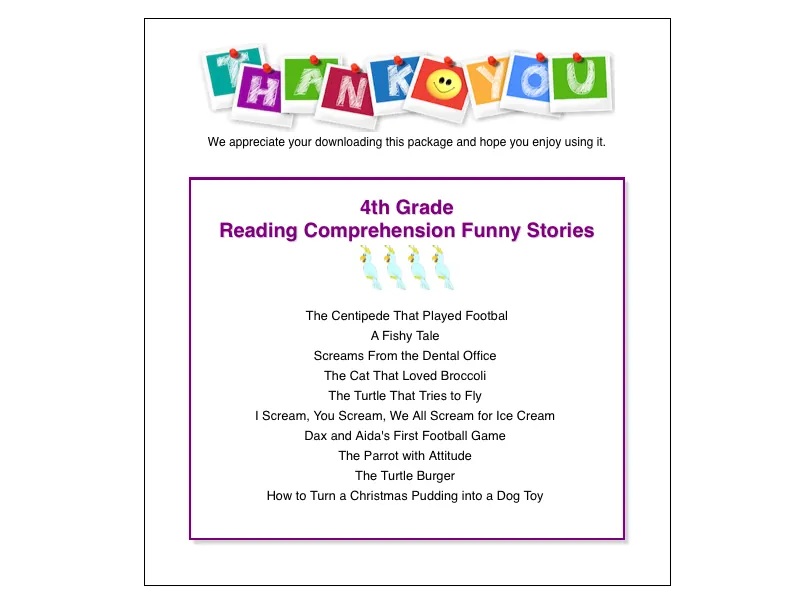
The 10 Stories
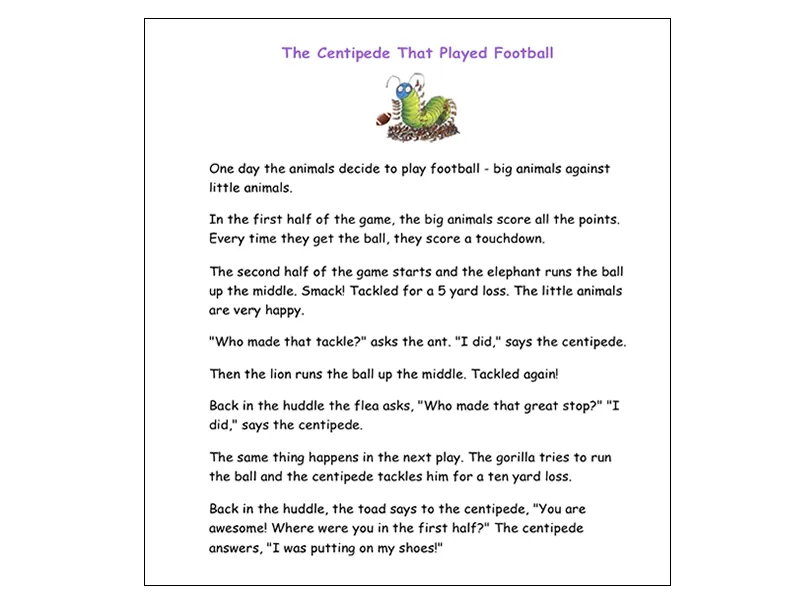
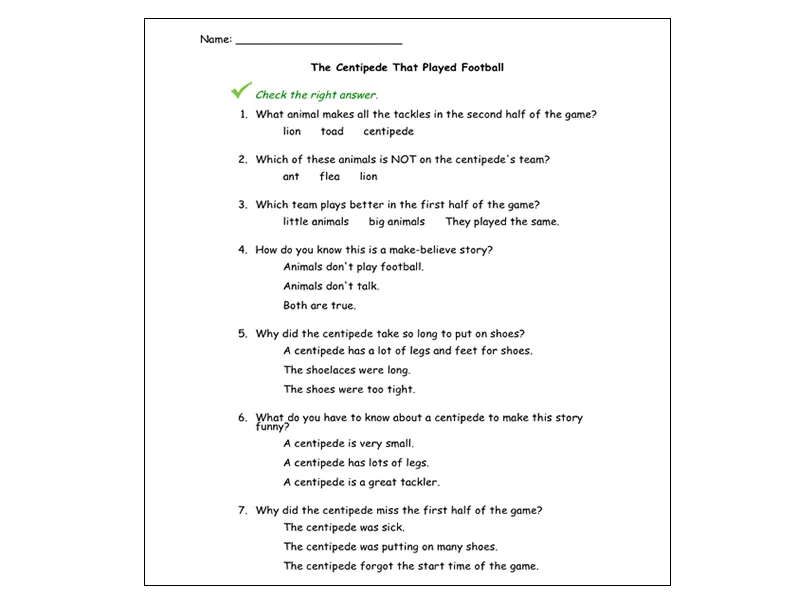
The Centipede That Played Football
A Fishy Tale
Screams From the Dental Office
The Cat That Loved Broccoli
The Turtle That Tries to Fly
I Scream, You Scream, We All Scream for Ice Cream Dax and Aida's First Football Game
The Parrot with Attitude
The Turtle Burger
How to Turn a Christmas Pudding into a Dog Toy
This collection of reading passages and comprehension questions addresses many of the 4th Grade Common Core ELA Reading standards:
Rl4.1, rf4.4, ccra.r.1, ccra.r.4
Looking for something a little easier?
Try the 3rd Grade Collection of Funny Stories:
Related resources
More resources teachers may find useful
24 related resources were found using this product's title, contributor, categories and tags.



In the classroom
Teaching tips & learning objectives

Learning objectives
Recall explicit story details, such as identifying which character performs a specific action in a story.
Draw inferences from context clues, such as recognizing an unstated make-believe element or a character's likely reasoning.
Determine word meaning from context, such as inferring the color of tar from its comparison to a pudding's appearance.

Teaching tips
Assign one story-and-question set per short session, since each stands alone and runs under two pages.
Use the built-in answer key to let students self-check immediately after finishing a story's questions, or remove that page for an independent assessment.
Because several stories turn on wordplay, such as the lobster-tail pun in "A Fishy Tale," consider reading a story aloud together first with English language learners or younger readers before assigning it independently. After discussing the stories, try this inference worksheet and ask students to explain which clues helped them.

Skills covered
Explicit detail recall — students answer literal comprehension questions about a story's characters and events, such as identifying who makes every tackle in "The Centipede That Played Football."
Inference — students draw conclusions the text doesn't state directly, such as recognizing make-believe clues or a character's motive.
Vocabulary in context — students infer a word's meaning from a story's own comparisons, such as the color of tar from a pudding description.
Good to know
Questions teachers ask about this resource
Do the solutions pages explain why each choice is correct, or just give the answer?
Just the correct choice — each solutions page lists which of the three options is right for all ten questions on the story before it, without additional explanation.
Do the ten stories need to be read in order, or does each stand alone?
Each story stands alone with its own characters, setting, and question set, so any one can be assigned by itself or in any order.

No reviews yet
Downloaded this resource? Tell other teachers how it went.
Curriculum
Standards, concepts & topics
Standards
 Standards
- CCSS.RL.4.1 — Refer to details and examples in a text when explaining what the text says explicitly and when drawing inferences from the text.
- CCSS.RL.4.4 — Determine the meaning of words and phrases as they are used in a text, including those that allude to significant characters found in mythology (e.g., Herculean).
Core concepts
 Core concepts
reading comprehension
inference
explicit detail recall
vocabulary in context
 Topics
Explore more
Categories this resource belongs to
Explore related searches
More to explore
You may also like