8th Grade End of Year ELA Review Worksheets & Games

- Grades
- Grade 8, Middle School
- Pages
- 101
- File type
- Answer key
- Included


- Subject
- ELA, End Of Year
- Topic
- ela, review
- Resource types
- Teacher Tools, Worksheets & Printables
- Answer key
- Included
- Standards
- CCSS.L.8.4 CCSS.W.8.8 +1
About this resource
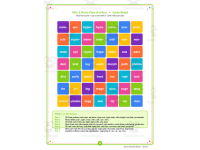
What's inside this resource
Prepare your students for high school success with this rigorous and engaging Grade 8 End-of-Year ELA Review Packet! This comprehensive middle school ELA resource helps eighth graders strengthen analytical reading, argument writing, MLA citation, allegory analysis, rhetorical skills, and advanced grammar before entering high school. With 52 printable review activities and 5 interactive literacy games, this resource is perfect for end-of-year review, summer bridge practice, test prep, literacy centers, homework, sub plans, and early finishers.
⭐ What’s Included
✅ 52 rigorous Grade 8 ELA review activities
✅ 5 interactive ELA review games
✅ Student workbook pages
✅ Complete answer key with sample responses
✅ Teacher guide with pacing plans and differentiation strategies
✅ Original allegory, speech, sonnet, and paired text passages
✅ MLA citation and research writing practice
✅ High-school-prep vocabulary and rhetorical analysis
✅ Grammar and sentence mastery activities
✅ Certificate of Completion
This resource includes four ready-to-print PDFs:
Student Worksheets
Answer Key
Teacher’s Guide
Games Packet
📚 How It Works in the Classroom
This 8th Grade ELA Review Packet is designed for flexible middle school ELA instruction and can be used for:
End-of-year review
High school prep
Literacy centers and stations
Independent practice
Homework
Summer review packets
Small-group reteaching
Whole-class review
Early finisher activities
Substitute teacher plans
Students engage with paired primary and secondary sources, analyze allegory and symbolism, study advanced rhetorical devices, practice MLA formatting, and strengthen analytical writing skills. The included games reinforce academic vocabulary, literary terminology, roots, and synthesis skills in an engaging and low-prep format.
🎯 Standards & Learning Goals
This resource aligns with Grade 8 Common Core ELA standards, including:
L.8.4–L.8.6 Vocabulary Acquisition
RL.8.4–RL.8.6 & RI.8.4–RI.8.6 Author’s Craft & Analysis
RL.8.1–RL.8.7 Reading Literature
RI.8.1–RI.8.9 Reading Informational Text
L.8.1–L.8.3 Grammar & Sentence Mastery
W.8.1–W.8.2 & W.8.7–W.8.8 Argument, Research & MLA Citation
Students will practice:
Allegory vs. symbolism
Motif and theme analysis
Primary vs. secondary sources
MLA citation and avoiding plagiarism
Synthesis writing and evidence integration
Chiasmus, antithesis, asyndeton, and polysyndeton
Persona vs. author
Ambiguity and multiple interpretations
Sonnet analysis and rhetorical structure
Advanced vocabulary and semantic shift
Grammar, verbals, and sentence mastery
❤️ Why Teachers Love It
⭐ Print-and-go format saves planning time
⭐ High-school-prep rigor builds analytical thinking
⭐ Original reading passages support deeper discussion
⭐ MLA citation and synthesis writing prepare students for ninth grade
⭐ Interactive games keep students engaged during review season
⭐ Includes differentiation strategies for struggling readers, advanced learners, and ELL students
⭐ Balanced mix of reading, writing, rhetoric, vocabulary, and grammar review
⭐ Excellent preparation for honors ELA and freshman English classes
Teachers love using this Grade 8 ELA Review Resource to help students transition confidently into high school-level reading and writing expectations while keeping instruction engaging and organized.
📥 Perfect For
Eighth grade ELA classrooms
Middle school language arts review
High school preparation
End-of-year test prep
Summer bridge packets
Homeschool ELA instruction
Literacy intervention
Independent practice
Emergency sub plans
Help your students finish middle school strong with this engaging and standards-aligned 8th Grade High School Prep ELA Review Packet!
Related resources
More resources teachers may find useful
24 related resources were found using this product's title, contributor, categories and tags.

In the classroom
Teaching tips & learning objectives

Learning objectives
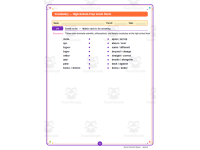
Use Greek and Latin roots (meta-, epi-, hyper-, hypo-, ortho-, ana-, para-, dict-, scrib-, spect-, tract-, voc-) to predict the meaning of unfamiliar words.
Identify allegory and symbolism in fiction and explain what a story's images or characters represent.
Distinguish primary from secondary sources and cite evidence from paired texts to support an interpretation.

Teaching tips
Print the 52 worksheets in batches rather than all at once, per the teacher's guide.
Read each activity's directions aloud the first time students see a new task format.
Use the Games packet at literacy centers alongside 2-3 worksheet activities for a full rotation.

Skills covered
Greek and Latin root analysis — students match roots such as meta-, hyper-, and dict- to their meanings and use them to decode unfamiliar words (pages 5-7).
Allegory and symbolism analysis — students identify allegorical works and interpret recurring symbols such as light/dark and water in classic texts (page 6 and Section 2 activities).
Primary vs. secondary source evaluation — students label historical documents, photographs, and interviews as primary or secondary and analyze an argumentative speech (pages 27-29, Section 3).
Good to know
Questions teachers ask about this resource
How are the worksheet packet and the games packet meant to work together?
The games packet reuses the same academic vocabulary set as the worksheet sections, so a Bingo round or the roots memory-match game can reinforce a section a class just completed on paper.
What kind of writing does the final section of the packet ask students to produce?
Section 5 moves from citation mechanics into original argument writing, including practicing closing techniques such as a call to action or a full-circle return to the opening hook for a given thesis statement.

No reviews yet
Downloaded this resource? Tell other teachers how it went.
Curriculum
Standards, concepts & topics
Standards
 Standards
- CCSS.L.8.4 — Determine or clarify the meaning of unknown and multiple-meaning words or phrases based on grade 8 reading and content, choosing flexibly from a range of strategies. a. Use context (e.g., the overall meaning of a sentence or paragraph; a word’s position or function in a sentence) as a clue to the meaning of a word or phrase. b. Use common, grade-appropriate Greek or Latin affixes and roots as clues to the meaning of a word (e.g., precede, recede, secede). c. Consult general and specialized reference materials (e.g., dictionaries, glossaries, thesauruses), both print and digital, to find the pronunciation of a word or determine or clarify its precise meaning or its part of speech. d. Verify the preliminary determination of the meaning of a word or phrase (e.g., by checking the inferred meaning in context or in a dictionary).
- CCSS.W.8.8 — Gather relevant information from multiple print and digital sources, using search terms effectively; assess the credibility and accuracy of each source; and quote or paraphrase the data and conclusions of others while avoiding plagiarism and following a standard format for citation
- CCSS.L.8.1 — Demonstrate command of the conventions of standard English grammar and usage when writing or speaking. a. Explain the function of verbals (gerunds, participles, infinitives) in general and their function in particular sentences. b. Form and use verbs in the active and passive voice. c. Form and use verbs in the indicative, imperative, interrogative, conditional, and subjunctive mood. d. Recognize and correct inappropriate shifts in verb voice and mood.*
Core concepts
 Core concepts
allegory
primary and secondary sources
MLA citation
verb mood
vocabulary roots
Topics
 Topics
Explore more
Categories this resource belongs to
Explore related searches
More to explore
You may also like