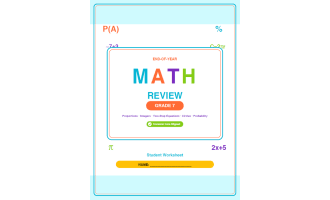
7th Grade End of Year ELA Review Worksheets & Games


- Grades
- Grade 7, Homeschool Resources, Middle School
- Pages
- 96
- File type
- Answer key
- Included


- Subject
- ELA, End Of Year
- Topic
- end of year, ela
- Resource types
- Lesson Plans, Teacher Tools, Worksheets & Printables, Activities, Games, Worksheets
- Answer key
- Included
- Standards
- CCSS.L.7.4 CCSS.RI.7.8 +1
About this resource
What's inside this resource
Challenge your students with a rigorous and engaging Grade 7 End-of-Year ELA Review Packet designed to strengthen critical thinking, rhetorical analysis, argument writing, and advanced reading comprehension skills! This comprehensive middle school ELA resource includes 52 printable review activities and 5 interactive games aligned to seventh grade Common Core standards. Perfect for end-of-year review, test prep, literacy centers, summer learning, homework, or sub plans!
⭐ What’s Included
✅ 52 printable Grade 7 ELA review activities
✅ 5 interactive literacy and vocabulary games
✅ Student workbook pages
✅ Complete answer key with sample responses
✅ Teacher guide with pacing plans and differentiation strategies
✅ Drama, poetry, and informational reading passages
✅ Rhetoric and argument analysis activities
✅ Grammar and conventions review
✅ Synthesis and research writing practice
✅ Academic vocabulary and Greek/Latin roots work
✅ Certificate of Completion
This resource includes four ready-to-print PDFs:
Student Worksheets
Answer Key
Teacher’s Guide
Games Packet
📚 How It Works in the Classroom
This 7th Grade ELA Review resource works beautifully for:
End-of-year middle school ELA review
Literacy centers and stations
Independent practice
Small-group reteaching
Homework
Summer review packets
Test prep
Early finisher activities
Whole-class review
Substitute teacher plans
Students review advanced seventh grade concepts including rhetoric, irony, logical fallacies, dramatic structure, synthesis writing, and evidence-based argumentation. Interactive games reinforce academic vocabulary, rhetorical terminology, Greek and Latin roots, and critical reading skills in a highly engaging format.
🎯 Standards & Learning Goals
This resource aligns with Grade 7 Common Core ELA standards, including:
L.7.4–L.7.6 Vocabulary Acquisition
RI.7.4–RI.7.8 & RL.7.4 Rhetoric & Author’s Craft
RL.7.1–RL.7.7 Reading Literature
RI.7.1–RI.7.9 Reading Informational Text
L.7.1–L.7.3 Grammar & Conventions
W.7.1–W.7.2, W.7.7–W.7.8 Argument, Synthesis & Research Writing
Students will practice:
Ethos, pathos, and logos
Rhetorical devices and logical fallacies
Verbal, situational, and dramatic irony
Satire and literary allusions
Drama and Freytag’s Pyramid
Theme and symbolism analysis
Synthesis across multiple texts
Multi-source argument writing
Grammar, clauses, modifiers, and verb mood
Academic vocabulary and etymology
❤️ Why Teachers Love It
⭐ Print-and-go format saves prep time
⭐ Higher-level critical thinking activities support middle school rigor
⭐ Includes original drama, poetry, and op-ed texts
⭐ Interactive games keep students engaged during review season
⭐ Perfect balance of reading, writing, grammar, and rhetoric skills
⭐ Differentiation strategies included for struggling readers, advanced learners, and ELL students
⭐ Supports strong preparation for eighth grade and high school ELA expectations
Teachers love using this comprehensive Grade 7 ELA Review Packet to reinforce analytical reading, rhetoric, synthesis writing, and academic language while keeping students motivated during the final weeks of school.
📥 Perfect For
Seventh grade ELA classrooms
Middle school language arts review
End-of-year test prep
Summer bridge packets
Literacy intervention
Independent practice
Homeschool families
Sub plans and emergency lessons
Help your students finish the year strong with this engaging and standards-aligned Middle School Grade 7 ELA Review Resource!
Related resources
More resources teachers may find useful
24 related resources were found using this product's title, contributor, categories and tags.


In the classroom
Teaching tips & learning objectives

Learning objectives
Identify ethos, pathos and logos in isolated claims, then quote and cite by paragraph number where each appeal appears in a full op-ed
Distinguish verbal, situational and dramatic irony and name six logical fallacies — ad hominem, straw man, bandwagon, false dilemma, slippery slope and hasty generalisation
Trace Freytag's five dramatic stages through a one-act play by quoting one line per stage, and interpret the fog and the handprint as symbols

Teaching tips
The two-week pacing plan runs five vocabulary activities a day to open, adds a game day at the end of week one, then gives three days to the reading section; a one-week quick review and a roughly five-week centre rotation cover the same 52 activities at different speeds.
Activity 42 is a single paragraph seeded with more than ten errors of mixed type — capitalisation, agreement, modifier placement, mood and spelling — and the guide recommends running it in pairs so students catch each other's blind spots.
Activities 28 and 32 both work across texts, so keep the play, the op-ed and the poem in circulation instead of retiring each one after its own page.

Skills covered
Rhetorical analysis — students label ethos, pathos and logos across six sample claims, then quote and cite by paragraph where each appeal appears in the op-ed "In Defense of Slowness".
Argument evaluation — students rate the op-ed's Stanford study, its garden and fire metaphors, an unsupported assertion and its closing call to action as strong, moderate or weak evidence and justify each rating.
Greek and Latin root analysis — students match roots including dem-, kratos, morph-, jur- and magn- to meanings and use them to predict democracy, dystopia, metamorphosis and empathy.
Good to know
Questions teachers ask about this resource
Which texts do the reading activities analyse?
Three original pieces written for the packet: a one-act play, "The Glass Window", in which two siblings talk at a fogged bedroom window; an op-ed, "In Defense of Slowness", arguing that depth beats speed; and a poem, "What the Wind Knows", spoken by the wind itself. Later activities compare the play with the op-ed and then synthesise all three.
How do the five games connect back to the worksheet sections?
The bingo caller list and the Roll, Read & Race board run on the same academic vocabulary the worksheets teach — ethos, anaphora, corroborate, imperturbable, hypophora — Memory Match and Four-in-a-Row rework the Greek and Latin roots from Section 1, and the four sentence spinners build argument-style sentences from subjects like The rhetorician and verbs like refuted and corroborated.
What does the teacher's guide add beyond the activity pages?
A section-by-section Common Core mapping table, three pacing options — a two-week plan, a one-week quick review and a self-paced centre rotation of about five weeks — teaching notes for each of the five sections, differentiation lists for struggling readers, advanced learners and English language learners, a game-by-game materials list and six assessment suggestions.

No reviews yet
Downloaded this resource? Tell other teachers how it went.
Curriculum
Standards, concepts & topics
Standards
 Standards
- CCSS.L.7.4 — Determine or clarify the meaning of unknown and multiple-meaning words and phrases based on grade 6 reading and content, choosing flexibly from a range of strategies. a. Use context (e.g., the overall meaning of a sentence or paragraph; a word’s position or function in a sentence) as a clue to the meaning of a word or phrase. b. Use common, grade-appropriate Greek or Latin affixes and roots as clues to the meaning of a word (e.g., audience, auditory, audible). c. Consult reference materials (e.g., dictionaries, glossaries, thesauruses), both print and digital, to find the pronunciation of a word or determine or clarify its precise meaning or its part of speech. d. Verify the preliminary determination of the meaning of a word or phrase (e.g., by checking the inferred meaning in context or in a dictionary).
- CCSS.RI.7.8 — Trace and evaluate the argument and specific claims in a text, assessing whether the reasoning is sound and the evidence is relevant and sufficient to support the claims.
- CCSS.W.7.1 — Write arguments to support claims with clear reasons and relevant evidence. a. Introduce claim(s), acknowledge alternate or opposing claims, and organize the reasons and evidence logically. b. Support claim(s) with logical reasoning and relevant evidence, using accurate, credible sources and demonstrating an understanding of the topic or text. c. Use words, phrases, and clauses to create cohesion and clarify the relationships among claim(s), reasons, and evidence. d. Establish and maintain a formal style. e. Provide a concluding statement or section that follows from and supports the argument presented.
Core concepts
 Core concepts
Rhetoric
Irony
Logical fallacies
Greek and Latin roots
Argument writing
Topics
 Topics
Explore more
Categories this resource belongs to
Explore related searches
More to explore
You may also like