



Apollo 13 Oxygen Tank Explosion STEM Case Study



About This Product
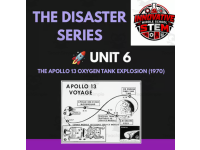
Investigate the most famous "successful failure" in human spaceflight history with this comprehensive, no-prep 6-page printable STEM Case Study Packet! Designed specifically for middle and high school classrooms, this multi-day unit provides an immersive, highly informative look at the miraculous 1970 Apollo 13 space crisis. By combining real NASA telemetry, aerospace engineering, life-support chemistry, applied mathematics, and regulatory ethics, this resource transforms a deep-space emergency into a rich, interactive learning unit.
Throughout this unit, students explore critical secondary STEM concepts—including supercritical cryogenic thermodynamics, Teflon wire insulation combustion, fuel cell power generation, lithium hydroxide CO2 scrubber geometry, and emergency orbital trajectory mechanics—in an accessible, highly engaging format.
What’s Included in this 6-Page Deep-Dive Packet:
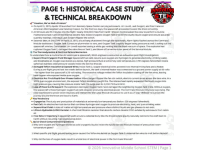
Page 1: Historical Case Study & Technical Breakdown
Features a detailed historical narrative of the April 13, 1970 explosion 200,000 miles from Earth. Students examine cryogenic liquid oxygen tank architecture, electric fan stir short-circuits, and fuel cell power shutdowns before answering targeted comprehension check questions.
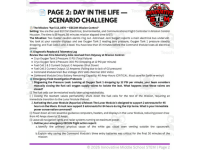
Page 2: Day in the Life Scenario Challenge
Students step into the shoes of an EECOM (Electrical, Environmental, and Communications) Flight Controller at NASA Mission Control in Houston. In this realistic roleplay assignment, they analyze real-time telemetry logs, evaluate pressure drops, and execute emergency Lunar Module lifeboat activation protocols.
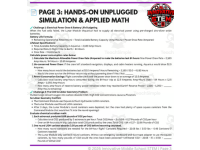
Page 3: Hands-On Unplugged Simulation & Applied Math
Brings spacecraft resource management math into the classroom with clear, step-by-step calculations. Students compute oxygen depletion rates, manage electrical power consumption amp-hour budgets, and calculate square versus round Lithium Hydroxide (LiOH) canister carbon dioxide scrubbing capacities.
Page 4: Engineering Ethics & Workplace Dilemma
Explores quality control standards and pre-flight sign-off protocols. Students analyze a 1968 factory tank dropping incident, the thermal breakdown of thermostatic switches caused by 65-volt ground testing, and the ethical responsibility of addressing testing anomalies prior to launch.
Page 5: Redesign Brief & Innovation Lab
A creative blueprinting challenge where students act as aerospace engineers designing "Apollo Service Module Cryo System V-2." Applying fail-safe spacecraft design principles, they incorporate an isolated third oxygen tank, stainless steel conduit wire routing, universal CO2 canister adapters, and emergency auxiliary battery buses.
Page 6: Teacher Answer Key & Scoring Rubric
Includes complete, step-by-step solutions for all narrative comprehension questions and mathematical calculations, along with a clear 10-point grading rubric to streamline assessment for the design blueprint assignment.
Teacher Benefits:
100% Unplugged & Copy-Paste Friendly: Clean layout with zero dark background boxes or awkward formatting, ensuring seamless editing in Google Docs, Word, or Canva.
Multi-Day Classroom Value: Designed to cover 3 to 5 full class periods. Perfect for Physics, Physical Science, Aerospace Science, Chemistry, CTE electives, or emergency sub plans.
High-Interest Real-World Content: Combines real NASA telemetry data, electrical short-circuit math, life-support chemistry, space ethics, and spacecraft engineering redesign into one high-impact unit.
Resource Tags
0 Reviews
Check out these other great products


