Atomic Structure and Notation Lesson - Google Slides and PowerPoint Lesson

- Grades
- Grades 8–9, Middle School, High School
- File type
- Multiple File Types


- Subject
- Science, Chemistry
- Topic
- atomic structure, atomic notation
- Resource types
- Presentations
About this resource
What's inside this resource
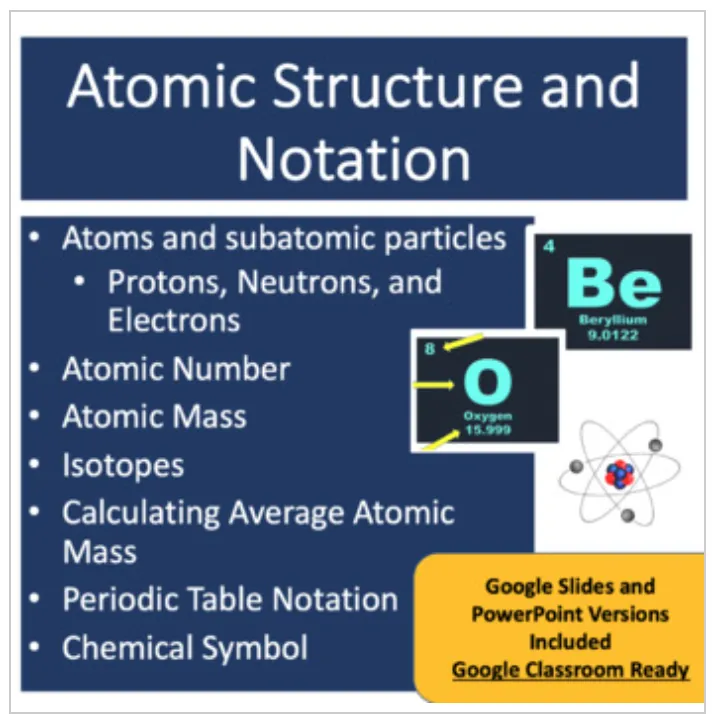
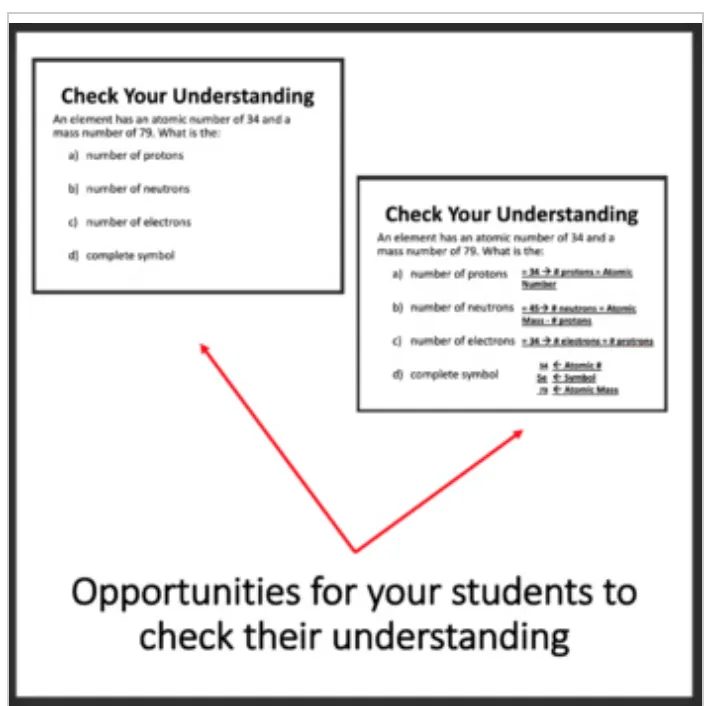
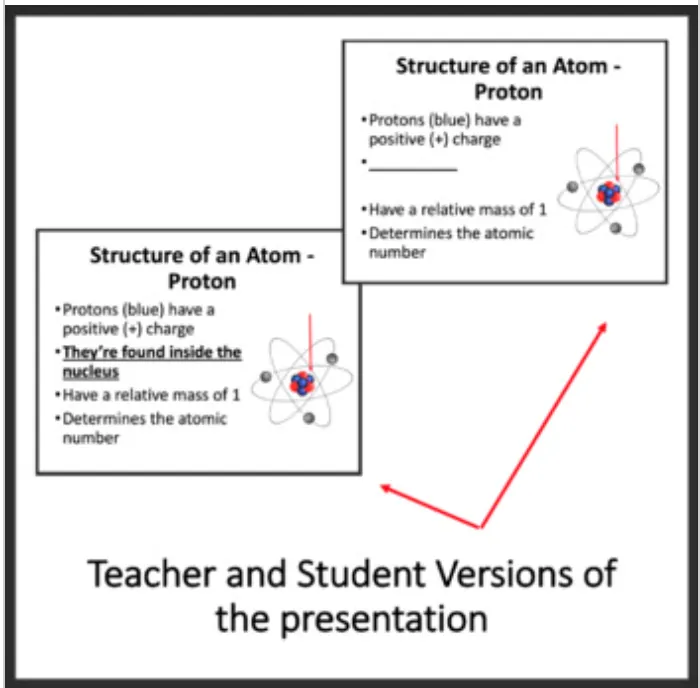
Atomic Structure and Notation Lesson. This lesson package introduces Atoms, Protons, Neutrons, and Electrons. Furthermore, it explains Atomic Number, Mass Number, and Atomic Symbols. This package includes the lesson (student and teacher versions of the presentation), an auto-graded Exit Ticket to check student understanding, a Bill Nye worksheet (includes answer key), and a student lesson handout as a document.
This lesson includes both Office and Google formats for ALL resources. The presentation is in PowerPoint and Google Slides while all documents contain Word and Google Doc versions.
Your resource is perfect for distance learning and integrates seamlessly with Google Classroom as I've included a link that will automatically create a copy of the resources and put them directly into your Google Drive with one click.
Purchase --> Open --> Click --> Assign to your students
Having both options allows you to use either without worrying about formatting issues as all the work has already been done for you. It safeguards you in case your department or school decides to go Google 100% and allows you as well as your students to access everything no matter where you are or what kind of equipment is being used.
Included in the lesson package is:
- Office and Google versions of the presentation
- The teacher version of the presentation
- The student version of the presentation
- An auto-graded Exit Ticket
- Bill Nye video worksheet
- Student worksheet
- Student lesson handout
In order, the lesson covers:
- Atoms
- Protons
- Neutrons
- Electrons
- Atomic Number
- Mass Number
- Atomic Symbols
- Calculations
The student version of the PowerPoint contains multiple blanks that need to be filled in throughout the lesson. These blanks are conveniently underlined and bolded on the teacher copy. I have found this to be the most effective means of keeping my students engaged and active without having them write everything out. This also leaves more time for discussion and activities.
I also have a range of assignments and lessons/units from other grade levels at my store. Please CLICK HERE to have a look around and don’t forget to follow if you like what you see.
Also, please visit my blog Teach With Fergy for my thoughts on teaching, learning and everything in between.
Related resources
More resources teachers may find useful
24 related resources were found using this product's title, contributor, categories and tags.
In the classroom
Teaching tips & learning objectives

Learning objectives
Identify the charge, relative mass, and location of protons, neutrons, and electrons in an atom
Determine an element's number of protons, neutrons, and electrons from its atomic number and mass number
Calculate the weighted average atomic mass of an element from its isotopes and their abundances

Teaching tips
Use the student cloze-deck for guided note-taking, then reveal the completed teacher deck to check answers as a class.
Assign the 'Check Your Understanding' problems as independent practice after modeling the worked isotope example.
Pair the 'Bill Nye: Atoms' worksheet with the referenced video for a video-response comprehension check separate from the slide content.

Skills covered
Atomic structure identification — students classify protons, neutrons, and electrons by charge, mass, and location within the atom.
Atomic mass calculation — students compute a weighted average atomic mass from isotope abundances, e.g. (4×0.5)+(5×0.4)+(6×0.1)=4.6.
Periodic notation interpretation — students read atomic number and mass number from standard element notation to find proton, neutron, and electron counts.
Good to know
Questions teachers ask about this resource
How does the lesson differentiate between the student and teacher versions of the slides?
The student deck leaves key terms and answers blank as cloze notes to fill in during the lesson, while the teacher deck and matching PDF present the identical slides with every blank completed.
What does the 'Bill Nye: Atoms' worksheet assume students have already done?
It assumes students have watched a specific referenced Bill Nye video on atoms, since questions such as describing the water-splitting experiment are only answerable after viewing that video.

No reviews yet
Downloaded this resource? Tell other teachers how it went.
Resource details
Concepts & topics
Core concepts
 Core concepts
atomic structure
atomic number
atomic mass
isotopes
periodic table notation
 Topics
More to explore
You may also like