Balloon Rocket Payload STEM Challenge (FME04)




About This Product
Bring Newton's Laws of Motion, pneumatic thrust propulsion, action-reaction force pairs, mass vs. acceleration dynamics, and flight speed math to life with the Balloon Rocket Payload STEM Challenge (FME04)! Designed for Middle School Physical Science, Physics, Aerospace Engineering, Math, and STEM classes across Grades 6–8, this 3-page, print-ready lab packet challenges students to engineer balloon-powered cargo rockets along guide wire tracks.
What Is Included in This 3-Page Packet?
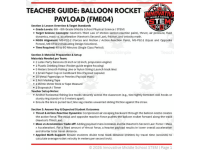
📋 Page 1: Teacher Guide & Lesson Plan
Features NGSS alignment (MS-PS2-1 Newton's Third Law Collision & Action-Reaction, MS-PS2-2 Newton's Second Law Forces & Motion, MS-ETS1-2 Engineering Design), key propulsion physics concepts, track setup guidelines, line tension troubleshooting tips, and a full teacher answer key.
🚀 Page 2: Student Mission Card & Blueprint
Hooks students with a commercial aerospace mission to launch satellite payloads into orbit. Includes material constraints (latex balloons, drinking straws, guide wire string track, paper cup carriage, paperclips/pennies payload, tape, meter stick, stopwatch) and a dedicated schematic sketching zone to diagram pneumatic air exhaust vectors, thrust force balance, and carriage alignment.
📊 Page 3: Testing Log & Scientific Reflection
Features a structured lab data table tracking added payload cargo mass (0, 5, and 10 items), total distance traveled in meters, flight duration time in seconds, and calculated speed in meters per second (m/s). Includes an applied math section to calculate average flight speed (Speed = Distance / Time), followed by reflection questions analyzing action-reaction force pairs, mass vs. acceleration trade-offs (F = ma), line friction reduction, and payload stabilization.
Educational Value & Key Benefits:
Hands-On Rocket Physics: Connects balloon air displacement thrust directly to forward carriage acceleration and payload load capacity.
Integrates Applied Math & Speed Calculations: Teaches students how to measure metric distance along guide tracks and calculate flight velocity in meters per second.
Low-Cost High-Engagement STEM: Uses accessible classroom supplies like balloons, straws, string, paper cups, paperclips, and tape for an unforgettable physical science launch event across Grades 6–8.
Resource Tags
0 Reviews
Check out these other great products