



Capitalism vs Communism – Reading + Video Analysis


- Grades
- Grades 7–8, High School
- File type
- Answer key
- Included


- Subject
- Social Studies, Economics
- Topic
- Capitalism, Communism
- Resource types
- Worksheets
- Answer key
- Included
Product description
From the author
Communism and capitalism are two contrasting economic and political systems that have been the subject of much debate and comparison throughout history.
Communism is a system in which all property is publicly owned and each person works and is paid according to their abilities and needs. The goal of communism is to create a classless society where wealth and resources are distributed equally among all members. Capitalism, on the other hand, is a system in which individuals and businesses own property and produce goods and services for profit. In a capitalist system, prices are determined by supply and demand, and individuals are free to pursue their own self-interest through entrepreneurship and competition. Proponents of communism argue that it is a fairer and more equitable system, as everyone is provided with the same basic necessities of life and has equal access to education and healthcare. They believe that capitalism creates inequality and promotes greed, leading to exploitation of the working class by the wealthy elite. Advocates of capitalism, however, argue that it promotes innovation, growth, and economic freedom, leading to a higher standard of living and greater prosperity for all members of society. They believe that communism stifles creativity and individual initiative, and that the government control necessary for communism leads to corruption and inefficiency.
Ultimately, the debate between communism and capitalism is one of competing values and priorities. While communism values equality and social welfare, capitalism values economic growth and individual freedom. The best system for a given society may depend on a variety of factors, including cultural values, historical context, and political climate.
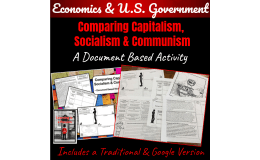
Students start off by taking a 10 question survey. They select "agree" or "disagree" with various statements regarding economic policies. Students also look at a chart comparison of Capitalism vs Communism. At the end of the activity the students tally up their points on the questions, and they are able to see if they identify with "capitalists" or "communist" ideology based on their answers.
Students then read about each economic system (reading is provided - very short and student friendly). Lastly, students connect the information to the economic effects of capitalism on the United States, and they reflect on the unequal distribution of wealth in this country after watching a short 5 minute video (video link included).
Thumbnail and product Clipart Credit: By Prince Padania
Related resources
More resources teachers may find useful
24 related resources were found using this product's title, contributor, categories and tags.


In the classroom
Teaching tips & learning objectives

Learning objectives
Classify ten economic-policy statements as reflecting capitalist or communist values using the provided survey and key.
Summarize the core tenets of capitalism and of communism after reading the two short informational passages.
Connect economic theory to a real-world issue by responding in writing to a video about U.S. wealth inequality.

Teaching tips
Separate students’ personal responses from the creator’s labels when discussing the ten survey statements.
Ask students to examine the packet’s descriptions critically; a government policy or benefit alone does not establish an entire economic system.
Check that the external video plays before the lesson, and explain that the linked 2013 presentation is a historical source.

Skills covered
Critical comparison — students compare their responses to ten economic-policy statements with the creator’s supplied classifications and discuss the limits of those labels.
Compare-and-contrast reading — students read two parallel passages on capitalism and communism and cross-reference them against a five-row comparison chart.
Written response to multimedia — students watch a short external video on U.S. wealth inequality and answer a written reflection question.
Good to know
Questions teachers ask about this resource
How can I use the opening survey in class?
Have students respond before reading, then compare their initial views with the systems described in the packet. Treat the statements as discussion starters and ask students to explain their reasoning.

No reviews yet
Downloaded this resource? Tell other teachers how it went.
Resource details
Concepts & topics
Core concepts
 Core concepts
Capitalism
Communism
Free-market vs. planned economies
Wealth distribution
 Topics
Explore more
Categories this resource belongs to
Explore related searches
More to explore
You may also like


