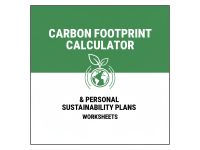
Carbon Footprint Calculator & Personal Sustainability Plans



Science, Basic Science, Earth and Environmental Sciences, Life Sciences, Earth Sciences, Environmental Science, Geology, Space, Nature & Plants, Biology
Homeschool Curriculum, Homeschool Templates, Grade 4, 5, 6, 7, 8
Worksheets & Printables, Workbooks, Worksheets, Word Searches, Teacher Tools, Assessments, Lesson Plans, Quizzes and Tests, Quizzes, Tests


About This Product
This fully planned out unit, straying away from Climate Anxiety and allowing students to build agency related to climate action, can be printed right out of this document and used in the classroom immediately. Designed for use in Grades 5–7 (ages 10–14), students will progress through this unit comprehensively by learning about the Carbon Cycle, measuring their actual CO₂e emissions, and creating their own personal plan for sustainability.
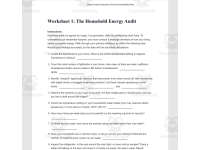
The unit provides scientific text, real-world case studies (i.e. The Life of a White Cotton T-shirt), 10 individual audit worksheets related to home energy, transportation, diet, consumption, and water use. There is a Carbon Calculator provided which translates students' daily habits into actual data as well as templates for SMART Goal Setting and Advocacy Letters to promote action from students after completing the project.
The materials align with NGSS (Earth and Human Activity Standard) and are ideal for Earth Day, STEM, or to promote Environmental Literacy throughout the rest of the school year. Not only does this package come with an extensive Teacher's Guide complete with answer keys, grading rubrics, visual aids, and a flexible 5-day pacing guide; the materials have been scaffolded to help mitigate eco-anxiety with both kindness and evidence-based science.
The highlights include:
4 engaging chapters on greenhouse gases, CO₂e, and Life Cycle Assessment
10 student audit worksheets and a Carbon Calculator to synthesize student audit results
SMART Goals Workshop for setting student action plans and evaluating systemic actions
Professional writing activity related to Advocacy Letters
A comprehensive Teacher Key, including Answer Keys, Grading Rubrics, and 5-Day Unit Plan
All materials have been classroom-tested and proved to be effective.
Appreciated by Parents and Educators:
Empowerment Versus Fear – Empowers children and youth to make positive changes by turning their fear of climate change into tangible steps they can take themselves.
Real-World Math/Data Skills – Develops mathematics and data-based skills through the calculation of CO₂e from current activities, reinforcing applied math and unit conversion skills and improving critical thinking.
Systems Thinking – Students develop a deeper understanding of system relationships and the ripple effects of human activity on the ecological system through Life Cycle Assessment (T-shirts) and permafrost feedback loops.
Teacher-friendly, Minimal Prep/Materials Needed – All materials required for implementation are provided (e.g., rubrics, answer keys, visuals, and 5-day pacing guides), so even non-science specialists can implement without difficulty.
Opens Up Conversation at Home/School/Community – The advocacy letter and family audit provide an avenue for discussion beyond the classroom, resulting in actual changes to household sustainability.
Targeted Grade Levels:
The statement in the introduction clearly states that targeted grade levels are ‘5th, 6th, and 7th Grade.’ Therefore, because the math being introduced in this program involves multiplication, metric/unit conversions, basic percentage reasoning and cognitive complexity, I believe students in grades 5 through 7 will best use this resource as follows:
Primary Group: 5th – 7th Grade (10-13 year olds)
Secondary/Extension Group: (4th Grade) Advanced; 8th – 9th Grade as a basic review of what they learned in grades 5 and/or 6.
Copyright/Terms of Use :
The copyright for this book is owned by Syed Hammad Rizvi. This resource is intended for personal use and to be used in a single classroom. This means that you may not repurpose, sell, or give away any part of this resource. In essence, you cannot upload this resource to any public place on the internet and make it available to the world.
If you wish to distribute this resource to other teachers, please purchase additional licenses through Teachsimple. Thank you for respecting these terms of use.
This product is brought to you proudly by Syed Hammad Rizvi.
Resource Tags
0 Reviews
Check out these other great products