Crash Course: Government and Politics #48: Monetary and Fiscal Policy…

- Grades
- Grades 9–12, High School
- Pages
- 2
- File type
- Zip


- Subject
- Life Studies, Business
- Topic
- crash course, worksheet
- Resource types
- Worksheets & Printables, Worksheets
About this resource
What's inside this resource
Related resources
More resources teachers may find useful
24 related resources were found using this product's title, contributor, categories and tags.


In the classroom
Teaching tips & learning objectives

Learning objectives
Explain the Federal Reserve's tools for controlling the money supply, including the reserve requirement, interest rates, open market operations, and quantitative easing
Describe the causes of inflation and fiscal policy's relationship to government taxing and spending
Summarize how federal tax policy has changed across recent presidential administrations, from Reagan through Obama

Teaching tips
Assign as a video-viewing guide, since the questions are written to be answered 'as answered in the video'
Use the editable Word document to adapt questions for a shorter class period or add questions of your own
Require complete-sentence answers, per the worksheet's own instructions, rather than one-word responses

Skills covered
Note-taking from video — students record complete-sentence answers as key concepts appear in the episode.
Economic-policy vocabulary — students explain terms such as reserve requirement, quantitative easing, and supply-side economics in their own words.
Historical policy comparison — students trace how tax policy shifted across the Reagan, Bush, and Obama administrations.
Good to know
Questions teachers ask about this resource
What kind of answers does the worksheet expect?
Complete-sentence answers explaining each concept — the worksheet's own instructions ask students to answer 'as answered in the video' using full sentences, not one-word responses.
Does the worksheet cover monetary policy, fiscal policy, or both?
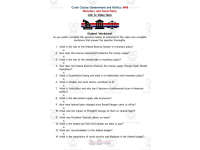
Both: the first six questions focus on monetary policy tools like the Federal Reserve, interest rates, and quantitative easing, and the remaining nine shift to fiscal policy topics like tax history and mandatory spending.

No reviews yet
Downloaded this resource? Tell other teachers how it went.
Resource details
Concepts & topics
Core concepts
 Core concepts
Monetary policy
Federal Reserve
Fiscal policy
Federal budget and taxation
 Topics
Explore more
Categories this resource belongs to
Explore related searches
More to explore
You may also like