Crash Course Psychology Episode Worksheet | 13 - How We Make Memories
- Grades
- Grades 10–12, High School
- File type
- Microsoft Word
- Editable
- Yes


- Subject
- Social Studies, History, Psychology
- Topic
- Crash Course Videos, Crash Course Psychology
- Resource types
- Worksheets & Printables, Worksheets
- Editable
- Yes
About this resource
What's inside this resource
Related resources
More resources teachers may find useful
24 related resources were found using this product's title, contributor, categories and tags.



In the classroom
Teaching tips & learning objectives

Learning objectives
Summarise the Clive Wearing case and explain what his condition shows about memory
Name the three ways memories are accessed - recall, recognition and relearning - and explain how different test types measure each
Attribute the three-stage model of memory formation to Richard Atkinson and Richard Shiffrin and name its stages: encoding, storage and retrieval

Teaching tips
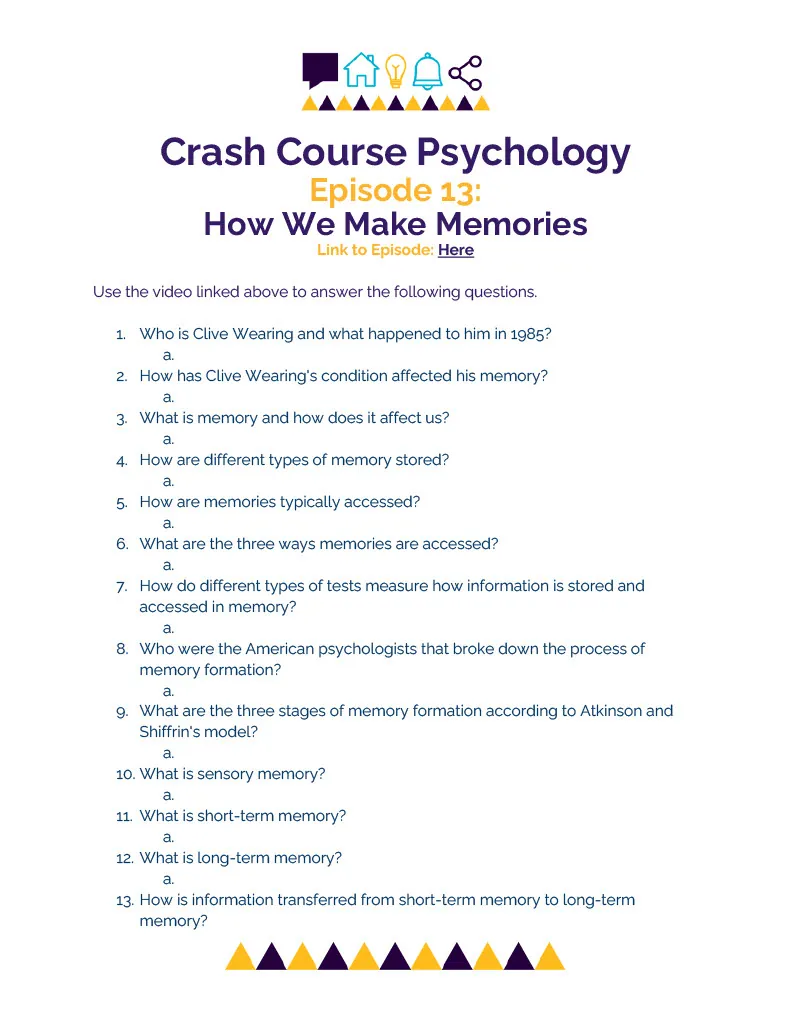
The question order tracks the episode, so students can answer as they watch rather than afterwards - items 1 to 3 cover the opening Clive Wearing segment and items 8 to 14 the Atkinson-Shiffrin model that closes it
Questions 5 and 6 overlap deliberately: one asks how memories are typically accessed and the next asks for the three ways by name, which gives a weaker student a second chance at the same content
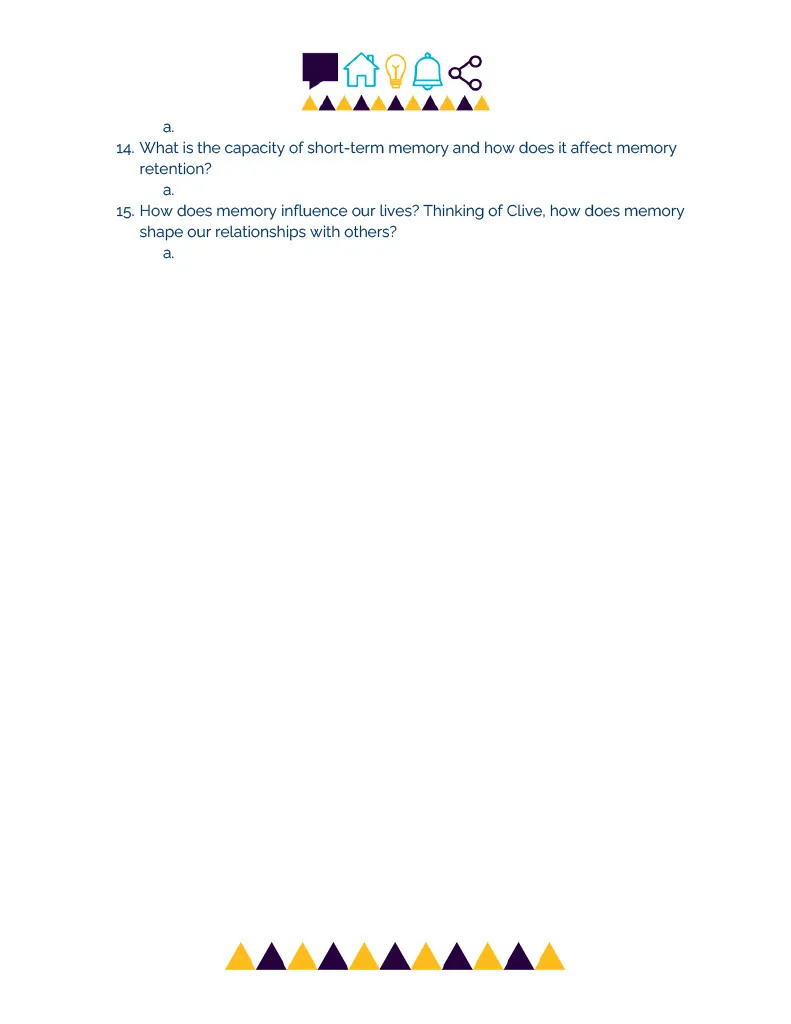
Item 15 is the only open question and asks students to think back to Clive; save it for discussion rather than marking it against the key, which records only that answers will vary

Skills covered
Extracting factual answers from a video - fifteen items require specific details from the episode, including names, dates and numbers such as 1985, four to seven bits, and thirty seconds.
Understanding a psychological model - questions 8 and 9 name Atkinson and Shiffrin and require their three stages of encoding, storage and retrieval.
Distinguishing related technical terms - separate items define sensory, short-term and long-term memory, and another asks how information passes between the last two.
Good to know
Questions teachers ask about this resource
Does the sheet work without the video?
No - it is written to accompany one specific episode. The student page is headed "Use the video linked above to answer the following questions" and carries a hyperlink reading "Link to Episode: Here". Every item asks for a detail stated in that episode.
Who is Clive Wearing and why does the sheet keep returning to him?
He is an accomplished London musician who contracted a rare Herpes encephalitis virus in 1985 and can remember almost none of his past nor form new memories. Three questions open the sheet on his case, and the final reflective item asks students to think of him again when considering how memory shapes relationships.
How specific do the expected responses get?
Quite specific. The key names Richard Atkinson and Richard Shiffrin, lists encoding, storage and retrieval as the three stages, and records that short-term memory holds information for usually under thirty seconds and between four and seven distinct bits at a time - figures a student would need to catch during the episode.

No reviews yet
Downloaded this resource? Tell other teachers how it went.
Resource details
Concepts & topics
Core concepts
 Core concepts
Memory formation
Encoding storage and retrieval
Short-term and long-term memory
Case study
Video comprehension
 Topics
Explore more
Categories this resource belongs to
Explore related searches
More to explore
You may also like