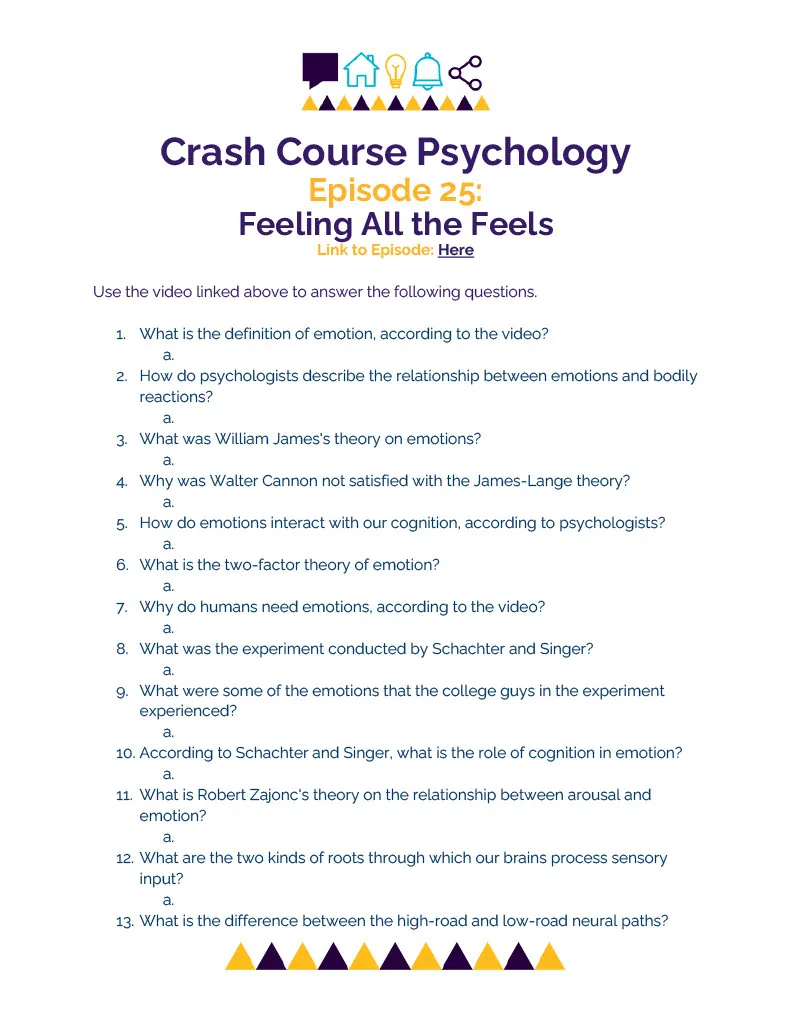
Crash Course Psychology Episode Worksheet | 25 - Feeling All the Feels

- Grades
- Grades 10–12, High School
- File type
- Microsoft Word
- Editable
- Yes


- Subject
- Social Studies, Psychology
- Topic
- Crash Course Video, Comprehension Questions
- Resource types
- Worksheets & Printables, Worksheets
- Editable
- Yes
About this resource
What's inside this resource
Related resources
More resources teachers may find useful
24 related resources were found using this product's title, contributor, categories and tags.


In the classroom
Teaching tips & learning objectives

Learning objectives
Define emotion and explain how psychologists describe the relationship between emotions and bodily reactions
Compare the James-Lange theory, Cannon's objection to it, and the two-factor theory of emotion
Summarize the Schachter and Singer experiment and what it suggested about the role of cognition in emotion

Teaching tips
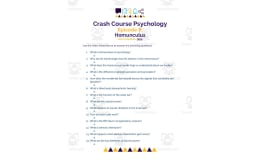
Play the linked Crash Course episode once through, then a second time pausing at the points covered by each of the 15 questions, since the episode moves through several theories in quick succession
Use the answer key to model one or two full-sentence answers before releasing students to complete the rest of the worksheet independently
Pair questions 3-4 and question 6 for a compare/contrast discussion, since they cover competing explanations (James-Lange vs. Cannon's objection vs. the two-factor theory) for the same phenomenon

Skills covered
Video-based note-taking — students extract and record answers to 15 targeted questions while watching a Crash Course Psychology episode.
Theory comparison — students distinguish between the James-Lange theory, Cannon's objection, the two-factor theory, and Zajonc's arousal-labeling theory of emotion.
Experimental reasoning — students summarize the Schachter and Singer epinephrine experiment and what its results suggested about cognition's role in emotion.
Good to know
Questions teachers ask about this resource
How thorough are the teacher's provided answers compared to the student worksheet questions?
Each of the 15 answers is a full explanatory paragraph rather than a short phrase — for example, the provided answers explain not just that Cannon disagreed with James-Lange, but the specific reasoning (that similar bodily reactions like a racing heart could signal fear, excitement, or anger, making it hard to explain how the reaction alone causes a specific emotion).

No reviews yet
Downloaded this resource? Tell other teachers how it went.
Resource details
Concepts & topics
Core concepts
 Core concepts
Theories of emotion
Autonomic nervous system
Cognition and arousal
Emotion research
 Topics
Explore more
Categories this resource belongs to
Explore related searches
More to explore
You may also like