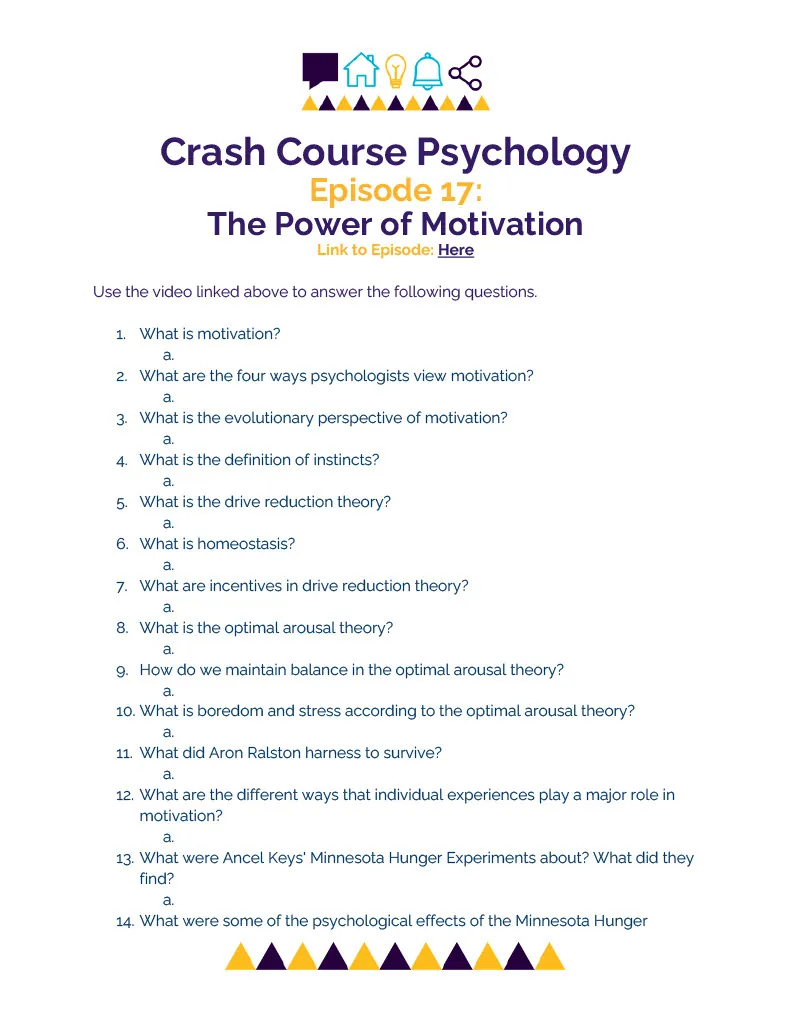
Crash Course Psychology Worksheet | 17 - The Power of Motivation

- Grades
- Grades 10–12, High School
- File type
- Microsoft Word
- Editable
- Yes


- Subject
- Social Studies, Psychology
- Topic
- Crash Course Worksheet, Crash Course Video
- Resource types
- Worksheets & Printables, Worksheets
- Editable
- Yes
About this resource
What's inside this resource
Related resources
More resources teachers may find useful
24 related resources were found using this product's title, contributor, categories and tags.


In the classroom
Teaching tips & learning objectives

Learning objectives
Define motivation and identify the four theoretical perspectives psychologists use to explain it: evolutionary, drive reduction, optimal arousal, and belonging
Explain drive reduction theory, including the concepts of homeostasis and incentives
Explain optimal arousal theory and how it differs from drive reduction theory

Teaching tips
Have students complete the sheet while watching the linked video, pausing at natural breaks between the four motivation theories
Use question 15's personal-reflection prompt as a class discussion starter after the video ends, since it asks students to connect the content to their own experience
Distribute the answer key afterward for self-checking, or use it to prep discussion talking points before class

Skills covered
Video-based note-taking — students extract and record definitions and theories directly from a spoken video source in response to guided questions.
Psychological theory comparison — students distinguish drive reduction theory, optimal arousal theory, and evolutionary and belonging-based explanations of motivation.
Case-study analysis — students summarize the Minnesota Hunger Experiments and connect real-world case studies (Aron Ralston) to abstract motivational concepts.
Good to know
Questions teachers ask about this resource
What did the Minnesota Hunger Experiments reveal about the psychological effects of starvation?
Participants became obsessed with food, lost interest in sex and social activities, and grew irritable, anxious, and depressed; the study also showed how frustrating one need (hunger) led to the decline of another, the need to belong, as participants withdrew from each other.
How does optimal arousal theory differ from drive reduction theory as presented here?
Drive reduction theory holds that a psychological need compels us to reduce that need and restore homeostasis, while optimal arousal theory holds that people are instead motivated to maintain a balance between stimulation and relaxation, avoiding both boredom and stress.

No reviews yet
Downloaded this resource? Tell other teachers how it went.
Resource details
Concepts & topics
Core concepts
 Core concepts
Drive reduction theory
Optimal arousal theory
Homeostasis and incentives
Need to belong
 Topics
Explore more
Categories this resource belongs to
Explore related searches
More to explore
You may also like