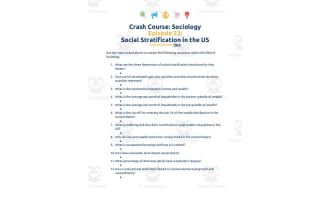
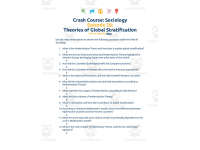
Crash Course Sociology Episode | 28 Theories of Global Stratification

- Grades
- Grades 10–12, High School
- File type
- Microsoft Word
- Editable
- Yes


- Subject
- Social Studies, Sociology
- Topic
- Crash Course, Crash Course Videos
- Resource types
- Worksheets & Printables, Worksheets
- Editable
- Yes
About this resource
What's inside this resource
Related resources
More resources teachers may find useful
24 related resources were found using this product's title, contributor, categories and tags.


In the classroom
Teaching tips & learning objectives

Learning objectives
Students will explain modernization theory and identify the two historical events it credits for Western Europe's faster development.
Students will describe Wallerstein's core, periphery, and semi-periphery model of the global economy.
Students will evaluate criticisms of both modernization theory and dependency theory.

Teaching tips
Have students watch the linked video first and pause to answer each question as its topic comes up, since the questions follow the video in order.
Use the answers document to run a whole-class discussion comparing student responses against the model answers.
Assign it as homework or independent classwork, since each question includes space for a written response and needs only the video link to complete.

Skills covered
Video-based comprehension — students extract specific facts and explanations from an assigned video, answering 15 short-answer questions in order.
Comparative analysis of sociological theories — students distinguish the claims and criticisms of modernization theory versus dependency theory.
Applying a conceptual model — students use Wallerstein's core/periphery/semi-periphery framework to categorize countries by economic role.
Good to know
Questions teachers ask about this resource
How do students access the video the questions are based on?
Both documents include a linked URL to the Crash Course Sociology episode the fifteen questions are drawn from, placed right below the episode title.
What does the core-periphery question ask students to do?
It asks students to explain Wallerstein's model, which sorts countries into a wealthy core, a resource-supplying periphery, and a semi-periphery of middle-income countries such as India or Brazil.

No reviews yet
Downloaded this resource? Tell other teachers how it went.
Resource details
Concepts & topics
Core concepts
 Core concepts
Global stratification
Modernization theory
Dependency theory
World systems theory
 Topics
Explore more
Categories this resource belongs to
Explore related searches
More to explore
You may also like