Double Pronouns French Exercises: Order, Y, En, Tenses and Commands
Two object pronouns in one French sentence, including y and en, are practiced in 25 items, from simple ordering to full rewrites in the present, passé composé, futur proche and imperative, affirmative and negative.


- Grades
- Grades 9–12, High School
- Pages
- 4
- File type
- Answer key
- Included


- Subject
- Foreign Languages, French
- Topic
- French assessment, double pronouns
- Answer key
- Included
About this resource
What's inside this resource
Me before le, le before lui, then y, then en: a five-box order chart across the top of page 1 shows where two French object pronouns sit in front of the verb. Three rule panes follow it, for statements (Elle me le prête), for affirmative commands, where the direct object comes first and moi + en becomes m’en, and for negative commands, infinitives and past-participle agreement.
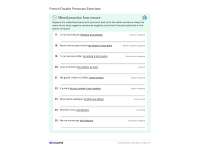
Part A gives six gapped sentences with two pronouns in scrambled order, so students decide only the order and the elision, as in Tu m’en donnes ? Part B asks for six full rewrites through negation, aller + infinitive and the passé composé, and Part C turns four commands into pronoun form. Part D on page 3 mixes nine more rewrites, each labeled with its tense: present, passé composé, futur proche or command, four of them negative, such as Nous n’avons pas montré les photos à nos amis.
The answer page lists all 25 answers with notes on agreement, a box of three common mistakes, a partner speaking prompt and an order chart recap.
Related resources
More resources teachers may find useful
24 related resources were found using this product's title, contributor, categories and tags.



In the classroom
Teaching tips & learning objectives

Learning objectives
- Place two object pronouns before the verb in the order me/te/se/nous/vous, le/la/les, lui/leur, y, en.
- Replace a direct object and an indirect object, a place or a de-phrase in one sentence with two pronouns.
- Keep both pronouns together before an infinitive in the futur proche and inside ne … pas.

Teaching tips
- Have students copy the five-box chart onto a scrap card and keep it beside them for every part; it gives the order for every item except the affirmative commands.
- Part A needs no rewriting, so it works as a quick warm-up before the full sentences in Parts B and D.
- Before items 11, 12, 18 and 21, review the agreement pane: la lettre gives envoyée, les clés gives mises, les photos gives montrées and cette montre gives offerte.

Skills covered
- Pronoun order — students place pairs such as les + nous, la + lui and les + leur in front of the verb using the five-box chart.
- Y and en — students write Elle les y met, Il y en a beaucoup, Vous les y emmenez and Il leur en a parlé.
- Placement with negation and infinitives — students rewrite Tu ne vas pas prêter ta voiture à ton cousin as Tu ne vas pas la lui prêter.
Good to know
Questions teachers ask about this resource
What should students know before starting?
The sheet assumes students can already replace a direct object with le, la or les and an indirect object with lui or leur, and form the present, passé composé, futur proche and imperative. Every item then combines two pronouns, so it fits as the step after single-pronoun practice.
How often do y and en appear?
Ten of the 25 items use them, from Il y en a beaucoup in Part A to Il leur en a parlé and Ne m’en donne pas in Part D. The chart places y before en at the end of the sequence, and the key notes that en never makes the participle agree.
Which negative forms are practiced?
Six items are negative: Il ne leur en sert pas in Part B, the command Ne les lui donne pas in Part C, and four in Part D across the present, passé composé, futur proche and a negative command. The key shows ne … pas around the auxiliary or the conjugated verb in each.

No reviews yet
Downloaded this resource? Tell other teachers how it went.
Resource details
Concepts & topics
Core concepts
 Core concepts
- Double object pronouns
- Pronoun order
- Pronouns y and en
- Imperative with pronouns
- Past-participle agreement
 Topics
Explore related searches
More to explore
You may also like