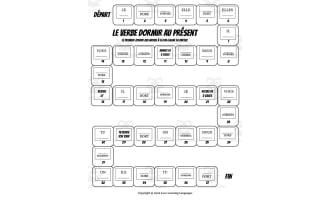
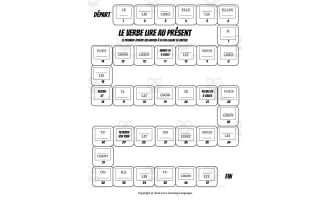
French Servir Conjugation – Present Tense Board Game
- Grades
- Grades 9–12, High School
- Pages
- 2
- File type
- Preparation
- Print ready


- Subject
- Foreign Languages, French
- Topic
- Board games, French
- Resource types
- Games, Activities
- Preparation
- Print ready
Product description
From the author
This resource is a French: Servir Conjugation Board Game - Present Tense.
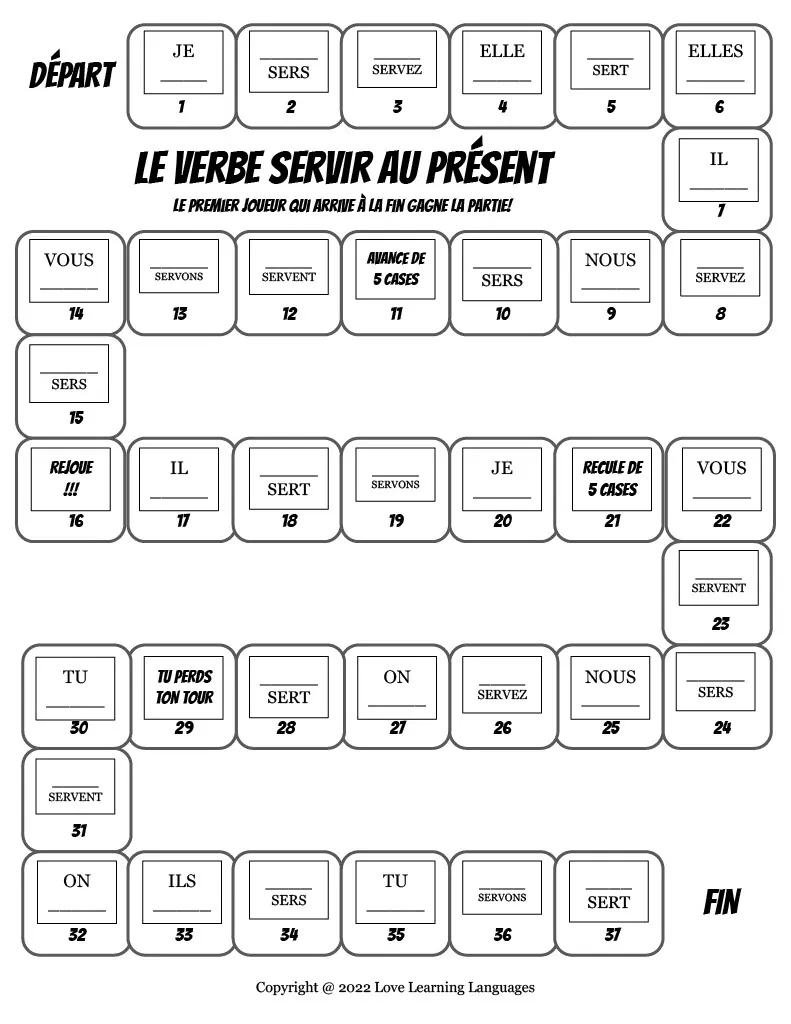
Print the one-page board and read the separate rules sheet. Supply a die for each group and a token for each player.
Students will conjugate servir along the way.
The first one to the finish line wins the game.
Related resources
More resources teachers may find useful
24 related resources were found using this product's title, contributor, categories and tags.



In the classroom
Teaching tips & learning objectives

Learning objectives
Conjugate servir in the present tense for any of the nine subjects printed on the board
Recognise the stem change between the singular and plural forms, moving from sers and sert to servons, servez and servent
Follow short French game instructions — Avance de 5 cases, Recule de 5 cases, Rejoue, Tu perds ton tour — with no English on the board

Teaching tips
Bring a die for each group and a token for each player; the rules sheet lists both under "Not included"
Groups of two to four are the stated size, so roughly one printed board for every three students covers a class
For a longer game, use the exact-landing variant on the rules sheet — the last square must be landed on directly and answered correctly

Skills covered
Conjugating an irregular -ir verb — players produce sers, sert, servons, servez or servent for the pronoun printed on the square they land on.
Handling a stem change — the board prints SERS and SERT alongside SERVONS, SERVEZ and SERVENT, so the difference between the singular and plural stems is visible in one place and has to be applied square by square.
Reading French instructions in play — four squares direct the turn in French alone, and the player has to act on them without an English prompt.

No reviews yet
Downloaded this resource? Tell other teachers how it went.
Resource details
Concepts & topics
Core concepts
 Core concepts
Verb conjugation
Present tense
Irregular verbs
Subject pronouns
French grammar
 Topics
Explore more
Categories this resource belongs to
Explore related searches
More to explore
You may also like