Fruits and Vegetables in German

- Grades
- Preschool, K–3
- Pages
- 39
- File type
- Preparation
- Print ready


- Subject
- Foreign Languages, German
- Topic
- German vocabulary, Fruits
- Resource types
- Worksheets, Activities, Flashcards
- Preparation
- Print ready
Product description
From the author
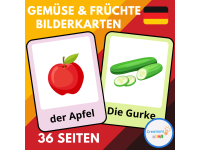
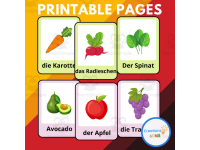
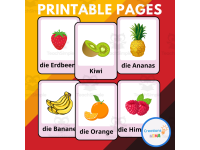
Make learning German fresh and fun with this colorful set of Fruits and Vegetables Flashcards! Whether you're teaching native German speakers, language learners, or introducing basic vocabulary at home, this resource is a versatile and engaging way to build vocabulary.
These flashcards are perfect for classrooms, language centers, homeschool activities, or visual displays. The kid-friendly illustrations make learning enjoyable and help students connect words with real-life objects.
What’s Included:
✔ 36 illustrated vocabulary cards, plus two dividers and a closing page
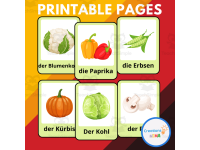
✔ Bright and clear visuals for each fruit and vegetable
✔ Vocabulary in German with matching illustrations
✔ PDF format, ready to print on 8.5 x 11" paper
✔ Easy to cut, laminate, and reuse
Great for:
German language lessons (both native and non-native speakers)
Visual learners and younger students
Classroom centers and vocabulary walls
Homeschooling and independent practice
Related resources
More resources teachers may find useful
24 related resources were found using this product's title, contributor, categories and tags.



In the classroom
Teaching tips & learning objectives

Learning objectives
Name eighteen vegetables and eighteen fruits in German
Give each noun with its definite article, separating der words (Spinat, Pilz, Knoblauch, Mais, Kohl, Kürbis, Salat, Blumenkohl, Apfel, Pfirsich) from die words (Gurke, Tomate, Karotte, Zwiebel, Aubergine, Paprika, Erdbeere, Banane, Orange, Zitrone) and the one das word, Radieschen
Recognise the plural forms used on selected cards — die Kartoffeln, die Erbsen, die Trauben

Teaching tips
The two dividers split the deck into vegetables and fruits, so each half can be taught, cut and drilled as its own set of eighteen.
Because the article is printed with the noun, folding or covering the first word turns the same deck from a vocabulary drill into a gender drill without any extra preparation.
Kiwi, Mango and Avocado carry no article on the card, which makes them a natural trio for a short dictionary check before the deck goes into circulation.

Skills covered
German food vocabulary — thirty-six produce nouns, eighteen vegetables and eighteen fruits, presented one to a page for cutting into cards.
Recognising German plural forms — die Kartoffeln, die Erbsen and die Trauben are given in the plural rather than the singular.
Category sorting — the die Gemüse and die Früchte dividers give the cut deck two ready categories to sort back into.
Good to know
Questions teachers ask about this resource
Can every page be used directly for noun-gender practice?
Most entries carry an article, but Kiwi, Mango, and Avocado are printed without one. Check the wording and supply the needed articles before assigning gender work.

No reviews yet
Downloaded this resource? Tell other teachers how it went.
Resource details
Concepts & topics
Core concepts
 Core concepts
German vocabulary
Noun gender
Fruits and vegetables
Flashcards
 Topics
Explore more
Categories this resource belongs to
Explore related searches
More to explore
You may also like