Industrial Revolution Cheat Sheet – 1-Page Guide
- Grades
- Grades 7–10
- Pages
- 1
- File type
- Preparation
- Print ready


- Subject
- Social Studies
- Topic
- Industrial Revolution, Inventors
- Resource types
- Posters, Teacher Tools
- Preparation
- Print ready
Product description
From the author
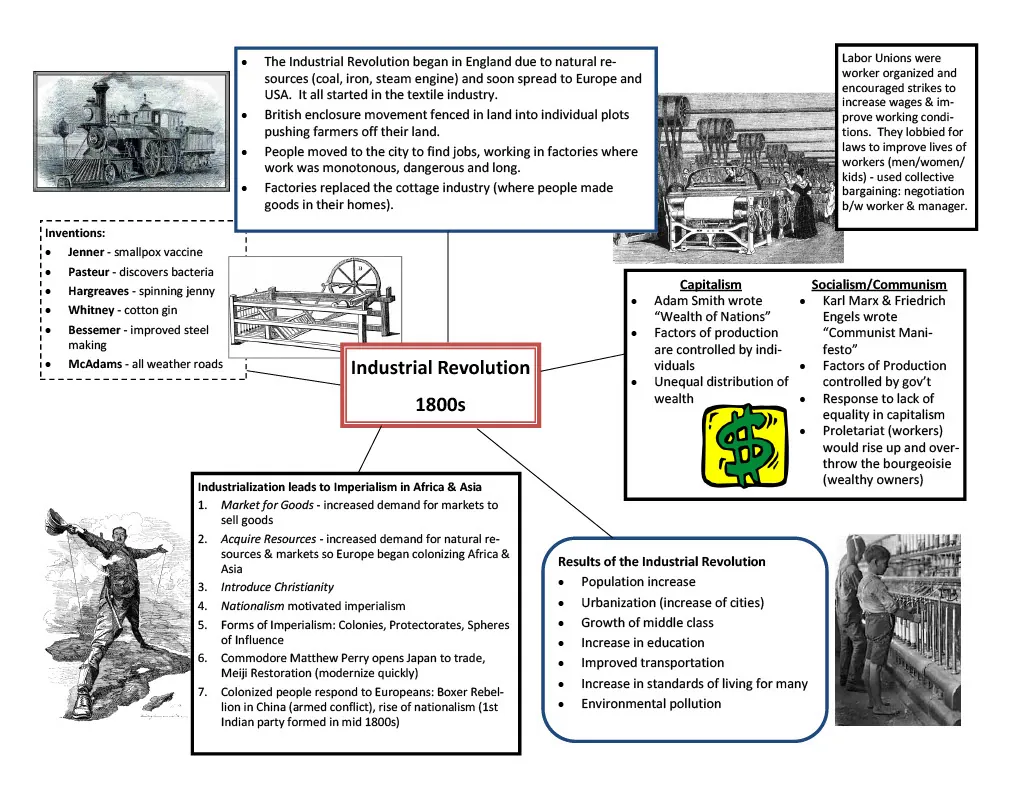
The Industrial Revolution Cheat Sheet is a 1-page printable graphic to distribute to students.
This sheet serves as a great reference page, study guide or introduction chart.
This gives students bullet points of information in a concise fashion.
Related resources
More resources teachers may find useful
24 related resources were found using this product's title, contributor, categories and tags.



In the classroom
Teaching tips & learning objectives

Learning objectives
Students review the causes of the Industrial Revolution, including natural resources, the enclosure movement, and the shift from cottage industry to factory labor.
Students compare capitalism and socialism/communism through their key thinkers (Adam Smith; Marx and Engels) and core ideas about who controls production.
Students connect industrialization to European imperialism in Africa and Asia, citing specific examples such as the Boxer Rebellion and the opening of Japan.

Teaching tips
Use this sheet as a pre-test or unit-review reference rather than a first introduction, since it condenses many linked concepts (causes, inventors, ideologies, imperialism) into a single dense page.
Pair the capitalism-versus-socialism comparison with the imperialism section to help students see how economic competition for markets and resources connected to European colonization.

Skills covered
Cause-and-effect reasoning — students trace how resource access and the enclosure movement led to factory-based industrialization and its social results.
Comparative analysis — students contrast capitalism and socialism/communism by their key texts, thinkers, and views on production and inequality.
Historical connections — students link industrialization's demand for markets and resources to specific imperialist actions in Africa and Asia.

No reviews yet
Downloaded this resource? Tell other teachers how it went.
Resource details
Concepts & topics
Core concepts
 Core concepts
Industrial revolution
Imperialism
Capitalism
Labor unions
 Topics
Explore related searches
More to explore
You may also like