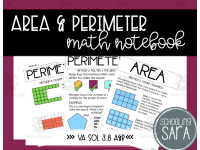
Area & Perimeter Interactive Notebook – Math Set



- Grades
- Grade 3, Elementary
- File type
- Preparation
- Print ready


- Subject
- Math, Measurements
- Topic
- mathematics, measurements
- Resource types
- Worksheets & Printables, Worksheets
- Preparation
- Print ready
About this resource
What's inside this resource
This product covers the 2016 Virginia (VA) Standards of Learning (SOL) 3.8: The student will estimate and a) measure the distance around a polygon in order to determine its perimeter using U.S. Customary and metric units; and b) count the
(note that this will also work for the 2023 VA SOL 3.MG.2 The student will use multiple representations to estimate and solve problems, including those in context, involving area and perimeter (in both U.S. Customary and metric units).
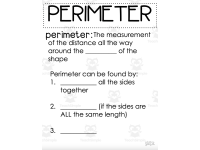
It contains notes pages on what area and perimeter are, how to find area using a formula, how to find area using a grid, how to find the perimeter of a polygon. It also has notes pages on finding the perimeter of equilateral shapes.
There are practice pages for each topic, with an answer key included.
The notes pages come in two sizes. The first size is a full-page size. You can print them as-is, or you can print them two to a pages. This is what I do as it saves on paper and the sheets will fit in a notebook. The second size is formatted to fit on a standard composition notebook page.
Additionally, there are two links included in the pdf: one which opens a digital version of the notes, and another that opens a slide show version, optimized for a projector or interactive board. In both cases, which you click the link, you will be prompted to make a copy, which you can then use with Google Slides or download and use with Keynote or PowerPoint.
What's included?
About Area
Finding the Area of a Rectangle
Finding Area Using a Grid
Area Practice
About Perimeter
Finding Perimeter
Finding Perimeter of Equilateral Shapes
Finding Perimeter Using a Grid
Perimeter Practice
For more no and low-prep activities, check these out:
October No-Prep Math Activities
No Prep Spiral Math Daily Review and Quizzes
Related resources
More resources teachers may find useful
24 related resources were found using this product's title, contributor, categories and tags.


In the classroom
Teaching tips & learning objectives

Learning objectives
Find the area of a rectangle or square by multiplying length by width.
Find the area of an irregular shape on a grid by counting unit squares.
Find the perimeter of a polygon by adding the length of each side.

Teaching tips
Print the full-size pages two-to-a-sheet to save paper, or use the separate notebook-sized set that is already formatted to cut and glue into a spiral or composition notebook, as the file itself suggests.
Each you-try practice page includes a real-world context question (a tablecloth, a garden's stone border, a fenced yard) alongside the plain shape problems, so plan a moment to walk through translating the word problem into the shape before students solve it.
The perimeter Method 2 pages remind students the equal-sides shortcut only works when every side is the same length; flag this limitation before students reach for it on an irregular polygon.

Skills covered
Area by multiplication — students apply the formula length x width to find the area of rectangles and squares given side measurements in different units (cm, in, ft).
Area by unit counting — students find area on a grid by counting whole and shaded unit squares, including a real-world tablecloth-fabric problem.
Perimeter by addition — students add each side's length to find the total perimeter of irregular polygons.
Good to know
Questions teachers ask about this resource
Why does the perimeter section include three different methods instead of just one?
Each method fits a different kind of shape: adding the sides works for any polygon, multiplying works only when every side is equal, and counting grid units is for shapes drawn on a grid rather than labeled with measurements.

No reviews yet
Downloaded this resource? Tell other teachers how it went.
Curriculum
Standards, concepts & topics
Standards
 Standards
- 3. MD.C.7 — Relate area to the operations of multiplication and addition. a. Find the area of a rectangle with whole-number side lengths by tiling it, and show that the area is the same as would be found by multiplying the side lengths. b. Multiply side lengths to find areas of rectangles with whole-number side lengths in the context of solving real world and mathematical problems, and represent whole-number products as rectangular areas in mathematical reasoning. c. Use tiling to show in a concrete case that the area of a rectangle with wholenumber side lengths a and b + c is the sum of a × b and a × c. Use area models to represent the distributive property in mathematical reasoning. d. Recognize area as additive. Find areas of rectilinear figures by decomposing them into non-overlapping rectangles and adding the areas of the nonoverlapping parts, applying this technique to solve real world problems.
- 3. MD.D.8 — Solve real world and mathematical problems involving perimeters of polygons, including finding the perimeter given the side lengths, finding an unknown side length, and exhibiting rectangles with the same perimeter and different areas or with the same area and different perimeters.
- 3. MD.C.6 — Measure areas by counting unit squares (square cm, square m, square in, square ft, and improvised units).
Core concepts
 Core concepts
area
perimeter
square units
polygons
Topics
 Topics
Explore more
Categories this resource belongs to
Explore related searches
More to explore
You may also like