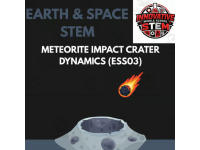
Meteorite Impact Crater Dynamics STEM Challenge (ESS03)



About This Product
Bring planetary geology, kinetic energy transfer mechanics, lunar regolith ray patterns, solar system bombardment history, and crater geometry ratio math to life with the Meteorite Impact Crater Dynamics STEM Challenge (ESS03)! Designed for Middle School Earth & Space Science, Physical Science, Physics, Math, and STEM classes across Grades 6–8, this 3-page, print-ready lab packet challenges students to model meteorite strikes on flour-and-cocoa planetary surfaces.
What Is Included in This 3-Page Packet?
📋 Page 1: Teacher Guide & Lesson Plan
Features NGSS alignment (MS-ESS1-3 Solar System Objects & Geology, MS-PS3-1 Kinetic Energy & Mass/Speed Relationships), key planetary physics concepts, regolith tray preparation directions, measurement troubleshooting tips, and a full teacher answer key.
☄️ Page 2: Student Mission Card & Blueprint
Hooks students with a planetary geology mission to analyze impact cratering history on the Moon, Mars, and Mercury. Includes material constraints (target tray, flour base, cocoa powder surface layer, 2 impactor marbles/spheres, meter stick, metric ruler) and a dedicated schematic sketching zone to diagram crater rim profiles, central peaks, depth cross-sections, and radial ejecta blanket rays.
📊 Page 3: Testing Log & Scientific Reflection
Features a structured lab data table tracking impactor mass in grams, drop height release elevation in centimeters, crater rim diameter in millimeters, crater depth in millimeters, and ejecta blanket blast distance. Includes an applied math section to calculate Crater Diameter-to-Depth Ratios, followed by reflection questions analyzing potential-to-kinetic energy conversion, mass vs. velocity kinetic energy scaling, and atmospheric impact protection differences between Earth and airless celestial bodies.
Educational Value & Key Benefits:
Hands-On Space & Physical Science: Connects impactor velocity and mass directly to surface deformation, kinetic wave dispersion, and crater geometry.
Integrates Applied Math & Ratio Calculations: Teaches students how to record millimeter and centimeter measurements to compute structural diameter-to-depth ratios.
Low-Cost High-Engagement STEM: Uses inexpensive kitchen supplies like baking pans, flour, cocoa powder, marbles, and rulers for a visually dramatic space physics lab across Grades 6–8.
Resource Tags
0 Reviews
Check out these other great products