Modern Marvels: Panama Canal Video Questions


- Grades
- Grades 6–11, Middle School, High School
- File type
- Preparation
- Print ready


- Subject
- Social Studies, History, History: USA
- Topic
- Panama Canal, Roosevelt
- Resource types
- Activities
- Preparation
- Print ready
About this resource
What's inside this resource
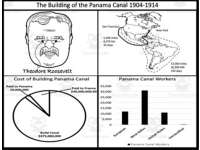
The Panama Canal is a large waterway that connects the Atlantic and Pacific Oceans through the Isthmus of Panama in Central America. The canal is an engineering marvel and a key route for global maritime trade, allowing ships to save time and distance by avoiding the longer and more dangerous route around the southern tip of South America. The idea of constructing a canal through Panama was first proposed in the 16th century by Spanish explorers, but it was not until the late 19th century that serious efforts were made to build the canal. The construction of the canal was a massive undertaking that involved digging a 50-mile-long canal across the isthmus, creating an artificial lake, and building a series of locks to lift ships up and down the canal's elevation changes. The canal was built by the United States between 1904 and 1914, with the French having previously attempted but failed to complete the project. The canal was officially opened on August 15, 1914, and since then has become one of the most important shipping routes in the world. The canal allows ships to travel between the east and west coasts of North and South America, as well as to and from Asia, Europe, and Africa, making it a vital component of global trade and commerce. In 1999, the Panama Canal was transferred from the United States to Panama, and it is now operated and managed by the Panama Canal Authority. The canal continues to play a vital role in global trade, with millions of tons of cargo passing through each year. The canal has also become a popular tourist attraction, with visitors from around the world coming to see the engineering feat that has connected two oceans and changed the course of history.
These movie questions are designed to help students grasped the important information from the History Channel video titled "Modern Marvels: Panama Canal." An incredible tale of drama, history, and action. See engineers tackle the most daunting project ever attempted. The video will serve as a great supplement to any history lesson about the Panama Canal and American Imperialism.
Here is the link to the video:
Modern Marvels: Panama Canal (episode 2)
Topics explored in this movie: Theodore Roosevelt, Panama Independence, Yellow Fever, Engineering, Roosevelt Corollary
Thumbnail Clipart Credit: Prince Padania
Related resources
More resources teachers may find useful
24 related resources were found using this product's title, contributor, categories and tags.


In the classroom
Teaching tips & learning objectives

Learning objectives
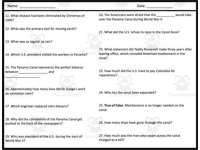
Capture specific factual detail from a documentary while it plays, keeping each answer matched to its numbered prompt as the film moves forward
Name the people behind the canal - Theodore Roosevelt, John Frank Stevens, George Washington Goethals and Dr Gorgas - and say what each contributed
Explain the disease problem the project faced and the effect of the sanitation work, using the film's own figures: yellow fever eliminated by Christmas 1905 and roughly 71,000 lives saved

Teaching tips
The episode itself is not part of the download, so queue it before the lesson and check its running order against the sheet - the questions are printed in the sequence the film answers them
Questions 1-10 sit on the first page and 11-27 on the second, which gives a natural pause point partway through the film for a quick check of answers so far
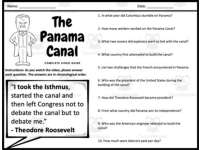
Question 22 asks for a remark that is already printed in the sheet's own margin, so it works better as a discussion prompt about what "I took the Isthmus" revealed than as a recall item

Skills covered
Note-taking from film - students record 27 specific facts while a documentary plays, working from prompts printed in the order the answers arrive.
Listening for named detail - items call for particular people (John Frank Stevens, George Washington Goethals, Franklin D. Roosevelt) and particular figures (100,000 workers, 90 cents a day, $25 million) rather than general impressions.
Cause and effect in United States history - questions tie the French failure to terrain and disease, the canal's quiet completion to the outbreak of the First World War, and the modern expansion to increased access.
Good to know
Questions teachers ask about this resource
Which film does the question sheet follow, and where does the film come from?
It is built around the Modern Marvels episode on the Panama Canal, named in the file title and in the printed direction "As you watch the video, please answer each question." The episode is sourced separately; the download supplies the question sheet, the title page and the completed Teacher KEY.
In what order do the questions run against the film?
Chronologically, and the sheet says so: "The answers are in chronological order." Item 1 asks the year Columbus reached Panama (1502), the middle items cover the French attempt, the 1905 yellow-fever campaign and the two world wars, and the last items reach present-day tolls and maintenance.
How many of the 27 items ask for something other than a written recall answer?
Three. Question 15 gives a sentence with two blanks to complete ("technology; teamwork"), question 20 gives a single blank ("Nazis"), and question 25 is a true/false item about whether maintenance is still needed. The other twenty-four are short written answers.

No reviews yet
Downloaded this resource? Tell other teachers how it went.
Resource details
Concepts & topics
Core concepts
 Core concepts
Panama Canal
American imperialism
Theodore Roosevelt
Video note-taking
United States history
 Topics
Explore more
Categories this resource belongs to
Explore related searches
More to explore
You may also like