Photosynthesis Lesson, Worksheets, and Experiments for 5th, 6th, & 7th



Science, Earth and Environmental Sciences, Earth Sciences, Physics, Nature & Plants, Biology


About This Product
Photosynthesis Lesson, Worksheets, and Experiments for 5th, 6th, and 7th Grade Science
I created this resource for teachers and parents who want a straightforward and engaging way to introduce photosynthesis to upper-elementary and middle-grade learners. I put together reading, comprehension questions and simple experiments in this lesson. It gives students a chance to learn the concept of photosynthesis step by step, while still keeping the lesson easy to teach and enjoyable for kids.
What’s inside?
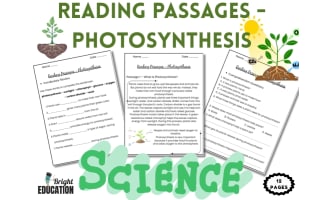
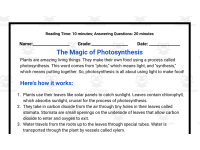
A detailed reading passage that explains photosynthesis in clear, student-friendly language
Seven comprehension questions with an answer key
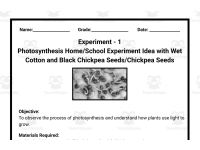
Three experiment guides that show photosynthesis in action
Discussion questions for each experiment, along with suggested answers
Safety notes and precautions for all hands-on activities
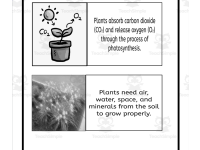
Anchor charts to support visual understanding
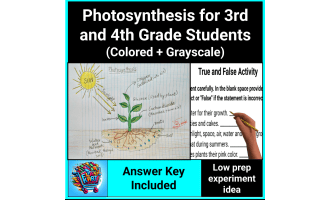
A True/False activity (answer key is included)
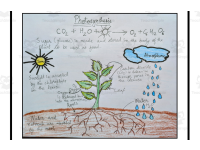
A diagram page that helps students label and understand the photosynthesis process
A creative dialogue-writing worksheet related to photosynthesis
Complete answer keys for every worksheet is included
Resource highlights
I wrote this reading passage with older elementary and younger middle-school students in mind. This lesson is clear enough for independent reading but still detailed enough for science instruction. The experiments use materials that are easy to find and take students beyond the textbook. All the discussion questions give structure to classroom conversations and help students connect what they read with what they observe. There’s also a creative writing component for teachers who like to include literacy work in their science lessons.
Ways to use this resource:
Reading activity: Introduce the topic with the passage and ask the students to solve all the comprehension questions.
Science lessons: Use the three experiments given inside to deepen understanding and encourage observation.
Vocabulary practice: Build a word wall or glossary using terms such as photosynthesis, chlorophyll, carbon dioxide, glucose, and stomata.
Creative projects: Have students draw or label their own diagrams to show the process of photosynthesis on a blank sheet or in their notebooks.
ESL support: This passage also works well for English learners as it includes clear definitions and repeated vocabulary.
Value for teachers, homeschoolers, and parents
Teachers will appreciate this ready to use lesson as everything inside is organized and easy to implement, even on a busy day.
Homeschoolers will find the step by step structure very useful and helpful, especially while conducting experiments.
Parents can use this resource to review science concepts at home. This lesson will help them support what students are already learning in school.
photosynthesis, science education, 5th grade science, 6th grade science, 7th grade science, 4th grade science, ESL learning, plant biology, elementary science, reading comprehension, hands-on learning, science experiments, chlorophyll, carbon dioxide, glucose, stomata, vocabulary building, homeschooling, teacher resources, parent support, science resources, EVS
Resource Tags
0 Reviews
Check out these other great products