New York NYS ELA Practice Test for Grade 4


- Grades
- Grade 4, Elementary, Homeschool Resources
- Pages
- 30
- File type
- Answer key
- Included


- Subject
- ELA, Reading Comprehension, Writing
- Topic
- new york, nys
- Resource types
- Assessments, Teacher Tools, Tests, Quizzes and Tests, Worksheets & Printables
- Answer key
- Included
- Standards
- CCSS.W.4.1 CCSS.RI.4.2 +1
About this resource
What's inside this resource
Looking for a Grade 4 ELA practice test aligned to New York State standards? This comprehensive resource gives students realistic test prep while strengthening reading comprehension, vocabulary, and multi-paragraph writing skills.
What’s Included
Full Grade 4 ELA Practice Test (3 sessions)
7 engaging passages (fiction, myth, historical fiction, informational texts, poetry, and paired texts)
35 student questions (multiple choice, short response, extended response)
Answer Key with detailed explanations
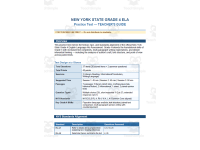
Teacher’s Guide with standards alignment & instructional support
Built-in rubrics for short responses and extended writing
Printable, classroom-ready format
How It Works in the Classroom
This Grade 4 ELA test prep resource mirrors real testing conditions and is easy to implement:
Whole-class test simulation
Small group intervention
Independent practice or homework
Test prep centers or review days
Sub plans with zero prep needed
Students complete 3 structured sessions covering literary texts, informational texts, vocabulary, and writing—just like the real exam format.
Standards & Learning Goals
Aligned to Grade 4 ELA Common Core / NYS Standards, including:
RL.4.1–RL.4.5 (theme, character, figurative language)
RI.4.1–RI.4.9 (main idea, text structure, evidence)
W.4.1 (opinion writing with evidence and counterargument)
L.4.1–L.4.4 (grammar and vocabulary skills)
Students will:
Analyze theme, character, and figurative language
Use text evidence to support responses
Compare multiple texts and author’s purpose
Determine vocabulary meaning using context clues
Write multi-paragraph opinion responses with evidence
Why Teachers Love It
✅ Realistic test format builds confidence and stamina
✅ Higher-level rigor aligned to Grade 4 expectations
✅ Time-saving with answer keys and rubrics included
✅ Data-driven insights to guide instruction
✅ Engaging, diverse passages students actually enjoy
✅ Easy to print and use—no prep required
Take the stress out of test prep with this Grade 4 ELA practice test. Add it to your classroom today and help your students feel confident and prepared for state assessments!
Related resources
More resources teachers may find useful
24 related resources were found using this product's title, contributor, categories and tags.


In the classroom
Teaching tips & learning objectives

Learning objectives
Students identify and explain figurative language (simile, metaphor, personification) and its effect within literary passages.
Students determine main idea, theme, and text structure across literary and informational texts.
Students use context clues to determine the meaning of grade-level vocabulary.

Teaching tips
Use the teacher's guide's per-passage discussion prompts to pre-teach genre and vocabulary (e.g., pourquoi tale, zooxanthellae) before students encounter each passage cold on the test.
Model the 'some say... but...' counterargument sentence frame before assigning the extended-response essay, since it is the most commonly missed element per the skill-gap chart.
Use the student self-revision checklist during drafting or conferencing for the extended-response question rather than only at final submission.

Skills covered
Figurative language identification — students distinguish simile, metaphor, and personification across a short story, a myth, historical fiction, and a poem.
Text structure and central idea analysis — students identify chronological and cause-effect structures and determine main idea in informational passages on coral reefs and Harriet Tubman.
Evidence-based short response — students answer 2-point short-response questions requiring two specific text details, following the guide's Topic + Evidence + Explanation model.
Good to know
Questions teachers ask about this resource
What distinguishes the two informational passages used for Session 2 from the paired opinion passages used for the extended writing task?
The Session 2 informational passages (coral reefs and Harriet Tubman) are explanatory texts assessed for main idea, structure, and vocabulary, while the paired opinion passages (7A and 7B, on longer school days) present opposing arguments specifically so students can synthesize evidence and a counterargument into their own extended-response essay.
How does the teacher's guide suggest handling a student who picks a 'distractor' answer that is technically true but doesn't answer the question asked?
It recommends teaching an 'answer the question test' where students re-read the question after choosing an answer to confirm the choice actually addresses what was asked, not just a true statement from the passage.

No reviews yet
Downloaded this resource? Tell other teachers how it went.
Curriculum
Standards, concepts & topics
Standards
 Standards
- CCSS.W.4.1 — Write opinion pieces on topics or texts, supporting a point of view with reasons and information. a. Introduce a topic or text clearly, state an opinion, and create an organizational structure in which related ideas are grouped to support the writer’s purpose. b. Provide reasons that are supported by facts and details. c. Link opinion and reasons using words and phrases (e.g., for instance, in order to, in addition). d. Provide a concluding statement or section related to the opinion presented.
- CCSS.RI.4.2 — Determine the main idea of a text and explain how it is supported by key details; summarize the text
- CCSS.L.4.5 — Demonstrate understanding of figurative language, word relationships, and nuances in word meanings. a. Explain the meaning of simple similes and metaphors (e.g., as pretty as a picture) in context. b. Recognize and explain the meaning of common idioms, adages, and proverbs. c. Demonstrate understanding of words by relating them to their opposites (antonyms) and to words with similar but not identical meanings (synonyms).
Core concepts
 Core concepts
Figurative language
Text structure
Main idea
Evidence-based response
Counterargument
Topics
 Topics
More to explore
You may also like