New York NYS ELA Practice Test for Grade 8

- Grades
- Grade 8, Middle School, Homeschool Resources
- Pages
- 30
- File type
- Answer key
- Included
- Subject
- ELA, Reading Comprehension, Writing, Grammar
- Topic
- new york, nys
- Resource types
- Assessments, Teacher Tools, Tests, Quizzes and Tests, Worksheets & Printables
- Answer key
- Included
- Standards
- CCSS.W.8.1 CCSS.RI.8.8 +1
About this resource
What's inside this resource
Product description
From the author
Looking for a Grade 8 ELA practice test aligned to New York State standards? This rigorous assessment prepares students for high school by building advanced reading analysis, argument evaluation, and formal academic writing skills.
What’s Included
Full Grade 8 ELA Practice Test (3 sessions)
Complex literary and informational passages (including canonical poetry and modern texts)
40 total questions + extended argument essay
Answer Key with detailed explanations and scoring guidance
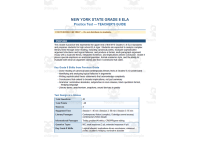
Teacher’s Guide with standards alignment, pacing, and intervention strategies
Built-in rubrics for short responses and extended writing
Printable, no-prep format
How It Works in the Classroom
This Grade 8 ELA test prep resource mirrors real NYS testing expectations and prepares students for high school-level rigor:
Full-length test simulation (3 sessions)
Small group intervention and reteaching
Independent practice or homework
Test prep centers or review rotations
Sub plans with zero prep required
Students engage in close reading, analyze complex arguments, identify logical fallacies, and complete a formal essay with a nuanced thesis, counterargument, and implications-based conclusion.
Standards & Learning Goals
Aligned to Grade 8 ELA Common Core / NYS Standards, including:
RL.8.2–RL.8.6 (theme, characterization, structure, author’s perspective)
RI.8.2–RI.8.9 (argument analysis, reasoning, evaluating evidence, fallacies)
W.8.1 (formal argument writing with counterargument and implications)
L.8.1–L.8.4 (advanced grammar, academic language, precision)
Students will:
Analyze complex literary texts and canonical poetry
Evaluate arguments, reasoning, and logical fallacies
Distinguish between claims, evidence, and rhetorical strategies
Use precise academic language and formal tone
Write sophisticated, multi-paragraph argument essays
Why Teachers Love It
✅ Prepares students for high school ELA expectations
✅ Focus on logical fallacies + argument evaluation (high-demand skill)
✅ Strong emphasis on academic writing and formal style
✅ Time-saving with answer key, rubrics, and teacher guidance
✅ Data-driven insights for targeted instruction
✅ Engaging, rigorous passages across genres
✅ Easy to print and implement
Take your test prep to the next level with this Grade 8 ELA practice test. Add it to your classroom today and help students build the advanced skills they need for success in high school and beyond!
In the classroom
Teaching tips & learning objectives
Learning objectives
Analyze theme, character, and figurative language in literary passages, including a canonical poem.
Evaluate argument structure, evidence quality, and logical fallacies across informational and paired opinion texts.
Apply Grade 8 grammar and mechanics conventions, including nominative absolutes, subjunctive mood, and parallel structure.
Write a formal, multi-paragraph argument essay with a nuanced thesis, integrated evidence from two texts, and a substantive counterargument and rebuttal.
Teaching tips
Use the teacher script provided for each session so directions are read consistently before Sessions 1, 2, and 3.
Pre-teach consequentialism vs. deontology before assigning the trolley-problem passage, as the guide notes the passage assumes some familiarity with those terms.
Have students read the Kubla Khan excerpt aloud twice — once for meaning and once for sound — before answering the sound-device questions, per the guide's instructional note.
Use the common-skill-gaps table (e.g., turning 'this proves' into 'this suggests' for hedging language) as a targeted mini-lesson before the extended writing task.
Skills covered
Literary analysis — students interpret theme, character motivation, and figurative/sound devices in short fiction and a canonical poem.
Argument evaluation — students assess evidence quality, structure, and logical fallacies across informational and paired opinion passages.
Grammar and mechanics — students apply Grade 8 conventions including nominative absolutes, subjunctive clauses, ellipsis, and block quotations.
Formal argumentative essay writing — students construct a multi-paragraph essay with thesis, counterargument, rebuttal, and broader implications.
Good to know
Questions teachers ask about this resource
Why does the practice test pair a neuroscience-based passage against a comparative-data passage on the same voting-age question rather than presenting one straightforward argument?
Pairing the two passages forces students to weigh different evidence types against each other — country-level turnout comparisons versus prefrontal-cortex development research — so the task tests evaluation of evidence quality, not just comprehension of a single argument.
Why does the teacher's guide say the He Jiankui case is included in the CRISPR passage even though its ethics were near-universally condemned?
The guide explains that the case functions as the pivotal example that moves CRISPR's risks from theoretical to actual and documented, giving students a concrete instance to evaluate rather than only an abstract ethical debate.
No reviews yet
Downloaded this resource? Tell other teachers how it went.
Curriculum
Standards, concepts & topics
Standards
- CCSS.W.8.1 — Write arguments to support claims with clear reasons and relevant evidence. a. Introduce claim(s), acknowledge and distinguish the claim(s) from alternate or opposing claims, and organize the reasons and evidence logically. b. Support claim(s) with logical reasoning and relevant evidence, using accurate, credible sources and demonstrating an understanding of the topic or text. c. Use words, phrases, and clauses to create cohesion and clarify the relationships among claim(s), counterclaims, reasons, and evidence. d. Establish and maintain a formal style. e. Provide a concluding statement or section that follows from and supports the argument presented.
- CCSS.RI.8.8 — Delineate and evaluate the argument and specific claims in a text, assessing whether the reasoning is sound and the evidence is relevant and sufficient; recognize when irrelevant evidence is introduced.
- CCSS.L.8.1 — Demonstrate command of the conventions of standard English grammar and usage when writing or speaking. a. Explain the function of verbals (gerunds, participles, infinitives) in general and their function in particular sentences. b. Form and use verbs in the active and passive voice. c. Form and use verbs in the indicative, imperative, interrogative, conditional, and subjunctive mood. d. Recognize and correct inappropriate shifts in verb voice and mood.*
Core concepts
theme analysis
argument evaluation
logical fallacies
grammar conventions
argumentative essay writing
Topics
More to explore