Poetry: A Crash Course
- Grades
- Grades 8–12, High School, Middle School
- File type
- Multiple File Types


- Subject
- ELA, Writing, Creative Writing, Literature, Poetry
- Topic
- poetry education, teaching resource
- Resource types
- Teacher Tools, Lesson Plans, Assessments, Activities
About this resource
What's inside this resource
Poetry: A Crash Course - An Effective Teaching Resource
Poetry: A Crash Course is a powerful, adaptable teaching resource, beneficial for educators in diverse educational environments ranging from public school classrooms to homeschooling setups. This unit serves as an enrichment tool for poetry studies, especially in scenarios where teaching time might be limited.
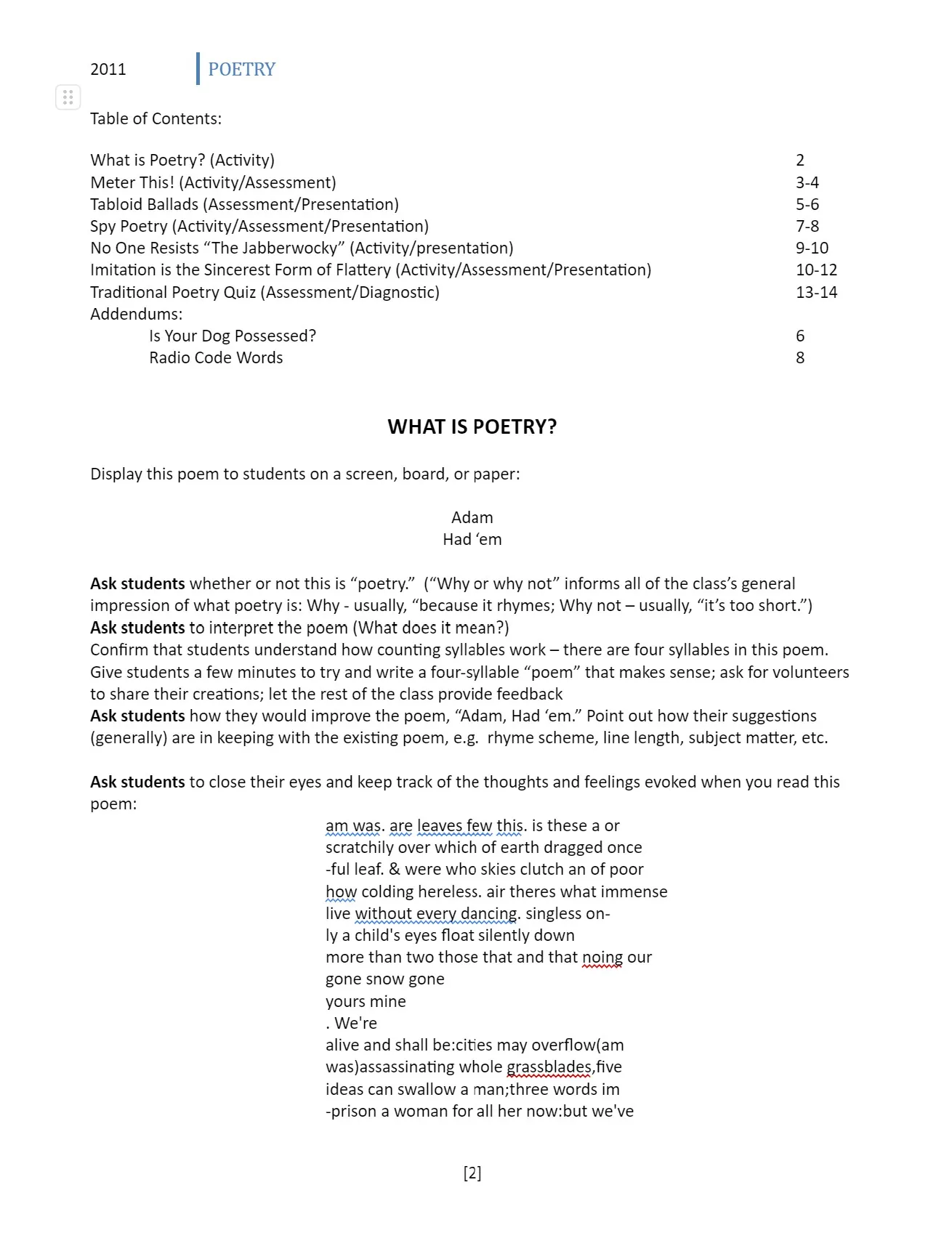
Six Distinct Lessons- Introduction to the fundamentals and appreciation of poetry.
- Wide range of unique writing styles.
- Easily applicable in whole group instruction, small group discussions or individual homework assignments.
An essential component that cultivates foundational understanding for learners. The packed unit expands into activities such as 'Meter This!' and 'Tabloid Ballads', providing students with creative engagement with poetic structures while offering assessable outputs.
Dynamism and Innovation within Unit
The 'Spy Poetry' and 'No One Resists The Jabberwocky' lessons provide interactive ways to involve students in poetical creations and recitations while the feature facet titled 'Imitation is the Sincerest Form of Flattery'nudges learners into demonstrating their understanding through mimicry of known works. To lighten up education's often strenuous hours come amusing intermissions like ‘Is Your Dog Possessed?’ and ‘Radio Code Words’.
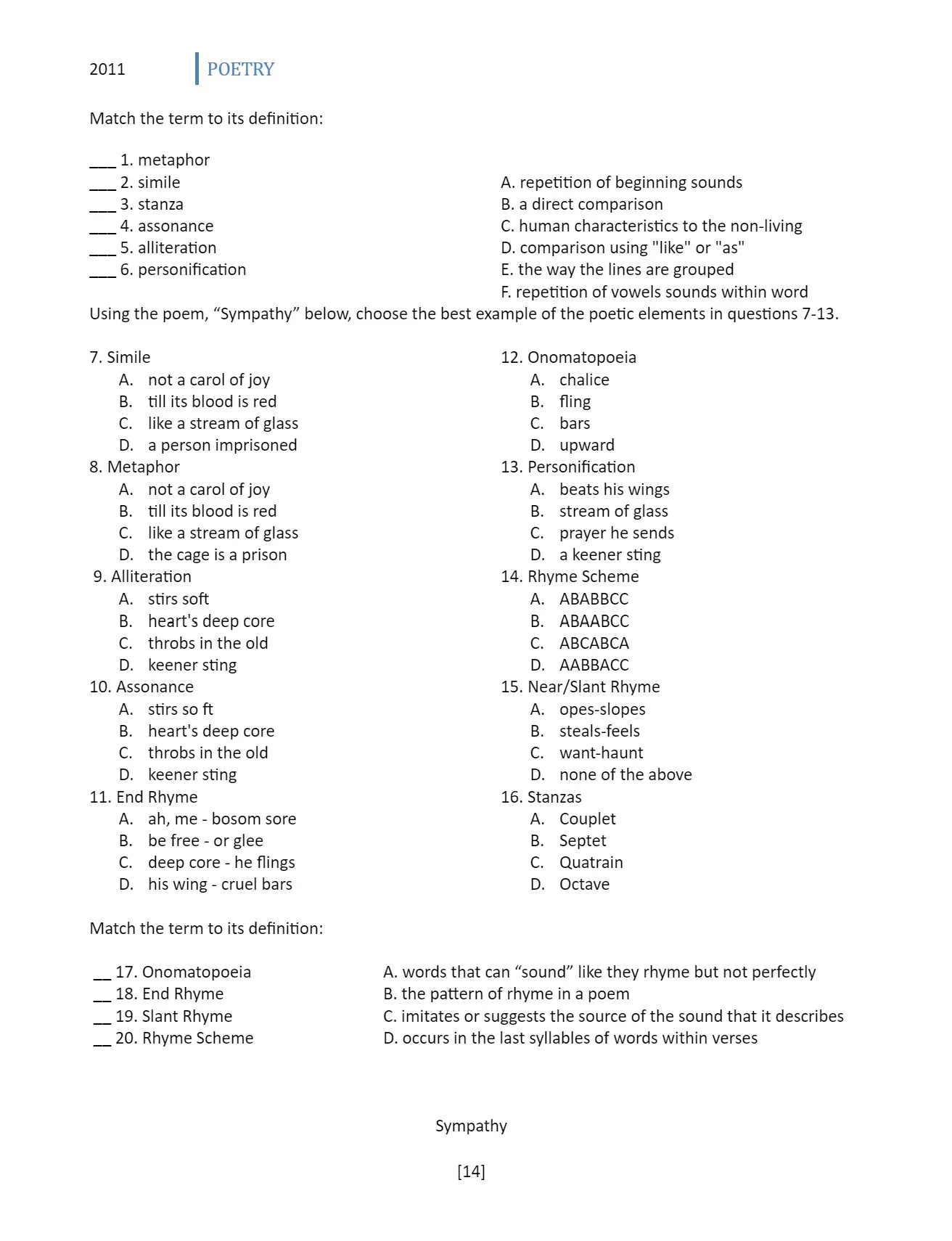
A Traditional Quiz Closing
The unit rounds off with a traditional poetry quiz serving both evaluation or grading purposes. Designed aptly for grades 8 through to grade 12,
Coverage Across Language Arts Areas:- Poetry Studies
- Creative Writing Skills Development
Format and Accessibility
In a convenient zip file format, Poetry: A crash course is an accessible resource designed for easy use.
The Ultimate Merge of Functionality & CreativityIf you need a flexible learning tool that both educates and inspires students about poetry within a limited timeframe, then prepare to explore Poetry: A Crash Course. It's practicality and creativity fashioned into one enriching educational package.
Related resources
More resources teachers may find useful
24 related resources were found using this product's title, contributor, categories and tags.
In the classroom
Teaching tips & learning objectives

Learning objectives
Identify the six basic metrical feet and scan a poem's meter.
Write an original ballad following traditional ballad-stanza conventions.
Compose a poem that imitates a mentor poem's stanza pattern, rhyme scheme, and style.

Teaching tips
The six lessons are designed to be taught in any order or independently, so pick and choose based on available time.
Use the Is Your Dog Possessed? tabloid article as the shared source material before assigning the ballad-writing task.
Assign the Traditional Poetry Quiz as a diagnostic before the unit or as a summative assessment after it, since it is labeled for either use.

Skills covered
Metrical scansion — students mark stressed and unstressed syllables to identify a poem's foot type and line length using Frost's poems.
Ballad composition — students write an original ballad in traditional stanza form based on a tabloid-style news story.
Poetic imitation — students mirror a mentor poem's stanza pattern, rhyme scheme, and style while writing about a new subject.
Good to know
Questions teachers ask about this resource
What poems does the imitation lesson use as models?
Students choose between Robert Hayden's 'Those Winter Sundays' and John Ashbery's 'Paradoxes and Oxymorons' as the poem they imitate.
How does the Spy Poetry lesson use the phonetic alphabet?
Students write a poem with as many lines as letters in their name, using one NATO Radio Code Word per line to spell their name phonetically.
How does the Jabberwocky activity work?
Students highlight the nonsense words in Lewis Carroll's poem, replace each with a real word of the same part of speech, and let a new subject emerge before rewriting the poem.

No reviews yet
Downloaded this resource? Tell other teachers how it went.
Resource details
Concepts & topics
Core concepts
 Core concepts
meter and scansion
ballad form
poetic imitation
literary devices
rhyme scheme
 Topics
Explore more
Categories this resource belongs to
Explore related searches
More to explore
You may also like