Psychological Mystery Files |Critical Thinking |Grades 9–12 | 100 Page



About This Product
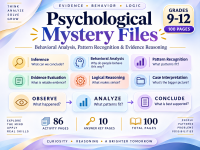
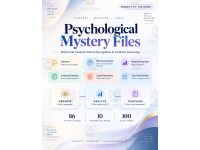
Psychological Mystery Files | Behavioral Analysis, Logic & Critical Thinking | Grades 9–12 | 100 Pages
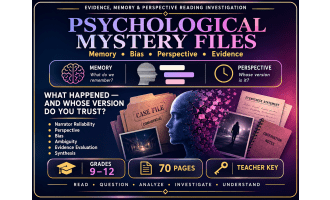
Challenge students to think critically, evaluate evidence, and investigate behavioral patterns with Psychological Mystery Files, a comprehensive 100-page educational workbook designed for high school students in Grades 9–12.
Featuring 86 student case activities across 10 learning units, this resource combines behavioral analysis, pattern recognition, logical reasoning, evidence evaluation, and case interpretation.
Students examine observations, analyze behavioral data, evaluate competing explanations, identify contradictions, and develop evidence-based conclusions through structured investigation activities.
What's Included:
100-page printable educational workbook
86 student investigation activity pages
516 questions
Six questions per activity page
10 structured learning units
10-page answer key (pages 91–100)
Behavioral pattern analysis
Evidence evaluation challenges
Graph and table interpretation
Timeline and statement analysis
Multi-source investigation cases
Final capstone investigations
10 Learning Units:
Baseline Behavior: Distinguish direct observations from inferences.
Pattern Recognition: Identify trends, behavioral shifts, and anomalies.
Competing Explanations: Test hypotheses and eliminate unsupported explanations.
Evidence Reliability: Evaluate bias, information gaps, and corroborating evidence.
Behavioral Data: Analyze behavioral frequency, patterns, and context.
Sequence & Timing: Examine chronology, timelines, and causal relationships.
Statement Analysis: Identify contradictions and evaluate wording and context.
Decision Logic: Make logical, evidence-based choices.
Multi-Source Cases: Combine two or three types of evidence within an investigation.
Final Investigations: Apply analytical and reasoning skills to comprehensive mixed-evidence cases.
Skills Developed:
Behavioral analysis
Critical thinking
Logical reasoning
Pattern recognition
Making inferences
Evidence evaluation
Hypothesis testing
Source reliability assessment
Timeline analysis
Graph and table interpretation
Claim-evidence reasoning
Evidence-based decision-making
Case interpretation
Perfect For:
High school psychology classrooms
Introductory behavioral science lessons
Critical thinking instruction
Logic and reasoning activities
Social studies enrichment
Evidence-based learning
Independent practice
Early finishers
Homeschool education
Cross-curricular learning
Analytical reasoning challenges
Encourage students to move beyond assumptions, examine evidence carefully, consider alternative explanations, and develop well-supported conclusions.
Observe. Analyze. Conclude.
This resource focuses on educational behavioral reasoning and evidence analysis rather than clinical psychological diagnosis.
Resource Tags
0 Reviews
Check out these other great products