Detective Logic & Evidence Case Files | Grades 6–8 | 70 Pages



About This Product
Detective Logic & Evidence Case Files | Grades 6–8 | 70 Pages
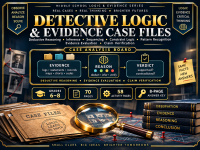
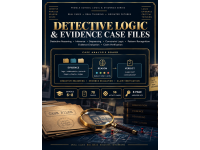
70-Page Middle School Logic, Deductive Reasoning & Evidence Analysis Workbook
Turn critical thinking into an engaging detective investigation with Detective Logic & Evidence Case Files!
Designed for students in Grades 6–8, this 70-page resource combines logic puzzles, deductive reasoning, evidence evaluation, sequencing, pattern recognition, and mathematical problem-solving through detective-themed investigations.
The workbook features 58 student activity pages, each listed individually in the table of contents, followed by an eight-page answer key.
Students take on the role of case analysts as they examine clues, identify patterns, evaluate information, resolve contradictions, and develop evidence-based conclusions.
What's Included?
70 total pages
58 student activity pages (Pages 5–62)
Eight answer key pages (Pages 63–70)
Detective-themed reasoning investigations
Deductive logic and inference challenges
Timeline sequencing and alibi verification
Route maps and constraint-based puzzles
Number patterns and mathematical codes
Bar graph and donut chart analysis
Source reliability and evidence evaluation
Claim verification and contradiction detection
Final investigation and evidence synthesis activities
Key Learning Areas
1. Detective Logic & Case Analysis
Students work through investigations involving missing objects, classroom mysteries, conflicting clues, and reasoning challenges.
Examples include Library Lock Case, Missing Badge Case, Science Cabinet Case, and Lost Tablet Case.
2. Timeline & Sequencing Investigations
Activities focus on reconstructing event sequences, identifying contradictions, evaluating alibis, and interpreting time-related evidence.
Examples include Witness Timeline Contradiction, Overlapping Alibi Windows, Reverse Timeline Challenge, and Final Timeline Investigation.
3. Route Maps & Constraint Logic
Students examine possible routes, evaluate restrictions, calculate or compare routes where required, and use spatial reasoning to verify claims.
Examples include Shortest Route Evidence Map, Blocked Path Escape, Travel-Time Alibi Map, and Risk-Weighted Route Choice.
4. Codes, Patterns & Logical Rules
Learners investigate number patterns, symbolic codes, letter shifts, input-output rules, and mathematical sequences.
Activities include Arithmetic Code Break, Letter-Shift Message, Symbol Frequency Cipher, and Sequence Error Detection.
5. Graphs & Evidence Evaluation
Students interpret bar graphs, compare evidence, identify missing values, and evaluate misleading or unsupported claims.
Examples include Evidence Rank Bar Graph, Two-Lead Comparison Graph, Missing Bar Value, and Final Bar-Graph Claim Case.
6. Source Reliability & Claim Verification
Activities encourage students to analyze sources, evaluate evidence strength, compare supported and contradictory statements, and develop reasoned verdicts.
Examples include Reliability vs Quantity Audit, Weighted Evidence Score, Conflicting Sources Resolution, and Missing-Clue Inference Board.
7. Final Detective Investigations
Integrated activities combine reasoning, evidence evaluation, graph interpretation, and logical deduction.
The workbook concludes with a Capstone Evidence Synthesis activity.
Skills Developed
Deductive reasoning
Logical thinking
Critical thinking
Evidence evaluation
Making inferences
Pattern recognition
Sequencing and timeline analysis
Constraint-based reasoning
Graph interpretation
Claim verification
Identifying contradictions
Problem-solving
Evaluating source reliability
Evidence-based decision-making
Suggested Classroom Uses
This resource can support:
Middle school critical thinking lessons
Grades 6–8 problem-solving practice
Logic puzzle activities
Mathematical reasoning enrichment
Independent classroom investigations
Small-group detective challenges
Early finisher activities
Homework assignments
Critical thinking workshops
Cross-curricular ELA and math activities
Review and enrichment lessons
Teachers can assign individual detective cases to target specific reasoning skills or combine several activities into a longer logic and evidence investigation unit.
Answer Key
Pages 63–70 are designated for the answer key, supporting student activities on Pages 5–62.
For open-ended evidence analysis tasks, student responses may vary when supported by relevant clues and clear reasoning.
Resource Information
Grade Levels: Grades 6–8
Primary Focus: Logic, Critical Thinking & Evidence Analysis
Format: Printable PDF
Total Pages: 70
Student Activity Pages: 58
Answer Key: Eight pages
Main Skills: Deductive Reasoning, Inference, Sequencing, Constraint Logic, Pattern Recognition & Claim Verification
Help students think carefully, question assumptions, analyze evidence, and solve engaging detective mysteries through logical reasoning.
Observe. Analyze. Reason. Solve!
Resource Tags
0 Reviews
Check out these other great products