Reading Inference & Text Evidence Files | Grades 6–8 | 70 Pages



About This Product
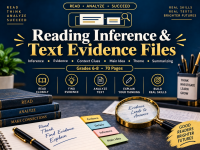
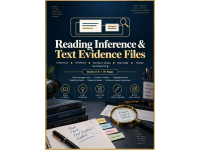
Reading Inference & Text Evidence Files | Critical Reading & Comprehension | Grades 6–8 | 70 Pages
Strengthen essential reading comprehension and analytical thinking skills with Reading Inference & Text Evidence Files, a comprehensive 70-page educational workbook designed for middle school students in Grades 6–8.
Featuring 58 student activity pages, this resource challenges students to read closely, make logical inferences, evaluate textual evidence, interpret vocabulary in context, identify main ideas, analyze themes, and develop evidence-based responses.
Students work with short reading passages, evidence folders, highlighted text, reading boards, graphs, tables, and multiple sources to develop deeper reading comprehension and critical thinking skills.
What's Included:
70-page printable reading workbook
58 student activity pages
Inference and text evidence investigations
Short passage analysis activities
Context clues and vocabulary challenges
Main idea and supporting detail activities
Theme and author's purpose analysis
Summary writing and revision activities
Graph and table interpretation
Two-source comparison challenges
Final evidence-based reading challenge
Major Learning Sections:
Inference Investigations (Pages 5–14): Make logical inferences, evaluate competing explanations, distinguish strong and weak conclusions, and identify missing information.
Text Evidence Files (Pages 15–24): Select relevant evidence, evaluate supporting details, and distinguish evidence from explanations.
Context Clues & Vocabulary (Pages 25–33): Determine word meanings using sentence clues, morphology, contextual information, and comparison.
Main Idea & Supporting Details (Pages 34–43): Identify central ideas, eliminate irrelevant details, and interpret evidence from passages, graphs, and tables.
Author's Purpose & Theme (Pages 44–52): Analyze audience, purpose, theme development, and the messages communicated through different texts.
Summarizing & Revision (Pages 53–56): Identify essential information, improve inaccurate summaries, and develop concise written responses.
Two-Source Comparison (Pages 57–62): Compare information across multiple sources, evaluate evidence, and synthesize findings.
Skills Developed:
Reading comprehension
Close reading
Making inferences
Identifying textual evidence
Evidence-based written responses
Vocabulary in context
Main idea and supporting details
Author's purpose
Theme analysis
Summarizing
Comparing multiple sources
Graph and table interpretation
Critical thinking
Analytical reasoning
Perfect For:
Middle school English Language Arts classrooms
Reading comprehension instruction
Text evidence practice
Close reading activities
Literacy centers
Reading intervention
Reading enrichment
Independent learning
Test preparation
Early finishers
Homeschool education
Cross-curricular literacy instruction
Help students move beyond surface-level reading by teaching them to question information, identify meaningful evidence, and explain their conclusions with confidence.
Read closely. Find evidence. Analyze text. Explain your thinking. Build real skills.
Resource Tags
0 Reviews
Check out these other great products