Cold Case Detective Files | Reading Comprehension | Grades 6–8


About This Product
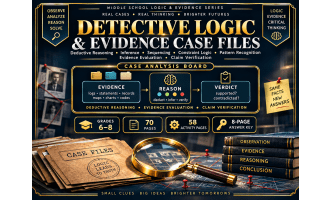
Cold Case Detective Files | Reading Comprehension | Grades 6–8 | 60 Pages
60-Page Middle School Mystery Reading Workbook | 8 Detective Cases, Inference & Text Evidence
Turn reading comprehension into an engaging detective investigation with Cold Case Detective Files!
Designed for students in Grades 6–8, this 60-page resource combines mystery-themed reading with evidence analysis, inferential reasoning, source evaluation, and critical thinking.
Students take on the role of junior case analysts as they investigate eight fictional mysteries involving witness statements, CCTV reports, timelines, digital metadata, access records, and physical evidence.
Each case encourages students to examine clues carefully, compare information, identify contradictions, evaluate explanations, and reach conclusions supported by evidence.
The resource also includes Challenge Labs focused on evidence ranking, source bias, counterarguments, and Claim-Evidence-Reasoning (CER) verdicts.
What's Included?
60 total pages
Student activity pages 3–54
Eight unique detective cases
Six answer key pages (Pages 55–60)
Mystery reading and evidence investigations
Witness statement comparisons
Timeline reconstruction
Source reliability and bias analysis
Digital evidence and metadata interpretation
Evidence ranking activities
Counterargument challenges
CER verdict practice
Eight Detective Cases
1. The Missing Championship Trophy
Students investigate a contradiction-focused mystery by comparing clues and considering conflicting information.
2. Mystery at Platform 6
A timeline reconstruction investigation in which students examine the sequence of events.
3. The Locked Art Room
Students evaluate evidence to eliminate suspects and identify explanations supported by the case information.
4. The Anonymous Note
An investigation focused on insider knowledge and the interpretation of available clues.
5. The Museum Alarm
Students examine evidence to consider whether an event was accidental or intentional.
6. The Impossible Alibi
An alibi stress test that encourages students to compare statements, timelines, and supporting information.
7. The Vanishing Backpack
A detective investigation centered on identity checking and evidence evaluation.
8. Case of the Changed Photograph
A digital evidence investigation involving the interpretation of photographic information.
Challenge Labs
Additional investigation tasks focus on:
Evidence ranking
Counterarguments
Source bias
Claim-Evidence-Reasoning (CER)
Evaluating conflicting information
Supporting conclusions with evidence
Key Learning Skills
Reading comprehension
Making inferences
Identifying text evidence
Analyzing point of view
Source reliability
Timeline sequencing
Drawing conclusions
Evidence evaluation
Identifying contradictions
Critical thinking
Logical reasoning
Counterargument development
CER writing
Evidence-based explanations
Suggested Classroom Uses
This resource is suitable for:
Middle school ELA instruction
Grades 6–8 reading comprehension
Mystery reading activities
Inference and text evidence lessons
Small-group detective investigations
Independent classroom practice
Reading enrichment
Critical thinking workshops
Evidence-based writing
Homework assignments
Early finisher activities
Cross-curricular literacy lessons
Teachers can assign individual cases to target specific reading skills or combine multiple investigations into a longer mystery reading unit.
Answer Key
Pages 55–60 are designated for the page-by-page answer key.
Open-ended responses should be evaluated according to how well students use relevant evidence and explain their reasoning.
Resource Information
Grade Levels: Grades 6–8
Primary Subject: English Language Arts / Reading Comprehension
Format: Printable PDF
Total Pages: 60
Detective Cases: 8
Student Activity Section: Pages 3–54
Answer Key: 6 pages
Main Skills: Inference, Text Evidence, Source Reliability, Logical Reasoning & Critical Thinking
Help students become thoughtful readers and careful investigators as they examine clues, evaluate evidence, question assumptions, and support their conclusions.
Read the Clues. Analyze the Evidence. Solve the Mystery!
Resource Tags
0 Reviews
Check out these other great products