Rounding Addition and Subtraction Worksheets: Round and Adjust
Third and fourth graders use rounding to add and subtract exactly: round one number to a ten or hundred, solve the friendlier problem, then adjust back.


- Grades
- Grade 4, Elementary
- Pages
- 6
- File type
- Answer key
- Included


- Subject
- Math, Addition and Subtraction, Addition
- Topic
- rounding, addition
- Resource types
- Worksheets & Printables, Worksheets
- Answer key
- Included
About this resource
What's inside this resource
Round one number, solve the easier problem, then fix the difference. These worksheets teach that round-and-adjust strategy for exact answers, not estimates: 38 + 47 becomes 40 + 47 = 87, and because 2 extra were added, students take 2 away to get 85.
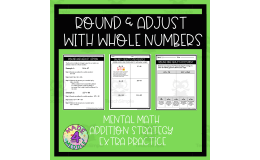
Each of the four pages has two worked examples, one rounding up and one rounding down, and 12 boxed problems. Every box has spaces for the friendly problem, its answer, the adjustment and the exact answer. Page 1 adds two-digit numbers near a ten, with two three-digit sums near a hundred. Page 2 adds three-digit numbers near a hundred and ends with 2,354 + 299 and 4,127 + 402. Pages 3 and 4 do the same for subtraction, where students round the number they subtract and learn that the adjustment flips.
Two answer pages show the round-and-solve step, the adjustment and the answer for all 48 problems. A teacher tip explains which way to adjust and flags the most common subtraction slip.
Related resources
More resources teachers may find useful
24 related resources were found using this product's title, contributor, categories and tags.

In the classroom
Teaching tips & learning objectives

Learning objectives
- Choose the number in a problem that is close to a ten or a hundred and round it.
- Add or subtract using the rounded, friendlier number.
- Adjust the result by the amount added or taken away to find the exact answer.

Teaching tips
- Work through the two examples at the top of each page first; one rounds up and one rounds down, so students see both kinds of adjustment.
- Before the subtraction pages, use the teacher tip: rounding the number you subtract up takes away too much, so add the extra back.
- Watch for the slip named on the answer page: 83 − 29 solved as 53 − 1 = 52 instead of 53 + 1 = 54.

Skills covered
- Rounding — students round 29 to 30, 31 to 30, 199 to 200 and 402 to 400.
- Compensation in addition — students solve 367 + 198 as 367 + 200 − 2.
- Compensation in subtraction — students solve 742 − 398 as 742 − 400 + 2.
Good to know
Questions teachers ask about this resource
Is this an estimation worksheet?
No. Students round only to make the problem easier, then adjust to reach the exact sum or difference. Every answer on the key is exact, and each box shows the adjustment step.
Why does the adjustment change direction in subtraction?
When students round the number they subtract up, they take away too much, so they add the extra back: 83 − 29 becomes 83 − 30 = 53, then 53 + 1 = 54. In addition, rounding up adds too much, so they take the extra away.
How hard do the problems get?
Page 1 starts with two-digit numbers near a ten, such as 54 + 19. The hundreds pages use three-digit numbers near a hundred, and each ends with two problems that pair a four-digit number with a three-digit one, such as 5,208 − 401.

No reviews yet
Downloaded this resource? Tell other teachers how it went.
Resource details
Concepts & topics
Core concepts
 Core concepts
- Compensation strategy
- Rounding to the nearest ten
- Rounding to the nearest hundred
- Mental math
- Multi-digit addition and subtraction
Topics
 Topics
Explore more
Categories this resource belongs to
Explore related searches
More to explore
You may also like