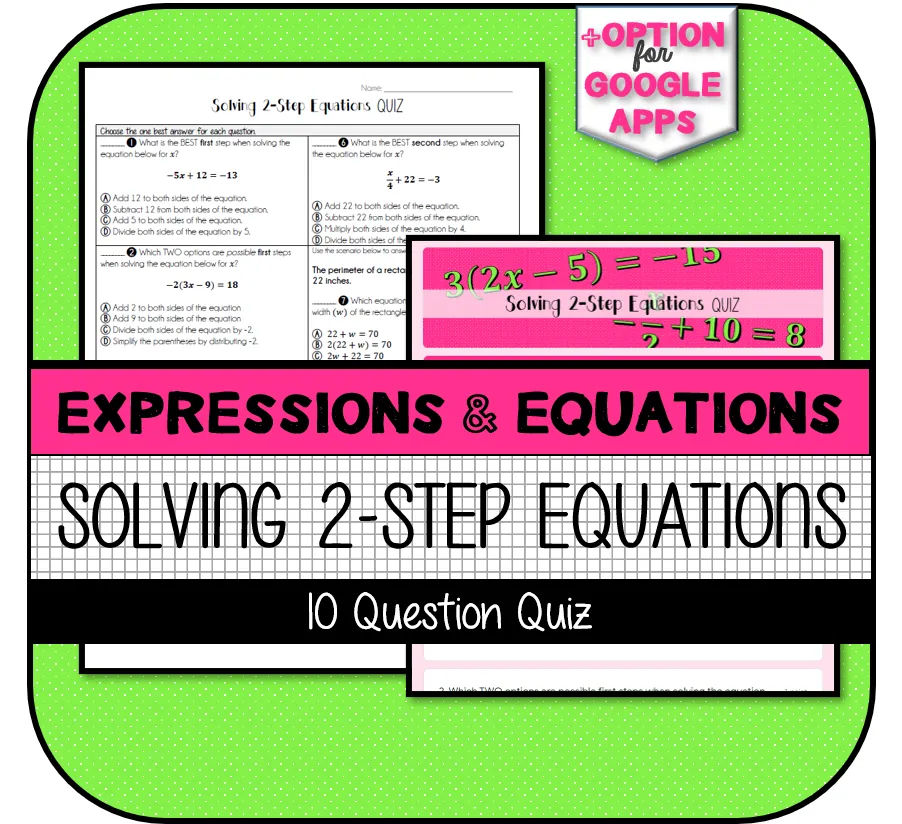
Solving Two-Step Equations QUIZ
- Grades
- Grades 7–8
- Pages
- 3
- File type
- Answer key
- Included


- Subject
- Math, Algebra
- Topic
- Two-step equations, Multiple choice
- Resource types
- Quizzes
- Answer key
- Included
- Standards
- 7.EE.B.4
Product description
From the author
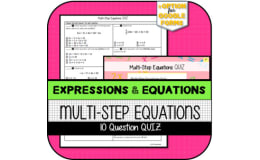
This quiz is meant to assess students' knowledge of solving 2-step equations, including knowledge of correct steps and final solution.
Related resources
More resources teachers may find useful
24 related resources were found using this product's title, contributor, categories and tags.


In the classroom
Teaching tips & learning objectives

Learning objectives
Identify the best first or second step for solving a two-step equation, choosing between adding, subtracting, multiplying, dividing or distributing
Solve two-step equations whose coefficients include negatives, fractions and expressions inside parentheses
Translate a real-world scenario into an equation of the form px + q = r or p(x + q) = r

Teaching tips
Item 2 asks which TWO options are possible first steps for −2(3x − 9) = 18, so tell students in advance that one item takes two selections.
Items 7 and 8 share the rectangle scenario and items 9 and 10 share the phone-plan scenario; if you shorten the quiz, cut them in pairs so each model-the-equation item keeps its follow-up.
Because the first six items separate step choice from final value, comparing a student's misses across those two groups shows quickly whether the error is procedural or computational.

Skills covered
Two-step equation solving — students find x in equations such as −x/2 − 12 = −20, −3(4x − 16) = −12 and (3/4)(4x − 24) = −18.
Applying the distributive property — one item offers "simplify the parentheses by distributing −2" as a valid opening move on −2(3x − 9) = 18.
Interpreting a solution in context — after choosing the equation students give the rectangle's width in inches and the number of people on the plan.
Good to know
Questions teachers ask about this resource
What should I tell students before the quiz?
One question asks for two selections even though the general directions say to choose one answer. Provide scratch paper if you want to see their calculations.
Can I assign it digitally?
Yes. The teacher letter includes a link to copy the Google Forms version.

No reviews yet
Downloaded this resource? Tell other teachers how it went.
Curriculum
Standards, concepts & topics
Standards
 Standards
- 7.EE.B.4
Core concepts
 Core concepts
Two-step equations
Inverse operations
Distributive property
Writing equations from word problems
Rational coefficients
 Topics
Explore more
Categories this resource belongs to
Explore related searches
More to explore
You may also like