24 related resources

Two Step Equations Emoji Math Activity
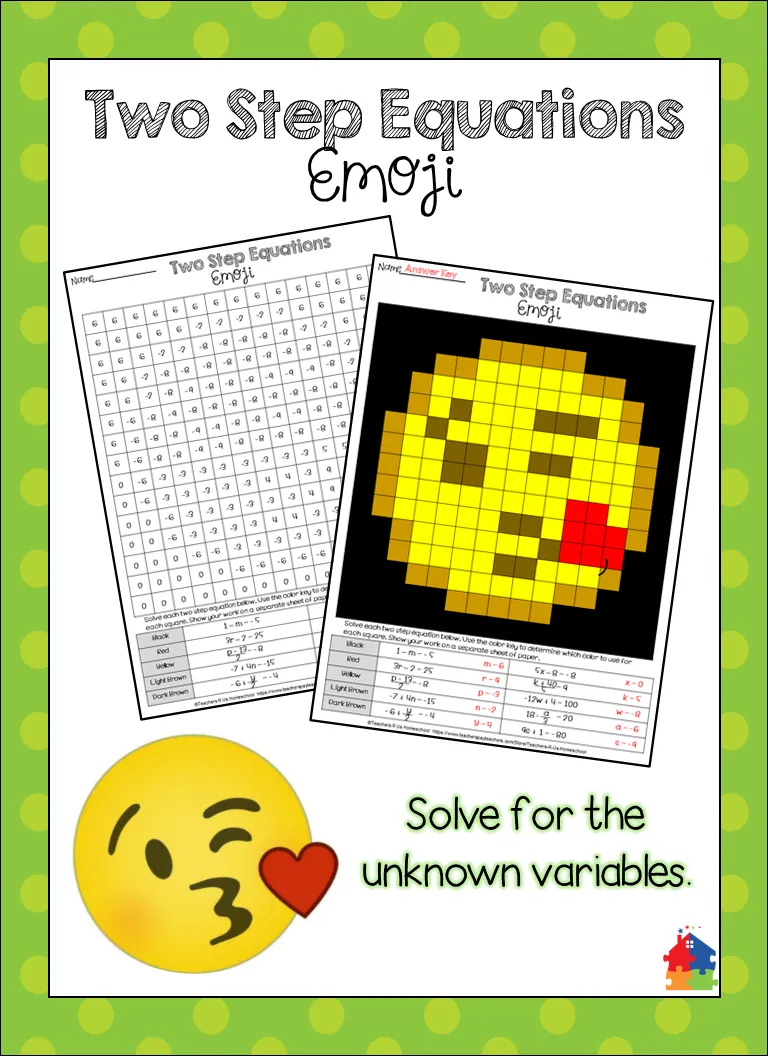
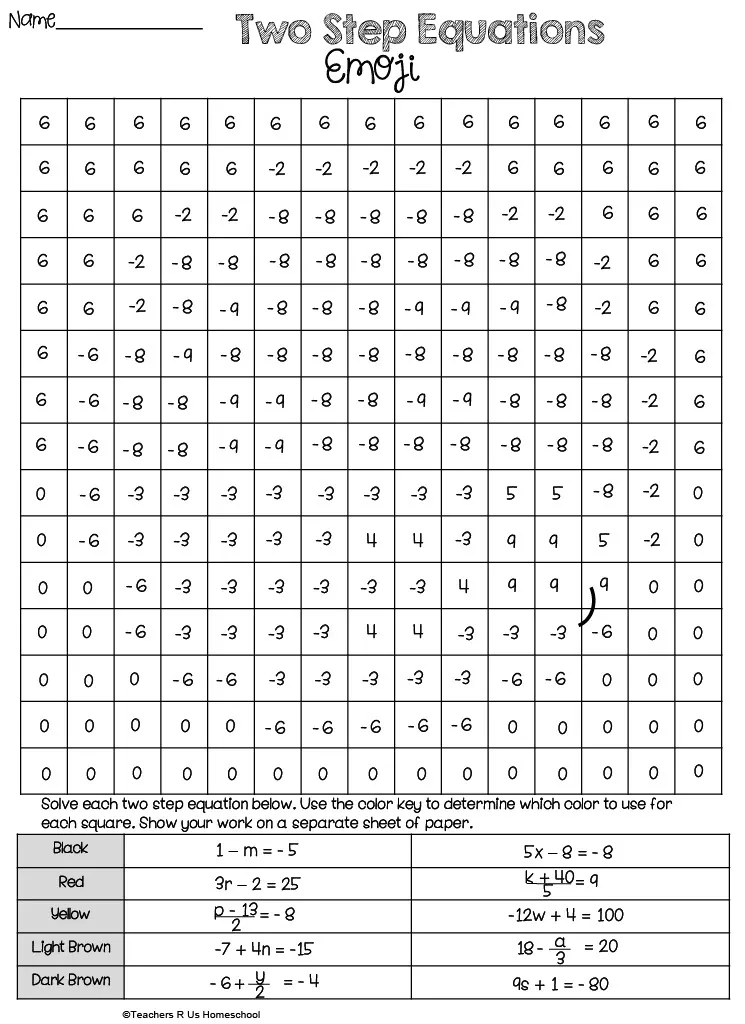
Ten two-step equations decide the colours on a fifteen-by-fifteen number grid, two equations to each of five colours, and the numbers in the grid are the solutions themselves, so a correct set of answers reveals an emoji picture.
Grades
Grades 5–8, Elementary, Middle School
File type
PDF
Preparation
Print ready

Updated May 13, 2022

Subject
Math, Algebra
Topic
two step equations, emoji math
Resource types
Activities
Preparation
Print ready

About this resource

What's inside this resource

This resource is a Two Step Equations Emoji printables/worksheets/worksheets-by-subject/math-worksheets">Math Worksheet.

Students will solve the two step equations at the bottom of the page. Then they will use their answers and the color key to determine how to color each square of the picture.

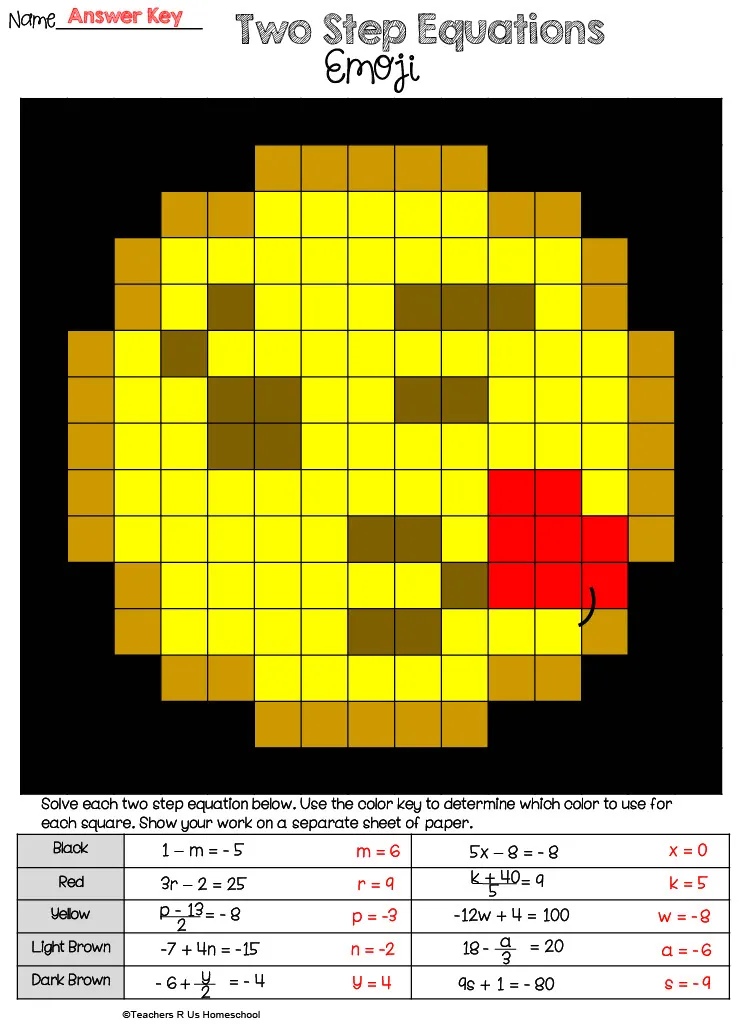
A final picture is included.

In the classroom

Teaching tips & learning objectives

Learning objectives

  • Solve a two-step equation by undoing addition or subtraction first and then multiplication or division

  • Work with negative solutions and negative coefficients, as in -12w + 4 = 100 and 9s + 1 = -80

  • Handle an equation where the variable is divided rather than multiplied, as in p/2 - 13 = -8 and 18 - a/3 = 20

  • Solve an equation where the variable appears after the constant, as in 1 - m = -5 and -7 + 4n = -15

  • Use a set of solutions as a colour key, matching each answer to the squares carrying that number

Teaching tips

  • Every number in the grid is one of the ten answers, so a student who mis-solves an equation will colour a whole set of squares wrongly - the picture, not the teacher, gives the first signal that something is off

  • Two equations share each colour, which means a single mistake still leaves that colour partly correct; comparing which squares were missed points straight at the equation that went wrong

  • The instruction is to show working on a separate sheet, so plan for a second page per student if the working is to be marked

  • Five colours are named rather than shown - black, red, yellow, light brown and dark brown - so students need pencils that can be told apart, particularly the two browns

  • The set covers a deliberate spread of forms: a fractional coefficient, a negative coefficient, a constant before the variable and a subtraction from a constant, which makes the ten equations a compact review rather than ten of the same thing

  • Four of the ten solutions are negative and one is zero, so it is worth checking students are comfortable with a zero answer before setting the sheet

Skills covered

  • Solving two-step equations - ten equations require two inverse operations each, from 3r - 2 = 25 to 9s + 1 = -80.

  • Working with negative numbers - four solutions are negative and several equations carry negative constants or coefficients, including -12w + 4 = 100.

  • Solving equations with a divided variable - p/2 - 13 = -8, k/5 + 40 = 9, 18 - a/3 = 20 and -6 + y/2 = -4 all place the variable over a denominator.

  • Self-checking through a visual outcome - because every grid number is one of the ten solutions, a wrong answer produces a visibly wrong picture.

  • Recording working separately - the sheet directs students to show their work on another page rather than in the margins, keeping the solution method visible for marking.

Good to know

Questions teachers ask about this resource

How do the equations connect to the grid?

Every number printed in the grid is one of the ten solutions - 6, 0, 9, 5, -3, -8, -2, -6, 4 and -9. Solving an equation tells a student which colour its answer takes, and every square carrying that number is then coloured accordingly. With five colours and two equations each, the finished grid shows an emoji.

What kinds of two-step equations are covered?

A deliberate spread rather than ten of the same form. Four place the variable over a denominator (p/2 - 13 = -8, k/5 + 40 = 9, 18 - a/3 = 20, -6 + y/2 = -4), two put the constant before the variable (1 - m = -5, -7 + 4n = -15), one has a negative coefficient (-12w + 4 = 100), and the rest are the standard px + q = r shape. Four solutions are negative and one is zero.

Where are students meant to write their working?

On a separate sheet. The instruction on the student page reads "Show your work on a separate sheet of paper", and the page itself carries only the grid and the colour key, with no space set aside for calculation.

No reviews yet

Downloaded this resource? Tell other teachers how it went.

Resource details

Concepts & topics

Explore more

Categories this resource belongs to

Explore related searches

More to explore

You may also like