Subject Singular and Plural Verbs Grammar Worksheet for Grade 1, 2, 3

- Grades
- Grades 1–4, Elementary
- Pages
- 10
- File type
- Preparation
- Print ready


- Subject
- Grammar, Language Development, ELA
- Topic
- verbs, grammar
- Resource types
- Worksheets & Printables, Worksheets
- Preparation
- Print ready
- Standards
- CCSS.L.1.1 CCSS.L.3.1
About this resource
What's inside this resource
Introduction
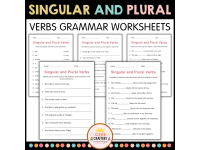
This set of Singular and Plural Verbs Worksheets helps students understand how verbs change depending on whether the subject of a sentence is singular or plural. Through a variety of practice activities, learners develop confidence in choosing the correct verb form and building grammatically correct sentences.
What’s Included:
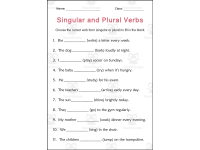
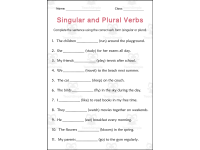
Choosing the correct singular or plural verb to complete sentences
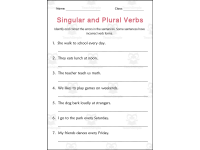
Identifying and correcting verb agreement errors
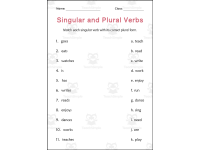
Matching singular verbs with their plural forms
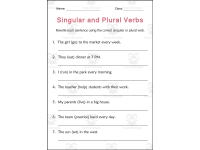
Rewriting sentences using the correct verb form
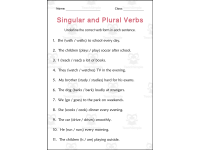
Underlining the correct verb in sentences
Identifying whether verbs are singular or plural
Matching subjects with the appropriate verbs
Editing sentences to fix incorrect verb usage
Grades / Ages:
Ideal for Grades 2–5
Implementation Format:
Perfect for grammar lessons, literacy centres, small group instruction, independent work, classroom practice, or homework assignments.
Answer Key:
Not included
File Type:
PDF (Non-editable)
Number of Pages:
10 pages total
License:
Paid product for personal or single-classroom use only
Tags to Use:
singular and plural verbs worksheets, subject verb agreement worksheets, ESL grammar worksheets, verb agreement practice, grammar worksheets for kids, elementary grammar activities, verb forms worksheets, sentence editing worksheets
Related resources
More resources teachers may find useful
24 related resources were found using this product's title, contributor, categories and tags.



In the classroom
Teaching tips & learning objectives

Learning objectives
Apply correct present-tense subject-verb agreement in written sentences.
Distinguish singular verb forms (e.g., 'walks') from plural verb forms (e.g., 'walk').
Identify and correct subject-verb agreement errors in already-written sentences.

Teaching tips
Introduce the singular/plural verb agreement rule directly before assigning this packet, since none of the ten pages explains the rule itself — all ten are practice-only.
Spread the ten pages across a week rather than assigning them all at once, since several pages (fill-in-the-blank, choose-the-form, complete-the-sentence) practice the same underlying skill in slightly different formats.
Use the error-correction pages (2 and 10) as a quick informal check of whether students can apply the rule, not just recognize it, since these require students to produce a correction rather than choose from given options.

Skills covered
Subject-verb agreement — students choose or supply the verb form that matches a singular or plural subject across a variety of everyday-life sentences.
Error detection and correction — on pages 2 and 10, students locate an already-incorrect verb in a sentence and rewrite it correctly.
Form recognition — on pages 3 and 9, students match singular verbs to their plural counterparts and match subjects to their correct verbs.
Good to know
Questions teachers ask about this resource
What range of practice formats does this packet use across its pages?
The ten pages rotate through fill-in-the-blank, underlining, circling, matching (subject-to-verb and singular-to-plural), sentence rewriting, and finding-and-correcting an incorrect verb, so students see the same skill from several angles rather than one repeated worksheet format.
Which verb tense do the practice sentences use?
All ten pages practice present-tense subject-verb agreement (for example, 'She walks to school' vs. 'They walk to school'); past and future tense are not covered.

No reviews yet
Downloaded this resource? Tell other teachers how it went.
Curriculum
Standards, concepts & topics
Standards
 Standards
- CCSS.L.1.1 — Demonstrate command of the conventions of standard English grammar and usage when writing or speaking. a. Print all upper- and lowercase letters. b. Use common, proper, and possessive nouns. c. Use singular and plural nouns with matching verbs in basic sentences (e.g., He hops; We hop). d. Use personal, possessive, and indefinite pronouns (e.g., I, me, my; they, them, their; anyone, everything). e. Use verbs to convey a sense of past, present, and future (e.g., Yesterday I walked home; Today I walk home; Tomorrow I will walk home). f. Use frequently occurring adjectives. g. Use frequently occurring conjunctions (e.g., and, but, or, so, because). h. Use determiners (e.g., articles, demonstratives). i. Use frequently occurring prepositions (e.g., during, beyond, toward). j. Produce and expand complete simple and compound declarative, interrogative, imperative, and exclamatory sentences in response to prompts
- CCSS.L.3.1 — Demonstrate command of the conventions of standard English grammar and usage when writing or speaking. a. Explain the function of nouns, pronouns, verbs, adjectives, and adverbs in general and their functions in particular sentences. b. Form and use regular and irregular plural nouns. c. Use abstract nouns (e.g., childhood). d. Form and use regular and irregular verbs. e. Form and use the simple (e.g., I walked; I walk; I will walk) verb tenses. f. Ensure subject-verb and pronoun-antecedent agreement.* g. Form and use comparative and superlative adjectives and adverbs, and choose between them depending on what is to be modified. h. Use coordinating and subordinating conjunctions. i. Produce simple, compound, and complex sentences.
Core concepts
 Core concepts
Singular vs. plural present-tense verbs
Subject-verb agreement
Topics
 Topics
Explore more
Categories this resource belongs to
Explore related searches
More to explore
You may also like