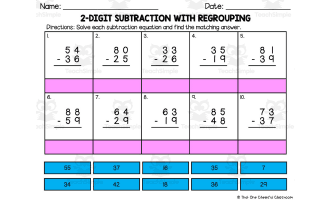
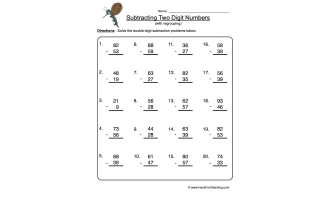
SUBTRACTION: Regrouping 10s and 1s • 2 Digit and 1 Digit Numbers
- Grades
- Grades 3–4, Elementary
- File type
- Preparation
- Print ready


- Subject
- Math, Early Math
- Topic
- Subtration, Regrouping
- Resource types
- Worksheets & Printables, Worksheets
- Preparation
- Print ready
About this resource
What's inside this resource
Regrouping worksheet 1
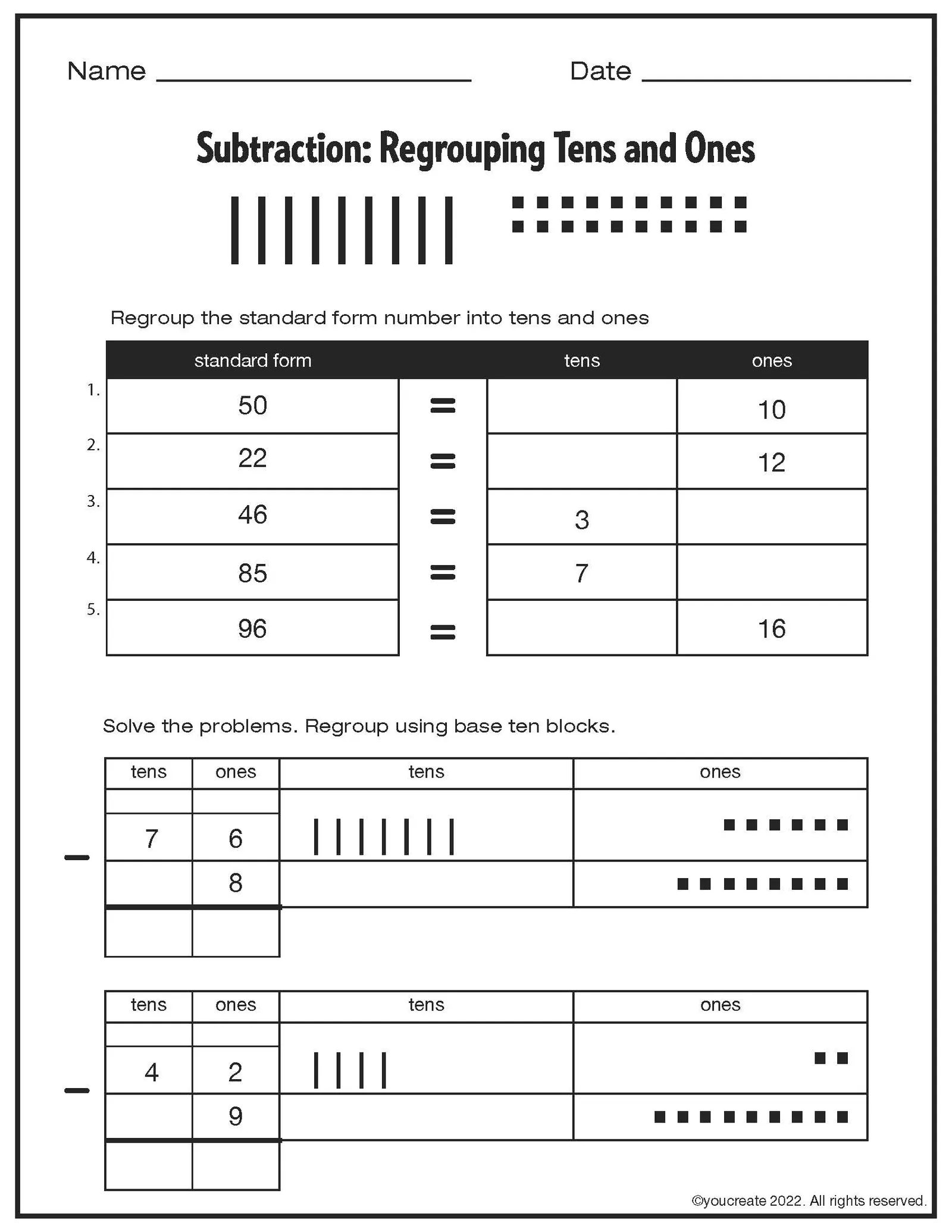
Teach students REGROUPING using base ten blocks and clear separations of tens and ones.
Part 1: Students regroup a standard number into 10s and 1s
Part 2: Students use base ten graphics to regroup tens and ones.
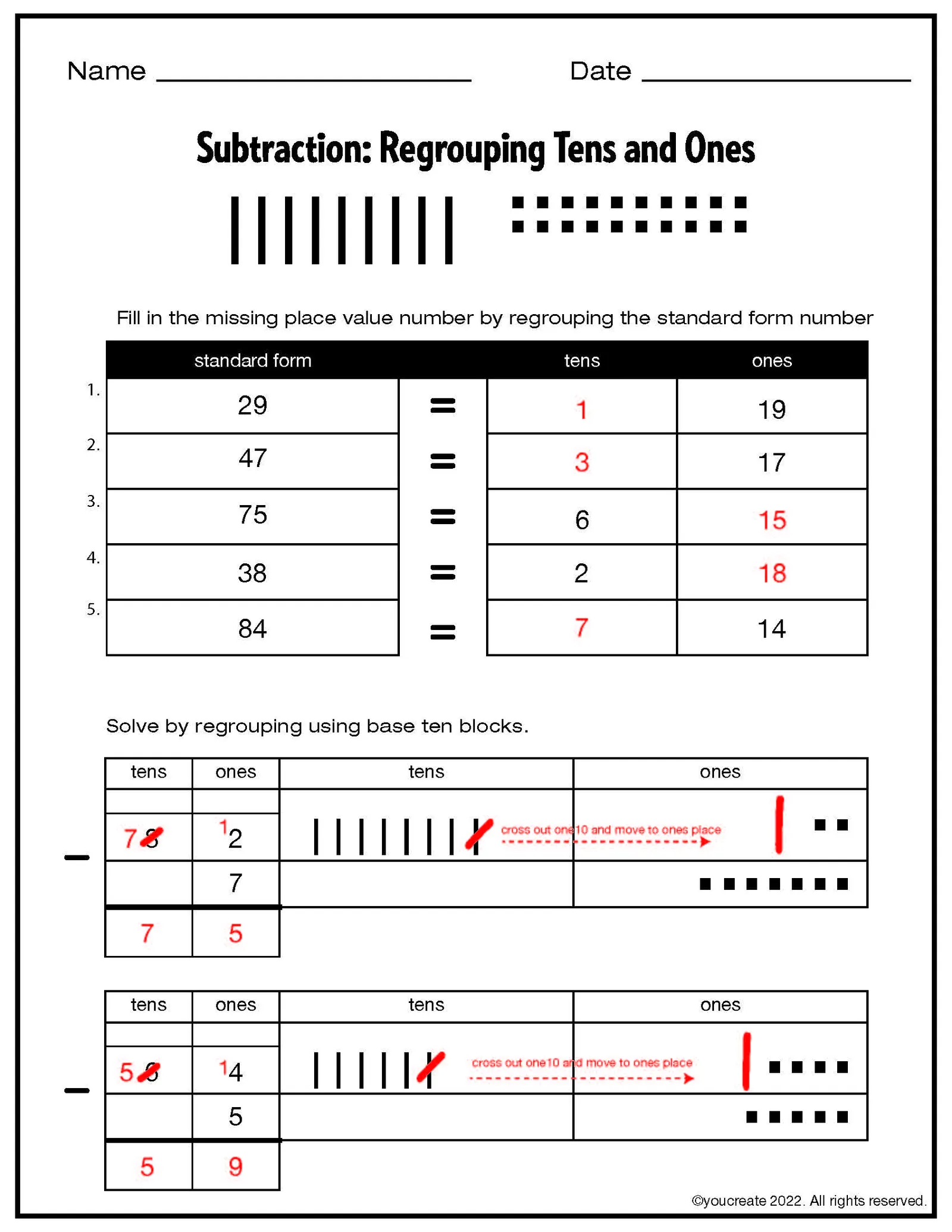
Two Worksheets and Two Answer Keys
Have students cross out a ten block and move it to the ones column and then solve the equation.
Related resources
More resources teachers may find useful
24 related resources were found using this product's title, contributor, categories and tags.


In the classroom
Teaching tips & learning objectives

Learning objectives
Decompose a two-digit number into tens and ones in a non-standard way — writing 96 as 8 tens and 16 ones rather than 9 tens and 6 ones
Complete a regrouped pair when only one of the two place-value amounts is supplied
Subtract a one-digit number from a two-digit number by exchanging one ten for ten ones before working in the ones column

Teaching tips
Each sheet runs its two steps in order — regroup a number first, then use that exchange to subtract — so the top half is deliberate preparation for the bottom half
One column of every regrouping row is already filled in, which makes it a fill-in rather than an open decomposition; covering the given number turns the same row into a harder task
The marked copies spell the move out as "cross out one 10 and move to ones place", so using that exact phrase aloud keeps the spoken method matched to the written one

Skills covered
Flexible place-value decomposition — students rewrite numbers such as 85 and 96 as 7 tens 15 ones and 8 tens 16 ones instead of their standard split.
Completing a regrouped pair — every row supplies only one of the two amounts, so students reason back from a given ones figure to the number of tens that keeps the total right.
Two-digit minus one-digit subtraction with an exchange — 76 minus 8, 42 minus 9, 82 minus 7 and 64 minus 5 all require taking a ten across before the ones can be subtracted.
Good to know
Questions teachers ask about this resource
How do the two halves of each sheet fit together?
The top half asks students to rewrite a two-digit number as tens and ones with one ten broken up — 96 as 8 tens and 16 ones. The bottom half then sets subtractions that need exactly that move, so the first exercise is the method the second one depends on.
How much of each regrouping row is already filled in?
One column of the two. Some rows give the ones amount and leave the tens blank, others give the tens and leave the ones blank — on the first sheet, 22 arrives with 12 ones showing while 46 arrives with 3 tens showing.
How does the marked copy show the exchange?
It writes the regrouped digits above the grid and prints the reminder "cross out one 10 and move to ones place" alongside each worked subtraction, so a student can see both what changed in the columns and why.

No reviews yet
Downloaded this resource? Tell other teachers how it went.
Resource details
Concepts & topics
Core concepts
 Core concepts
Regrouping
Place value
Two-digit subtraction
Base ten blocks
 Topics
Explore more
Categories this resource belongs to
Explore related searches
More to explore
You may also like