Summer Solstice Reading Activities
- Grades
- Not Grade Specific
- File type
- Preparation
- Print ready


- Subject
- ELA, Language Development, ESL
- Topic
- reading worksheets, summer
- Resource types
- Activities
- Preparation
- Print ready
About this resource
What's inside this resource
This resource is a set of reading worksheets for the Summer Solstice.
Students will read text and engage in 4 different exercises, from writing tasks to fill in the blanks.
There are 2 chatterbox activities to engage your ESL students in dialogue.
Answer key included.
Related resources
More resources teachers may find useful
24 related resources were found using this product's title, contributor, categories and tags.


In the classroom
Teaching tips & learning objectives

Learning objectives
Read an intermediate-level article about the summer solstice and locate specific factual details
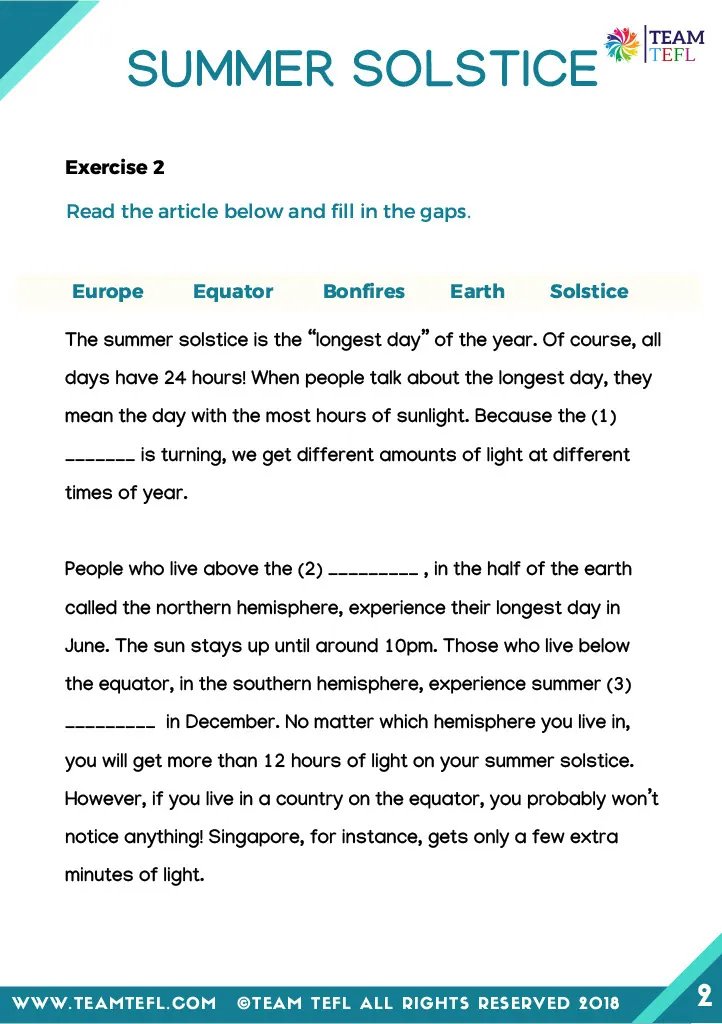
Complete a gapped text using a word bank of topic vocabulary (Earth, equator, solstice, Europe, bonfires)
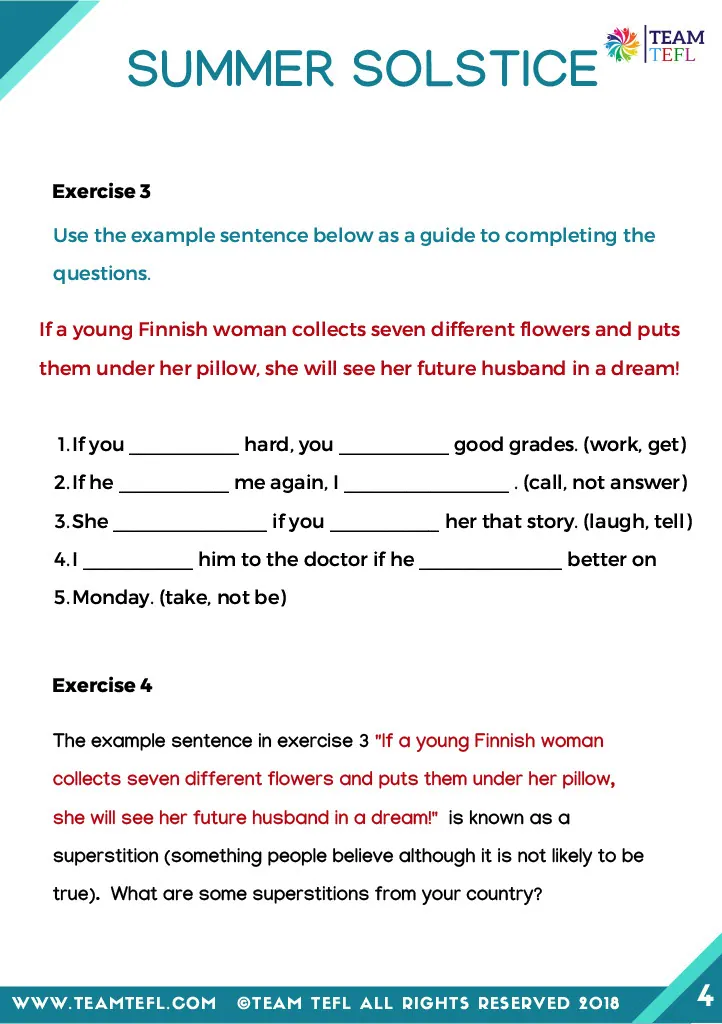
Form first-conditional sentences (if + present simple, will + verb) from verb prompts

Teaching tips
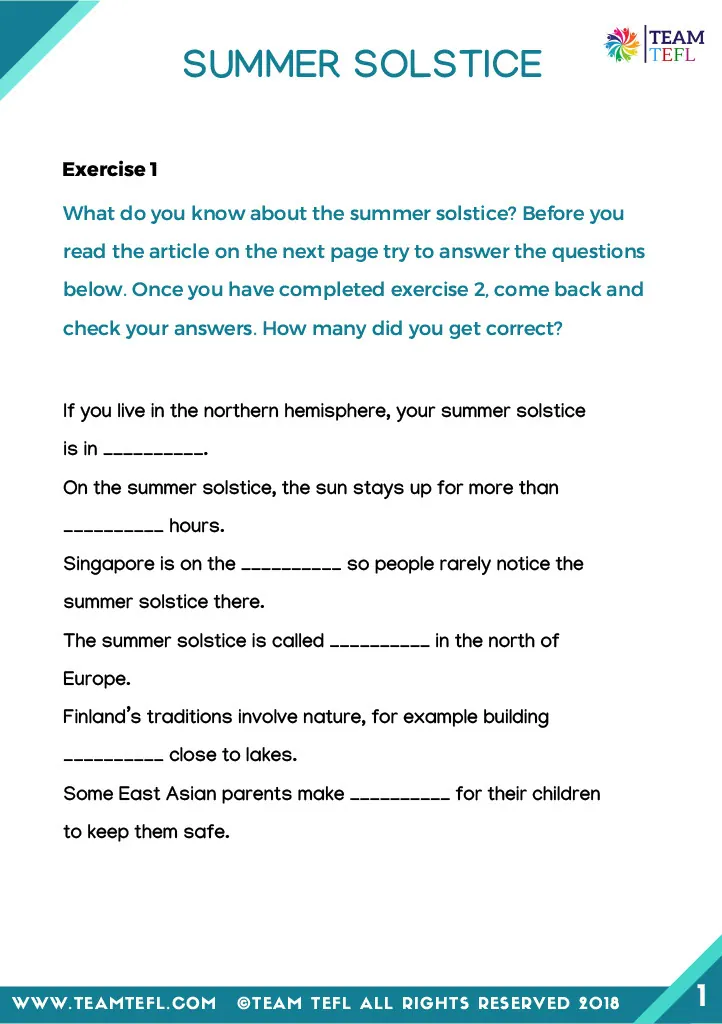
Keep Exercise 1 strictly before the reading — the page directs students to guess first, then return after Exercise 2 to count how many predictions were correct
Preview the word bank (Europe, Equator, Bonfires, Earth, Solstice) with lower-intermediate groups before they tackle the gapped article
Use the article's own superstition sentence as the worked model when introducing the first conditional in Exercise 3, since Exercise 4 and Chatterbox 1 both circle back to superstitions

Skills covered
Reading for detail — students fill five gaps in a solstice article using a word bank and verify their six pre-reading predictions against the text.
First-conditional grammar — students complete four if-sentences with prompted verbs (work/get, call/not answer, laugh/tell, take/not be).
Predicting before reading — six statements about hemispheres, Singapore, midsummer, and bracelets are guessed first and checked after reading.
Good to know
Questions teachers ask about this resource
What grammar point does the packet practise?
The first conditional. Students complete four sentences such as "If you work hard, you will get good grades," using the article's Finnish flower superstition as the model sentence.
How do the two Chatterbox tasks differ?
Chatterbox 1 is small-group discussion of four questions about solstice celebrations and superstitions. Chatterbox 2 is a paired task: students get ten minutes to research the Stonehenge summer solstice, then each pair shares findings with the group.
Which regions' solstice traditions does the article cover?
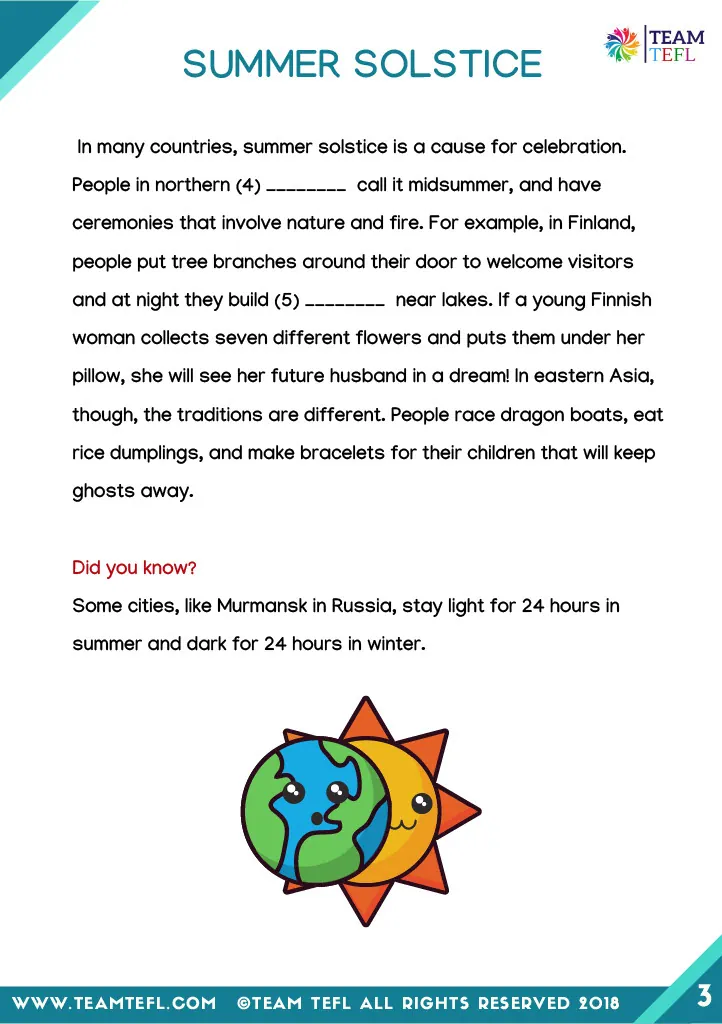
Northern Europe's midsummer — Finnish door branches, lakeside bonfires, and the seven-flowers superstition — plus East Asia's dragon-boat races, rice dumplings, and protective bracelets, with Singapore and Murmansk as contrasting examples of equatorial and polar daylight.

No reviews yet
Downloaded this resource? Tell other teachers how it went.
Resource details
Concepts & topics
Core concepts
 Core concepts
Summer solstice
Cultural traditions
First conditional
Reading comprehension
 Topics
Explore more
Categories this resource belongs to
Explore related searches
More to explore
You may also like