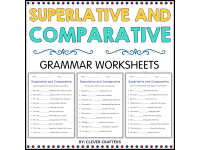
Comparative & Superlative Adjectives – Grade 2 Pack

- Grades
- Grades 1–5, Elementary
- Pages
- 10
- File type
- Preparation
- Print ready


- Subject
- Grammar, Language Development, ELA
- Topic
- adjectives, grammar
- Resource types
- Worksheets, Worksheets & Printables
- Preparation
- Print ready
- Standards
- CCSS.L.3.1
About this resource
What's inside this resource
Introduction
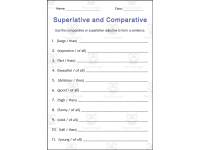
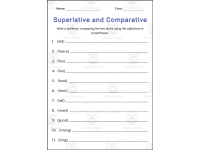
This set of Comparative and Superlative Adjectives Worksheets helps students understand how adjectives change when comparing two or more people, places, or things. Through a variety of engaging activities, learners practice forming comparative adjectives using “-er” or “more” and superlative adjectives using “-est” or “most.”
What’s Included:
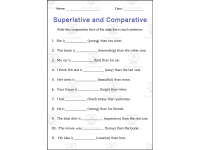
Writing the comparative form of adjectives in sentences
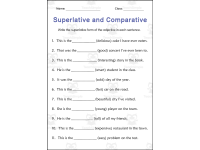
Writing the superlative form of adjectives
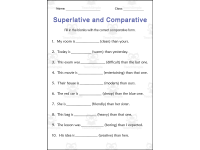
Fill-in-the-blank exercises using comparative adjectives
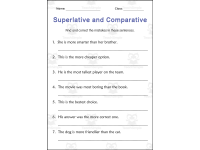
Identifying and correcting common grammar mistakes
Sentence writing using comparative and superlative adjectives
Comparing two items using given adjectives
Identifying whether adjectives are comparative or superlative
Adding -er or -est to adjectives to form comparisons
Matching comparative adjectives with their superlative forms
Choosing the correct adjective form to complete sentences
Grades / Ages:
Ideal for Grades 2–6
Implementation Format:
Perfect for grammar lessons, literacy centres, small group instruction, independent work, classroom practice, or homework assignments.
Answer Key:
Not included
File Type:
PDF (Non-editable)
Number of Pages:
10 pages total
License:
Paid product for personal or single-classroom use only
Tags to Use:
comparative and superlative worksheets, adjectives worksheets for kids, ESL grammar worksheets, comparison adjectives practice, grammar worksheets elementary, English adjectives activities, sentence building worksheets, comparative adjectives exercises, superlative adjectives practice
Related resources
More resources teachers may find useful
24 related resources were found using this product's title, contributor, categories and tags.


In the classroom
Teaching tips & learning objectives

Learning objectives
Write the correct comparative form of an adjective ('-er' or 'more') to complete a sentence
Write the correct superlative form of an adjective ('-est' or 'most') to complete a sentence
Identify and correct common double-marking errors such as 'more smarter' or 'bestest'

Teaching tips
Use page 4's error-correction exercise as a diagnostic before assigning the rest of the packet, since it surfaces the double-marking mistakes (e.g., 'most tallest,' 'more friendlier') most likely to recur across the fill-in-the-blank pages
Model one open-ended comparative sentence and one superlative sentence before assigning pages 5 and 6, since those two pages give only a bracketed adjective prompt with no sentence starter
Pair page 7's form-identification task with page 10's choose-the-correct-form task in the same sitting, since both ask students to apply the comparative/superlative distinction to full sentences rather than just filling a blank

Skills covered
Comparative adjective formation — students add '-er' or 'more' to fit context across three separate fill-in pages (1, 3, 10).
Superlative adjective formation — students add '-est' or 'most' to fit context across two pages (2, 10).
Error correction — page 4 has students find and fix double-marking mistakes such as 'more smarter' and 'bestest.'
Good to know
Questions teachers ask about this resource
What kind of mistakes does the correction exercise target?
Page 4 gives seven sentences with double-marking errors — forms like 'more smarter,' 'most tallest,' and 'bestest' — for students to find and fix.
How does the open-ended writing task differ from the fill-in-the-blank pages?
Pages 5 and 6 give only a bracketed adjective, such as 'fast' or 'heavy,' with no sentence provided, so students write their own complete comparative or superlative sentence from scratch rather than completing an existing one.

No reviews yet
Downloaded this resource? Tell other teachers how it went.
Curriculum
Standards, concepts & topics
Standards
 Standards
- CCSS.L.3.1 — Demonstrate command of the conventions of standard English grammar and usage when writing or speaking. a. Explain the function of nouns, pronouns, verbs, adjectives, and adverbs in general and their functions in particular sentences. b. Form and use regular and irregular plural nouns. c. Use abstract nouns (e.g., childhood). d. Form and use regular and irregular verbs. e. Form and use the simple (e.g., I walked; I walk; I will walk) verb tenses. f. Ensure subject-verb and pronoun-antecedent agreement.* g. Form and use comparative and superlative adjectives and adverbs, and choose between them depending on what is to be modified. h. Use coordinating and subordinating conjunctions. i. Produce simple, compound, and complex sentences.
Core concepts
 Core concepts
Comparative adjectives
Superlative adjectives
Adjective suffixes (-er, -est)
Irregular comparative/superlative forms
Topics
 Topics
Explore more
Categories this resource belongs to
Explore related searches
More to explore
You may also like