Tornado Multiplication Worksheet
- Grades
- Grades 3–4
- Pages
- 2
- File type
- Preparation
- Print ready


- Subject
- Math, Multiplication
- Topic
- Multiplication facts, Factor pairs
- Resource types
- Worksheets
- Preparation
- Print ready
- Standards
- 3.OA.C.7
Product description
From the author
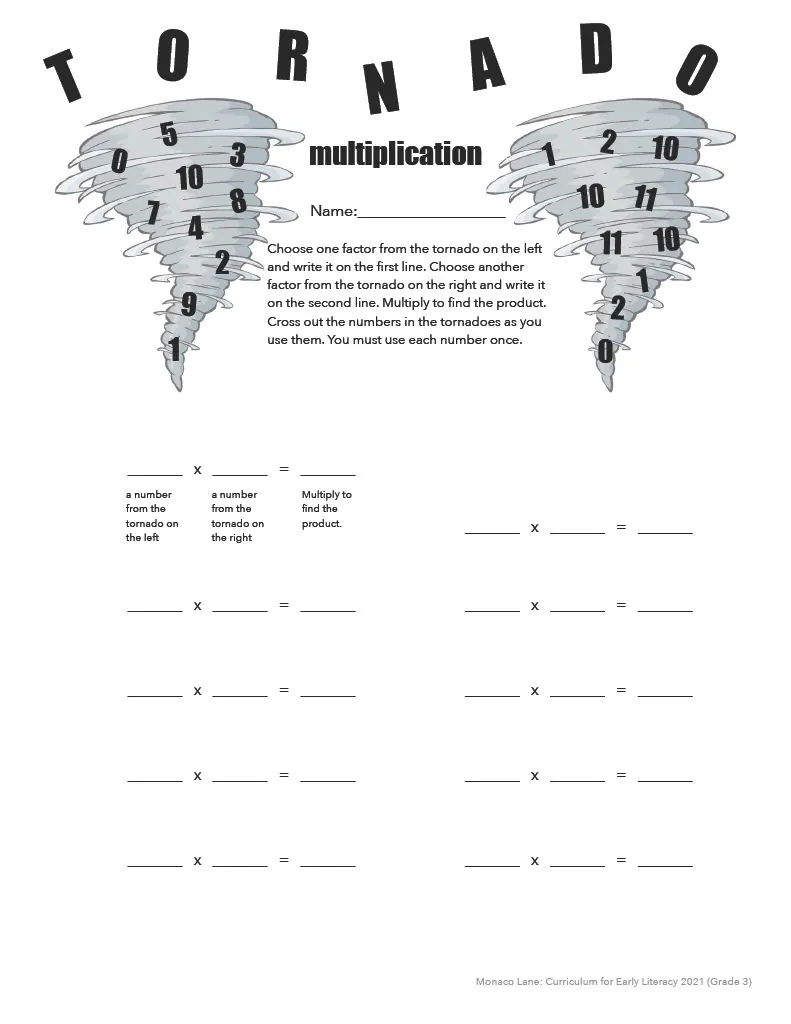
This Tornado Multiplication activity has two worksheets. Choose one factor from each tornado-shaped bank, write both factors in an equation frame and multiply.
Cross out each printed entry as it is used. Repeated values are separate entries. Each page provides ten equation frames; the second includes larger left-hand factors up to 200. Students choose their own pairings, so completed pages can differ.
Related resources
More resources teachers may find useful
24 related resources were found using this product's title, contributor, categories and tags.


In the classroom
Teaching tips & learning objectives

Learning objectives
Multiply pairs of whole numbers drawn from two fixed sets and record each as a complete equation
Multiply by 0, 1, 2, 10 and 11, which are the only values the right-hand tornado offers
Multiply larger numbers such as 44, 75 and 200 by a small factor on the second sheet

Teaching tips
Model choosing one printed entry from each bank, writing the equation and crossing out those two entries. Repeated values are separate entries.
Use the banks for practice with multipliers 0, 1, 2, 10 and 11; they do not cover every multiplication fact.
Choose the second sheet when students are ready for larger factors, including 200.

Skills covered
Multiplying with a constraint - each printed entry may be used once and is crossed off as it goes, so students plan their pairings rather than working straight down a list.
Multiplying by 0, 1, 2, 10 and 11 - the right-hand tornado is built entirely from these, so every product on both sheets tests one of the friendly multipliers.
Writing multiplication in standard form - each answer goes into a printed frame reading factor times factor equals product, with labels naming which tornado each factor came from.
Good to know
Questions teachers ask about this resource
How do the sheets differ?
The second sheet includes larger left-hand factors, including values up to 200, while retaining the same right-hand number bank.

No reviews yet
Downloaded this resource? Tell other teachers how it went.
Curriculum
Standards, concepts & topics
Standards
 Standards
- 3.OA.C.7
Core concepts
 Core concepts
Multiplication
Factors and products
Multiplying by 10 and 11
 Topics
Explore more
Categories this resource belongs to
Explore related searches
More to explore
You may also like