



3,993 products added recently
Page 79 - Science Activities
Ignite your students' interest in science with activities that make learning interactive and exciting. This collection offers experiments, demonstrations, and inquiry-based projects covering various scientific fields. By integrating these science activities into your lessons, you can encourage critical thinking, foster curiosity, and deepen understanding of scientific concepts.

 Show filters

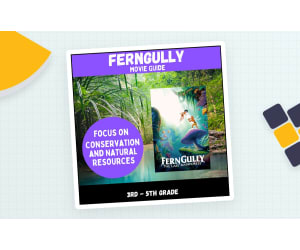
FernGully Movie Guide (Conservation and Natural Resources)
Science, Earth and Environmental Sciences, Environmental Science, Grade 3, 4, 5, Activities, Teacher Tools
Following the FernGully movie guide will utilize both writing and science concepts (conservation, natural resources, pollution and human interaction), for students to provide evidence of how these concepts are used. Using movie guides in the classroom can make content interactive and more relatable for your class. Movies bring lessons to life by showing science concepts and even social issues in an entertaining way. Movie guides help students focus on important details throughout at the movie and think critically about what they watch. Movie Synopsis: Crysta is a fairy who lives in FernGully, a rainforest in Australia, and has never seen a human before. Growing up, she is told humans no longer exist. When a logging company comes near the rainforest, to cut down the trees for human use, she sees that they do exist and she even meets one! Crysta accidentally shrinks one of the workers - a boy named Zak. Now as small as a fairy, Zak sees the damage that the company does (and humans do) and helps Crysta stop the company and an evil entity, named Hexxus. Hexxus feeds off pollution that the humans are creating. Many species are introduced throughout the movie and can be used to discuss ecosystems, if needed. Speaking and listening standards are also covered, depending on how many of the above topics you discuss in your classroom. The movie guide provides an opportunity for teachers to "get back" some of that class time at the end of a unit, whether needed for grading projects, working one on one with students, or finishing up assessments. Other students are engaged and still actively searching for the topics covered in the unit discussed. The activities provided allow for: Class discussion Small group discussion Informal assessment Movie Rating: G Grades: 3rd - 5th Tags: FernGully., Disney Pixar, movie guide, conservation, natural resources, environment, pollution, Earth Day, rainforest, environment protection File type: PDF Pages: 3 - including answer key
Author Kel's Klass
Tags Disney Pixar, Movie Guide, Ferngully, Conservation, Natural Resources, Environment, Pollution, Earth Day, Rainforest, Environment Protection
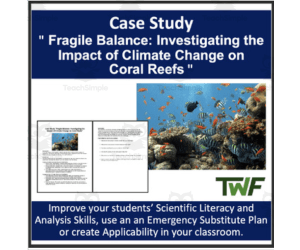
Ecology Case Study - The Impact of Climate Change on Coral Reefs
Science, Life Sciences, Nature & Plants, Biology, Earth and Environmental Sciences, Earth Sciences, Environmental Science, Grade 6, 7, 8, Activities
Bring climate science to life for your middle or high school students with this engaging case study on the threats facing coral reef ecosystems. Students will be immersed in a real-world investigation of how rising ocean temperatures are damaging delicate coral habitats across the globe. The case study provides an in-depth look at the cascading effects of climate change on the Great Barrier Reef, the world's largest reef system off the coast of Australia. Vibrant photos and maps put learners on location to witness firsthand the alarming phenomenon of coral bleaching. As carbon emissions continue to warm and acidify ocean waters, students will come to understand why coral polyps are under attack. This interdisciplinary activity blends literacy skills with ecology, Earth science and biology concepts. The reading builds background knowledge on reef biodiversity and why coral health is critical for local marine ecosystems and economies. Students will learn how coral bleaching and lowering pH impede symbiotic relationships, reproductive cycles and calcification. Following the well-researched narrative are open-ended discussion questions and analysis tasks. Learners will interpret impacts through data analysis and make predictions on the future of reefs based on climate projections. Additional student research explores mitigation strategies like reducing tourism, overfishing and pollution. Use this case study to kickstart a unit on climate change, introduce systems thinking, or drive an inquiry project . The blending of science disciplines promotes analysis from multiple angles. Assign as individual work or group discussion to fit diverse class needs. Whatever the approach, students will gain a memorable look into cascading climate impacts on the front lines. Turn up the heat on climate literacy in your classroom with this thought-provoking reef case study! Immerse students in investigating the threats coral ecosystems face from acidic and warming waters due to greenhouse gas emissions. Understanding the science behind these impacts creates informed, caring stewards of the environment. NGSS: MS-LS2-4 HS-LS2-7 HS-ESS3-5 HS-ESS2-2
Author Teach With Fergy
Tags Science Reading, Coral, Climate Change

U.S. States Project-Based Learning (Quilt Research Project and Craft)
Social Studies, ELA, Biographies, History, History: USA, Geography, Reading, Reading Comprehension, Language Development, Spelling, Writing, Science, Life Sciences, Animals, Research, Grade 3, 4, 5, Activities
U.S. States Project -Based Learning (Quilt Research Project and Craft) As an ideal asset for educators, this dynamic teaching resource brings creativity into learning, encompassing subjects from Social Studies to Science, Language Arts, and more. Suitable Grades: This teaching resource is designed for students in Grade 3 through Grade 5. About the project : The project involves researching information about each state - its symbols, history, geography, climate & seasons, attractions and more - then crafting that information into a personalized quilt square design. It can focus on either one specific region or all fifty states at once. "It isn't just about Geography or History" Bio-sketches of significant personalities are included in the study material. Zoology and botany come to play when studying state animals & flowers respectively. The approach emphasizes improving writing & spelling skills as well. Promoting Creativity through Quilt Squares: The U.S State Topic Quilt Squares themselves are varied – ranging from looking at a topographical layout of geography through regional flora and fauna along with notable individuals related with the particular state being studied. The quilt concept adds an intriguing Art component where children can take pride in creating unique visual representations of what they've learned; This approach to teaching stimulates student engagement like no other – it works excellently as a collective group assignment promoting collaborative exploration; For Example: Teachers can get creative by formulating different scenarios such as assigning one topic per student enabling them craft a comprehensive class quilt giving everyone involved a holistic image of US states. Also, Can also be implemented as homework assignments for independent research abilities; Possibility to be incorporated within centers -based rotation classes inducing peer mentoring environments. Specifications: Includes: A charming decorative piece for classrooms once the project concludes serving as an instant reference tool of pride for students; Resource includes 258 PDF pages, Detailed teacher instructions; and 17 distinct quilt square designs surrounding 14 U.S. state topics. This isn’t just about an engaging and knowledge-enriching experience but also includes elements of joy-filled crafting sessions leaving students curious to learn more.</p
Author Heather Huhman
Tags Project-based Learning, Quilt Research, Cross-curricular, US States, Creativity

Penguins Activity
Science, Life Sciences, Biology, Animals, Grade 3, 4, 5, 6, 7, 8, Activities
Activity Introduction An amazing activity designed for the students to learn more about famous places in different countries. The Penguins Do you like animals? what is your favorite one? Do you own a pet? If yes, tell us more about it, like what its name? And what do you like most about it? What are the animal kingdoms? Can you write down the characteristics of each animal class like mammals, birds, reptiles, amphibian, fish and mollusks. Do you know that some animals can sing, can you name any of them? What is the largest and the smallest mammal in the world? What is the largest and the smallest bird in the world? What is the largest and the smallest fish in the world? Penguins Activity The activity is perfect for encouraging the researching skills for the students, while learning more about this fantastic place. Penguins This friendly designed worksheet is suitable for students at school, homeschooling, and as a group activity. Instructions How much do you know about penguins? Let's answer some questions about penguins. Format Available in a PDF format.
Author Educational Voice
Tags Penguins Activity, Penguins, Penguin, Penguins Facts, Penguins Facts For Kids, Animal, Animals, Animals Facts, Animals Facts For Kids
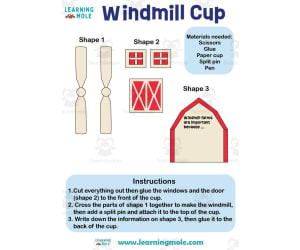
Windmill Farm Activity
Science, Earth and Environmental Sciences, Environmental Science, Grade 2, 3, 4, 5, 6, 7, Activities
Activity Introduction An amazing activity designed for the students to learn more about famous places in different countries. The Windmill Farms Do you like STEM subjects? what is your favorite one? Have you ever tried to plant a seed? If yes, tell us more about it. Or have you ever tried to invent something? If yes, tell us more about it. And how do you think it will help us? Have you ever seen a microorganism under a microscope? What was it? And how it looked like? Mathematics is a marvelous subject. Let' sharpen our brains and solve some equations. Do you like timetable tricks? What is your favorite one? Do you know how to code? Have you ever created an app or a game before? If yes, how was it like? Windmill Farms Activity The activity is perfect for encouraging the researching skills for the students, while learning more about this fantastic place. Windmill Farms This friendly designed worksheet is suitable for students at school, homeschooling, and as a group activity. Instructions Cut everything out then glue the windows and the door (shape 2) to the front of the cup. Cross the parts of shape 1 together to make the windmill, then add a split pin and attach it to the top of the cup. Write down the information on shape 3, then glue it to the back of the cup. Format Available in a PDF format.
Author Educational Voice
Tags Windmill Farm Activity, Windmill Farm, Windmill, Windmills, Windmills Facts, Windmills Facts For Kids, Environment, Environmental Science, Environment Facts, Environment Facts For Kids
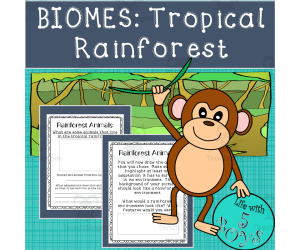
Tropical Rainforest Biome Activity
Science, Earth and Environmental Sciences, Earth Sciences, Grade 1, 2, 3, 4, 5, Activities
Tropical Rainforest Biome Activity Transport students to the lush and vibrant tropical rainforest biome with this engaging science activity. Students will brainstorm rainforest animals, choose one to research, and write about its adaptations that enable survival in the hot, wet climate. Next, learners will study the tropical rainforest's environment and climate. Finally, students will draw their chosen rainforest creature, focusing on detail and scale to showcase features and adaptations. This activity can be implemented in one session or over several days. Use it for whole-class instruction, small groups, partner work, or independent practice across elementary grade levels. The multiple components promote creativity, research skills, and retention of rainforest biome concepts.
Author Life with 5 Boys
Tags Biomes, Habitats, Rainforest, Rain Forest, Tropical Rainforest, Tropical Rain Forest, Science, Activities In Tropical Rainforest, Biome Activities, Tropical Rainforest Biome Project Ideas, Tropical Rainforest Activities, Activities To Do In The Tropical Rainforest, Animal In The Tropical Rainforest Biome
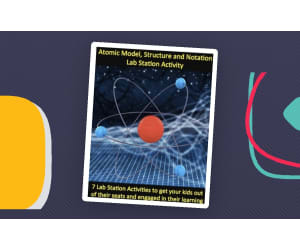
Atomic Model, Structure and Notation – Lab Station Activity
Science, Chemistry, Grade 7, 8, 9, 10, Labs, Experiments, Activities
Atomic Model, Structure and Notation Lab Station Activity Engage students in learning atomic model, structure, and notation through this customizable lab station activity . Students move through various stations testing their knowledge about topics like atomic theory history, the Bohr-Rutherford atomic model, subatomic particles, calculating atomic mass/numbers, and more. Activities include drawing models, researching questions, writing explanations, watching videos, answering test questions, and even formulating their own questions. Recording sheets provided for students to document their work. Use this as an introductory or review lab activity in individual, small group, or whole class settings to bring interactive chemistry learning to life. Modifiable with answer keys. 7th-10th grade. Chemistry.
Author Teach With Fergy
Tags Atomic, Model, Structure, Notation, Lab Station, Simple Atomic Model

Reading Passage 7: Force and Motion (Google Forms)
ELA, Reading, Science, Physics, Common Core, ESL, Language Development, Resources for Teachers, Reading Comprehension, Grade 5, 6, 7, Centers, Activities, Assessments, Teacher Tools, Tests, Quizzes and Tests
Free Reading Passage on Force & Motion for Physical Science What's inside this free product? Science Reading Comprehension Passage: Force & Motion Independent Google Forms Version: This is the independent Google Forms version containingone lesson. Product Info: 1 form(US English with Answers) Google Forms Version Teaching Duration: 90 Minutes Science Reading Comprehension Outline: Introducing a comprehensive resource tailored for 5th and 6th graders, this product offers enriching reading passages supplemented with illustrative pictures and graphs to clarify key concepts. Aligned with the Common Core State Standards (CCSS), it offers a hassle-free approach to teaching, given that the bulk of the preparation is already done for you. The passages present a diverse set of questions – from multiple choice to data analysis and fill-in-the-blanks. This ensures a rich blend of high-interest content and fundamental curriculum-based science themes. With its versatility, you can seamlessly integrate these lessons into various classroom settings, whether it's whole class discussions, morning exercises, independent desk tasks, small group engagements, contingency plans for substitute teachers, regular homework assignments, or even themed activities for holidays. FULL CATALOG OF DOWNLOAD LINKS HERE Grade 5/6 Links: Physical Science Part 1 - Physical and Chemical Properties Google Docs/Slides/Forms PDF PPT Word Free Supplementary Pack Accompanying Videos Physical Science Part 2 - Motion and Energy Google Docs/Slides/Forms PDF PPT Word Free Supplementary Pack Accompanying Videos Physical Science Part 3 - Electricity and Magnets Google Docs/Slides/Forms PDF PPT Word Free Supplementary Pack Accompanying Videos Life Science Part 1 - Cells, Reproduction and Genetics Google Docs/Slides/Forms PDF PPT Word Free Supplementary Pack Accompanying Videos Life Science Part 2 - Human Body Systems Google Docs/Slides/Forms PDF PPT Word Free Supplementary Pack Accompanying Videos Life Science Part 3 - Plant Parts and Ecosystems Google Docs/Slides/Forms PDF PPT Word Free Supplementary Pack Accompanying Videos Earth Science Part 1 - Plate Tectonics and Rock Cycle Google Docs/Slides/Forms PDF PPT Word Free Supplementary Pack Accompanying Videos Earth Science Part 2 - Ocean Exploration and Natural Resources Google Docs/Slides/Forms PDF PPT Word Free Supplementary Pack Accompanying Videos Earth Science Part 3 - Weather and Solar System Google Docs/Slides/Forms PDF PPT Word Free Supplementary Pack Accompanying Videos For similar products and other frees, do check out Cored Group on TeachSimple .
Author Cored Education
Tags Science, Elementary, Reading, Comprehension, Vocabulary, Answers, Physics, Physical Science, Ccss, Digital Centers
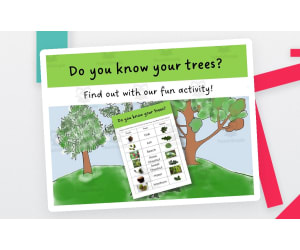
Tree ID Activity – Identify Common Trees Game
Science, Life Sciences, Nature & Plants, Biology, Grade 1, 2, 3, Activities, Games
Test your pupil's knowledge of common trees with this simple, fun Tree ID Activity. Introduction and objectives This simple puzzle, helps children to learn to recognize a tree by its leaf and fruit. The trees included on the more advanced puzzle are: Oak Ash Beech Horse Chestnut Sweet Chestnut Hazel Hawthorn And on the easier one: Oak Horse Chestnut Beech Hawthorn How to use this activity The tree activity can be used as part of a science lesson on comparing trees, or as an assessment after studying different trees and their fruits, possibly in autumn time. It can be successfully used alongside our Leaf Sorting Activity. It can follow a walk where the fruits of different trees are collected along with their leaves, in autumn, and the children can use books or other sources to help them to identify the leaves and fruit - as such it can be a learning activity rather than a puzzle. Children can either draw lines from each fruit to ots tree and then its leaf, or the sections can but cut out and stuck onto another sheet (provided). There are two levels of difficulty, one activity with seven trees and one with four. Choose the one most suitable for each child. Who can use the Tree ID Puzzle? It can be used in the home, by teachers and in the home-school. It can be blown up large and completed together by a class/group. It can be made into a centre activity by cutting out the individual words and pictures and allowing children to put the ones that go together next to each other. I suggest laminating the pieces to make them more durable. Answers provided.
Author Lilibette's Resources
Rating
Tags Tree Id, Tree Identification, Tree Leaves And Fruit ID, Tree Leaves And Fruit Puzzle, Tree Leaves And Fruit, Identifying Trees By Their Leaves, Identifying Trees By Their Fruit

African Animals - I Have Who Has Cards
Science, Life Sciences, Animals, Grade 3, 4, 5, 6, Activities
These are African Animals - I Have Who Has Cards. This set of cards comes with 2 levels for differentiation. Animal characteristics and traits are the focus for these cards, making it a great review or introduction for students when studying animals. Cards are printed 4 per page. You will print, cut and laminate for durability.
Author More Than Just Reading
Tags Game Cards, African Animals, I Have Who Has, Whole Group Games, Literacy

Reading Passage 15: Electric Energy Google Docs
ELA, Reading, Reading Comprehension, Science, Physics, Common Core, ESL, Language Development, Spelling, Resources for Teachers, Grade 5, 6, 7, Centers, Activities, Assessments, Teacher Tools, Worksheets & Printables, Tests, Quizzes and Tests
Free Reading Passage on Electric Energy for Physical Science What's inside this free product? Science Reading Comprehension Passage: Electric Energy This is the independent Google Docs version containingone lesson. Product Info: 7 PAGES (US English with Answers) Google Docs Version Teaching Duration: Approx. 90 Minutes Science Reading Comprehension Outline: Introducing a comprehensive resource tailored for 5th and 6th graders, this product offers enriching reading passages supplemented with illustrative pictures and graphs to clarify key concepts. Aligned with the Common Core State Standards (CCSS), it offers a hassle-free approach to teaching, given that the bulk of the preparation is already done for you. The passages present a diverse set of questions – from multiple choice to data analysis and fill-in-the-blanks. This ensures a rich blend of high-interest content and fundamental curriculum-based science themes. With its versatility, you can seamlessly integrate these lessons into various classroom settings, whether it's whole class discussions, morning exercises, independent desk tasks, small group engagements, contingency plans for substitute teachers, regular homework assignments, or even themed activities for holidays. FULL CATALOG OF DOWNLOAD LINKS HERE Grade 5/6 Links: Physical Science Part 1 - Physical and Chemical Properties Google Docs/Slides/Forms PDF PPT Word Free Supplementary Pack Accompanying Videos Physical Science Part 2 - Motion and Energy Google Docs/Slides/Forms PDF PPT Word Free Supplementary Pack Accompanying Videos Physical Science Part 3 - Electricity and Magnets Google Docs/Slides/Forms PDF PPT Word Free Supplementary Pack Accompanying Videos Life Science Part 1 - Cells, Reproduction and Genetics Google Docs/Slides/Forms PDF PPT Word Free Supplementary Pack Accompanying Videos Life Science Part 2 - Human Body Systems Google Docs/Slides/Forms PDF PPT Word Free Supplementary Pack Accompanying Videos Life Science Part 3 - Plant Parts and Ecosystems Google Docs/Slides/Forms PDF PPT Word Free Supplementary Pack Accompanying Videos Earth Science Part 1 - Plate Tectonics and Rock Cycle Google Docs/Slides/Forms PDF PPT Word Free Supplementary Pack Accompanying Videos Earth Science Part 2 - Ocean Exploration and Natural Resources Google Docs/Slides/Forms PDF PPT Word Free Supplementary Pack Accompanying Videos Earth Science Part 3 - Weather and Solar System Google Docs/Slides/Forms PDF PPT Word Free Supplementary Pack Accompanying Videos For similar products and other frees, do check out Cored Group on TeachSimple .
Author Cored Education
Tags Science, Elementary, Reading, Comprehension, Vocabulary, Answers, Physics, Physical Science, Ccss, Digital Centers

French: The Environment and Pollution - Sudoko Games
Science, Earth and Environmental Sciences, Environmental Science, Grade 6, 7, 8, 9, 10, 11, 12, Games, Activities
The French: The Environment and Pollution - Sudoko Games This versatile teaching resource creatively blends scientific learning with a focus on strengthening French language skills. Designed primarily for students from Grade 6 to Grade 12, it utilizes an engaging sudoko puzzle format to familiarize learners with important environmental science terms. The resource features three uniquely crafted sudoku games aimed at stimulating learners' minds while introducing new terminologies related to environment and pollution. This worksheet type resource allows educators flexibility in their approach; they can: Conduct whole group sessions fostering collective problem-solving, Adopt a targeted small group approach for in-depth discussions, or Assign these puzzles as homework tasks promoting educational continuity. Included Answer Keys Bolstering the usability of this single PDF file are included answer keys that pave the way for swift checking and corrections. This allows teachers more time to concentrate on ensuring conceptual understanding and fostering student interaction than tedious evaluation tasks. The integration of subjects like Science, particularly subtopics of Environmental Science, with elements of the French language makes this tool multi-faceted promoting interdisciplinary learning; a refreshing diversion from routine lessons. A valuable tool for both public school and homeschool environments , incorporating these fun-filled gaming resources into existing lesson plans can pique curiosity around topics like environment preservation and pollution control while boosting non-native linguistic abilities through engaging instructional methods.
Author Love Learning Languages
Tags French, Environment, Pollution, Sudoko Games, Teaching Resource
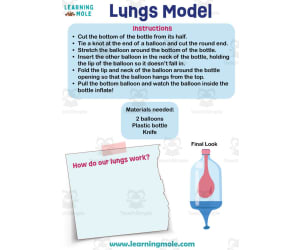
Lungs Model Activity
Life Sciences, Science, Biology, Human Body, Grade 2, 3, 4, 5, 6, 7, 8, Activities
Activity Overview The human body is full of fascinating wonders to learn. This activity is created to help the students recognize the anatomy and the job of the human body. Lungs Model Have you ever thought about how do we breath? And what exactly the respiratory system do? How is our brain connected to our respiratory system? Can you mention the respiratory system's organs? And what are the jobs of every organ? What does the heart do? And how important is our heart? Lungs are really important. Can you mention any of the lungs properties? Did you know that our left lung is slightly smaller than the right one? Lungs Model Activity The activity is perfect for encouraging the researching skills for the students, while learning more about our fantastic human body. Lungs Model This friendly designed worksheet is suitable for students at school, homeschooling, and as a group activity. Format Available in a PDF format.
Author Educational Voice
Rating
Tags Lungs Model Activity, Lungs Model, Lungs, Lungs Facts, Lungs Facts For Kids, Respiratory System, Respiratory System Facts, Respiratory System Facts For Kids, Human Body, Human Body Facts

Florida Wildlife Animal Project
Science, Life Sciences, Animals, Biology, Earth and Environmental Sciences, Earth Sciences, Grade 3, 4, 5, Projects, Activities
This product is perfect for teachers who want to help their students learn about the animals that live in Florida. The Florida Wildlife Animal Project includes research, poster design, model creation, and presentation elements that will engage and educate students.
Author Have Fun Teaching
Tags Living And Non-Living Things
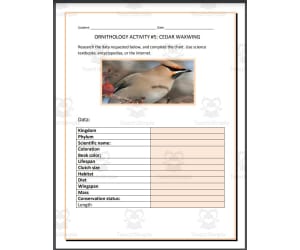
Ornithology: Cedar Waxwing - Research Project
Science, Life Sciences, Animals, Research, Grade 4, 5, 6, 7, Activities
With this resource Ornithology: Cedar Waxwing - Research Project, students will research the data requested and complete the chart provided while expanding their knowledge about the Cedar Waxwing. Students are asked to use science textbooks, encyclopedias, or the internet to find their information. Some of the required information to find include: Kingdom Phylum Scientific name: Coloration Beak color; Lifespan Clutch size Habitat Diet Wingspan Mass Conservation status: Length Additionally, students are asked to Describe the eggs of the Cedar Waxwing bird, describe their tail, and draw a picture of the two birds listed in the resource. Color them in. List their scientific name. (Draw their closest relative the Bohemian Waxwing). Students can present their findings in different ways: Oral presentation, posters, digital slides, brochures, etc. And they also can be required to turn in this resource! This resource Ornithology: Cedar Waxwing - Research Project was designed for middle school students, however it can also be used for high schoolers. Students may work independently, in pairs, or in groups. If students work in groups, make sure each student has their part of the research assigned so that everyone does their part in completing the research project. Find more interesting resources in my store here!
Author THE LANTERN OF KNOWLEDGE
Tags Ornithology, Cedar Waxwing, Research Project, Birds, Classification
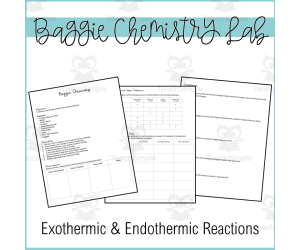
Baggie Chemistry Lab | Endothermic and Exothermic Reactions
Science, Chemistry, Grade 6, 7, 8, Activities, Projects
Baggie Chemistry Lab | Endothermic and Exothermic Reactions Students explore chemical reactions and their resulting energy changes with this engaging baggie chemistry lab . Learners follow procedures to combine household ingredients in plastic bags, closely observing the vivid reactions that result. Comparing endothermic and exothermic processes, they identify indicators like temperature change, bubbles, color shifts, and precipitates formed. This activity builds critical thinking as students collect qualitative data, draw conclusions about energy transfers occurring, and differentiate between physical changes and chemical reactions. Use this lab to reinforce chemistry concepts for middle schoolers or high schoolers in small groups or as an independent inquiry project.
Author Maude in the Middle
Tags Chemistry, Lab, Endothermic, Exothermic Reactions, Science Activity, Endothermic And Exothermic Reactions Lab, Exothermic And Endothermic Reactions Lab, Exothermic Reaction Experiment

Separating Mixtures and Solutions - Wildcard and Snap Card Games for Middle School
Science, Chemistry, Grade 5, 6, 7, 8, 9, Activities, Games
Separating Mixtures and Solutions - Wildcard and Snap Card Games for Middle School: An Exciting Academic Resource This teaching resource aims to help students in grades 5 through 9 master crucial scientific concepts interactively. Spanning topics such as mixtures, solutions, suspensions, solubility, and saturated solutions. The Card Game Package The package features 84 playing cards, ingeniously blending academics with fun gameplay. The main aim of this approach is to reinforce the learned concepts while fostering their joy for learning. Suitable For Whom? Ideal for middle school learners specializing in science, specifically chemistry. Before implementing this resource effectively as part of your teaching strategy, students should have basic knowledge in subjects such as: Composition and physical properties of mixtures, Evaporation to dryness and crystallisation, Fractional distillation along with distillation, Filtration tactics together with Chromatography. Versatility of the Resource This multi-faceted tool can be used during whole group review sessions or assigned as homework tasks after covering thematic units-instructional flexibility is key here. Included Materials: The package includes an Animated PowerPoint providing comprehensive instructions on how-to-play both wildcard and snap games included within. This easy-to-follow instruction guide ensures that both teachers and students find the learning process pleasing; not a chore! Downloading should be seamless due to its adaptability across various devices – PCs or tablets. This encourages flexible mobility during game time. Why Should You Choose This Resource? Turn education into an engaging experience with the Separating Mixtures and Solutions - Wildcard and Snap Card Games for Middle School. Embed fun into your teaching approach while retaining the academic essence. Remember, learning should always be exciting!
Author Elf off the Shelf Resources
Tags Mixtures, Solutions, Suspensions, Solubility, Card Games
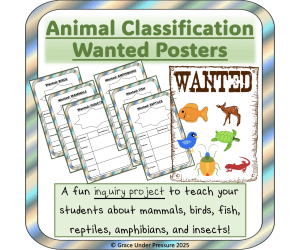
Science Project: Animal Classification Posters Types of Animals
Science, Life Sciences, Insects, Animals, Biology, Research, Grade 2, 3, 4, 5, Activities, Worksheets & Printables, Worksheets
This elementary science project is a fun and interactive way for your students to learn about animal classes- different types of animals and how we can tell them apart by their unique features! Students can work independently or in small groups to research six animal classes: mammals, reptiles, fish, amphibians, birds, and insects. They need to find information about the following topics: Vertebrate or invertebrate: Find out if this kind of animal has a back bone or not. (Check the correct box.) Features: What helps people classify this kind of animal? What features make them different than the other classes? Five examples of animals from this class: Find some unique ones! Fun facts: What interesting information should your classmates know? These posters are specially designed to be printed on 11x17 paper for the best results! How to Use: Print a two-page note-taking sheet for each student. Print the posters on 11x17 paper: one for each student or group. Assign each student or small group one kind of animal class to research. Provide information, books, or websites for students to use to complete research. Students will fill in the information on their poster. They will present to the rest of the class so that everyone learns about each animal class. The other students take notes on their sheets. The completed posters can be hung up to present the information around your room. Grades to Use WIth: This elementary science project is great for students in 2nd, 3rd, 4th, and 5th grade who are developing research skills and learning about animal classification. What's Included: A total of 9 pages in PDF Format: Ready to print and use! Title Page 2-Page Note-Taking Sheet to use during the presentations 6 Posters- one for each of the six animal classes included: mammals, reptiles, fish, amphibians, birds and insects.
Author Grace Under Pressure
Rating
Tags Animal Classes, Vertebrate, Invertebrate, Mammals, Science Project, Birds, Reptiles, Amphibians, Animal Research Posters, Types Of Animals

LEARNING RECYCLING | FREE RESOURCE
Earth and Environmental Sciences, Science, Adult Education, Early Learning, Elementary, High School, Homeschool Resources, Middle School, Not Grade Specific, Pre-K, Activities, Worksheets & Printables
RECYCLING | FREE RESOURCE INTRODUCTION ABOUT THIS PRODUCT: 1. Brief introduction: Hello, thank you very much for being interested in this educational document. This document will help you a lot both in the classroom if you are a teacher, as well as if you homeschool and want to stimulate your children from home. 2. Title of the educational resource: This document is titled "Teaching material for children" 3. Topic to work on: Thanks to this educational document, we are going to work on a basic topic that every child and/or student should master. 4. Area of knowledge where it should be applied: Thanks to this document, we will address a topic and at the same time an important area of learning. SECONDARY AND COMPLEMENTARY INFORMATION: 5. Document version: This educational document is available in PDF version, size A4. 6. Color or black/white: This educational product is designed in color because we believe that this will be much more attractive for your children. 7. Aimed at children of ages: This educational document is specifically aimed at children in primary education. 8. Area: This educational document may be used in some area of primary education for children. 9. Keywords: children, primary education, resources for children, free resources, primary resources, resources for primary education. 10. Tags or keywords that describe the content: didactic material, teaching sheets, material for children, printable educational material, printable material. 11. Ways to print: I suggest you print this document in A4 format, and check if your printer has enough ink for the printout to be of quality and so that your students can complete their worksheet without any problem. 12. Ways to apply it in class: You can apply this document both individually and as a group, it all depends on your criteria. THANK YOU SO MUCH FOR PREFERING MY PRODUCTS! PLEASE VISIT MY STORE BECAUSE I HAVE A LOT OF RESOURCES, AND THE BEST PART, IS THAT THERE ARE FREE FOR YOU!
Author EDITORIAL LAURA EDUCA
Tags RECYCLING, RECICLE, FREE RESOURCES, EARTH, ENVIRONMENTAL, FREE
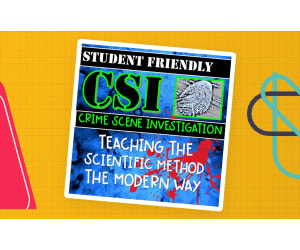
Crime Scene Investigation Student Activity
Science, Chemistry, Grade 5, 6, 7, Activities, Projects
This resource is a Crime Scene Investigation Student Activity . Included in this lesson is a 9 day unit plan, instructions for all the experiments and activities, and packet for a crime scene investigation. You will receive a PDF download which includes the teacher notes/lessons plans as well as the student packets. This is a highly authentic and engaging unit- it's designed so that you are able to teach the scientific method using real world and inquiry based application. It's easy to follow, and amazingly fun. Sally Scarecrow has suffered a deadly hiccup attack at the hands of a teacher in the building. Student detectives spent the first day in detective school brushing up on content vocabulary, reviewing our suspect list, making predictions and observing the crime scene from a far. Over the next several days you will ask questions, compose experiments testing the cola from the crime scene for poison with litmus juice, dusting for finger prints, analyzing handwriting and more. We concluded our CSI by drafting a composite sketch of who we thought the culprit was, serving the culprit with an arrest warrant and reading her/him their Miranda Rights. Students will love solving the mystery of Sally Scarecrow! This is a great back to school or end of the year activity . There is not a better or more applicable way to teach students about the Scientific Method. The report portion of the packet can be used as the assessment component of the unit and includes a rubric. It covers everything!
Author Hey Teacher Shoppe
Tags Chemistry, CSI, Laboratory, Science Project, DNA, Crime Scene Scenarios For High School Students
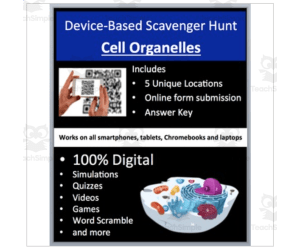
Cell Organelles - Device-Based Scavenger Hunt Activity - Let the Hunt begin!
Science, Life Sciences, Biology, Grade 7, 8, 9, 10, Activities
Cell Organelles - Device-Based Scavenger Hunt Activity Invite your students to delve into the fascinating world of cellular biology. This cutting-edge teaching tool is uniquely adapted for grade 7-10 science students with a keen focus on Biology. The multi-file download caters to a variety of implementation methods, whether as group activities or individual assignments that promote self-learning exploration. The device-based component allows for flexible use with smartphones, Chromebooks, laptops or tablets – fostering tech-savvy minds while learning. This teaching resource links each QR code scanned with integral pieces of knowledge related to cell organelles like the Golgi Body, Endoplasmic Reticulum, Nucleus, Cell Membrane & more plus brief touches upon cellular diseases. An Innovative Learning Journey: Scanning QR Codes: Each successful scan discloses hidden information vital in learning about cell organelles gradually. Evaluation Ease: Seamless evaluation tools available through my website allowing direct submissions of student task completion that eliminates traditional paperwork hassles. Tailor-Made Experience: The design encapsulates limitless adaptability potential according your unique classroom needs ensuring every student enjoys this exciting adventure inside cells - may it be via educational videos or simulations or weaving an open-ended story! . Dare to transcend traditional boundaries and immerse your students in an unforgettable journey within cells enhancing both their scientific knowledge and technology usage literacy simultaneously!
Author Teach With Fergy
Tags Cell Organelles, Scavenger Hunt, Biology, Interactive Learning, Technology
Average Atomic Mass Practice ESL: Spanish version
Science, Chemistry, Grade 8, 9, 10, 11, 12, Activities
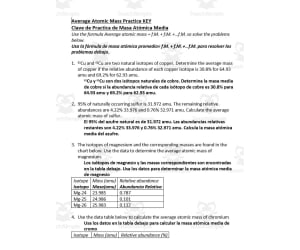
Average Atomic Mass Practice Problems (Spanish Translation) This chemistry resource provides 13 practice problems covering topics related to average atomic mass, including calculating the amu of elements, determining relative abundance, and using mass spectrometry data. The practice problems build skills in atomic mass concepts and calculations. The resource includes a Spanish translation under each question to support bilingual and English language learning students. The translations aim to improve comprehension for students whose first language is Spanish. A bilingual AP chemistry student provided the accurate Spanish translations. Teachers can implement this printable resource in many ways - as whole class practice, small group work, or as a homework assignment to give students extra practice with atomic mass concepts. The answer key allows students to check their understanding and self-assess their learning. This resource helps chemistry students master an essential concept – average atomic mass.
Author Schrim's Chem
Tags Average Atomic Mass, Atomic Mass, ESL , Chemistry Spanish, Simple Spanish Text

Average Atomic Mass Practice ESL: Korean version
Science, Chemistry, Grade 8, 9, 10, 11, 12, Activities
Average Atomic Mass Practice Problems: Korean Translation This chemistry resource provides 13 practice problems covering topics like calculating the atomic mass units (amu) of elements, determining relative abundance, and using mass spectrometry data to identify elements. The practice problems come with an answer key that shows the step-by-step solutions. To aid English language learner students, the resource includes Korean translations under each practice problem. The translations were done by a native bilingual Korean student to help ESL students better understand the questions. This supplemental resource can be used by science teachers in grades 8-12 in various ways - as individual practice, a small group activity , or a take-home assignment. It is designed to help students gain proficiency in using atomic mass concepts by providing real-world calculation problems with detailed solutions.
Author Schrim's Chem
Tags Atomic Mass, Average Atomic Mass, ESL, Chemistry Korean, Chemistry Practice

Science Reading Comprehension Project: Marine Animal
ELA, Writing, Science, Life Sciences, Biology, Research, Preschool, Grade 1, 2, 3, 4, Projects, Activities
Science Reading Comprehension Project: Marine Animal This package centers around marine animals making it an ideal aid for educators aiming to improve their students' understanding of marine biology with engaging and student-friendly material. The main focus of this resource is research about various sea creatures through project-based learning. Beyond the typical writing exercise by leading students to explore the fascinating world beneath our oceans' surface. Included in this Resource Packet: An easy-to-follow set of project instructions A clear-cut rubric ensuring smooth implementation in any classroom or homeschool setting The structure prioritizes comprehension—students don't merely read about marine life; they actively participate in research activities that encourage diverse thinking skills and expand their knowledge base. This resource is targeting Kindergarten, Grade 1, Grade 2, Grade 3, and Grade 4 students. Designed to fit seamlessly into Language Arts and Science curriculum areas specifically focused on Writing and Biology sub-subjects. The file type is PDF adding user convenience since it offers portability. Teachers can print copies as needed or share digitally for remote learning platforms—adapting smoothly within modern inclusive education standards. The Marine Animal Project also offers rich opportunities for children's presentations—nurturing not only reading comprehension skills but public speaking capabilities crucial for holistic growth developing both academic proficiency from early education phases and building confidence at the same time. As a teacher, you'll find that using this high-quality Marine Animal Project saves your time by offering ready-made content while giving your learners an exciting educational experience uncovering one of nature's most unique environments—the oceanic world right at their desks. Note: Your purchase correlatively supports Teach with Flair by Delightfully GiGi who continuously aims at integrating flair into everyday global classrooms.
Author FlairSquare Educational Resources
Tags Marine Biology, Reading Comprehension, Project-Based Learning, Public Speaking, Research Activities