



3,912 products added recently
Page 5 - Writing Center
Writing Centers are an excellent resource for nurturing students' creativity and enhancing their writing abilities. These centers offer various activities, including journaling, storytelling, poetry, and collaborative writing projects. By implementing a writing center, you create a dedicated space where students feel encouraged to express themselves and experiment with different writing styles. Resources such as graphic organizers, word banks, and writing prompts support students in developing confidence and proficiency in their writing. Enrich your language arts curriculum with these inspiring tools.

 Show filters


Owls Reading Comprehension Passage - Cored Ed Encyclopedia
ELA, Language Development, Resources for Teachers, Reading Comprehension, Reading, Pre-Reading, Writing, Science, Animals, Life Sciences, Grade 2, 3, 4, 5, Worksheets & Printables, Worksheets, Teacher Tools, Centers, Activities, Writing Prompts, Assessments, Tests, Quizzes and Tests, Quizzes
This owls reading comprehension contains the following: Visualize on the Cover (Teacher Read Aloud Script) Start your lesson by taking a few moments to visualize the topic and share thoughts or feelings about it. COMPANION VIDEO NOW AVAILABLE (EMBEDDED AFTER PREVIEW PICTURES IN PRODUCT DESCRIPTION) Pre-Reading Trivia Students will write down one thing they already know about the subject and then read five more facts and discuss. These facts are fun, and the students will enjoy learning about the subject before reading more. Reading Passage The text is a high-interest reading passage with set paragraphs, roughly three to four paragraphs long. It contains a variety of themes about the topic, anywhere from history to technology. The passage is between 250 and 350 words in length. Mixed Questions The first question page contains four multiple-choice questions, each with a choice of four answers, and three written response questions that require a sentence or two from the student. Vocabulary Questions Practice seven key words from the text in this section across two activities. First section is scrambled words where students will unscramble three words given a clue for each. The second section is a word to meaning matching activity. Creative Writing In this question, the student will be required to write a five to eight sentence paragraph on a question related to the topic. Extension Activities This page is optional for fast finishers or to take home. There are several activities, each one requiring a different skill. Do some, do none, do all, completely optional - but you will feel reassured knowing every possibility is planned for. Includes summary writting question. Answer Key There are answers for the multiple-choice questions, written response questions have sample answers, vocabulary answers and if there is a summary question then a sample summary will be provided as well. FULL CATALOG OF DOWNLOAD LINKS AND ENCYCLOPEDIA INDEX HERE Lesson Snapshot Title: Owls Genre: Nonfiction (informational text) Subject: Life Science (animals) / Reading Informational Text Primary Topic: How owls hunt, live, and help ecosystems Estimated Guided Reading Level (A–Z): S What This Lesson Teaches Best How owls are birds of prey in a group called Strigiformes , with more than 200 kinds , and most hunt alone and mostly at night. How an owl’s facial disc works “like a satellite dish” to gather tiny sounds and guide them toward its ears. How owl bodies help hunting: wing feathers let air pass quietly, and owls turn their heads (nearly 270 degrees ) because their eyes stay fixed. How scientists sort owls into two main families— Tytonidae and Strigidae —and how owls live in many habitats worldwide (with a few exceptions). How pellets and nest boxes connect owls to people today (learning what was eaten, helping keep mouse numbers down, and supporting safe nesting). Learning Goals Students will describe what the text says about how many kinds of owls there are and when most owls hunt. Students will explain how a facial disc helps an owl find prey using details from the passage. Students will describe two body features that help owls hunt quietly and accurately. Students will identify the two main owl families named in the text and one detail about each. Students will explain what an owl pellet is and how it helps students and scientists learn. Students will name habitats where owls can live and describe one way people can help owls near fields and barns. Key Vocabulary From the Text Strigiformes — a group name for owls. facial — related to the face. parliament — a name for a group of owls. Tytonidae — the barn owl family. pellets — dry bundles of fur and bones owls cough up. Cored Ed Encyclopedia Overview The Cored Ed Encyclopedia is a weekly series of lessons that you can pick up and use right away. These short readings fit into whatever time you have available. Each one includes a warm-up, a reading, and a set of questions, but it’s flexible — you can do just the reading, the full lesson, or skip the writing section if you need to. Each lesson focuses on a single topic so students don’t get lost. The writing is clear but never childish, making it perfect for grades two through five. Topics range from animals and science to history, inventions, and everyday things. No matter the level of the student, everyone should take away at least one new idea or fact from each lesson. The materials are easy to print, easy to explain, and require no setup. They work well for whole-class teaching, partner work, or independent study.
Author Cored Education
Rating
Tags Vocabulary, Spelling, Reading Comprehension, Reading Passages, Reading, Creative Writing, Reading Strategies, Writing Prompts, Owls, Life Science
Reading Comprehension Passages Fiction Set 1 - Animals (Google Docs)
ELA, Reading, Common Core, Reading Comprehension, Children’s Literature, Literature, Spelling, Language Development, Vocabulary, Writing, Grade 4, 5, Worksheets & Printables, Worksheets, Writing Prompts, Assessments, Teacher Tools, Tests, Quizzes and Tests, Centers, Activities, Quizzes
Reading Comprehension Passages Fiction Set 1 Overview No prep reading comprehension lessons, with enjoyable stories and topics. Each lesson has a blend of post-reading activities. Mixed questions to check overall understanding. Vocabulary activities, plus a writing section. Lessons also contain a bonus extension exercise at the end. Some you may like, some you may not, either way they are there if you wish to use them. Full answer keys are provided. Passages Include 1.Donny's Glasses: Donny is being chased by a monster. Or so he thinks! 2.Hare & Bear: Hare & Bear have a cup of tea together in the warmth. 3.Maggie's Turtle: Maggie is desperate to win the fishing competition. 4.New Pup: Hugh finds out a new puppy isn't as fun as he hoped. 5.Naughty Cat: Lizzie can't find any of her stuff. Read this story to find outwhere it is. 6.Ella's Baseball Bat: Ella's dad is scared of bats, and now there is one in the house! 7.Ola the Rabbit: Read about Darla's newest pet in this lesson. 8.Ethan and the Puppies: Ethan gets ready for the puppies to arrive. 9.Endangered Animals: Sam learns all about endangered animals in this passage. 10.Chinese New Year: Jessie and Sally talk about the upcoming Chinese New Year. Docs Version This is the Docs editable and fillable version. This download is available in GOOGLE Docs, GOOGLE Forms, GOOGLE Slides. PDF, PPT, WORD. FULL CATALOG OF DOWNLOAD LINKS HERE Reading Passages Each reading passage has been written specifically for students in Grades 4–5, using vocabulary and language that match their age and ability level. The collection covers a wide range of engaging topics, supported by colorful visuals that help bring the content to life. Every lesson is designed to build knowledge while keeping students interested and motivated to read. These resources are also designed with flexibility in mind. Unlike traditional textbooks that can quickly become outdated, lessons can be updated over time to reflect changes in technology, discoveries, and the world around us. Mixed Questions Every lesson includes a variety of questions that help students think more deeply about what they have read. The question section combines reading comprehension, vocabulary, and math skills, while also regularly reinforcing important reading strategies such as cause and effect, summarizing, compare and contrast, and drawing conclusions. Most lessons include a mix of multiple-choice and written-response questions, giving students opportunities to explain their thinking as well as select answers. Complete answer keys and sample responses are provided at the end of each lesson for quick and easy reference. Spelling & Vocabulary Each passage introduces students to useful words and phrases appropriate for Grades 4–5. To help build confidence and word knowledge, every lesson includes a spelling or vocabulary activity. Rather than repeating the same task throughout the collection, activities vary from lesson to lesson to keep practice fresh and engaging. Activities may include spelling challenges, sentence matching, decoding activities, mixed-up text exercises, and other vocabulary-building tasks connected directly to the reading. Writing Prompts Each lesson includes a writing activity that extends the ideas, themes, or topics explored in the passage. Students are encouraged to write in a variety of formats, with prompts providing helpful guidance and ideas to get them started. Writing tasks vary throughout the collection and may include creative writing, research activities, personal responses, poetry, opinion writing, and other engaging assignments. Full Answer Keys Complete answer keys and sample responses are included with every lesson, making planning and marking quicker and easier. Reading comprehension answers include evidence and support from the text, while math-based questions show the relevant working where appropriate. The answer keys are designed primarily for teachers but can also be shared with students when needed. Just for Fun Each lesson finishes with an optional extension activity called Just for Fun . These bonus activities provide an enjoyable way to extend learning beyond the main lesson and often encourage creativity, discussion, or independent thinking. They are completely optional, giving you the flexibility to use the activities that best suit your students and classroom needs. For similar downloads and other frees, do check out Cored Group on TeachSimple.
Author Cored Education
Rating
Tags Elementary, Reading, Comprehension, Vocabulary, Answers, Ccss, Spelling, Writing, Digital Centers, Vocabulary Assessments
Reading Comprehension and Questions Fiction Set 5 - Sports (PDF)
ELA, Reading, Reading Comprehension, Common Core, ESL, Language Development, Vocabulary, Spelling, Literature, Writing, Grade 4, 5, Worksheets & Printables, Worksheets, Writing Prompts, Assessments, Teacher Tools, Tests, Quizzes and Tests, Centers, Activities
Reading Comprehension Passages Fiction Set 5 Overview No prep reading comprehension lessons, with enjoyable stories and topics. Each lesson has a blend of post-reading activities. Mixed questions to check overall understanding. Vocabulary activities, plus a writing section. Lessons also contain a bonus extension exercise at the end. Some you may like, some you may not, either way they are there if you wish to use them. Full answer keys are provided. Passages Include 1.Olympics: Lauren and her class get excited when talking about the Olympics. 2.Tryouts: Max is getting himself ready for the basketball tryouts. 3.Big Brienne: Kitty has the game of her life against Big Brienne. 4.A Skate on the Lake: Aimee has a nice evening at the lake with her dad and friends. 5.Baseball Boy: Mitch goes to watch the Chicago Hitters. Read about his day. 6.Running: An informative, yet light piece about running. PDF Version This is the PDF uneditable version. This download is available in GOOGLE Docs, GOOGLE Forms, GOOGLE Slides. PDF, PPT, WORD. Browse the Complete Cored Catalog — 2,000+ Resources Included Reading Passages Each reading passage has been written specifically for students in Grades 4–5, using vocabulary and language that match their age and ability level. The collection covers a wide range of engaging topics, supported by colorful visuals that help bring the content to life. Every lesson is designed to build knowledge while keeping students interested and motivated to read. These resources are also designed with flexibility in mind. Unlike traditional textbooks that can quickly become outdated, lessons can be updated over time to reflect changes in technology, discoveries, and the world around us. Mixed Questions Every lesson includes a variety of questions that help students think more deeply about what they have read. The question section combines reading comprehension, vocabulary, and math skills, while also regularly reinforcing important reading strategies such as cause and effect, summarizing, compare and contrast, and drawing conclusions. Most lessons include a mix of multiple-choice and written-response questions, giving students opportunities to explain their thinking as well as select answers. Complete answer keys and sample responses are provided at the end of each lesson for quick and easy reference. Spelling & Vocabulary Each passage introduces students to useful words and phrases appropriate for Grades 4–5. To help build confidence and word knowledge, every lesson includes a spelling or vocabulary activity. Rather than repeating the same task throughout the collection, activities vary from lesson to lesson to keep practice fresh and engaging. Activities may include spelling challenges, sentence matching, decoding activities, mixed-up text exercises, and other vocabulary-building tasks connected directly to the reading. Writing Prompts Each lesson includes a writing activity that extends the ideas, themes, or topics explored in the passage. Students are encouraged to write in a variety of formats, with prompts providing helpful guidance and ideas to get them started. Writing tasks vary throughout the collection and may include creative writing, research activities, personal responses, poetry, opinion writing, and other engaging assignments. Full Answer Keys Complete answer keys and sample responses are included with every lesson, making planning and marking quicker and easier. Reading comprehension answers include evidence and support from the text, while math-based questions show the relevant working where appropriate. The answer keys are designed primarily for teachers but can also be shared with students when needed. Just for Fun Each lesson finishes with an optional extension activity called Just for Fun . These bonus activities provide an enjoyable way to extend learning beyond the main lesson and often encourage creativity, discussion, or independent thinking. They are completely optional, giving you the flexibility to use the activities that best suit your students and classroom needs. For similar downloads and other frees, do check out Cored Group on TeachSimple.
Author Cored Education
Rating
Tags Elementary, Reading, Comprehension, Vocabulary, Answers, Spelling, Writing, Passages, Reading Centers, Reading Comprehension Assessments

Ninjas Reading Comprehension Passage - Cored Ed Encyclopedia
ELA, Language Development, Resources for Teachers, Reading Comprehension, Reading, Pre-Reading, Writing, History, Social Studies, Strategies, Grade 2, 3, 4, 5, Worksheets & Printables, Worksheets, Teacher Tools, Centers, Activities, Writing Prompts, Assessments, Tests, Quizzes and Tests, Quizzes
This ninjas reading comprehension contains the following: Visualize on the Cover (Teacher Read Aloud Script) Start your lesson by taking a few moments to visualize the topic and share thoughts or feelings about it. Pre-Reading Trivia Students will write down one thing they already know about the subject and then read five more facts and discuss. These facts are fun, and the students will enjoy learning about the subject before reading more. Reading Passage The text is a high-interest reading passage with set paragraphs, roughly three to four paragraphs long. It contains a variety of themes about the topic, anywhere from history to technology. The passage is between 250 and 350 words in length. Mixed Questions The first question page contains four multiple-choice questions, each with a choice of four answers, and three written response questions that require a sentence or two from the student. Vocabulary Questions Practice seven key words from the text in this section across two activities. First section is scrambled words where students will unscramble three words given a clue for each. The second section is a word to meaning matching activity. Creative Writing In this question, the student will be required to write a five to eight sentence paragraph on a question related to the topic. Extension Activities This page is optional for fast finishers or to take home. There are several activities, each one requiring a different skill. Do some, do none, do all, completely optional - but you will feel reassured knowing every possibility is planned for. Includes summary writting question. Answer Key There are answers for the multiple-choice questions, written response questions have sample answers, vocabulary answers and if there is a summary question then a sample summary will be provided as well. FULL CATALOG OF DOWNLOAD LINKS AND ENCYCLOPEDIA INDEX HERE Lesson Snapshot Title: Ninjas Genre: Nonfiction Subject: Social Studies (World History) Primary Topic: Ninjas in Japan: spying, training, legends Estimated Guided Reading Level (A–Z): N What This Lesson Teaches Best Explains what a ninja (also called a shinobi ) did in pre modern Japan: move unnoticed and gather information. Shows why ninjas were useful during the Sengoku period , when warlords fought for power and secret information mattered. Describes key parts of training connected to ninjutsu , including disguise, hiding, escaping, and careful attention to the world around them. Compares legends to history by noting stories made ninjas seem magical, while historical evidence points toward spying, scouting, and sneaky missions. Connects place and community to history by describing ninja traditions linked to Iga Province and the nearby Kōka district , including teamwork and shared knowledge. Learning Goals Explain what the passage says a ninja (shinobi) was trained to do. Describe why ninjas became especially useful during the Sengoku period, using details from the text. Identify skills named in the passage that helped ninjas stay unnoticed (such as disguise, hiding, escaping, and patience). Describe how ninja work could involve watching, listening, and bringing back clues from enemy areas. Explain how the passage says ninja stories changed over time under the Tokugawa shogunate and during the Edo period. Key Vocabulary From the Text Shinobi — another name for a ninja. Warlords — powerful leaders who fought for control. Evidence — facts that help show what was true. Disguise — a way to look like someone else. Shogunate — government led by a shogun in Japan. Cored Ed Encyclopedia Overview The Cored Ed Encyclopedia is a weekly series of lessons that you can pick up and use right away. These short readings fit into whatever time you have available. Each one includes a warm-up, a reading, and a set of questions, but it’s flexible — you can do just the reading, the full lesson, or skip the writing section if you need to. Each lesson focuses on a single topic so students don’t get lost. The writing is clear but never childish, making it perfect for grades two through five. Topics range from animals and science to history, inventions, and everyday things. No matter the level of the student, everyone should take away at least one new idea or fact from each lesson. The materials are easy to print, easy to explain, and require no setup. They work well for whole-class teaching, partner work, or independent study.
Author Cored Education
Rating
Tags Vocabulary, Spelling, Reading Comprehension, Reading Passages, Reading, Creative Writing, Reading Strategies, Writing Prompts, History, Ninjas

Reading Comprehension Nonfiction Set 4 - Nature (Docs)
ELA, Reading, Common Core, ESL, Language Development, Spelling, Vocabulary, Reading Comprehension, Creative Writing, Writing, Grade 4, 5, Worksheets & Printables, Worksheets, Assessments, Teacher Tools, Tests, Quizzes and Tests, Centers, Activities
Reading Comprehension Passages Nonfiction Set 4 Overview No prep reading comprehension lessons, with enjoyable articles and topics. Each lesson has a blend of post-reading activities. Mixed questions to check overall understanding. Vocabulary activities, plus a writing section. Lessons also contain a bonus extension exercise at the end. Some you may like, some you may not, either way they are there if you wish to use them. Full answer keys are provided. Passages Include 1.Best Season: Is winter the best season? What activities do we do? Read more in this article. 2.Changing Leaves: This article explains how and why leaves change in fall. 3.Pesky Weeds: Love them or hate them, dandelions are more useful that you think. 4.All About Hurricanes: Here's all you need to know about hurricanes. 5.Earth Day: What can we do to help our world on a daily basis? 6.Caspian Sea: What? Where? How? Why? Learn about the history of the Caspian Sea in his lesson. Docs Version This is the Docs editable and fillable version. This download is available in GOOGLE Docs, GOOGLE Forms, GOOGLE Slides. PDF, PPT, WORD. FULL CATALOG OF DOWNLOAD LINKS HERE Grade 4/5 Links Fiction Set 1 - Animals Google Docs Google Forms Google Slides PDF PPT Word Guided Reading Materials Fiction Set 2 - Family Google Docs Google Forms Google Slides PDF PPT Word Guided Reading Materials Fiction Set 3 - Friends Google Docs Google Forms Google Slides PDF PPT Word Guided Reading Materials Fiction Set 4 - School Google Docs Google Forms Google Slides PDF PPT Word Guided Reading Materials Fiction Set 5 - Sports Google Docs Google Forms Google Slides PDF PPT Word Guided Reading Materials Nonfiction Set 1 - Birds Google Docs Google Forms Google Slides PDF PPT Word Guided Reading Materials Nonfiction Set 2 - Insects Google Docs Google Forms Google Slides PDF PPT Word Guided Reading Materials Nonfiction Set 3 - Mammals Google Docs Google Forms Google Slides PDF PPT Word Guided Reading Materials Nonfiction Set 4 - Nature Google Docs Google Forms Google Slides PDF PPT Word Guided Reading Materials Nonfiction Set 5 - Sea Animals Google Docs Google Forms Google Slides PDF PPT Word Guided Reading Materials Reading Passages Overview Each passage is especially written for Grade 4-5 students, including key vocabulary required for this age group. Topics are varied and are accompanied by colorful graphics. Topics are meant to educate, yet entertain the modern student. These passages are perfect for the modern classroom. Whereas textbooks can become outdated in no time, any changes to technology or the world will result in updates to this product. Mixed Questions The mixed questions section of each lesson includes a variation of five comprehension, vocabulary and math questions. In addition, key reading strategies are frequently covered including cause & effect, summarizing, compare & contrast and making conclusions. Two or three of the questions will be MCQs and other questions will require a written response of some kind. Full answers and example responses appear at the end of the lesson. Spelling & Vocab Each reading passage contains a variety of words and phrases designed for Grade 4-5 students. Spelling and vocab activities provide the opportunity to build fluency with these words. As it can become quite mundane doing the same activities over and over, each lesson in a set will contain a different spelling and vocab activity . Activities include: spelling games, sentence match-ups, mixed-up text and decoding words from the lesson. Writing Prompts Writing prompts are designed to continue the theme or lessons learned in the story. Students are persuaded to write in a variety of ways and each prompt includes several cues to help. As with the spelling/vocab section, writing prompts will vary. This includes research pieces, reading responses, poetry and creative writing prompts. Full Answer Keys Full answer keys and sample responses are provided so no matter how busy you are, you know you're covered! Mixed question answers provide evidence from the text, math questions contain the relevant workings. Answers are designed for use by the teacher, but also suitable as a handout to the student. Just for Fun Each lesson will have a bonus extension exercise. This is something fun to extend the lesson with. You can find these at the end of each lesson, titled Just for Fun. Just for Funs are optional. Some you may like, some you may not. Either way, they are there to do with as you wish. For similar downloads and other frees, do check out Cored Group on TeachSimple.
Author Cored Education
Rating
Tags Elementary, Reading, Comprehension, Vocabulary, Answers, Common Core, Spelling, Writing, Digital Centers, Vocabulary Assessments
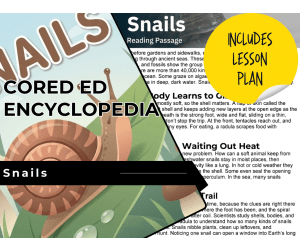
Snails Reading Comprehension Passage - Cored Ed Encyclopedia
ELA, Language Development, Reading Comprehension, Reading, Pre-Reading, Writing, Science, Animals, Life Sciences, Strategies, Grade 2, 3, 4, 5, Worksheets & Printables, Worksheets, Teacher Tools, Centers, Activities, Writing Prompts, Assessments, Quizzes and Tests, Quizzes, Lesson Plans
This snails reading comprehension includes: Visualization (on the front cover) Start your lesson by taking a minute to think and share something about the topic. Read the script aloud (slowly), perhaps prepare some music or sound effects. Student close their eyes and let their imaginations wander. Students open their eyes, read the question aloud and give them a few minutes to complete. Ask a few students to share or keep answers until the end to compare with what they learn in the passage. Quick pause—thousands of Cored Education products are included with your TeachSimple membership. Download links and encyclopedia index available here. Pre-Reading Trivia Students will write down one thing they already know about the subject and then read five more facts and discuss. These facts are fun, and the students will enjoy learning about the subject before reading more. Give 1 minute for students to write what they already know (no pressure—best guess is fine). Read the five facts together. After each fact, do ask a student for their opinion, was it surprising? Set a purpose by asking students to highlight/underline one fact they want to learn more about during the reading. Reading Passage The text is a high-interest reading passage with set paragraphs, roughly three to four paragraphs long. It contains a variety of themes about the topic, anywhere from history to technology. The passage is between 250 and 350 words in length. First, ask students to look at the headings and see what they’ll learn about today. What do they know about the topic/heading? First read options: Teacher read-aloud (best for support). Partner reading (paragraph by paragraph). While reading, students underline important details, and vocabulary words they think may come up in the questions section. Mixed Questions The first question page contains four multiple-choice questions, each with a choice of four answers, and three written response questions that require a sentence or two from the student. Students complete the mcqs first independently, then review quickly as a class. For the 3 written responses, try to get students giving the answer with some form of evidence: “I think ___ because the text says ___.” If students get stuck, send them back to check the passage. Vocabulary Questions Practice seven key words from the text in this section across two activities. First section is scrambled words where students will unscramble three words given a clue for each. The second section is a word to meaning matching activity. Before starting, have some students read out words they underlined in the passage. Ask students to say the word and read aloud the sentence(s) around each word. Ask students to do scrambled words and the matching exercise in pairs then go through answers as a class. For the scrambled spelling task, get four pairs to come up to the board and write the words for extra practice with the other student reading out the clue. For the matching task, prompt students to give full sentences: “I matched ___ with ___ because ___.” Creative Writing In this question, the student will be required to write a five to eight sentence paragraph on a question related to the topic. Before starting, ask students write down 3 key ideas they are going to include in their piece. Ask students for ideas to share around the class to help those struggling. Pro writing expectations: 5–8 sentences At least 2 facts or details from the passage At least 2 vocabulary words from the previous page Students read their paragraphs while classmates listen for facts and vocabulary words. Extension Activities This page is optional for fast finishers or to take home. There are several activities, each one requiring a different skill. Do some, do none, do all, completely optional - but you will feel reassured knowing every possibility is planned for. Includes summary writting question. Answer Key There are answers for the multiple-choice questions, written response questions have sample answers, vocabulary answers and if there is a summary question then a sample summary will be provided as well. Lesson Plan Included Customized lesson plan for this lesson is included. Lesson Snapshot Title: Snails Genre: Nonfiction (informational text with support pages) Subject: Science (Life Science) Primary Topic: Snail traits, habitats, and how they survive Estimated Guided Reading Level (A–Z): S What This Lesson Teaches Best What snails are (gastropods, “belly-footed” mollusks) and how they move using a strong foot on the bottom of their bodies. How snail body parts work, including the mantle making the shell, tentacles with tiny eyes, and a radula that scrapes food with many tiny teeth. How snails live in many habitats (mostly ocean; also land and freshwater), including near shore, on reefs, and in deep, dark water. How snails stay safe and survive tough conditions by pulling into their shell, becoming dormant, and sometimes sealing the opening with mucus or an operculum. How scientists use evidence (shell growth spirals and silvery trails) to study snails and understand how they live in so many places. Learning Goals Explain what “gastropods” means and how snails move using a strong foot. Describe how a snail’s mantle helps make and grow its shell. Identify what a radula is and how it helps a snail eat. Describe how land and freshwater snails avoid drying out and handle hot or cold weather. Use details from the passage to describe where snails live (near shore, reefs, deep water, and moist land places). Key Vocabulary From the Text gastropods — “belly-footed” animals that move using a strong foot. mantle — a flap of skin that makes the shell. radula — a scraper with many tiny teeth for eating. dormant — resting and not active for a while. operculum — a little door that can seal a shell opening. FULL CATALOG OF DOWNLOAD LINKS AND ENCYCLOPEDIA INDEX HERE
Author Cored Education
Rating
Tags Vocabulary, Reading Comprehension, Reading Passages, Reading, Creative Writing, Reading Strategies, Writing Prompts, Lesson Plans, Snails, Life Science

Lawn Mowers Reading Comprehension Passage - Cored Ed Encyclopedia
ELA, Language Development, Resources for Teachers, Reading Comprehension, Reading, Pre-Reading, Writing, Strategies, Science, Technology, Grade 2, 3, 4, 5, Worksheets & Printables, Worksheets, Teacher Tools, Centers, Activities, Writing Prompts, Assessments, Tests, Quizzes and Tests, Quizzes
This lawn mowers reading comprehension contains the following: Visualize on the Cover (Teacher Read Aloud Script) Start your lesson by taking a few moments to visualize the topic and share thoughts or feelings about it. Pre-Reading Trivia Students will write down one thing they already know about the subject and then read five more facts and discuss. These facts are fun, and the students will enjoy learning about the subject before reading more. Reading Passage The text is a high-interest reading passage with set paragraphs, roughly three to four paragraphs long. It contains a variety of themes about the topic, anywhere from history to technology. The passage is between 250 and 350 words in length. Mixed Questions The first question page contains four multiple-choice questions, each with a choice of four answers, and three written response questions that require a sentence or two from the student. Vocabulary Questions Practice seven key words from the text in this section across two activities. First section is scrambled words where students will unscramble three words given a clue for each. The second section is a word to meaning matching activity. Creative Writing In this question, the student will be required to write a five to eight sentence paragraph on a question related to the topic. Extension Activities This page is optional for fast finishers or to take home. There are several activities, each one requiring a different skill. Do some, do none, do all, completely optional - but you will feel reassured knowing every possibility is planned for. Includes summary writting question. Answer Key There are answers for the multiple-choice questions, written response questions have sample answers, vocabulary answers and if there is a summary question then a sample summary will be provided as well. FULL CATALOG OF DOWNLOAD LINKS AND ENCYCLOPEDIA INDEX HERE Lesson Snapshot Title: Lawn Mowers Genre: Nonfiction (informational text) Subject: Science & Technology / Reading (Informational Text) Primary Topic: How lawn mowers cut grass and affect noise/air Estimated Guided Reading Level (A–Z): O What This Lesson Teaches Best Defines what a lawn mower does (trims grass so lawns stay short and even) and where it might be used (backyard, park, sports field). Compares two cutting methods: reel-style “scissors” cutting vs. fast-spinning blade cutting “by impact.” Explains key machine parts and results, including what the mower “deck” does and how dull blades can shred tips and turn them brown. Builds historical understanding with the 1830 invention and patent by Edwin Beard Budding, including materials and design details. Introduces environmental and sound impacts by comparing electric vs. gas mowers (decibels, exhaust, and emissions). Learning Goals Students will explain the main job of a lawn mower using details from the text. Students will describe how a reel mower cuts grass and how a fast-spinning flat blade cuts grass. Students will identify what the mower “deck” does and what can happen when blades are dull. Students will recount what happened in 1830 with Edwin Beard Budding and why his mower mattered. Students will compare gas and electric mowers using the text’s information about loudness and air pollution. Key Vocabulary From the Text reel — a spinning set of curved blades. deck — cover around blade area that guides clippings. patent — legal protection for an invention. decibels — units used to measure how loud sound is. emissions — pollution released into the air. Cored Ed Encyclopedia Overview The Cored Ed Encyclopedia is a weekly series of lessons that you can pick up and use right away. These short readings fit into whatever time you have available. Each one includes a warm-up, a reading, and a set of questions, but it’s flexible — you can do just the reading, the full lesson, or skip the writing section if you need to. Each lesson focuses on a single topic so students don’t get lost. The writing is clear but never childish, making it perfect for grades two through five. Topics range from animals and science to history, inventions, and everyday things. No matter the level of the student, everyone should take away at least one new idea or fact from each lesson. The materials are easy to print, easy to explain, and require no setup. They work well for whole-class teaching, partner work, or independent study.
Author Cored Education
Rating
Tags Vocabulary, Spelling, Reading Comprehension, Reading Passages, Reading, Creative Writing, Reading Strategies, Writing Prompts, Technology, Lawn Mowers

Reading Comprehension Passages Fiction Set 3 - Food Presentable PDF
ELA, Reading, Reading Comprehension, Common Core, Spelling, Language Development, Vocabulary, Writing, Children’s Literature, Literature, Grade 2, 3, Worksheets & Printables, Worksheets, Assessments, Teacher Tools, Quizzes and Tests, Tests, Writing Prompts, Centers, Activities
Reading Comprehension Passages Fiction Set 3 Snapshot Title: Title not stated Genre: Fiction (short story collection) Subject: Reading Primary Topic: Food-themed stories for comprehension practice Estimated Guided Reading Level (A–Z): O What This Teaches Best Trying new things (theme/lesson): A student refuses banana muffins, then tries one and likes it. Sequencing and procedural text in narrative form: One story walks through cookie-baking steps with time and temperature details (measure, mix, roll, cut, bake, cool). Everyday problem/solution: Characters solve small problems (boredom during summer; fitting a garden into a small space; choosing one pizza everyone likes). Character feelings and motivations: Students can track wants and emotions that drive actions (hungry and impatient; confused but excited; bored then creative; busy but valuing family time). Built-in literacy practice pages connected to the stories (with a few check points): Most questions/vocabulary tasks refer directly to story details, but one story ends with “blueberry muffin” after describing banana muffins, and one question asks which language Dad uses even though the story only says he is “translating for the Brazilian government.” Learning Goals Students will recount key events from a story in order using text details. Students will describe a character’s problem and explain how it is solved. Students will describe characters’ feelings or motivations and point to words/actions that show them. Students will identify cause-and-effect relationships (what happened and why) within a story. Students will use context clues to figure out the meaning of unfamiliar words from the stories. Students will explain how a routine or tradition shapes events in a story. Passages Include 1.Happy Birthday Mrs. B: Mrs. Barber has cooked something special for the class. 2.Sophie's Own Garden: Grandma buys Sophie some garden supplies. 3.Lunchtime: Kasey has a surprise for her lunch. 4.Cindy's Tea Party: Cindy invites some special friends to her tea party. 5.My Saturdays: Anything better than baking cookies on a Saturday? 6.Friday Night Pizza: Read about the Webster Family Special in this story. PRESENTABLE PDF VERSION Run it like a slide show straight from a PDF, with no PowerPoint or extra software needed, just open, project, and teach. Other versions are available in the links list below or in the full catalog. FULL CATALOG OF DOWNLOAD LINKS HERE For similar downloads and other frees, do check out Cored Group on TeachSimple.
Author Cored Education
Rating
Tags Elementary, Reading, Comprehension, Vocabulary, Answers, Spelling, Writing, Passages, Reading Centers, Reading Comprehension Assessments
Reading Comprehension Passages Fiction Set 6 - Family (Google Forms)
ELA, Reading, Language Development, Vocabulary, Common Core, Spelling, Children’s Literature, Literature, Writing, Resources for Teachers, Grade 2, 3, Assessments, Teacher Tools, Tests, Quizzes and Tests, Activities, Centers
Reading Comprehension Passages Fiction Set 6 Overview Fascinating reading comprehension passages, each with an array of activities included. Stories are written for the modern classroom and topics are designed to promote enthusiasm from each student. Each lesson contains a mixed questions section to check understanding, a vocabulary or spelling activity to help remember key language introduced, and a writing exercise. Full answer keys are provided. For a more detailed overview, check the section under the links at the bottom of this description. Passages Include 1.Molly's Home Carnival: It looks like Molly will miss the carnival. Until... 2.Big Bro's Big Idea: Noah's big brother does his best to cheer him up. 3.Denny's Car Wash: Denny wants a new game, but does he get the money for it? 4.Tessa's Grandma: Emma misses her grandma, but Tessa has a great idea. 5.Tom's Canadian Mom: The most important person from Canada is...Tom's mom! 6.Big Brother Woes: Big Brother gets to do whatever he wants. It's just not fair! 7.Tell Us a Story, Grandpa: Grandpa's tales are true family treasures. 8.My Weekend: Read about the author's fun weekend in this interesting story. 9.All in the Picture: Learn how the author has changed in the last 22 years. 10.California 'Coaster: Find out how this author spends his summer vacation. Additional File: Big Bro's Big Idea: Cork Boat Instructions Google Forms Version This is the Google Forms editable and fillable/self grading version. This download is available in GOOGLE Docs, GOOGLE Forms, GOOGLE Slides. PDF, PPT, WORD. FULL CATALOG OF DOWNLOAD LINKS HERE Grade 2/3 Links Fiction Set 1 - Nature Google Docs Google Forms Google Slides PDF PPT Word Guided Reading Materials Fiction Set 2 - Animals Google Docs Google Forms Google Slides PDF PPT Word Guided Reading Materials Fiction Set 3 - Food Google Docs Google Forms Google Slides PDF PPT Word Guided Reading Materials Fiction Set 4 - School Google Docs Google Forms Google Slides PDF PPT Word Guided Reading Materials Fiction Set 5 - Friends Google Docs Google Forms Google Slides PDF PPT Word Guided Reading Materials Fiction Set 6 - Family Google Docs Google Forms Google Slides PDF PPT Word Guided Reading Materials Fiction Set 7 - Sports Google Docs Google Forms Google Slides PDF PPT Word Guided Reading Materials Nonfiction Set 1 - Technology Google Docs Google Forms Google Slides PDF PPT Word Guided Reading Materials Nonfiction Set 2 - Nutrition Google Docs Google Forms Google Slides PDF PPT Word Guided Reading Materials Nonfiction Set 3 - Animals Google Docs Google Forms Google Slides PDF PPT Word Guided Reading Materials Reading Passages Overview Each passage is especially written for Grade 2-3 students, including key vocabulary required for this age group. Topics are varied and are accompanied by colorful graphics. Topics are meant to educate, yet entertain the modern student. These passages are perfect for the modern classroom. Whereas textbooks can become outdated in no time, any changes to technology or the world will result in updates to this product. Mixed Questions The mixed questions section of each lesson includes a variation of fivecomprehension, vocabulary and math questions. In addition, key reading strategies are frequently covered including cause & effect, summarizing, compare & contrast and making conclusions. Three of the questions will be MCQs and two will require a written response of some kind. Full answers and example responses appear at the end of the lesson. Spelling & Vocab Each reading passage contains a variety of words and phrases designed for Grade 2-3 students. Spelling and vocab activities provide the opportunity to build fluency with these words. As it can become quite mundane doing the same activities over and over, each lesson in a set will contain a different spelling and vocab activity . Writing Prompts Writing prompts are designed to continue the theme or lessons learned in the story. Students are persuaded to write in a variety of ways and each prompt includes several cues to help. As with the spelling/vocab section, writing prompts will vary. This includes research pieces, reading responses, poetry and creative writing prompts. Full Answer Keys Full answer keys and sample responses are provided so no matter how busy you are, you know you're covered! Mixed question answers provide evidence from the text, math questions contain the relevant workings. Answers are designed for use by the teacher, but also suitable as a handout to the student. Additional File One lesson will have an additional file. This is something fun to extend the lesson with. For similar downloads and other frees, do check out Cored Group on TeachSimple.
Author Cored Education
Rating
Tags Elementary, Reading, Comprehension, Vocabulary, Answers, Common Core, Spelling, Writing, Digital Centers, Self Assessment

The Swiss Family Robinson Foldable Mini-Book Set Grade 1 2 3 ELA
ELA, Language Development, Reading, Writing, Grade 1, 2, 3, Activities, Crafts, Projects, Centers
Encourage your students to explore the wonderful world of reading through this The Swiss Family Robinson Foldable Mini-Book Set ! Made for Grades 1, 2, 3, homeschoolers, and EFL/ESL learners, this set is an amazing tool for teachers to inspire the love for reading. With contents listed below, this pack ensures that learners have the maximum chance to develop their skills in reading, reading comprehension, writing, and even their critical thinking skills! What’s included: 1. The Swiss Family Robinson Colored mini-book 2. The Swiss Family Robinson Black and white mini-book with story tracing activities 3. The Swiss Family Robinson Picture-fill mini-book for sequencing test or exercise 4. The Swiss Family Robinson Black and white mini-book for story re-tell and writing exercise 5. The Swiss Family Robinson Blank mini-book pages for story re-tell, writing and drawing exercises 6. The Swiss Family Robinson Sample lesson plan The Swiss Family Robinson Foldable Mini-Book Set can be used as reading class supplement, reading project, reading centers, and subplan.
Author It's Teacher L
Rating
Tags Reading Centers, The Swiss Family Robinsons, Reading Classic Novels, Reading Comprehension., Reading Projects, Mini-book, Foldable

Lemonade Reading Comprehension Passage - Cored Ed Encyclopedia
ELA, Language Development, Resources for Teachers, Reading Comprehension, Reading, Pre-Reading, Writing, Strategies, Science, Physics, Grade 2, 3, 4, 5, Worksheets & Printables, Worksheets, Teacher Tools, Centers, Activities, Writing Prompts, Assessments, Tests, Quizzes and Tests, Quizzes
This lemonade reading comprehension contains the following: Visualize on the Cover (Teacher Read Aloud Script) Start your lesson by taking a few moments to visualize the topic and share thoughts or feelings about it. Pre-Reading Trivia Students will write down one thing they already know about the subject and then read five more facts and discuss. These facts are fun, and the students will enjoy learning about the subject before reading more. Reading Passage The text is a high-interest reading passage with set paragraphs, roughly three to four paragraphs long. It contains a variety of themes about the topic, anywhere from history to technology. The passage is between 250 and 350 words in length. Mixed Questions The first question page contains four multiple-choice questions, each with a choice of four answers, and three written response questions that require a sentence or two from the student. Vocabulary Questions Practice seven key words from the text in this section across two activities. First section is scrambled words where students will unscramble three words given a clue for each. The second section is a word to meaning matching activity. Creative Writing In this question, the student will be required to write a five to eight sentence paragraph on a question related to the topic. Extension Activities This page is optional for fast finishers or to take home. There are several activities, each one requiring a different skill. Do some, do none, do all, completely optional - but you will feel reassured knowing every possibility is planned for. Includes summary writting question. Answer Key There are answers for the multiple-choice questions, written response questions have sample answers, vocabulary answers and if there is a summary question then a sample summary will be provided as well. FULL CATALOG OF DOWNLOAD LINKS AND ENCYCLOPEDIA INDEX HERE Lesson Snapshot Title: Lemonade Genre: Nonfiction (informational text) Subject: Reading (Informational Text) / Social Studies (Food history & culture) / Science (mixtures) Primary Topic: What lemonade is, and how it varies by place Estimated Guided Reading Level (A–Z): O What This Lesson Teaches Best What lemonade is usually made from and how flavors can be adjusted (more lemon = sharper; more sugar = softer). Science-connected ideas in everyday life (citric acid, vitamin C, and sugar dissolving with stirring). A brief history of lemon drinks across time and places (12th-century Egypt; 1600s England; 1676 Paris sellers). How the same word can mean different things in different regions (cloudy still drink vs. bubbly lemon soda). Cultural connection: lemonade stands as a summer way for kids to earn money and a “symbol” of warm-weather fun. Learning Goals Describe the typical ingredients in lemonade named in the passage. Explain why lemons taste tart, using the text’s reason. Summarize the historical examples of lemon drinks given (Egypt, England, Paris). Compare what “lemonade” can mean in different places using details from the passage. Describe what happens when sugar dissolves and why stirring helps, according to the text. Key Vocabulary From the Text sweetener — something added to make a drink taste sweet. citric — related to the sour acid found in citrus fruits. zest — tiny bits of the outer lemon peel. dissolves — mixes into liquid and seems to disappear. bubbly — full of bubbles, like soda. Cored Ed Encyclopedia Overview The Cored Ed Encyclopedia is a weekly series of lessons that you can pick up and use right away. These short readings fit into whatever time you have available. Each one includes a warm-up, a reading, and a set of questions, but it’s flexible — you can do just the reading, the full lesson, or skip the writing section if you need to. Each lesson focuses on a single topic so students don’t get lost. The writing is clear but never childish, making it perfect for grades two through five. Topics range from animals and science to history, inventions, and everyday things. No matter the level of the student, everyone should take away at least one new idea or fact from each lesson. The materials are easy to print, easy to explain, and require no setup. They work well for whole-class teaching, partner work, or independent study.
Author Cored Education
Rating
Tags Vocabulary, Spelling, Reading Comprehension, Reading Passages, Reading, Creative Writing, Reading Strategies, Writing Prompts, Lemonade, Physics

Letter I Phonics and Writing Centers with Real Photographs
ELA, Writing, Handwriting, Language Development, Phonics, Kindergarten, Preschool, Centers, Activities
This letter I beginning sounds and handwriting activity includes real photographs to practice learning to recognize, write and identify the sound of the letter I. Each picture has bold colors and includes easily recognized pictures. Each activity can be used in a literacy center for students to practice letter recognition. What is Included: There is an instructional page with printing instructions. There are letter I posters with various letter I words. There are handwriting task cards that allow students to practice writing the letter I as well as words that begin with the letter I. There are beginning sound clip cards that allow students to practice clipping the images that begin with the letter I. There is a sorting activity where you sort pictures that begins with I from words that do not begin with I. The letter I sorting cards that can also be used to play memory, matching, or concentration games. These cards can also be used during a lesson in a pocket chart as well as for a center display. When to Use: All of the activities make great literacy centers, by placing each set of activities in the center and letting students complete activities alone or with a partner. These activities make great morning tub activities. Just place these activities in morning bins for students to complete as their classmates arrive to class. Skills Assessed: These activities assess letter recognition skills, beginning sounds, handwriting, and sorting skills. Each activity in this set is low prep. Each activity just needs to be printed out, cut apart, and laminated if desired. When you laminate the writing cards, you can create a writing center activity that is reusable is you add dry erase markers. The handwriting cards and beginning sound clip cards can be turned into task box activities.
Author The Connett Connection
Tags Phonics, Writing Centers, Real Photographs, Early Literacy, Letter I

Reading Comprehension Passages Fiction Set 6 - Family (Fillable PDF)
ELA, Reading, Reading Comprehension, Common Core, Children’s Literature, Literature, Vocabulary, Language Development, Spelling, Writing, Grade 2, 3, Worksheets & Printables, Worksheets, Assessments, Teacher Tools, Tests, Quizzes and Tests, Writing Prompts, Centers, Activities
Reading Comprehension Passages Fiction Set 6 Snapshot Genre: Fiction (short story + comprehension practice) Subject: Reading (Literature) Primary Topic: Family support and problem-solving at home Estimated Guided Reading Level (A–Z): M What This Teaches Best How a character responds when plans change (Molly can’t attend a party because she has a fever). How family members show support through actions (her parents and brother set up games in her room). Sequencing key events across a short narrative with dialogue and action. Understanding setting details and objects that matter to the plot (thermometer, balloons, soda cans, sock ball). Learning Goals Students will identify the problem and explain why it happens in the story. Students will describe how Molly’s family helps her and cite details from the text. Students will retell the story in order, including beginning, middle, and end events. Students will answer questions about key details (who, what, where, why) using the text. Students will use context clues to explain the meaning of unfamiliar words from the story. Passages Include 1.Molly's Home Carnival: It looks like Molly will miss the carnival. Until... 2.Big Bro's Big Idea: Noah's big brother does his best to cheer him up. 3.Denny's Car Wash: Denny wants a new game, but does he get the money for it? 4.Tessa's Grandma: Emma misses her grandma, but Tessa has a great idea. 5.Tom's Canadian Mom: The most important person from Canada is...Tom's mom! 6.Big Brother Woes: Big Brother gets to do whatever he wants. It's just not fair! 7.Tell Us a Story, Grandpa: Grandpa's tales are true family treasures. 8.My Weekend: Read about the author's fun weekend in this interesting story. 9.All in the Picture: Learn how the author has changed in the last 22 years. 10.California 'Coaster: Find out how this author spends his summer vacation. Additional File: Big Bro's Big Idea: Cork Boat Instructions FILLABLE PDF VERSION Worksheet-style pages, but with type-in answer boxes so students can complete and save their work digitally. Other versions are available in the links list below or in the full catalog. FULL CATALOG OF DOWNLOAD LINKS HERE For similar downloads and other frees, do check out Cored Group on TeachSimple.
Author Cored Education
Rating
Tags Elementary, Reading, Comprehension, Vocabulary, Answers, Spelling, Writing, Passages, Reading Centers, Reading Comprehension Assessment
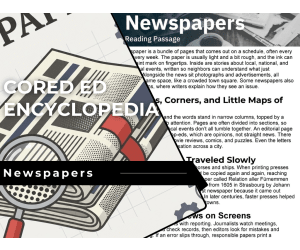
Newspapers Reading Comprehension Passage - Cored Ed Encyclopedia
ELA, Language Development, Resources for Teachers, Reading Comprehension, Reading, Pre-Reading, Writing, History, Social Studies, Strategies, Grade 2, 3, 4, 5, Worksheets & Printables, Worksheets, Teacher Tools, Centers, Activities, Writing Prompts, Assessments, Tests, Quizzes and Tests, Quizzes
This newspapers reading comprehension contains the following: COMPANION VIDEO NOW AVAILABLE (EMBEDDED AFTER PREVIEW PICTURES IN PRODUCT DESCRIPTION) Visualize on the Cover (Teacher Read Aloud Script) Start your lesson by taking a few moments to visualize the topic and share thoughts or feelings about it. Pre-Reading Trivia Students will write down one thing they already know about the subject and then read five more facts and discuss. These facts are fun, and the students will enjoy learning about the subject before reading more. Reading Passage The text is a high-interest reading passage with set paragraphs, roughly three to four paragraphs long. It contains a variety of themes about the topic, anywhere from history to technology. The passage is between 250 and 350 words in length. Mixed Questions The first question page contains four multiple-choice questions, each with a choice of four answers, and three written response questions that require a sentence or two from the student. Vocabulary Questions Practice seven key words from the text in this section across two activities. First section is scrambled words where students will unscramble three words given a clue for each. The second section is a word to meaning matching activity. Creative Writing In this question, the student will be required to write a five to eight sentence paragraph on a question related to the topic. Extension Activities This page is optional for fast finishers or to take home. There are several activities, each one requiring a different skill. Do some, do none, do all, completely optional - but you will feel reassured knowing every possibility is planned for. Includes summary writting question. Answer Key There are answers for the multiple-choice questions, written response questions have sample answers, vocabulary answers and if there is a summary question then a sample summary will be provided as well. FULL CATALOG OF DOWNLOAD LINKS AND ENCYCLOPEDIA INDEX HERE Lesson Snapshot Title: Newspapers Genre: Nonfiction Subject: Reading (Informational Text / Media Literacy) Primary Topic: What newspapers are, how they work, and why they matter Estimated Guided Reading Level (A–Z): N What This Lesson Teaches Best Explains what a newspaper is (a bundle of pages on a schedule) and what it contains (stories, photos, advertisements, and sometimes opinions). Teaches how newspapers are organized, including narrow columns, headlines, sections, and an editorial page with editorials and op-eds (opinions, not straight news). Builds understanding of how newspapers developed over time, including printing presses spreading and a 1605 paper from Strasbourg that is often recognized as the first newspaper. Describes how newspapers are made: reporting, interviewing, checking records, editors looking for mistakes, and printing a correction if an error slips through. Reinforces the passage with support pages (trivia, mixed questions, vocabulary, writing, and extensions) that match the same ideas and terms (headline, editorial/op-ed, correction, newsstands, online editions). Learning Goals Define a newspaper using details from the passage. Identify features of a newspaper mentioned in the text, such as columns, headlines, photographs, and advertisements. Explain how sections and the editorial page help separate topics and opinions from straight news. Describe how printing presses helped printed news reach many readers. Describe what journalists and editors do to make a newspaper accurate and clear. Explain what stays the same when newspapers publish online for screens. Key Vocabulary From the Text Schedule — a planned time pattern (every day or every week). Columns — narrow vertical parts that words stand in. Editorial — an opinion piece in a newspaper. Op-eds — opinion writing, not straight news. Correction — a note printed to fix a mistake. Cored Ed Encyclopedia Overview The Cored Ed Encyclopedia is a weekly series of lessons that you can pick up and use right away. These short readings fit into whatever time you have available. Each one includes a warm-up, a reading, and a set of questions, but it’s flexible — you can do just the reading, the full lesson, or skip the writing section if you need to. Each lesson focuses on a single topic so students don’t get lost. The writing is clear but never childish, making it perfect for grades two through five. Topics range from animals and science to history, inventions, and everyday things. No matter the level of the student, everyone should take away at least one new idea or fact from each lesson. The materials are easy to print, easy to explain, and require no setup. They work well for whole-class teaching, partner work, or independent study.
Author Cored Education
Rating
Tags Vocabulary, Spelling, Reading Comprehension, Reading Passages, Reading, Creative Writing, Reading Strategies, Writing Prompts, Newspapers, History

Letter V Phonics and Writing Centers with Real Photographs
ELA, Language Development, Phonics, Writing, Handwriting, Kindergarten, Preschool, Centers, Activities
This letter V beginning sounds and handwriting activity includes real photographs to practice learning to recognize, write and identify the sound of the letter V. Each picture has bold colors and includes easily recognized pictures. Each activity can be used in a literacy center for students to practice letter recognition. What is Included: There is an instructional page with printing instructions. There are letter V posters with various letter V words. There are handwriting task cards that allow students to practice writing the letter V as well as words that begin with the letter V. There are beginning sound clip cards that allow students to practice clipping the images that begin with the letter V. There is a sorting activity where you sort pictures that begins with V from words that do not begin with V. The letter V sorting cards that can also be used to play memory, matching, or concentration games. These cards can also be used during a lesson in a pocket chart as well as for a center display. When to Use: All of the activities make great literacy centers, by placing each set of activities in the center and letting students complete activities alone or with a partner. These activities make great morning tub activities. Just place these activities in morning bins for students to complete as their classmates arrive to class. Skills Assessed: These activities assess letter recognition skills, beginning sounds, handwriting, and sorting skills. Each activity in this set is low prep. Each activity just needs to be printed out, cut apart, and laminated if desired. When you laminate the writing cards, you can create a writing center activity that is reusable is you add dry erase markers. The handwriting cards and beginning sound clip cards can be turned into task box activities.
Author The Connett Connection
Tags Phonics, Writing Centers, Real Photographs, Early Literacy, Letter V

Reading Comprehension Fiction Set 4 Sample: My Love of Art (Forms)
ELA, Reading, Language Development, Spelling, Common Core, ESL, Reading Comprehension, Writing, Children’s Literature, Literature, Grade 2, 3, Centers, Activities, Assessments, Teacher Tools, Tests, Quizzes and Tests
Reading Comprehension Passages Fiction Set 4 Sample Overview Fascinating reading comprehension passages, each with an array of activities included. Stories are written for the modern classroom and topics are designed to promote enthusiasm from each student. Each lesson contains a mixed questions section to check understanding, a vocabulary or spelling activity to help remember key language introduced, and a writing exercise. Full answer keys are provided. For a more detailed overview, check the section under the links at the bottom of this description. Passage Included 6.My Love of Art: Read about the author's love of art class in this lesson. Forms Version This is the Forms editable and fillable/self grading version. This download is available in GOOGLE Docs, GOOGLE Forms, GOOGLE Slides. PDF, PPT, WORD. FULL CATALOG OF DOWNLOAD LINKS HERE Grade 2/3 Links Fiction Set 1 - Nature Google Docs Google Forms Google Slides PDF PPT Word Guided Reading Materials Fiction Set 2 - Animals Google Docs Google Forms Google Slides PDF PPT Word Guided Reading Materials Fiction Set 3 - Food Google Docs Google Forms Google Slides PDF PPT Word Guided Reading Materials Fiction Set 4 - School Google Docs Google Forms Google Slides PDF PPT Word Guided Reading Materials Fiction Set 5 - Friends Google Docs Google Forms Google Slides PDF PPT Word Guided Reading Materials Fiction Set 6 - Family Google Docs Google Forms Google Slides PDF PPT Word Guided Reading Materials Fiction Set 7 - Sports Google Docs Google Forms Google Slides PDF PPT Word Guided Reading Materials Nonfiction Set 1 - Technology Google Docs Google Forms Google Slides PDF PPT Word Guided Reading Materials Nonfiction Set 2 - Nutrition Google Docs Google Forms Google Slides PDF PPT Word Guided Reading Materials Nonfiction Set 3 - Animals Google Docs Google Forms Google Slides PDF PPT Word Guided Reading Materials Reading Passages Overview Each passage is especially written for Grade 2-3 students, including key vocabulary required for this age group. Topics are varied and are accompanied by colorful graphics. Topics are meant to educate, yet entertain the modern student. These passages are perfect for the modern classroom. Whereas textbooks can become outdated in no time, any changes to technology or the world will result in updates to this product. Mixed Questions The mixed questions section of each lesson includes a variation of fivecomprehension, vocabulary and math questions. In addition, key reading strategies are frequently covered including cause & effect, summarizing, compare & contrast and making conclusions. Three of the questions will be MCQs and two will require a written response of some kind. Full answers and example responses appear at the end of the lesson. Spelling & Vocab Each reading passage contains a variety of words and phrases designed for Grade 2-3 students. Spelling and vocab activities provide the opportunity to build fluency with these words. As it can become quite mundane doing the same activities over and over, each lesson in a set will contain a different spelling and vocab activity . Writing Prompts Writing prompts are designed to continue the theme or lessons learned in the story. Students are persuaded to write in a variety of ways and each prompt includes several cues to help. As with the spelling/vocab section, writing prompts will vary. This includes research pieces, reading responses, poetry and creative writing prompts. Full Answer Keys Full answer keys and sample responses are provided so no matter how busy you are, you know you're covered! Mixed question answers provide evidence from the text, math questions contain the relevant workings. Answers are designed for use by the teacher, but also suitable as a handout to the student. Additional File One lesson will have an additional file. This is something fun to extend the lesson with. For similar downloads and other frees, do check out Cored Group on TeachSimple.
Author Cored Education
Tags Elementary, Reading, Comprehension, Vocabulary, Answers, Ccss, Common Core, Spelling, Writing, Digital Centers
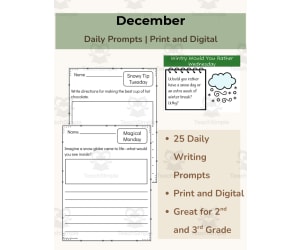
Free Sample — December Daily Writing Prompts | 2nd–3rd Grade
ELA, Writing, Creative Writing, Holiday & Seasonal, Months, December, Seasons, Winter, Grade 2, 3, Activities, Centers, Worksheets & Printables, Writing Prompts, Worksheets, Workbooks
Bring some winter magic to your classroom writing routine with this FREE sample of December Daily Writing Prompts! This freebie gives you a sneak peek into the full December Daily Writing Prompts Pack , designed to keep your 2nd and 3rd graders writing (and loving it!) all season long. With festive yet holiday-friendly themes, these prompts are perfect for morning work, journals, writing centers, or early finishers. What’s Included in the Freebie: ✔ A week’s worth of writing prompts (5 total) ✔ Fun, seasonal themes that students will love ✔ A mix of narrative, opinion, how-to, and free-write styles ✔ Low-prep, ready-to-use pages Daily themed titles keep students engaged all week: Magical Monday – imaginative winter stories Snowy Tip Tuesday – how-to writing with a frosty twist Wintry Would-You-Rather Wednesday – opinion writing Throwback Thursday: Frosty Edition – reflective prompts Festive Free-Write Friday – silly and creative fun Check out my store for other months!
Author A Day In Elementary
Rating
Tags Free, Freebie, December, Writing, Writing Prompts, Daily, Daily Writing Prompts, Printables, Centers, Worksheets

Letter X Phonics and Writing Centers with Real Photographs
ELA, Language Development, Phonics, Writing, Handwriting, Kindergarten, Preschool, Centers, Activities
This letter X beginning and ending sounds and handwriting activity includes real photographs to practice learning to recognize, write and identify the sound of the letter X. Each picture has bold colors and includes easily recognized pictures. Each activity can be used in a literacy center for students to practice letter recognition. What is Included: There is an instructional page with printing instructions. There are letter X posters with various letter X words. There are handwriting task cards that allow students to practice writing the letter X as well as words that end with the letter X. There are beginning sound clip cards that allow students to practice clipping the images that begin with the letter X. There is a sorting activity where you sort pictures that end with X from words that do not end with X. The letter X sorting cards that can also be used to play memory, matching, or concentration games. These cards can also be used during a lesson in a pocket chart as well as for a center display. When to Use: All of the activities make great literacy centers, by placing each set of activities in the center and letting students complete activities alone or with a partner. These activities make great morning tub activities. Just place these activities in morning bins for students to complete as their classmates arrive to class. Skills Assessed: These activities assess letter recognition skills, beginning/ending sounds, handwriting, and sorting skills. Each activity in this set is low prep. Each activity just needs to be printed out, cut apart, and laminated if desired. When you laminate the writing cards, you can create a writing center activity that is reusable is you add dry erase markers. The handwriting cards and beginning sound clip cards can be turned into task box activities.
Author The Connett Connection
Tags Phonics, Writing Centers, Real Photographs, Early Literacy, Letter X
Reading Comprehension Passages Nonfiction Set 1 (Docs) Digital Centers
ELA, Reading, Common Core, Reading Comprehension, Language Development, Spelling, Vocabulary, Resources for Teachers, Writing, Creative Writing, Grade 6, 7, Worksheets & Printables, Worksheets, Centers, Activities, Writing Prompts, Assessments, Teacher Tools, Tests, Quizzes and Tests
Reading Comprehension Passages Nonfiction Set 1 Overview Reading comprehension lessons, especially written for Grade 6-7, providing the chance to read interesting and engaging passages. Each lesson has a mix of questions to check understanding, a vocabulary or spelling activity to help remember key language introduced, and a writing exercise. Full answer keys are provided. Passages Include 1.American Bison: Find out more about North America's heaviest land animal. 2.Brown Bears: Featuring brown bears and Kodiak bears. 3.Elephant Seals: Fact: Elephant Seals spend 2 months a year on the beach! 4.Visayan Pigs: Punk rock pigs? Discover more about this endangered species. 5.Seahorses:Terrible swimmers but beautiful creatures all the same. 6.Pandas: Read about China's national symbol then write about America's. 7.Wolves: What does a wolf's howl mean? This article features that, and more! 8.Blue Jays: Can imitate other bird calls and feast on other birds' eggs! 9.Iceland: An amazing country, find out everything there is to know in this one. 10.Yogurt: Healthiest treat? Learn how yogurt is made & how it's good for us. 11.Karate: Who? How? When? Where? Did Karate all begin? 12.Clean Air: A longer article but the most important of subjects. Google Docs Version This is the Google Docs fillable and editable version. This download is available in GOOGLE Docs, GOOGLE Forms, GOOGLE Slides. PDF, PPT, WORD. FULL CATALOG OF DOWNLOAD LINKS HERE Grade 6/7 Links Fiction Set 1 Google Docs Google Forms Google Slides PDF PPT Word Guided Reading Materials Fiction Set 2 Google Docs Google Forms Google Slides PDF PPT Word Guided Reading Materials Nonfiction Set 1 Google Docs Google Forms Google Slides PDF PPT Word Guided Reading Materials Nonfiction Set 2 Google Docs Google Forms Google Slides PDF PPT Word Guided Reading Materials Reading Passages Overview Each passage is especially written for Grade 6/7 students, including key vocabulary required for this age group. Topics are varied and are accompanied by colorful graphics. Topics are meant to educate, yet entertain the modern student. The majority of these short stories contain an important message - a way of developing these young learners further. Mixed Questions The mixed questions section of each lesson includes a variation of five to six comprehension, vocabulary and Math questions. In addition, key reading strategies are frequently covered including cause & effect, summarizing, compare & contrast and making conclusions. Mixed questions require a written response (no MCQ's), full answers and example responses appear at the end of the lesson. Spelling & Vocab Each reading passage contains a variety of words and phrases designed for Grade 6/7 students. Spelling and vocab activities provide the opportunity to build fluency with these words. Activities provide clues to help assist students. Vocabulary activities include extra questions where students must write a synonym, an antonym or a sentence using a certain word. Writing Prompts Writing prompts are designed to continue the theme or lessons learned in the story. Students are persuaded to write in a variety of ways and each prompt includes several cues to help. The main focus in this product, is the student. Prompts will require the student to relate to past experiences and encourage them to discuss feelings and ways to improve. Full Answer Keys Full answer keys and sample responses are provided so no matter how busy you are, you know you're covered! Mixed question answers provide evidence from the text, Math questions contain the relevant workings. Answers are designed for use by the teacher, but also suitable as a handout to the student. For similar downloads and other frees, do check out Cored Group on TeachSimple.
Author Cored Education
Rating
Tags Elementary, Reading, Comprehension, Vocabulary, Answers, Common Core, Spelling, Writing, Digital Centers, Vocabulary Assessments

Lobsters Reading Comprehension Passage - Cored Ed Encyclopedia
ELA, Language Development, Resources for Teachers, Reading Comprehension, Reading, Pre-Reading, Writing, Science, Animals, Life Sciences, Grade 2, 3, 4, 5, Worksheets & Printables, Worksheets, Teacher Tools, Centers, Activities, Writing Prompts, Assessments, Tests, Quizzes and Tests, Quizzes
This lobsters reading comprehension contains the following: Visualize on the Cover (Teacher Read Aloud Script) Start your lesson by taking a few moments to visualize the topic and share thoughts or feelings about it. Pre-Reading Trivia Students will write down one thing they already know about the subject and then read five more facts and discuss. These facts are fun, and the students will enjoy learning about the subject before reading more. Reading Passage The text is a high-interest reading passage with set paragraphs, roughly three to four paragraphs long. It contains a variety of themes about the topic, anywhere from history to technology. The passage is between 250 and 350 words in length. Mixed Questions The first question page contains four multiple-choice questions, each with a choice of four answers, and three written response questions that require a sentence or two from the student. Vocabulary Questions Practice seven key words from the text in this section across two activities. First section is scrambled words where students will unscramble three words given a clue for each. The second section is a word to meaning matching activity. Creative Writing In this question, the student will be required to write a five to eight sentence paragraph on a question related to the topic. Extension Activities This page is optional for fast finishers or to take home. There are several activities, each one requiring a different skill. Do some, do none, do all, completely optional - but you will feel reassured knowing every possibility is planned for. Includes summary writting question. Answer Key There are answers for the multiple-choice questions, written response questions have sample answers, vocabulary answers and if there is a summary question then a sample summary will be provided as well. FULL CATALOG OF DOWNLOAD LINKS AND ENCYCLOPEDIA INDEX HERE Lesson Snapshot Title: Lobsters Genre: Nonfiction (informational text) with a short sensory “visualize” opener Subject: Life Science (Animals) / Reading (Informational Text) Primary Topic: Lobster body parts, molting, habitat, and life cycle Estimated Guided Reading Level (A–Z): L What This Lesson Teaches Best Basic lobster classification and habitat: lobsters are crustaceans , related to crabs and shrimp, living on the ocean floor in crevices or burrows . How lobster body parts help them survive: two different “job” claws , antennae with sensors, eyes on stalks , and a strong tail that can flick to shoot backward. Molting as a growth process: a lobster’s exoskeleton can’t stretch, so it molts , leaving it soft and unprotected until the new shell hardens. Day vs. night behavior: hiding among rocks during the day and crawling out at night to hunt or scavenge . Early life stages: females carry thousands of eggs on their swimmerets , and tiny hatchlings float near the surface at first. Learning Goals Identify what kind of animal a lobster is and where it lives, using text evidence. Describe the two different claws and explain what each one does. Explain why lobsters molt and what happens to the lobster during and after molting. Compare what lobsters do during the day versus at night, based on the passage. Describe one way lobsters move or escape danger using their tail. Describe how baby lobsters begin life and what females do with eggs. Key Vocabulary From the Text crustacean — an animal with a hard outer shell. crevice — a narrow crack or small opening in rock. exoskeleton — a hard outer shell that protects the body. molt — shed an old outer covering so a new one grows. scavenge — search for and eat leftover or dead food. Cored Ed Encyclopedia Overview The Cored Ed Encyclopedia is a weekly series of lessons that you can pick up and use right away. These short readings fit into whatever time you have available. Each one includes a warm-up, a reading, and a set of questions, but it’s flexible — you can do just the reading, the full lesson, or skip the writing section if you need to. Each lesson focuses on a single topic so students don’t get lost. The writing is clear but never childish, making it perfect for grades two through five. Topics range from animals and science to history, inventions, and everyday things. No matter the level of the student, everyone should take away at least one new idea or fact from each lesson. The materials are easy to print, easy to explain, and require no setup. They work well for whole-class teaching, partner work, or independent study.
Author Cored Education
Rating
Tags Vocabulary, Spelling, Reading Comprehension, Reading Passages, Reading, Creative Writing, Reading Strategies, Writing Prompts, Lobsters, Animals

Letter Y Phonics and Writing Centers with Real Photographs
ELA, Language Development, Phonics, Writing, Handwriting, Kindergarten, Preschool, Centers, Activities
This letter Y beginning sounds and handwriting activity includes real photographs to practice learning to recognize, write and identify the sound of the letter Y. Each picture has bold colors and includes easily recognized pictures. Each activity can be used in a literacy center for students to practice letter recognition. What is Included: There is an instructional page with printing instructions. There are letter Y posters with various letter W words. There are handwriting task cards that allow students to practice writing the letter Y as well as words that begin with the letter Y. There are beginning sound clip cards that allow students to practice clipping the images that begin with the letter Y. There is a sorting activity where you sort pictures that begins with Y from words that do not begin with Y. The letter Y sorting cards that can also be used to play memory, matching, or concentration games. These cards can also be used during a lesson in a pocket chart as well as for a center display. When to Use: All of the activities make great literacy centers, by placing each set of activities in the center and letting students complete activities alone or with a partner. These activities make great morning tub activities. Just place these activities in morning bins for students to complete as their classmates arrive to class. Skills Assessed: These activities assess letter recognition skills, beginning sounds, handwriting, and sorting skills. Each activity in this set is low prep. Each activity just needs to be printed out, cut apart, and laminated if desired. When you laminate the writing cards, you can create a writing center activity that is reusable is you add dry erase markers. The handwriting cards and beginning sound clip cards can be turned into task box activities.
Author The Connett Connection
Tags Phonics, Writing Centers, Real Photographs, Early Literacy, Letter Y

Letter M Phonics and Writing Centers with Real Photographs
ELA, Writing, Handwriting, Language Development, Phonics, Kindergarten, Preschool, Centers, Activities
This letter M beginning sounds and handwriting activity includes real photographs to practice learning to recognize, write and identify the sound of the letter M. Each picture has bold colors and includes easily recognized pictures. Each activity can be used in a literacy center for students to practice letter recognition. What is Included: There is an instructional page with printing instructions. There are letter M posters with various letter M words. There are handwriting task cards that allow students to practice writing the letter M as well as words that begin with the letter M. There are beginning sound clip cards that allow students to practice clipping the images that begin with the letter M. There is a sorting activity where you sort pictures that begins with M from words that do not begin with M. The letter K sorting cards that can also be used to play memory, matching, or concentration games. These cards can also be used during a lesson in a pocket chart as well as for a center display. When to Use: All of the activities make great literacy centers, by placing each set of activities in the center and letting students complete activities alone or with a partner. These activities make great morning tub activities. Just place these activities in morning bins for students to complete as their classmates arrive to class. Skills Assessed: These activities assess letter recognition skills, beginning sounds, handwriting, and sorting skills. Each activity in this set is low prep. Each activity just needs to be printed out, cut apart, and laminated if desired. When you laminate the writing cards, you can create a writing center activity that is reusable is you add dry erase markers. The handwriting cards and beginning sound clip cards can be turned into task box activities.
Author The Connett Connection
Tags Phonics, Writing Centers, Real Photographs, Early Literacy, Letter M

Reading Comprehension Fiction Set 7: Ian's Friday Nights (Forms)
ELA, Reading, Language Development, Common Core, ESL, Vocabulary, Children’s Literature, Literature, Writing, Reading Comprehension, Grade 2, 3, Centers, Activities, Assessments, Teacher Tools, Tests, Quizzes and Tests
Reading Comprehension Passages Fiction Set 7 Sample Overview Fascinating reading comprehension passages, each with an array of activities included. Stories are written for the modern classroom and topics are designed to promote enthusiasm from each student. Each lesson contains a mixed questions section to check understanding, a vocabulary or spelling activity to help remember key language introduced, and a writing exercise. Full answer keys are provided. For a more detailed overview, check the section under the links at the bottom of this description. Passage Included 3.Ian's Friday Nights: Ian wants to be anywhere but the bleachers on Friday nights. Forms Version This is the Forms editable and fillable/self grading version. This download is available in GOOGLE Docs, GOOGLE Forms, GOOGLE Slides. PDF, PPT, WORD. FULL CATALOG OF DOWNLOAD LINKS HERE Grade 2/3 Links Fiction Set 1 - Nature Google Docs Google Forms Google Slides PDF PPT Word Guided Reading Materials Fiction Set 2 - Animals Google Docs Google Forms Google Slides PDF PPT Word Guided Reading Materials Fiction Set 3 - Food Google Docs Google Forms Google Slides PDF PPT Word Guided Reading Materials Fiction Set 4 - School Google Docs Google Forms Google Slides PDF PPT Word Guided Reading Materials Fiction Set 5 - Friends Google Docs Google Forms Google Slides PDF PPT Word Guided Reading Materials Fiction Set 6 - Family Google Docs Google Forms Google Slides PDF PPT Word Guided Reading Materials Fiction Set 7 - Sports Google Docs Google Forms Google Slides PDF PPT Word Guided Reading Materials Nonfiction Set 1 - Technology Google Docs Google Forms Google Slides PDF PPT Word Guided Reading Materials Nonfiction Set 2 - Nutrition Google Docs Google Forms Google Slides PDF PPT Word Guided Reading Materials Nonfiction Set 3 - Animals Google Docs Google Forms Google Slides PDF PPT Word Guided Reading Materials Reading Passages Overview Each passage is especially written for Grade 2-3 students, including key vocabulary required for this age group. Topics are varied and are accompanied by colorful graphics. Topics are meant to educate, yet entertain the modern student. These passages are perfect for the modern classroom. Whereas textbooks can become outdated in no time, any changes to technology or the world will result in updates to this product. Mixed Questions The mixed questions section of each lesson includes a variation of fivecomprehension, vocabulary and math questions. In addition, key reading strategies are frequently covered including cause & effect, summarizing, compare & contrast and making conclusions. Three of the questions will be MCQs and two will require a written response of some kind. Full answers and example responses appear at the end of the lesson. Spelling & Vocab Each reading passage contains a variety of words and phrases designed for Grade 2-3 students. Spelling and vocab activities provide the opportunity to build fluency with these words. As it can become quite mundane doing the same activities over and over, each lesson in a set will contain a different spelling and vocab activity . Writing Prompts Writing prompts are designed to continue the theme or lessons learned in the story. Students are persuaded to write in a variety of ways and each prompt includes several cues to help. As with the spelling/vocab section, writing prompts will vary. This includes research pieces, reading responses, poetry and creative writing prompts. Full Answer Keys Full answer keys and sample responses are provided so no matter how busy you are, you know you're covered! Mixed question answers provide evidence from the text, math questions contain the relevant workings. Answers are designed for use by the teacher, but also suitable as a handout to the student. Additional File One lesson will have an additional file. This is something fun to extend the lesson with. For similar downloads and other frees, do check out Cored Group on TeachSimple.
Author Cored Education
Tags Elementary, Reading, Comprehension, Vocabulary, Answers, Ccss, Common Core, Spelling, Writing, Digital Centers

Reading Comprehension Fiction Set 6 Sample Tom's Canadian Mom (Forms)
ELA, Reading, Language Development, Common Core, Spelling, ESL, Children’s Literature, Literature, Writing, Reading Comprehension, Grade 2, 3, Centers, Activities, Assessments, Teacher Tools, Tests, Quizzes and Tests
Reading Comprehension Passages Fiction Set 6 Sample Overview Fascinating reading comprehension passages, each with an array of activities included. Stories are written for the modern classroom and topics are designed to promote enthusiasm from each student. Each lesson contains a mixed questions section to check understanding, a vocabulary or spelling activity to help remember key language introduced, and a writing exercise. Full answer keys are provided. For a more detailed overview, check the section under the links at the bottom of this description. Passage Included 5.Tom's Canadian Mom: The most important person from Canada is...Tom's mom! Forms Version This is the Forms editable and fillable/self grading version. This download is available in GOOGLE Docs, GOOGLE Forms, GOOGLE Slides. PDF, PPT, WORD. FULL CATALOG OF DOWNLOAD LINKS HERE Grade 2/3 Links Fiction Set 1 - Nature Google Docs Google Forms Google Slides PDF PPT Word Guided Reading Materials Fiction Set 2 - Animals Google Docs Google Forms Google Slides PDF PPT Word Guided Reading Materials Fiction Set 3 - Food Google Docs Google Forms Google Slides PDF PPT Word Guided Reading Materials Fiction Set 4 - School Google Docs Google Forms Google Slides PDF PPT Word Guided Reading Materials Fiction Set 5 - Friends Google Docs Google Forms Google Slides PDF PPT Word Guided Reading Materials Fiction Set 6 - Family Google Docs Google Forms Google Slides PDF PPT Word Guided Reading Materials Fiction Set 7 - Sports Google Docs Google Forms Google Slides PDF PPT Word Guided Reading Materials Nonfiction Set 1 - Technology Google Docs Google Forms Google Slides PDF PPT Word Guided Reading Materials Nonfiction Set 2 - Nutrition Google Docs Google Forms Google Slides PDF PPT Word Guided Reading Materials Nonfiction Set 3 - Animals Google Docs Google Forms Google Slides PDF PPT Word Guided Reading Materials Reading Passages Overview Each passage is especially written for Grade 2-3 students, including key vocabulary required for this age group. Topics are varied and are accompanied by colorful graphics. Topics are meant to educate, yet entertain the modern student. These passages are perfect for the modern classroom. Whereas textbooks can become outdated in no time, any changes to technology or the world will result in updates to this product. Mixed Questions The mixed questions section of each lesson includes a variation of fivecomprehension, vocabulary and math questions. In addition, key reading strategies are frequently covered including cause & effect, summarizing, compare & contrast and making conclusions. Three of the questions will be MCQs and two will require a written response of some kind. Full answers and example responses appear at the end of the lesson. Spelling & Vocab Each reading passage contains a variety of words and phrases designed for Grade 2-3 students. Spelling and vocab activities provide the opportunity to build fluency with these words. As it can become quite mundane doing the same activities over and over, each lesson in a set will contain a different spelling and vocab activity . Writing Prompts Writing prompts are designed to continue the theme or lessons learned in the story. Students are persuaded to write in a variety of ways and each prompt includes several cues to help. As with the spelling/vocab section, writing prompts will vary. This includes research pieces, reading responses, poetry and creative writing prompts. Full Answer Keys Full answer keys and sample responses are provided so no matter how busy you are, you know you're covered! Mixed question answers provide evidence from the text, math questions contain the relevant workings. Answers are designed for use by the teacher, but also suitable as a handout to the student. Additional File One lesson will have an additional file. This is something fun to extend the lesson with. For similar downloads and other frees, do check out Cored Group on TeachSimple.
Author Cored Education
Tags Elementary, Reading, Comprehension, Vocabulary, Answers, Ccss, Common Core, Spelling, Writing, Passages