



5,112 products added recently
Page 72 - Newest Teaching Resources

 Show filters

Parts of Speech | Nouns 2 | High School Grammar Worksheet (PDF)
Common Core, ELA, Language Development, ESL, Grammar, Spelling, Resources for Teachers, Grade 8, 9, 10, 11, 12, Centers, Activities, Teacher Tools, Assessments, Quizzes and Tests, Quizzes, Tests, Worksheets & Printables, Worksheets
Parts of Speech: Nouns (2) | High School Grammar Worksheet (PDF) Help your students strengthen their grammar skills with this focused Parts of Speech: Nouns worksheet designed for high school learners. This resource gives students meaningful practice identifying and classifying different types of nouns while also reviewing plural and possessive forms. The worksheet includes 20 multiple-choice questions (spread across 6 pages ) covering common nouns, proper nouns, abstract nouns, concrete nouns, collective nouns, compound nouns, plural nouns, and possessive nouns . The questions use age-appropriate vocabulary and sentence contexts suitable for secondary students, making the activity useful for grammar review, independent practice, homework, intervention, or test preparation. Students will practice distinguishing noun types, recognizing correct plural forms, identifying possessive constructions, and applying grammar knowledge in context rather than relying only on simple definitions. Other Formats: Fillable PDF Word Docs Google Docs This resource includes: 20 multiple-choice questions Common and proper nouns Abstract and concrete nouns Collective and compound nouns Singular and plural noun forms Possessive nouns Irregular and compound plurals Full answer key Suitable for Grades 8–12 This worksheet will help your students strengthen their grammar skills and build confidence in their writing. It works well for English Language Arts classes, grammar review, bell ringers, homework, substitute plans, independent work, and skill reinforcement . Looking for more? Explore the store for a growing collection of grammar resources and engaging reading comprehension passages designed to strengthen literacy skills across ELA and content-area learning. You’ll find practice activities, informational texts, comprehension questions, vocabulary work, and more resources created to make lesson planning easier and student practice more meaningful. ** Click here to check Middle and High School Resources ** You may also be interested in these resources from the store: Life Science Reading Comprehension Passages and Questions (6th, 7th, 8th Grade) Physical Science Reading Comprehension Passages and Questions (6th, 7th, 8th Grade) Earth Science Reading Comprehension Passages and Questions (6th, 7th, 8th Grade) Social Studies Reading Comprehension Passages and Questions (6th, 7th, 8th Grade)
Author EduNation Creative Store
Rating
Tags High School, Grammar, Worksheets, Common Core, ESL, Nouns, Types Of Nouns, Common And Proper Nouns, Abstract And Concrete Nouns, Collectibe And Compound Nouns

New Grade 5 Science Resource | Forces & Magnetism
Science, Basic Science, Grade 5, 6, 7, 8, Worksheets & Printables, Worksheets
Make science more active, practical and meaningful with the new TraceBloom Learning Grade 5 Forces & Magnetism Activity-Led Workbook ! 🌸 This 30-page science resource is designed to help Grade 5 learners build strong scientific understanding while developing the skills they need to think and work like young scientists. The workbook explores important concepts related to forces and magnetism , including: • Gravity, normal force and applied force • Gravity and satellites • Friction and different types of resistance • Air resistance and other forces that oppose motion • Upthrust • Multiple forces acting on objects • Magnets and magnetic materials • Magnetic force and attraction • Fair testing and scientific investigations • Identifying variables • Force diagrams • Recording observations and data • Reading and representing data using graphs • Making predictions and observations • Analysing results • Drawing evidence-based conclusions Rather than functioning as a traditional learner textbook, this workbook follows an activity-led approach . Learners are encouraged to actively engage with science through prediction, investigation, observation, recording, comparison, analysis and application . Activities are designed to give learners opportunities to connect scientific ideas with situations they can observe in everyday life. They can explore how forces affect movement, investigate friction and resistance, think about how magnets interact with different materials, interpret simple scientific data and communicate their findings using appropriate scientific language. The workbook also introduces important scientific investigation skills , helping learners understand why fair tests are important, how variables can affect an investigation, how evidence can be recorded clearly, and how conclusions should be based on results rather than guesses. Whether you are a classroom teacher, homeschool educator, tutor or parent looking for additional Grade 5 science practice, this resource can be used for classroom activities, independent work, revision, science centres, homework or additional practice. 🌸 TraceBloom Learning — Explore • Investigate • Discover Created with a focus on clear explanations, purposeful activities and practical scientific thinking , TraceBloom Learning resources are designed to help learners move beyond simply remembering facts and begin using science to question, investigate, reason and explain . 📚 Explore more TraceBloom Learning resources and build your science collection today!
Author Tracebloom Learning
Rating
Tags FORCES AND MAGNETISM, FORCES, MAGNETS, SCIENCE, GRADE 5, MAGNETISM, GRADE 5 SCIENCE, GRADE 6 SCIENCE, GRADE 7 SCIENCE, HOMESHOOLING

102 Minutes Inside the Towers 9/11 Worksheet + Google Forms
History: USA, History, Social Studies, Grade 9, 10, 11, 12, Worksheets, Worksheets & Printables
Keep students watching and writing the whole way through with this fill-in-the-blank worksheet for 102 Minutes Inside the Towers (History Channel, 2026). The 35 questions follow the video in the order it plays, so students record each answer as that moment happens on screen instead of reconstructing it afterward — which holds their attention and leaves them with an organized set of notes to study from later. Built for US History, it is a natural fit for US History classes (grades 9-12) teaching September 11 and post-9/11 America -- the single most reliably taught calendar moment in the survey, amplified by the 25th anniversary, and Government and current-issues classes covering terrorism, emergency response and homeland security policy. The film runs about 102 minutes, so the sheet is built to carry a multi-day study or a longer viewing block rather than a single sitting. Use it as a full-period viewing activity, a guided companion when you hand the room to a substitute, or a focused review at the end of a unit. A complete answer key is printed on the final page, so whoever is covering the class can run it with no preparation and no background knowledge. The 3-pages layout is clean and low-ink, designed to print two-sided. One practical note before you plan the lesson: this is survivor testimony from inside the World Trade Center, and the film carries footage and firsthand accounts that some classes will find hard to watch. Screen it yourself first and decide what your own room needs set up in advance. The worksheet itself is anchored to the documented record — what happened and when, how the buildings and their exits worked, how the emergency response unfolded, and the decisions people made under pressure — so nothing on the page asks a student to write about injury or death. If it works well for your students, a quick rating wherever you downloaded it helps other teachers find it. Questions or a correction are always welcome at contact@responseresources.studio .
Author Response Resources
Rating
Tags 102 Minutes Inside The Towers, 9/11, September 11, 9/11 25th Anniversary, World Trade Center, Twin Towers, September 11 Documentary, US History, Documentary Worksheet, Movie Guide

Integrated Science Bell Ringers Unit 4 - 45 Daily Warm-Ups
Physics, Science, Grade 6, 7, 8, Worksheets, Worksheets & Printables
These integrated science bell-ringers give middle school students a calm, consistent way to begin class. Unit 4 gathers 45 short prompts on physical science core & year review, arranged as nine weekly pages a teacher can hand out each Monday and collect on Friday. The set is written for schools that teach one general science course a year rather than a separate life science year, Earth science year and physical science year, so the strands are sequenced to live together in a single course instead of being split apart. Each day asks something different. Monday introduces a term and asks students to use it, not just recite it. Tuesday supplies two or three sentences of real science and a question that can only be answered by reading them. Wednesday poses an analysis problem or a short calculation, worked the way a scientist would work it. Thursday is a quick multiple-choice check a teacher can scan in seconds. Friday asks for a claim supported by evidence, which is the reasoning skill the standards care most about and the one students get the least practice with. That variety keeps a daily routine from going stale while still reinforcing properties and states of matter, atoms, elements and the periodic table, chemical change and conservation of mass, motion, speed and acceleration, forces, gravity and Newton's laws, work, energy and energy transformations, waves, sound and light, heat, electricity and magnetism, and a closing cross-strand review that ties all three strands back together. The quantitative prompts were written deliberately so that every answer resolves to a whole number, which keeps a warm-up to five minutes and keeps the key beyond dispute. Everything is print-first: a clean PDF that copies well, uses little ink, prints two-sided so a full week fits on one sheet, and needs no student accounts, devices, or logins. A complete answer key covers all 45 prompts, and a standards page lists the NGSS middle school codes and the CCSS literacy in science codes the set actually addresses. Designed for grades 6-8, the prompts work as a daily opener while attendance is taken, as an exit slip at the end of the period, as spiral review before a test, or as ready-made work to leave for a substitute. Teachers who want the whole course can buy the full-year set of 180 prompts, of which this unit is one quarter.
Author Response Resources
Rating
Tags Integrated Science Bell Ringers, Middle School Science Warm Ups, Integrated Science Warm Ups, Daily Science Bell Ringers, Science Exit Slips, Science Do Now, Science Bell Work, Science Entry Ticket, No Prep Science, Science Daily Starter
Integrated Science Bell Ringers Unit 3 - 45 Daily Warm-Ups
Earth Sciences, Earth and Environmental Sciences, Science, Grade 6, 7, 8, Worksheets, Worksheets & Printables
These integrated science bell-ringers give middle school students a calm, consistent way to begin class. Unit 3 gathers 45 short prompts on earth & space core, arranged as nine weekly pages a teacher can hand out each Monday and collect on Friday. The set is written for schools that teach one general science course a year rather than a separate life science year, Earth science year and physical science year, so the strands are sequenced to live together in a single course instead of being split apart. Each day asks something different. Monday introduces a term and asks students to use it, not just recite it. Tuesday supplies two or three sentences of real science and a question that can only be answered by reading them. Wednesday poses an analysis problem or a short calculation, worked the way a scientist would work it. Thursday is a quick multiple-choice check a teacher can scan in seconds. Friday asks for a claim supported by evidence, which is the reasoning skill the standards care most about and the one students get the least practice with. That variety keeps a daily routine from going stale while still reinforcing Earth's layers and plate tectonics, earthquakes and volcanoes, minerals and the rock cycle, weathering, erosion and soil, the water cycle and the oceans, the atmosphere and weather, weather and climate, the Earth-Moon-Sun system and the seasons, and the solar system, stars and the universe. The quantitative prompts were written deliberately so that every answer resolves to a whole number, which keeps a warm-up to five minutes and keeps the key beyond dispute. Everything is print-first: a clean PDF that copies well, uses little ink, prints two-sided so a full week fits on one sheet, and needs no student accounts, devices, or logins. A complete answer key covers all 45 prompts, and a standards page lists the NGSS middle school codes and the CCSS literacy in science codes the set actually addresses. Designed for grades 6-8, the prompts work as a daily opener while attendance is taken, as an exit slip at the end of the period, as spiral review before a test, or as ready-made work to leave for a substitute. Teachers who want the whole course can buy the full-year set of 180 prompts, of which this unit is one quarter.
Author Response Resources
Rating
Tags Integrated Science Bell Ringers, Middle School Science Warm Ups, Integrated Science Warm Ups, Daily Science Bell Ringers, Science Exit Slips, Science Do Now, Science Bell Workscience Do Now, Science Entry Ticket, No Prep Science, Science Daily Starter

Integrated Science Bell Ringers Unit 2 - 45 Daily Warm-Ups
Biology, Life Sciences, Science, Grade 6, 7, 8, Worksheets, Worksheets & Printables
These integrated science bell-ringers give middle school students a calm, consistent way to begin class. Unit 2 gathers 45 short prompts on life science core, arranged as nine weekly pages a teacher can hand out each Monday and collect on Friday. The set is written for schools that teach one general science course a year rather than a separate life science year, Earth science year and physical science year, so the strands are sequenced to live together in a single course instead of being split apart. Each day asks something different. Monday introduces a term and asks students to use it, not just recite it. Tuesday supplies two or three sentences of real science and a question that can only be answered by reading them. Wednesday poses an analysis problem or a short calculation, worked the way a scientist would work it. Thursday is a quick multiple-choice check a teacher can scan in seconds. Friday asks for a claim supported by evidence, which is the reasoning skill the standards care most about and the one students get the least practice with. That variety keeps a daily routine from going stale while still reinforcing cells and their organelles, cell transport and the membrane, photosynthesis and cellular respiration, levels of organization and homeostasis, the digestive, circulatory, respiratory, nervous and muscular systems, heredity, alleles and Punnett squares, DNA, reproduction and variation, and ecosystems and energy flow. The quantitative prompts were written deliberately so that every answer resolves to a whole number, which keeps a warm-up to five minutes and keeps the key beyond dispute. Everything is print-first: a clean PDF that copies well, uses little ink, prints two-sided so a full week fits on one sheet, and needs no student accounts, devices, or logins. A complete answer key covers all 45 prompts, and a standards page lists the NGSS middle school codes and the CCSS literacy in science codes the set actually addresses. Designed for grades 6-8, the prompts work as a daily opener while attendance is taken, as an exit slip at the end of the period, as spiral review before a test, or as ready-made work to leave for a substitute. Teachers who want the whole course can buy the full-year set of 180 prompts, of which this unit is one quarter.
Author Response Resources
Rating
Tags Integrated Science Bell Ringers, Middle School Science Warm Ups, Integrated Science Warm Ups, Daily Science Bell Ringers, Science Exit Slips, Science Do Now, Science Bell Work, Science Entry Ticket, No Prep Science, Science Daily Starter

Autumn Harvest and October Events Crosswords with Word Bank
Vocabulary, Language Development, ELA, Grade 3, 4, 5, 6, Crosswords Puzzles, Worksheets, Worksheets & Printables
🎃 Capture the cozy magic of the fall season and keep your students engaged with these highly structured autumn vocabulary crosswords. 4 puzzles 2 versions crosswords with word bank. (16 Pages Total). Every activity is completely plug-and-play with zero prep required for busy teachers. Each puzzle strictly features eight core vocabulary words to protect student cognitive load and ensure maximum retention. Students master vivid seasonal terminology context clues and spelling while enjoying the changing of the seasons. These crosswords provide the perfect meaningful solution for morning work early finishers autumn centers and substitute folders. Puzzle 1 Agricultural Gatherings features 8 words including Agriculture, Orchard, Tractor, Farmer, Wheat, Produce, Bushel, Barn. Puzzle 2 Fall Foliage and Weather features 8 words including Foliage, Autumn, Crisp, Breeze, Season, Acorn, Deciduous, Equinox. Puzzle 3 Countryside Activities features 8 words including Hayride, Cornmaze, Carnival, Pumpkinpatch, Campfire, Wagon, Cider, Apple. Puzzle 4 Scarecrows and Fields features 8 words including Scarecrow, Sunflower, Burlap, Overalls, Flannel, Harvester, Field, Raking.
Author Sarah Baradin
Rating
Tags Halloween, , Crossword, , Halloween Crossword, , Crossword With Word Bank,
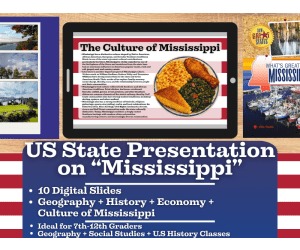
US State Presentation - Mississippi
Social Studies, Economics, First Peoples (Native), Geography, History: USA, History, Middle School, Not Grade Specific, High School, Adult Education, Presentations, Teacher Tools, Lesson Plans
US State Presentation - Mississippi Bring the United States to life in your classroom with this engaging US State Presentation on Mississippi , a ready-to-use digital resource designed for Geography, Social Studies, and US History classes from 7th grade through 12th grade . This presentation provides students with a clear, structured introduction to one US state while combining essential geographical, historical, economic, and cultural information in an accessible format. This US State Presentation on Mississippi , includes: The resource begins with a general introduction to the state , helping students understand its location, identity, and importance within the United States. Students then explore the state's borders and neighboring states , making it easier to place it within the broader geography of the country. A general data section introduces key facts such as population, area, population density, capital city, and other essential statistics , providing a useful foundation for further study. A paragraph that explores the history of this US state , highlighting important events, periods, people, and developments that have shaped its identity. This section is particularly useful for US History lessons because it allows students to connect state-level history with major events and themes in American history. A Geography section examines the state's physical characteristics, including its territory, landscapes, natural features, environment, and climate. Students can discover how mountains, rivers, plains, forests, coastlines, deserts, or other geographical characteristics have influenced settlement and human activity. A presentation also introduces the state's economy , explaining its major economic sectors, industries, natural resources, agricultural activities, and other economic strengths. This provides an excellent opportunity to connect geography with economics and understand why particular industries have developed in different parts of the United States. A dedicated section focuses on the capital city , introducing its importance as a political and administrative center. Students can also learn about other important cities , discovering major urban centers and their roles in business, transportation, education, culture, tourism, or industry. A paragraoh that explores culture , giving students an opportunity to learn about traditions, food, music, celebrations, landmarks, historical heritage, and other characteristics that contribute to the state's unique identity. This digital US State Presentation on Mississippi is ideal for classroom instruction, student research, geography units, US History lessons, Social Studies activities, state studies, homework, review activities, and independent learning. Its organized structure makes it suitable for middle school and high school students , while its broad range of topics encourages students to view a state from multiple perspectives. Whether you are teaching a unit on the United States, American Geography, US History, state studies, or regional culture , this resource offers a convenient and engaging way to help students explore the diversity and complexity of the United States. Perfect for: Geography Classes, Social Studies Classes, US History Classes, Middle School, High School, Grades 7–12, State Studies, American Studies, Homeschooling, Student Research, and Digital Learning. Learning with Alan is an educational resource store created to help teachers, educators, and tutors reach their teaching goals while building a fun, engaging, and stimulating learning environment . Because learning should always be meaningful—and fun! 🎓✨ If you want to browse more of my Teaching Resources, click here Learning with Alan!!
Author Learning with Alan
Rating
Tags Social Studies, Geography, USA, United States Of America, US State, US History, Mississippi, Lesson, Introduction, Presentation
The Digestive System & Balanced Diet | Printable Workbook.
Science, Basic Science, Human Body, Life Sciences, Biology, Grade 5, 6, 7, 8, 9, Worksheets & Printables
Make Grade 5 Science engaging, practical, and activity-led with this Digestive System & Balanced Diet Workbook from TraceBloom Learning. Designed for learners who benefit from doing, investigating, recording, and applying their knowledge, this resource provides a variety of purposeful activities covering digestion, digestive organs, nutrients, food groups, and healthy eating. Students begin by exploring the human digestive system and identifying important organs such as the mouth, oesophagus (gullet), stomach, liver, small intestine, large intestine, rectum, and anus. They follow the journey of food through the digestive system and develop an understanding of what happens at different stages. The workbook also introduces digestion in the mouth , including the role of chewing and saliva. Investigation-based activities encourage learners to observe results, record findings, and draw conclusions using simple scientific skills. The second part focuses on balanced diets, food groups, and nutrients . Learners explore carbohydrates, proteins, fats, vitamins, minerals, and water, while learning why the body needs a variety of foods. They identify food groups, classify foods, examine healthy choices, and consider how different nutrients support the body. Students then apply their knowledge through practical activities such as building balanced meals, completing food-related investigations, analysing results, planning healthier choices, and solving real-life food and nutrition scenarios . What’s Included: Digestive system introduction Parts of the digestive system Functions of digestive organs Food journey activities Digestion in the mouth Saliva investigation Digestive system model activity Investigation results and conclusions Balanced diet introduction Food groups and nutrients Nutrient activities Balanced meal planning Food diary activity Healthy food choices Balanced diet investigation Results and conclusion activities Unit application Comprehensive Unit 4 review Reflection and application activities This resource is suitable for classroom Science lessons, independent work, homework, revision, science centers, homeschool learning, early finishers, and additional practice . The workbook uses clear instructions, learner-friendly language, varied activity formats, and generous spaces for students to record their ideas and demonstrate their understanding. 🌸 TraceBloom Learning — Helping children learn, practice and bloom!
Author Tracebloom Learning
Rating
Tags Digestive System, Digestive System Worksheet, Balanced Diet, Nutrition, Food Group, Human Body, Food And Nutrition, Digestion

Hotel Front Desk Conflict Resolution Scripts
Social Studies, Economics, Psychology, Special Education Needs (SEN), Special Resources, Social Emotional Learning (SEL), Resources for Teachers, Life Studies, Career, Leadership, Homeschool Curriculum, Homeschool Templates, Grade 9, 10, 11, 12, Teacher Tools, Assessments, Lesson Plans, Quizzes and Tests, Quizzes, Tests, Worksheets & Printables, Workbooks, Worksheets, Word Searches
Transform your classroom and empower your students with the ultimate real-world training tool for the hospitality industry! This comprehensive, 46-page curriculum workbook is expertly designed to turn your ESL, CTE, and vocational students into confident, professional, and highly skilled front desk agents. Are your students prepared for the most challenging part of the job? This guide moves beyond basic check-ins and equips them with the precise language, psychological frameworks, and de-escalation tactics needed to handle angry guests, booking errors, and high-stress situations with grace and authority. Grounded in proven pedagogical methods like Script-Based Roleplay Acquisition (SBRA) and the LEAP/HEART frameworks, this resource bridges the critical gap between theoretical knowledge and practical application. It's specifically tailored for ESL/EFL learners, focusing on the nuances of English pragmatics, tone, and politeness that are essential for exceptional customer service. WHAT'S INSIDE THIS COMPLETE CURRICULUM PACK: Part 1: The Pedagogy of De-escalation (Instructor Guide): Chapter 1: The Psychology of Guest Frustration: Understand the "why" behind guest anger with concepts like the Disconfirmation Paradigm and Amygdala Hijack. Chapter 2: Language Structures for Empathetic Communication: Master the art of using modal verbs, hedging, and the passive voice to soften bad news and avoid blame. Chapters 3 & 4: Realistic Case Studies & Scripts: Break down complex scenarios like disconnected reservations and explosive guest anger, providing word-for-word professional scripts. Part 2: Student Workbook (10 In-Depth Worksheets): 10 Rigorous, Hands-On Worksheets with over 70+ prompts covering everything from vocabulary and authentic apologies to navigating overbookings, cross-cultural conflicts, unauthorized pets, and catastrophic service failures. Real-World Scenario Builders that guide students step-by-step through the most common and difficult front desk challenges. Part 3: Visuals & Teacher Resources: 3 Powerful Pedagogical Visuals: Including flowcharts and diagrams for the H.E.A.T. protocol and booking error diagnostics, perfect for visual learners. A Comprehensive 10-Page Answer Key: Providing model answers for every single prompt, saving you valuable prep time and ensuring effective evaluation. This isn't just a list of phrases; it's a complete system for building job-ready skills and turning potential customer service disasters into opportunities for creating profound guest loyalty. Perfect For: High School CTE (Career and Technical Education) Hospitality & Tourism Classes Community College & Vocational School Hospitality Programs Advanced Adult ESL/EFL for the Workplace or Business English Classes Hotel Corporate Training & New Hire Onboarding Keywords: Hotel Front Desk Training, Conflict Resolution Scripts, ESL for Hospitality, CTE Hospitality, Customer Service English, De-escalation Techniques, Roleplay Scenarios for Work, Angry Customer Scripts, Business English, Workplace English, Adult Education, Vocational Training, ESL. Why Parents/Schools Love It: Builds Real-World Job Skills: This curriculum goes beyond textbook theory to prepare students for the actual high-stress situations they will face, making them more confident and employable. Comprehensive & No-Prep: With 10 detailed worksheets, visual aids, and a complete answer key, this is a print-and-go resource that saves instructors hours of preparation time. Fosters Empathy & Professionalism: It teaches more than just English; it builds critical soft skills like emotional intelligence, active listening, and problem-solving under pressure. Specifically Designed for ESL Success: The material directly addresses the unique challenges non-native speakers face with tone, indirect language, and cultural nuances, setting them up for success. Turns Crises into Opportunities: Students learn the valuable skill of service recovery—how to transform a negative guest experience into one of loyalty and satisfaction. Target Student Audience : Based on the academic language, specific industry jargon, and focus on ESL pragmatics, target the following groups: Primary Target: Post-Secondary Students. This includes students in Community College, Vocational School, or University programs for Hospitality Management, Tourism, or Hotel Administration. The material's depth is perfectly suited for this level. Secondary Target: High School Career and Technical Education (CTE) Students. This is a fantastic resource for high schoolers in a dedicated Hospitality & Tourism pathway. It provides the professional-level training they need for internships and future careers. Tertiary Target: Advanced Adult ESL/EFL Students. Specifically, those in "Workplace English" or "Business English" courses who are preparing to enter the service industry. The guide's focus on politeness, pragmatics, and cultural nuance is invaluable for non-native speakers. Professional Target: Hotel Human Resources & Training Managers. This can be marketed as a ready-to-use training module for new hires or for the professional development of existing front desk staff. Copyright/Terms of Use: This Book was copyrighted by Syed Hammad Rizvi. This resource is for personal and single classroom use only. You may not alter, redistribute, or sell any part of this resource. In other words, you may not put it on the Internet where it could be publicly found and downloaded. If you want to share this resource with colleagues, please purchase additional licenses from Teachsimple. Thank you for respecting these terms of use. This product is happily brought to you by Syed Hammad Rizvi
Author Creative Book Store
Rating
Tags HospitalityTraining, ConflictResolution, DeescalationTechniques, HotelFrontDesk, ESLforHospitality, CTEhospitlaity, ServiceRecovery, CustomerServiceScripts, AngryCustomer, WorkplaceConflict
Integrated Science Bell Ringers Unit 1 - 45 Daily Warm-Ups
Theories, Basic Science, Science, Grade 6, 7, 8, Worksheets, Worksheets & Printables
These integrated science bell-ringers give middle school students a calm, consistent way to begin class. Unit 1 gathers 45 short prompts on how science works, arranged as nine weekly pages a teacher can hand out each Monday and collect on Friday. The set is written for schools that teach one general science course a year rather than a separate life science year, Earth science year and physical science year, so the strands are sequenced to live together in a single course instead of being split apart. Each day asks something different. Monday introduces a term and asks students to use it, not just recite it. Tuesday supplies two or three sentences of real science and a question that can only be answered by reading them. Wednesday poses an analysis problem or a short calculation, worked the way a scientist would work it. Thursday is a quick multiple-choice check a teacher can scan in seconds. Friday asks for a claim supported by evidence, which is the reasoning skill the standards care most about and the one students get the least practice with. That variety keeps a daily routine from going stale while still reinforcing observation and inference, asking questions and writing a testable hypothesis, designing a controlled experiment, collecting and averaging data, measurement and the metric system, lab safety and equipment, models, systems and scale, and an integrated introduction to the three strands of science and Earth as a system. The quantitative prompts were written deliberately so that every answer resolves to a whole number, which keeps a warm-up to five minutes and keeps the key beyond dispute. Everything is print-first: a clean PDF that copies well, uses little ink, prints two-sided so a full week fits on one sheet, and needs no student accounts, devices, or logins. A complete answer key covers all 45 prompts, and a standards page lists the NGSS middle school codes and the CCSS literacy in science codes the set actually addresses. Designed for grades 6-8, the prompts work as a daily opener while attendance is taken, as an exit slip at the end of the period, as spiral review before a test, or as ready-made work to leave for a substitute. Teachers who want the whole course can buy the full-year set of 180 prompts, of which this unit is one quarter.
Author Response Resources
Rating
Tags Integrated Science Bell Ringers, Middle School Science Warm Ups, Integrated Science Warm Ups, Daily Science Bell Ringers, Science Exit Slips, Science Do Now, Science Bell Work, Science Entry Ticket, No Prep Science, Science Daily Starter

Integrated Science Bell Ringers FULL YEAR - 180 Daily Warm-Ups
Biology, Life Sciences, Science, Earth Sciences, Earth and Environmental Sciences, Physics, Grade 6, 7, 8, Worksheets, Worksheets & Printables
This is a full year of integrated science bell-ringers - 180 short daily prompts that give middle school students a steady, five-minute way to begin class. It is written for the schools that teach one general science course each year instead of a separate life science year, Earth science year and physical science year. Teachers in those schools cannot use a single-strand warm-up set without leaving two thirds of their course uncovered, and that gap is what this resource fills. The set spans an entire course. It opens with how science actually works: the difference between an observation and an inference, asking a question and writing a hypothesis that can be tested, designing a controlled experiment with one variable, collecting and averaging data, measurement and the metric system, lab safety, and the use of models. The opening unit closes with two deliberately cross-strand weeks that introduce matter, energy and life together and treat Earth as a single system of interacting spheres. The second quarter covers the life science core: cells and their organelles, transport across the membrane, photosynthesis and cellular respiration, levels of organization and homeostasis, the digestive, circulatory, respiratory, nervous and muscular systems, heredity and Punnett squares, DNA and variation, and ecosystems and energy flow. The third covers Earth and space: Earth's layers and plate tectonics, earthquakes and volcanoes, minerals and the rock cycle, weathering and erosion, the water cycle and the oceans, the atmosphere and weather, weather versus climate, the Earth-Moon-Sun system, and the solar system and stars. The final quarter covers physical science - properties and states of matter, atoms and the periodic table, chemical change and conservation of mass, motion and acceleration, forces and Newton's laws, work and energy, waves, sound and light, and heat, electricity and magnetism - and finishes with a year-end review week that carries one idea back through all three strands at once. Prompts are arranged into 36 weekly pages, each holding five days of work a teacher can hand out on Monday and collect on Friday. Every week rotates through the same five kinds of thinking: a vocabulary term used rather than recited, a short reading with a question that requires reading it, an analysis problem or a short calculation, a quick multiple-choice check, and a question that asks students to state a claim and back it with evidence. That last one is the reasoning skill the standards weight most heavily and the one students practice least, so it appears every single Friday for 36 weeks. A wrong key is worse than no key, so every quantitative prompt in this set was written to resolve to a clean whole number - an average of 13 seconds, a density of 8 grams per cubic centimetre, a mass number of 16, 25 grams of product from 10 grams and 15 grams of reactants, a speed of 5 metres per second, an acceleration of 5 metres per second squared, and 100 joules of work delivered at 25 watts. Students get real practice with the procedure without a five-minute warm-up turning into a ten-minute arithmetic exercise. Everything is print-first: one clean PDF that copies well, uses little ink, prints two-sided so a full week fits on a single sheet, and needs no student accounts, devices, or logins. A complete answer key covers all 180 prompts, and a standards page lists the NGSS middle school life, Earth and physical science codes along with the CCSS literacy in science and technical subjects codes the set actually addresses - each one earned by a named week rather than claimed in general. Built for grades 6-8, it works as a daily opener while attendance is taken, as an exit slip at the end of the period, as spiral review before an exam, or as ready-made work to leave for a substitute teacher on short notice.
Author Response Resources
Rating
Tags Integrated Science Bell Ringers, Middle School Science Warm Ups, Integrated Science Warm Ups, Daily Science Bell Ringers, Science Exit Slips, Science Do Now, Science Bell Work, Science Entry Ticket, No Prep Science, Science Daily Starter

States and Properties of Matter | 30-Page Activity Workbook
Science, Basic Science, Chemistry, Grade 5, 6, 7, 8, 9, Worksheets & Printables
Make learning about matter engaging, practical, and easy to understand with this 30-page Grade Science activity workbook from TraceBloom Learning.This resource provides a balanced mix of clear teaching reminders, visual activities, investigations, recording tasks, and scientific thinking challenges. Students will explore the key concepts in States and Properties of Matter , including: 🌡️ States of Matter – Review solids, liquids, and gases and identify examples from everyday life. 🌬️ Gases – Explore the properties of gases, the particle model, air as a mixture, and sources and effects of air pollution. 💧 Properties of Water – Investigate water, temperature, heating, boiling point, and changes of state. ☀️ Evaporation & Condensation – Explore what causes evaporation, investigate factors that affect drying, identify variables in a fair test, record results, and understand condensation. 🌧️ The Water Cycle – Label, explain, and model evaporation, condensation, precipitation, and collection. 🧪 Solutions – Investigate dissolving, solutions, soluble and insoluble substances, and methods for separating mixtures and solutions. ⭐ Master Review – Finish the unit with mixed review activities and a scientific-thinking challenge. What makes this resource useful? ✔️ 30 printable activity pages ✔️ Grade 5-8 appropriate language and content ✔️ Clear, bold, student-friendly visuals ✔️ Practical science investigations ✔️ Prediction and observation activities ✔️ Tables and graphing practice ✔️ Classification and sorting activities ✔️ Scientific reasoning and application ✔️ Spacious layouts that do not overwhelm learners ✔️ Suitable for classroom practice, homework, revision, science centers, and homeschooling The workbook is activity-led rather than textbook-heavy, allowing students to learn through doing, observing, recording, explaining, and applying their knowledge. Whether you are introducing a new topic, reinforcing classroom learning, preparing students for assessment, or providing independent practice, this workbook gives learners meaningful opportunities to think and work like young scientists. 🌸 TraceBloom Learning — Helping children learn, practice & bloom!
Author Tracebloom Learning
Rating
Tags SCIENCE, GRADES 5-8, CHEMISTRY , GRADE 9, STATES OF MATTER, SOLIDS, LIQUID, GAS, WATER CYCLE
OREO and STAR-R Frameworks Guide
ELA, Language Development, ESL, Adult Education, Worksheets & Printables, Workbooks
Two prompts that sound almost identical need two different answers, and mixing them up is why opinion questions ramble and interview stories lose their point. This guide gives you OREO for opinion and agree/disagree answers, and STAR-R for interview stories and professional storytelling, side by side. Pick the wrong framework for the moment and the answer either rambles or misses the point entirely. What's Included: - A when-to-use-each-framework section showing the same prompt answered two ways - The full OREO framework (opinion, reason, example, opinion restated) with an annotated example and a fill-in skeleton template - The full STAR-R framework (situation, task, action, result, reflection) with annotated examples at two levels and a fill-in skeleton template - 2 full language banks, roughly 44 phrases across both frameworks - 4 full model answers with annotation notes Who it's for: adult professionals (B1-C1+ English level) preparing for interview questions, opinion-based speaking tasks, or any moment they need to structure an answer on the spot, without sounding like they're reciting a script. How to use it: read the when-to-use-each-framework section first so the choice becomes automatic, then fill in the skeleton template with your own example before you need it live. Review the 4 model answers with annotation notes to see how the structure holds up under a real question. Professional English isn't about being perfect. It's about reaching for the right framework the instant a question starts, instead of realizing halfway through an answer that you picked the wrong structure. Mixing up an opinion question with a story question is one of the most common ways a strong answer runs out of road. Answer keys: model answers with annotation notes are provided; not a formal answer key since these are open speaking/writing tasks. File type: PDF, 9 pages. Format: instant digital download, non-editable. © Business English Edge, 2026
Author Business English Edge
Rating
Tags ESL, OREO Framework, STAR Method, Interview English, Interview Skills, Opinion Essay Structure, Public Speaking, Business English, Adult Education
IELTS Study Guide
ELA, Language Development, ESL, Adult Education, Worksheets & Printables, Workbooks
IELTS band scores hinge on specifics most study guides skip: what costs a band and what a Band 7 answer sounds like next to a Band 6. This guide covers both Academic and General Training, with mock exercises scored the way an examiner scores them. Independently produced study material, not affiliated with or endorsed by any official IELTS body. You see exactly what separates a Band 6 answer from a Band 7, not a vague description of what examiners want. What's Included: - Full exam overview: Academic vs. General Training comparison, scoring explained, minimum bands for common purposes - All 4 skill sections (Reading, Writing, Listening, Speaking) with band descriptors, common traps, and timing strategy - Full mock exercises for every skill, including a complete listening transcript - Band 7 model answers with examiner commentary for both writing tasks - A common errors section for every skill Who it's for: adult professionals (B1-C1+ English level) preparing for IELTS Academic or General Training for study, immigration, or work purposes, especially anyone unsure which version applies to their situation. How to use it: read the exam overview first to confirm Academic versus General Training, then work through each skill section's mock exercise under timed conditions. Compare your writing tasks against the Band 7 model answers and examiner commentary before moving to the next skill. Professional English isn't about being perfect. It's about knowing exactly what separates a Band 6 answer from a Band 7, instead of guessing at what examiners are actually scoring for. That specificity is what most study guides skip, and it's the difference this guide is built around. Answer keys: Band 7 model answers with examiner commentary are provided for the writing tasks; this functions as a model-answer key rather than a single right/wrong answer key across all sections. File type: PDF, 24 pages. Format: instant digital download, non-editable. © Business English Edge, 2026
Author Business English Edge
Rating
Tags ESL, IELTS, IELTS Academic, IELTS General Training, Exam Prep, Band Score, Listening, Reading, Speaking, Writing
Idioms and Phrasal Verbs Guide for English Learners
ELA, Language Development, ESL, Vocabulary, Adult Education, Worksheets & Printables, Workbooks
A long alphabetical idiom list doesn't stick, and most people give up on it within a week. This guide organizes idioms and phrasal verbs by theme, by separability, and by communicative function, three different angles on the same small set, so the pattern sticks instead of the list. Once you see the theme or the function behind a group, the individual expressions stop needing to be memorized one by one. What's Included: - An idioms bank of 25 idioms organized by workplace theme, with meaning, example sentence, and a register note - A separable phrasal verbs section covering which phrasal verbs allow the object between the verb and particle - A communicative function section organizing expressions by what they do - A full worked dialogue between two colleagues discussing a delayed project - A 15-question gap-fill practice exercise with a complete answer key Who it's for: adult professionals (B1-C1+ English level) who already know grammar but want the natural expressions that make spoken English sound like a colleague's, not a textbook's, especially in day-to-day workplace conversation. How to use it: read one theme from the idioms bank and the matching phrasal verbs section together, then check the register note before using either one in a formal setting. Work through the gap-fill exercise once you've covered a few themes, and check it against the answer key. Professional English isn't about being perfect. It's about reaching for the expression a colleague would actually use, instead of the correct-but-flat version that comes from translating too literally. Once the pattern behind a group of idioms clicks, the individual expressions stop needing to be memorized one at a time, and the phrasal verb that goes with it stops needing to be looked up at all. Answer keys: provided for the gap-fill practice exercise. File type: PDF, 8 pages. Format: instant digital download, non-editable. © Business English Edge, 2026
Author Business English Edge
Rating
Tags ESL, Idioms, Phrasal Verbs, English Expressions, Vocabulary, Workplace English, Adult Education
Fillers, Connectors, and Closings Guide
ELA, Language Development, ESL, Adult Education, Worksheets & Printables, Workbooks
Losing your thread mid-sentence is normal. Filling the gap with silence or repeated "um"s is what costs you the room. This one-page speaking reference replaces fillers with phrases that buy real thinking time, links your ideas while you think, and closes every response instead of letting it trail off. A one-page reference is enough, because the fix here is a handful of phrases, not a new skill. What's Included: - 6 filler phrase swaps to replace "um," "uh," and "ah" - 8 connecting-phrase categories, each with a worked example sentence - 8 closing lines by response type - A what-to-avoid section naming 4 specific habits that break a listener's attention Who it's for: adult professionals (B1-C1+ English level) who lose their thread under pressure and fill the gap with silence or repeated fillers instead of a phrase that buys real thinking time. This is the guide to keep open during a live call itself, not one to sit down and study in advance. How to use it: pick two filler swaps and two closing lines that match how you actually talk, then practice saying them before your next call. The connecting-phrase categories are worth a second look if your ideas tend to arrive as separate, disconnected sentences instead of one connected thought a listener can follow. Professional English isn't about being perfect. It's about having a phrase ready for the three seconds after you lose your thread, instead of filling that gap with silence or the same repeated filler. A phrase that buys three seconds of real thinking time is worth more here than a perfectly formal sentence you never get to finish. Answer keys: not applicable, this is a one-page speaking reference with no practice exercises. File type: PDF, 3 pages. Format: instant digital download, non-editable. © Business English Edge, 2026
Author Business English Edge
Rating
Tags ESL, Filler Words, Connectors, Closing A Conversation, Spoken English, Fluency, Adult Education
English Contractions Guide for Spoken Fluency
ELA, Language Development, ESL, Grammar, Adult Education, Worksheets & Printables, Workbooks
Full forms in spoken English read as careful, not correct, and that's rarely the impression a fluent professional wants to give in a meeting or on a call. This guide covers every contraction group with the stress pattern that makes it sound natural, plus the specific mistakes that give away a non-native error. The full forms aren't wrong. They just don't sound like a fluent colleague talking. What's Included: - A full contractions list organized by group, with an example sentence for every entry - A pronunciation section covering stress and rhythm - 7 common contraction errors explained one by one - Register notes flagging exactly which contractions to drop in formal writing - 2 practice sections with a full answer key Who it's for: adult professionals (B1-C1+ English level) who write correctly but sound stiff when they speak, especially on calls where every sentence comes out fully spelled out. Most non-native speakers over-formalize speech without noticing it, which is exactly what this guide is built to catch. How to use it: read the contractions list by group and say each example out loud, paying attention to the stress pattern in the pronunciation section. Then check the register notes before you use contractions in writing, since formal documents are the one place they still don't belong. The two practice sections with a full answer key let you check your instinct before you use it live. Professional English isn't about being perfect. It's about sounding like a colleague on a call, not like someone reading from a script. Spelling out every word where a fluent colleague would contract half of them is the gap this guide is built to close. Answer keys: provided for both practice sections. File type: PDF, 6 pages. Format: instant digital download, non-editable. © Business English Edge, 2026
Author Business English Edge
Rating
Tags ESL, Grammar, English Contractions, Spoken Fluency, Pronunciation, Spoken English, Adult Education

Confident Language Guide for Professionals
ELA, Language Development, ESL, Adult Education, Worksheets & Printables, Workbooks
Hedged language undercuts a point before it's finished, even when the grammar behind it's perfect. This guide pairs common hedging phrases with confident alternatives that say the exact same thing, then covers the delivery habits that hold your presence in a conversation. The words are fine. It's the delivery that undercuts them, and that's fixable. What's Included: - 12 hedging-to-confident phrase swaps, each with the specific reason the confident version lands stronger - A holding-the-floor section: 6 phrases for keeping your point when someone interrupts - A delivery signals table pairing 5 uncertain habits with their confident counterpart - A full before-and-after paragraph comparison Who it's for: adult professionals (B1-C1+ English level) whose English is accurate but sounds tentative, especially in meetings where a hedged opinion gets talked over. This applies whether you're presenting to your own team or pushing back on a client's timeline. How to use it: read through the 12 hedging-to-confident swaps and mark the ones you actually say. Practice the confident version out loud until it feels natural, then use the holding-the-floor phrases the next time someone interrupts you mid-point. The before-and-after comparison shows exactly how much stronger a paragraph sounds once the hedges are gone. Professional English isn't about being perfect. It's about a sentence landing with the weight you intended, instead of getting talked over because it sounded like a suggestion. A hedged opinion and a confident one can use almost the same words and still land completely differently in a room. The delivery signals table alone is worth a second read before your next presentation, since it changes how a room hears you. Answer keys: not applicable, the closing exercise is a self-directed application to the reader's own next meeting. File type: PDF, 4 pages. Format: instant digital download, non-editable. © Business English Edge, 2026
Author Business English Edge
Rating
Tags ESL, Confidence, Assertive Communication, Hedging Phrases, Professional Presence, Spoken English, Business English, Adult Education
English Word Order Guide for Professionals
ELA, Language Development, ESL, Grammar, Adult Education, Worksheets & Printables, Workbooks
Choosing the right words doesn't help if they come out in the wrong order, and that's one of the fastest tells a listener notices. This guide covers statement order, question order, and the professional habit of softening a direct question into an indirect one. You see the pattern once, in your own words, and it stops being a guessing game. What's Included: - Statement word order (subject-verb-object) with a "not this, this" contrast - Question word order broken down by auxiliary, subject, and main verb position - A full indirect questions section for professional settings, with 6 direct-to-indirect example pairs - A 6-part practice section, with every wrong-order example paired against its corrected version Who it's for: adult professionals (B1-C1+ English level) whose sentences are grammatically correct but come out in the wrong order under pressure, especially in questions and requests. How to use it: read the indirect questions section closely if you ask colleagues or clients direct questions that land as blunt, then run through the 6-part practice section, checking each wrong-order example against its correction before moving to the next one. Professional English isn't about being perfect. It's about a sentence landing the way you meant it the first time, instead of technically correct but oddly ordered. Word order mistakes are some of the hardest for a fluent speaker to place, since nothing sounds obviously wrong, it just sounds slightly off, and that's the gap this guide closes. Fix the order once and the sentence reads the way you actually meant it, on the first try, every time. That's the whole fix, and it holds up under pressure. Answer keys: every practice item is paired against its corrected version directly, rather than a separate answer key section. File type: PDF, 5 pages. Format: instant digital download, non-editable. © Business English Edge, 2026
Author Business English Edge
Rating
Tags ESL, Grammar, English Word Order, Sentence Structure, Indirect Questions, Business English, Adult Education

English Grammar Reference Guide
Language Development, ELA, ESL, Grammar, Adult Education, Worksheets & Printables, Workbooks
You know the rules. The problem is remembering which one applies mid-email or mid-meeting, when there's no time to look it up properly. Most grammar resources split every point across a different page or a different site, so by the time you find the rule, the moment has passed. This guide puts every core grammar point a working professional needs in one place, with the form spelled out and a real example next to it, not just the rule on its own. You check the table, confirm the form, and keep writing. What's Included: - 9 sections: present tenses, past tenses, future forms, conditionals and hypotheticals, passive voice, modal verbs, articles, comparatives and superlatives - 11 structure tables pairing every grammar form with a working example sentence - A 36-row master quick-reference table pulling every structure into one lookup page - The same three-column layout throughout (structure, form, example) Who it's for: adult professionals (B1-C1+ English level) who already know English but want one place to check a structure fast, especially mid-email or right before a call, when there's no time for a full grammar review. How to use it: keep it open next to your inbox or your notes before a call. When a sentence doesn't sound right, find the structure, check the example, and fix it before you send. No separate lesson required, just the table you need, when you need it. Professional English isn't about being perfect. It's about having the right form ready the moment you need it, instead of guessing and hoping the sentence still works. The 36-row master table alone replaces having nine separate grammar references open at once. Answer keys: not applicable, this is a reference guide, not a set of graded exercises. File type: PDF, 7 pages. Format: instant digital download, non-editable. © Business English Edge, 2026
Author Business English Edge
Rating
Tags ESL, CELPIP, CELPIP General, Canadian Immigration English Test, IRCC, CLB, Exam Prep, Reading, Listening, Speaking
Small Talk Phrases for Professionals
ELA, ESL, Language Development, Adult Education, Worksheets & Printables, Workbooks
Going quiet before a meeting starts, or letting a conversation trail off with nothing left to say, reads as distance, even when the rest of your English is strong. This guide covers what to say at every stage of a professional conversation, from opening it to closing it on purpose. You get a specific line for every stage, not just a list of topics to bring up. What's Included: - Phrase banks for all 4 conversation stages (opening, sustaining, topic-shifting, closing), 34 phrases total, sorted by register - A topics that work vs. topics to avoid table - A 16-topic follow-up question bank - A full worked dialogue between two colleagues - 2 practice exercises: sentence completion with model answers, and a role-play setup card Who it's for: adult professionals (B1-C1+ English level) who go quiet before meetings start or don't know how to end a conversation without it trailing off awkwardly. How to use it: pick two or three opening lines and two closing lines that fit your workplace, practice them out loud until they feel automatic, then use the follow-up question bank when a conversation needs a second topic. Professional English isn't about being perfect. It's about having a line ready for the ten seconds before a meeting starts, instead of standing there in silence while everyone else finds something to say. A conversation that opens well tends to close well too, and this guide covers both ends. Ten seconds of silence before a meeting starts reads as distance, even when the rest of your English is strong, and this guide fixes exactly that ten seconds. Answer keys: model answers are included for the sentence-completion exercise; the role-play exercise is open-ended by design. File type: PDF, 7 pages. Format: instant digital download, non-editable. © Business English Edge, 2026
Author Business English Edge
Rating
Tags ESL, Small Talk, Workplace Conversation, Conversation Skills, Networking, Business English, Adult Education
English Verb Tenses Reference Guide
ELA, Language Development, ESL, Grammar, Adult Education, Worksheets & Printables, Workbooks
Most professionals know the tenses individually and still mix them up in the moment, especially present perfect and past simple, the pair that causes more real mistakes than any other. This guide covers every tense with a working example, then isolates that exact pair and gives it a section of its own. You see the exact rule that separates them, with an example that shows the difference, not just states it. What's Included: - Present, past, and future tense sections, each with a form-plus-example table - A dedicated section on present perfect vs. past simple - A narrative tense mixing section for telling a work story with the tenses in the right order - A 17-row master quick-reference table - 2 practice exercises: choosing the wrong tense, and finding and fixing an error already on the page Who it's for: adult professionals (B1-C1+ English level) who know the tenses individually but mix them up the moment they're telling a work story under pressure. How to use it: read the present perfect versus past simple section first, since that's where most real mistakes happen, then work through the narrative tense mixing section using a recent work story of your own as practice material. Professional English isn't about being perfect. It's about picking the right tense on the first try instead of correcting yourself mid-sentence in front of a client. Present perfect and past simple cause more real mistakes in professional English than every other tense combined, which is why that pair gets its own dedicated section here. Get that one pair right and most of the narrative-tense confusion in a work story disappears with it. Answer keys: the exercises show the correct form alongside the practice item rather than a separate answer key section. File type: PDF, 5 pages. Format: instant digital download, non-editable. © Business English Edge, 2026
Author Business English Edge
Rating
Tags ESL, Grammar
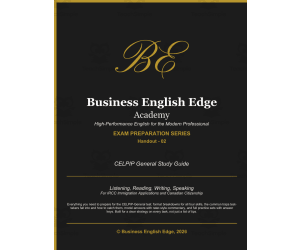
CELPIP General Study Guide
ELA, Language Development, ESL, Adult Education, Worksheets & Printables, Workbooks
CELPIP is scored differently than IELTS, and studying with IELTS material alone leaves gaps in exactly the places CELPIP tests differently. This guide walks through all four skills the way CELPIP itself is built: the exact task types, the CLB level conversions IRCC programs check against, and the specific traps the test uses to catch a rushed answer. Independently produced study material, not affiliated with or endorsed by any official CELPIP body. You get the exact task types, the exact scoring language, and the traps the test sets for a rushed answer. What's Included: - Full exam overview: CELPIP-General vs. CELPIP-General LS, CLB Level 1-12 scoring explained in plain language - All 4 skill sections (Reading, Writing, Listening, Speaking) with worked examples for every task type - Mock exercises with full transcripts, model responses, and answer keys, including error analysis notes - The 12-sentence model for Task 1 email writing, with a full worked response and commentary - IRCC minimum score requirements by program and a one-page quick reference Who it's for: adult professionals (B1-C1+ English level) preparing for the CELPIP-General test for Canadian immigration or citizenship purposes, especially anyone who has already studied IELTS material and is finding it doesn't fully transfer. How to use it: work through one skill section at a time, do the matching mock exercise, then check your answer against the model response and the error analysis notes. Repeat the sections where your CLB target sits above your current score. Professional English isn't about being perfect. It's about knowing exactly what a CELPIP rater is scoring for, so you stop losing marks on things you didn't know were being counted. The CLB conversion table turns a raw score into a number IRCC programs actually recognize. Answer keys: provided for all mock exercises, with model responses and error analysis notes. File type: PDF, 26 pages. Format: instant digital download, non-editable. © Business English Edge, 2026
Author Business English Edge
Rating
Tags ESL, CELPIP, CELPIP General, IRCC, CLB, Exam Prep, Listening, Reading, Speaking, Writing