


9,581 products added recently
Page 784 - Newest Teaching Resources

 Show filters


Atoms, Elements, and the Periodic Table Crossword Puzzle Activity
Science, Chemistry, Grade 8, 9, 10, 11, Crosswords Puzzles, Worksheets, Worksheets & Printables
This activity is a fantastic way to review Atoms, Elements, and the Periodic Table with your students. It covers multiple standards and concepts within Atoms, Elements, and the Periodic Table and comes in two different forms. The first is a basic crossword with a set of 15 clues. The second option includes a word bank where students can match the answers to the questions. I've used these crossword puzzles in my classroom to great success and have found that my students really enjoy completing them. It can be used as: straight review of Atoms, Elements, and the Periodic Table additional work for those who finish early bonus activity introduction to tectonic plates if you allow your students access to a device to help them get the answers This activity can be used for students in middle and high school, individually or in a group. In class or at home. It comes in Word and PDF formats and can also be uploaded to your Google Drive for easy access.
Author Teach With Fergy
Tags Crossword Puzzle, Science Crossword, Crossword Review, Atoms, Elements, Periodic Table
Photosynthesis and Cellular Respiration Science BINGO Activity
Science, Life Sciences, Biology, Nature & Plants, Grade 6, 7, 8, 9, 10, 11, Activities, Worksheets
Your students will love this engaging science review activity. Everyone loves BINGO and it makes for a great review activity that is fun and competitive. This interactive game reinforces key scientific concepts and theories, ensuring curriculum relevance and accuracy. The game package includes 36 unique 4x4 bingo cards featuring essential terms and concepts from Photosynthesis and Cellular Respiration, a set of call-out cards with clear and concise definitions tailored to the students' level, and detailed gameplay instructions. To play, simply distribute the bingo cards to your students along with markers or chips. Read out the definitions from the call-out cards in a random order, and have students place a marker on the corresponding term on their card. The first student to complete a row or column exclaims "Bingo!" and emerges victorious. Following the game, engage in a discussion of the terms to reinforce understanding and clarify any misconceptions. The beauty of this game is that it allows for multiple rounds of learning and review. Teachers will appreciate the game's ability to encourage active participation and engagement in the classroom setting, catering to various student learning styles and promoting differentiated learning. By matching definitions to terms on their bingo cards, students actively engage with the material, enhancing their retention and comprehension of complex scientific theories. Here is a sample from the instructions. BINGO – Instructions, Terms, and Descriptions Cut out and distribute the BINGO cards to your students. Each student will get a unique card. Students can use markers or chips to cover squares that have been called. Print out and cut out each term/description below – these are the call-out cards. Fold each call-out card and place in a hat or box and remove one at a time. After you’ve read the call-out card description, your students are to place a marker on the term associated with the description located on their card. The first student to get 4 in a row horizontally or vertically, wins. Ensure accuracy by checking marked terms on student card to the called-out descriptions.
Author Teach With Fergy
Tags Science Bingo, Bingo Activity, Ecology, Ecosystems, Photosynthesis, Cellular Respiration, Photosynthesis And Cellular Respiration
The Scientific Method Science BINGO Activity
Science, Earth and Environmental Sciences, Earth Sciences, Grade 6, 7, 8, 9, 10, 11, Activities
Your students will love this engaging science review activity. Everyone loves BINGO and it makes for a great review activity that is fun and competitive. This interactive game reinforces key scientific concepts and theories, ensuring curriculum relevance and accuracy. The game package includes 36 unique 4x4 bingo cards featuring essential terms and concepts from The Scientific Method, a set of call-out cards with clear and concise definitions tailored to the students' level, and detailed gameplay instructions. Here is a sample from the instructions. BINGO – Instructions, Terms, and Descriptions Cut out and distribute the BINGO cards to your students. Each student will get a unique card. Students can use markers or chips to cover squares that have been called. Print out and cut out each term/description below – these are the call-out cards. Fold each call-out card and place in a hat or box and remove one at a time. After you’ve read the call-out card description, your students are to place a marker on the term associated with the description located on their card. The first student to get 4 in a row horizontally or vertically, wins. Ensure accuracy by checking marked terms on student card to the called-out descriptions.
Author Teach With Fergy
Tags Science Bingo, Bingo Activity, Scientific Method, Scientific Method Activity

Biomes Science BINGO Activity
Science, Earth and Environmental Sciences, Earth Sciences, Grade 6, 7, 8, 9, 10, 11, Activities
Your students will love this engaging science review activity. Everyone loves BINGO and it makes for a great review activity that is fun and competitive. This interactive game reinforces key scientific concepts and theories, ensuring curriculum relevance and accuracy. The game package includes 36 unique 4x4 bingo cards featuring essential terms and concepts from Biomes, a set of call-out cards with clear and concise definitions tailored to the students' level, and detailed gameplay instructions. To play, simply distribute the bingo cards to your students along with markers or chips. Read out the definitions from the call-out cards in a random order, and have students place a marker on the corresponding term on their card. The first student to complete a row or column exclaims "Bingo!" and emerges victorious. Following the game, engage in a discussion of the terms to reinforce understanding and clarify any misconceptions. The beauty of this game is that it allows for multiple rounds of learning and review. Here is a sample from the instructions. BINGO – Instructions, Terms, and Descriptions Cut out and distribute the BINGO cards to your students. Each student will get a unique card. Students can use markers or chips to cover squares that have been called. Print out and cut out each term/description below – these are the call-out cards. Fold each call-out card and place in a hat or box and remove one at a time. After you’ve read the call-out card description, your students are to place a marker on the term associated with the description located on their card. The first student to get 4 in a row horizontally or vertically, wins. Ensure accuracy by checking marked terms on student card to the called-out descriptions.
Author Teach With Fergy
Tags Science Bingo, Bingo Activity, Ecology, Ecosystems, Biomes

Cells and Cell Organelles Science BINGO Activity
Science, Life Sciences, Biology, Grade 6, 7, 8, 9, 10, 11, Activities
Your students will love this engaging science review activity. Everyone loves BINGO and it makes for a great review activity that is fun and competitive. This interactive game reinforces key scientific concepts and theories, ensuring curriculum relevance and accuracy. The game package includes 36 unique 4x4 bingo cards featuring essential terms and concepts from Cells and Cell Organelles, a set of call-out cards with clear and concise definitions tailored to the students' level, and detailed gameplay instructions. To play, simply distribute the bingo cards to your students along with markers or chips. Read out the definitions from the call-out cards in a random order, and have students place a marker on the corresponding term on their card. The first student to complete a row or column exclaims "Bingo!" and emerges victorious. Following the game, engage in a discussion of the terms to reinforce understanding and clarify any misconceptions. The beauty of this game is that it allows for multiple rounds of learning and review. Teachers will appreciate the game's ability to encourage active participation and engagement in the classroom setting, catering to various student learning styles and promoting differentiated learning. By matching definitions to terms on their bingo cards, students actively engage with the material, enhancing their retention and comprehension of complex scientific theories. Here is a sample from the instructions. BINGO – Instructions, Terms, and Descriptions Cut out and distribute the BINGO cards to your students. Each student will get a unique card. Students can use markers or chips to cover squares that have been called. Print out and cut out each term/description below – these are the call-out cards. Fold each call-out card and place in a hat or box and remove one at a time. After you’ve read the call-out card description, your students are to place a marker on the term associated with the description located on their card. The first student to get 4 in a row horizontally or vertically, wins. Ensure accuracy by checking marked terms on student card to the called-out descriptions.
Author Teach With Fergy
Tags Science Bingo, Bingo Activity, Cells, Organelles, Cells And Organelles, Biology

Matter and the Particle Theory Science BINGO Activity
Science, Chemistry, Grade 6, 7, 8, 9, 10, 11, Activities
Your students will love this engaging science review activity. Everyone loves BINGO and it makes for a great review activity that is fun and competitive. This interactive game reinforces key scientific concepts and theories, ensuring curriculum relevance and accuracy. The game package includes 36 unique 4x4 bingo cards featuring essential terms and concepts from Matter and the Particle Theory, a set of call-out cards with clear and concise definitions tailored to the students' level, and detailed gameplay instructions. The included terms encompass a wide range of topics, such as; Solid, Liquid, Gas, Melting, Freezing, Evaporation, Boiling, Volume, Density, Particle Arrangement, Temperature, Atom, Molecule, Phase Change, Kinetic Energy, Heat Transfer. To play, simply distribute the bingo cards to your students along with markers or chips. Read out the definitions from the call-out cards in a random order, and have students place a marker on the corresponding term on their card. The first student to complete a row or column exclaims "Bingo!" and emerges victorious. Following the game, engage in a discussion of the terms to reinforce understanding and clarify any misconceptions. The beauty of this game is that it allows for multiple rounds of learning and review. Teachers will appreciate the game's ability to encourage active participation and engagement in the classroom setting, catering to various student learning styles and promoting differentiated learning. By matching definitions to terms on their bingo cards, students actively engage with the material, enhancing their retention and comprehension of complex scientific theories. Here is a sample from the instructions. BINGO – Instructions, Terms, and Descriptions Cut out and distribute the BINGO cards to your students. Each student will get a unique card. Students can use markers or chips to cover squares that have been called. Print out and cut out each term/description below – these are the call-out cards. Fold each call-out card and place in a hat or box and remove one at a time. After you’ve read the call-out card description, your students are to place a marker on the term associated with the description located on their card. The first student to get 4 in a row horizontally or vertically, wins. Ensure accuracy by checking marked terms on student card to the called-out descriptions.
Author Teach With Fergy
Tags Science Bingo, Bingo Activity, Matter, Particle Theory, Density, States Of Matter, Phases Of Matter

Periodic Table, Atoms, and Elements Science BINGO Activity
Science, Chemistry, Grade 6, 7, 8, 9, 10, 11, Activities
Your students will love this engaging science review activity. Everyone loves BINGO and it makes for a great review activity that is fun and competitive. This interactive game reinforces key scientific concepts and theories, ensuring curriculum relevance and accuracy. The game package includes 36 unique 4x4 bingo cards featuring essential terms and concepts from and Periodic Table, Atoms, and Elements, a set of call-out cards with clear and concise definitions tailored to the students' level, and detailed gameplay instructions. The included terms encompass a wide range of topics, such as; Period, Group, Metal, Nonmetal, Metalloid, Atomic Number, Atomic Mass, Element, Compound, Electron, Proton, Neutron, Chemical Symbol, Alkali Metal, Halogens, Noble Gases To play, simply distribute the bingo cards to your students along with markers or chips. Read out the definitions from the call-out cards in a random order, and have students place a marker on the corresponding term on their card. The first student to complete a row or column exclaims "Bingo!" and emerges victorious. Following the game, engage in a discussion of the terms to reinforce understanding and clarify any misconceptions. The beauty of this game is that it allows for multiple rounds of learning and review. Teachers will appreciate the game's ability to encourage active participation and engagement in the classroom setting, catering to various student learning styles and promoting differentiated learning. By matching definitions to terms on their bingo cards, students actively engage with the material, enhancing their retention and comprehension of complex scientific theories. Here is a sample from the instructions. BINGO – Instructions, Terms, and Descriptions Cut out and distribute the BINGO cards to your students. Each student will get a unique card. Students can use markers or chips to cover squares that have been called. Print out and cut out each term/description below – these are the call-out cards. Fold each call-out card and place in a hat or box and remove one at a time. After you’ve read the call-out card description, your students are to place a marker on the term associated with the description located on their card. The first student to get 4 in a row horizontally or vertically, wins. Ensure accuracy by checking marked terms on student card to the called-out descriptions.
Author Teach With Fergy
Tags Science Bingo, Bingo Activity, Periodic Table, Atoms, Elements
Force and Motion Science BINGO Activity
Science, Physics, Grade 6, 7, 8, 9, 10, 11, Activities
Your students will love this engaging science review activity. Everyone loves BINGO and it makes for a great review activity that is fun and competitive. This interactive game reinforces key scientific concepts and theories, ensuring curriculum relevance and accuracy. The game package includes 36 unique 4x4 bingo cards featuring essential terms and concepts from Force and Motion, a set of call-out cards with clear and concise definitions tailored to the students' level, and detailed gameplay instructions. The included terms encompass a wide range of topics, such as; Force, Motion, Gravity, Friction, Mass, Acceleration, Velocity, Newton's First Law, Displacement, Speed, Distance, Newton's Third Law, Newtons, Electromagnetic, Net Force, F=ma. To play, simply distribute the bingo cards to your students along with markers or chips. Read out the definitions from the call-out cards in a random order, and have students place a marker on the corresponding term on their card. The first student to complete a row or column exclaims "Bingo!" and emerges victorious. Following the game, engage in a discussion of the terms to reinforce understanding and clarify any misconceptions. The beauty of this game is that it allows for multiple rounds of learning and review. Teachers will appreciate the game's ability to encourage active participation and engagement in the classroom setting, catering to various student learning styles and promoting differentiated learning. By matching definitions to terms on their bingo cards, students actively engage with the material, enhancing their retention and comprehension of complex scientific theories. Here is a sample from the instructions. BINGO – Instructions, Terms, and Descriptions Cut out and distribute the BINGO cards to your students. Each student will get a unique card. Students can use markers or chips to cover squares that have been called. Print out and cut out each term/description below – these are the call-out cards. Fold each call-out card and place in a hat or box and remove one at a time. After you’ve read the call-out card description, your students are to place a marker on the term associated with the description located on their card. The first student to get 4 in a row horizontally or vertically, wins. Ensure accuracy by checking marked terms on student card to the called-out descriptions.
Author Teach With Fergy
Tags Science Bingo, Bingo Activity, Force, Motion, Force And Motion

Photosynthesis Infographic Assignment
Science, Life Sciences, Biology, Nature & Plants, Grade 10, 11, 12, Activities, Worksheets
This project combines science with creativity and art. I find this the most effective way to engage students who might like science but really enjoy other things like drawing and computer work. However, it still allows you to assess their understanding of photosynthesis. Here is the first bit of the project so you have an idea of what the rest will look like. Objective: The purpose of this assignment is for students to consolidate their understanding of the photosynthesis process by designing an original and engaging infographic. This visual should effectively communicate the key stages of photosynthesis, including the absorption of light, conversion of energy, and production of oxygen. Assignment Description: You are tasked with creating an infographic that breaks down the complex process of photosynthesis into easy-to-understand components. Your design should be both educational and creative, capturing the attention of viewers and providing them with a clear understanding of how photosynthesis sustains life on Earth.
Author Teach With Fergy
Tags Photosynthesis, Infographic Assignment

Reef Animal Adaptations Worksheets
ELA, Reading, Writing, Science, Basic Science, Grade 2, 3, Worksheets & Printables, Worksheets
Dive into the world of the reef habitat with this cross curricular set of worksheets. Your grade 2 and grade 3 learners will be engaged as they gather knowledge about 8 reef animals and their unique adaptations. Along the way they will also strengthen their skills in reading, writing, and critical thinking. Before listing animal adaptations on the differentiated worksheets, learners will read brief paragraphs as animals such as the Parrotfish, dugong, octopus, Moray eel, Manta ray, jellyfish, sea turtle, and Mantis shrimp. They’ll also gather information about the walrus, ostrich, and koala. They’ll use this information to compare and contrast an animal that lives in the reef versus one that lives in a different habitat. This product will allow your learners to understand how each animal’s adaptations enable it to live in its specific habitat instead of another location on Earth. After learners have compared both animals, they will complete the writing activity with illustrations of both animals. Your learners will enjoy this product because it teaches about animals, a topic in which most children find an interest. You’ll find this product useful because it touches on several subjects, is differentiated for most learners, and saves you time with its print and go format. Not only that, but it is available in a color version, as well as a black & white version. Both versions are identical. Please note that an answer key is not provided because most answers will vary from learner to learner. Below are details of each learning activity included in this product. PAGE 1: learners will read brief paragraphs about the Parrotfish, dugong, octopus, and Moray eel and their unique adaptations for life in the reef. PAGE 2: learners will read brief paragraphs about the Manta ray, jellyfish, sea turtle, and Mantis shrimp and their unique adaptations for life in the reef. PAGE 3: learners will read brief paragraphs about the walrus, ostrich, and koala and their unique adaptations for life in the Arctic, on the Savanna, and in the Outback. PAGE 4: learners will use the information from the reading passages to write one adaptation for 6 reef animals. PAGE 5: learners will use the information from the reading passages to write two adaptations for 6 reef animals. PAGE 6: learners will use the information from the reading passages to write three adaptations for 6 reef animals. PAGE 7: learners will use the information from the reading passages to write one adaptation for 3 reef animals and 3 non-reef animals. PAGE 8: learners will use the information from the reading passages to write two adaptations for 3 reef animals and 3 non-reef animals. PAGE 9: learners will use the information from the reading passages to write three adaptations for 3 reef animals and 3 non-reef animals. PAGE 10: learners will write a brief comparison of one reef animal and one non-reef animal, followed by an illustration for each animal. PAGE 11: a list of additional animals that live in the reef and a list of other habitats. THIS TYPE OF PRODUCT IS ALSO AVAILABLE FOR THE FOLLOWING HABITATS: Arctic, desert, rainforest, Savanna, and woodlands.
Author Quail Trail Products
Tags Animal Adaptations, Reef Habitat, Grade 2 Science, Grade 3 Science, Reading, Writing, Critical Thinking, Compare And Contrast

Add and Subtract 5-Digit to 8-Digit Numbers - Standard Algorithm
Math, Addition and Subtraction, Addition, Subtraction, Grade 4, Worksheets & Printables, Worksheets
These Worksheets provide an extensive source for reinforcing the skills needed for adding and subtracting multi-digit numbers using the standard algorithm. You can differentiate right from the beginning and build up the confidence, accuracy and speed at a pace that is just right for each of your students. There are 16 Sets, starting from addition of 4 & 5-Digit numbers and subtraction of a 4-Digit from a 5-Digit number to addition with four 8-Digit numbers A standout feature is the worksheet randomization. With a single click, educators can generate an entirely new set of questions, making it a renewable resource for the entire school year. Be it for classwork, revision, or homework, adaptability ensures students achieve proficiency in the topic. You could also use any of the worksheets to explain or introduce the subject to your class as you will have almost unlimited examples to work with and they will be different from the actual worksheets you hand out to your students. As these worksheets need little explanation and no preparation, they are ideal if you need to leave work for a substitute teacher. You have a choice of whether to give your students a worksheet with the questions prepared fully in the standard format or add in the extra step of requiring your student to write out the questions in their exercise books to practice aligning the digits based on their place values . You can choose from three number formats based on the way the thousands and hundreds are separated in your region i.e. with no space, a comm or with a space. Answers found on the second page of every worksheet are automatically generated when you create a new worksheet. Lastly, it's essential to note that these resources are compatible PDF documents. They operate seamlessly with the official Adobe Acrobat Reader on both Windows and Mac. Plus, the randomizing features are effortlessly accessible via touchscreen devices or interactive whiteboards. You may also like ...... Add and Subtract 2-digit numbers with and without regrouping Add and subtract 3 Digit numbers with and without regrouping Add and Subtract 4 digit whole numbers using the standard algorithm Add and Subtract 4 and 5 digit whole numbers using the standard algorithm Add and Subtract 5 digit whole numbers using the standard algorithm
Author Jeff's Notebooks
Tags Math, Addition, Subtraction, 5-digit Numbers, 6-digit Numbers, 7-digit Numbers, 8-digit Numbers, Add, Subtract, Worksheets

Engaging Business Case Study: Expansion, Mergers, and Acquisitions
Life Studies, Social Studies, Finance, Business, Economics, Grade 9, 10, 11, 12, Activities, Projects
Sal’s Snips: A Case Study Exploring Mergers, Competition, and Expansion In front of Sal Saldano sits a huge decision-- whether or not to expand his business to the lucrative downtown of Genericburg. And if so, how? In this case study students will follow the story of an invented small business owner-- Sal Saldano-- as he hires students to consult him on his expansion efforts. Your students will be charged with pouring over the information provided, and then constructing a consultant's presentation for Sal on how he should proceed. In the meantime, students will learn about minimizing risks, best/worst/most-likely outcomes, expansion, and competition. In short, this activity is designed to get them out of the textbook and into real business scenarios! Included Materials: Instructor's Guide: A helpful guide for you, the teacher, as you look to make this project a successful one! Guiding PowerPoint: A detailed slides presentation to keep your students anchored to the content and the task at hand. The presentation is polished, and designed to introduce key ideas that the case study will also address. Student Case Packet: This packet includes an original narrative about Sal Saldano, detailed financial data for Sal’s Snips and its competitor, Cut-N-Go, and a clearly defined task. Students will work in consulting groups to analyze the information and develop a strategic recommendation for Sal. Activity Structure: Introduction: Use the guiding PowerPoint to introduce the case study and key business concepts. Case Scenario: Present the original narrative about Sal Saldano and his decision-making dilemma. Group Work: Divide students into consulting groups and provide them with the student case packet. Give them time to analyze the data, discuss options, and formulate their recommendations. Presentations: Each group will present their strategic recommendation, including financial projections, market analysis, and action steps. Class Discussion: Facilitate a discussion to compare different recommendations and explore the various aspects of the case. This case study not only engages students with a realistic business scenario but also develops their analytical and presentation skills, preparing them for real-world business challenges.
Author Pygmalion Ed
Rating 5
Tags Business Case Study, Case Study, Business, Small Business, Merger, Expansion, Acquisition, Economics, Entrepreneurship , Business Owner

TRACING NUMBERS 0 TO 10 | PENCIL THEME
Math, Numbers, Kindergarten, Preschool, Grade 1, Worksheets & Printables, Worksheets
TRACING THE NUMBERS FROM 1 TO 10! Fantastic worksheets to review the name and symbols of the numbers from 1 to 10 TAKE ADVANTAGE NOW TO DOWNLOAD THIS DOCUMENT COMPLETELY FREE. KEYWORDS: Numbers, numbers from 1 to 10, number cards, learning numbers. A. MAIN PRODUCT INFORMATION: Below we offer you essential information about this product so that you can make the decision to download it now. 1. Brief introduction: Tracing is a basic activity for children, because this will allow them to greatly develop their psychomotor area. It will also help them have enough hand-eye coordination, in addition to stimulating their fine motor skills. 2. Product Description: This product contains traces of the numbers 0 to 10. 3. Benefits of using this product: Children will be able to learn the numbers from 1 to 10 in a didactic way. In addition, children will be able to reduce their anxiety and stress when learning mathematics, because this is a didactic resource to learn mathematics in another way. 4. Number of pages contained in this document: It contains 4 pages. 5. Topic addressed in this document: The numbers from 0 to 10. B. OTHER RESOURCES ALSO AVAILABLE FOR FREE: Download these documents for free now as well, you just have to click on the link next to each title. TRACING ALPHABET: https://teachsimple.com/product/26-alphabet-tracing-letters-free-worksheets TRACING LINES: https://teachsimple.com/product/30-funny-tracing-lines-10-worksheets DIVISION TABLES: https://teachsimple.com/product/12-free-division-charts-tables-1-to-12 SUBTRACTION TABLES: https://teachsimple.com/product/12-subtraction-charts-tables-1-to-12 ADDITION TABLES: https://teachsimple.com/product/12-addition-charts-tables-1-to-12 MULTIPLICATION TABLES: https://teachsimple.com/product/12-multiplication-charts-tables-1-to-12 TRACING WORDS: https://teachsimple.com/product/15-basic-spanish-words-learning-spanish TRACING COLORS: https://teachsimple.com/product/15-spanish-colors-tracing-spanish-worksheet C. SECONDARY PRODUCT INFORMATION: 6. Children's ages in which it can be applied: Children from 3 to 6 years old who are learning their first numbers. 7. Version in which this resource is found: Available in PDF version, A4 size. 8. How it should be printed: Print it as it is, in A4 format. 9. Standards based on which this resource was developed: It was not prepared based on any standard.
Author EDITORIAL LAURA EDUCA
Tags Numbers, Numbers 1 To 10, Numbers Worksheets, Numbers Resources

10 NUMBERS COUNT AND CLIP CARDS | Easter Day
Math, Numbers, Kindergarten, Preschool, Grade 1, Worksheets & Printables, Flashcards
10 WORKBOOKS TO LEARN NUMBERS FROM 1 TO 10 - 10 Easter egg themed booklets TAKE ADVANTAGE AS THIS DOCUMENT IS AVAILABLE FOR FREE A. FREE RESOURCES YOU CAN DOWNLOAD: Hello! We have here for you the following resources available completely free of charge that we are sure will be very useful in your classroom, so do not hesitate to download them now. TRACING ALPHABET: https://teachsimple.com/product/26-alphabet-tracing-letters-free-worksheets TRACING LINES: https://teachsimple.com/product/30-funny-tracing-lines-10-worksheets DIVISION TABLES: https://teachsimple.com/product/12-free-division-charts-tables-1-to-12 SUBTRACTION TABLES: https://teachsimple.com/product/12-subtraction-charts-tables-1-to-12 ADDITION TABLES: https://teachsimple.com/product/12-addition-charts-tables-1-to-12 MULTIPLICATION TABLES: https://teachsimple.com/product/12-multiplication-charts-tables-1-to-12 B. INFORMATION ABOUT THIS PRODUCT: You will surely wonder what this product is about, because here we have the basic information for you to inform yourself. 1. Why should teachers use educational materials in the classroom? As is known, learning mathematics requires additional use of educational or concrete resources so that learning is more meaningful. 2. What is the name of this document? This document is called "10 cards to recognize numbers from 1 to 10" 3. What topic will you address in this resource? You will be able to address the topic of numbers from 1 to 10. 4. For what ages is it recommended? Recommended for children from 3 to 7 years old who are learning their first numbers. 5. Who is the author of this document? The author of this document is EDITORIAL ARENAS EDUCATIVAS. C. KEYWORDS OF THIS PRODUCT: Numbers from 1 to 10, number cards, games with numbers, Easter, Easter games, educational resources on numbers D. SECONDARY PRODUCT INFORMATION: 6. In what area of knowledge can it be applied? In Mathematics for children. 7. Should I apply it individually or in groups in my class? Preferably individually or in pairs. 8. What size and format is this resource in? A4 size, PDF format. 9. Do I need some extra elements to apply it? Yes, you will need clothespins and scissors to cut the primers.
Author EDITORIAL LAURA EDUCA
Tags Numbers, Numbers Flashcards, Numbers Resources, Numbers Worksheets, Count And Clip

Renewable and Nonrenewable Energy Crossword Puzzle Review Activity
Science, Physics, Grade 7, 8, 9, 10, Crosswords Puzzles, Worksheets, Worksheets & Printables
This activity is a fantastic way to review Renewable and Nonrenewable Energy Sources with your students. It covers multiple standards and concepts within Renewable and Nonrenewable Energy Sourcesand comes in two different forms. The first is a basic crossword with a set of 15 clues. The second option includes a word bank where students can match the answers to the questions. I've used these crossword puzzles in my classroom to great success and have found that my students really enjoy completing them. It can be used as: straight review of Renewable and Nonrenewable Energy Sources additional work for those who finish early bonus activity introduction to tectonic plates if you allow your students access to a device to help them get the answers This activity can be used for students in middle and high school, individually or in a group. In class or at home. It comes in Word and PDF formats and can also be uploaded to your Google Drive for easy access.
Author Teach With Fergy
Tags Crossword Puzzle, Science Crossword, Crossword Review, Renewable Energy, Nonrenewable Energy, Energy

Ecology and Ecosystems Science BINGO Activity
Science, Earth and Environmental Sciences, Earth Sciences, Grade 6, 7, 8, 9, 10, 11, Activities
Your students will love this engaging science review activity. Everyone loves BINGO and it makes for a great review activity that is fun and competitive. This interactive game reinforces key scientific concepts and theories, ensuring curriculum relevance and accuracy. The game package includes 36 unique 4x4 bingo cards featuring essential terms and concepts from Ecology and Ecosystems, a set of call-out cards with clear and concise definitions tailored to the students' level, and detailed gameplay instructions. To play, simply distribute the bingo cards to your students along with markers or chips. Read out the definitions from the call-out cards in a random order, and have students place a marker on the corresponding term on their card. The first student to complete a row or column exclaims "Bingo!" and emerges victorious. Following the game, engage in a discussion of the terms to reinforce understanding and clarify any misconceptions. The beauty of this game is that it allows for multiple rounds of learning and review. Teachers will appreciate the game's ability to encourage active participation and engagement in the classroom setting, catering to various student learning styles and promoting differentiated learning. By matching definitions to terms on their bingo cards, students actively engage with the material, enhancing their retention and comprehension of complex scientific theories. Here is a sample from the instructions. BINGO – Instructions, Terms, and Descriptions Cut out and distribute the BINGO cards to your students. Each student will get a unique card. Students can use markers or chips to cover squares that have been called. Print out and cut out each term/description below – these are the call-out cards. Fold each call-out card and place in a hat or box and remove one at a time. After you’ve read the call-out card description, your students are to place a marker on the term associated with the description located on their card. The first student to get 4 in a row horizontally or vertically, wins. Ensure accuracy by checking marked terms on student card to the called-out descriptions.
Author Teach With Fergy
Tags Science Bingo, Bingo Activity, Ecology, Ecosystems
Energy Forms and Transformations Science BINGO Activity
Science, Physics, Grade 6, 7, 8, 9, 10, 11, Activities
Your students will love this engaging science review activity. Everyone loves BINGO and it makes for a great review activity that is fun and competitive. This interactive game reinforces key scientific concepts and theories, ensuring curriculum relevance and accuracy. The game package includes 36 unique 4x4 bingo cards featuring essential terms and concepts from Energy Forms and Transformations, a set of call-out cards with clear and concise definitions tailored to the students' level, and detailed gameplay instructions. To play, simply distribute the bingo cards to your students along with markers or chips. Read out the definitions from the call-out cards in a random order, and have students place a marker on the corresponding term on their card. The first student to complete a row or column exclaims "Bingo!" and emerges victorious. Following the game, engage in a discussion of the terms to reinforce understanding and clarify any misconceptions. The beauty of this game is that it allows for multiple rounds of learning and review. Teachers will appreciate the game's ability to encourage active participation and engagement in the classroom setting, catering to various student learning styles and promoting differentiated learning. By matching definitions to terms on their bingo cards, students actively engage with the material, enhancing their retention and comprehension of complex scientific theories. Here is a sample from the instructions. BINGO – Instructions, Terms, and Descriptions Cut out and distribute the BINGO cards to your students. Each student will get a unique card. Students can use markers or chips to cover squares that have been called. Print out and cut out each term/description below – these are the call-out cards. Fold each call-out card and place in a hat or box and remove one at a time. After you’ve read the call-out card description, your students are to place a marker on the term associated with the description located on their card. The first student to get 4 in a row horizontally or vertically, wins. Ensure accuracy by checking marked terms on student card to the called-out descriptions.
Author Teach With Fergy
Tags Science Bingo, Bingo Activity, Energy Forms, Energy Transformations

Tectonic Plates Crossword Puzzle Review Activity
Science, Earth and Environmental Sciences, Earth Sciences, Grade 7, 8, 9, 10, Crosswords Puzzles, Worksheets, Worksheets & Printables
This activity is a fantastic way to review tectonic plates with your students. It covers multiple standards and concepts within tectonic plates and comes in two different forms. The first is a basic crossword with a set of 15 clues. The second option includes a word bank where students can match the answers to the questions. I've used these crossword puzzles in my classroom to great success and have found that my students really enjoy completing them. It can be used as: straight review of tectonic plates additional work for those who finish early bonus activity introduction to tectonic plates if you allow your students access to a device to help them get the answers This activity can be used for students in middle and high school, individually or in a group. In class or at home. It comes in Word and PDF formats and can also be uploaded to your Google Drive for easy access.
Author Teach With Fergy
Tags Crossword Puzzle, Science Crossword, Crossword Review, Tectonic Plates

30 FUNNY TRACING LINES | 10 Worksheets
ELA, Special Resources, Writing, Handwriting, Speech Therapy, Kindergarten, Preschool, Grade 1, 2, Worksheets & Printables, Worksheets
30 SUPER STROKE EXERCISES FOR KIDS - Page number: 10 pages 3 EXERCISES PER PAGE. YOU JUST HAVE TO PRINT THIS AND GIVE IT TO YOUR CHILDREN AND START TRACING I TELL YOU THAT WE ALSO HAVE OTHER COMPLETELY FREE RESOURCES AVAILABLE THAT MAY INTEREST YOU: Just read the title of each product carefully and click on the link on the side and download the resource totally free. NUMBERS CLIPCARDS: https://teachsimple.com/product/20-numbers-clipcards-animal-theme DINOSAUR TRACING: https://teachsimple.com/product/alphabet-tracing-minibook-dinosaur-theme VEHICLES TRACING: https://teachsimple.com/product/10-funny-worksheets-tracing-lines TRACING SHAPES: https://teachsimple.com/product/10-tracing-worksheets-the-shapes TRACING NUMBERS: https://teachsimple.com/product/10-tracing-numbers-worksheets-numbers-1-to-10 50 ANIMAL PUZZLES: https://teachsimple.com/product/50-awesomes-puzzles-animals-theme DINOSAUR PUZZLES: https://teachsimple.com/product/20-funny-puzzles-dinosaur-theme TRACING LINES: https://teachsimple.com/product/10-tracing-worksheets-minibook COPY THE MODEL: https://teachsimple.com/product/copy-the-model-5-worksheets SEQUENCING NUMBERS: https://teachsimple.com/product/sequencing-numbers-worksheets-1-to-100-dinosaur-theme NUMBERS SOUP 1-100: https://teachsimple.com/product/10-numbers-soups-numbers-1-to-100 ADDITION MATCHING: https://teachsimple.com/product/10-addition-matching-worksheets-addition-1-to-100 ADDITION AND SUBTRACTION: https://teachsimple.com/product/5-worksheets-2-digit-additions-and-subtraction 1. Brief introduction: Strokes are a fundamental part of children's development because they help in multiple aspects, such as: - Helps hand-eye coordination - Helps with good pencil grip - Stimulates creativity and imagination 2. Title of the pedagogical resource: 30 line drawing exercises for children 3. Topic to work on: Graphomotor skills 4. Area of knowledge where it should be applied: Graphomotor skills and early stimulation 5. Number of pages contained: It contains 10 pages, on each page you will find 3 exercises, so in total you will have 30 line drawing exercises. 6. Is it available in color or white/black? Available in color. 7. What version is it available in? Available in PDF, A4 size. SECONDARY INFORMATION: 8. Editable/Not Editable: It is not editable because it is a product to print directly. 9. Age at which it can be applied: Apply it to children ages 4 to 6 who are learning to draw and then move on to writing. 10. Tags or keywords that describe the content: strokes, tracing exercises, drawing lines, tracing resources, tracing sheets. 11. Ways to print: Print this as is, in A4 format. 12. Forms of application in class: Apply preferably individually or in pairs. 13. Will you need extra elements to use this sheet? Yes, you will need a pencil or colored pencils or markers to make your lines. IMPORTANT TO REMEMBER: This file is for personal use only. It is not allowed to be resold or shared with others.
Author EDITORIAL LAURA EDUCA
Tags Tracing Lines, Tracing Pages, Tracing Worksheets

12 FREE DIVISION CHARTS | Tables 1 to 12
Math, Multiplication and Division, Multiplication, Grade 3, 4, 5, 6, Charts
12 DIVISION TABLES TO COMPLETE - Practicing tables from 1 to 12 - Animal theme COME UP NOW TO DOWNLOAD THIS FANTASTIC RESOURCE FOR FREE THAT WILL HELP YOUR STUDENTS PRACTICE THE DIVISION FROM 1 TO 12. A. OTHER COMPLETELY FREE RESOURCES We have other totally free resources available to you, you just have to read the title and then click on the link on the side to download it. 20 MULTIPLICATION CARDS: https://teachsimple.com/product/20-multiplication-flashcards-exercises-with-options 10 ADDITION WORKSHEETS: https://teachsimple.com/product/10-free-addition-worksheets-look-and-complete HOW MANY?: https://teachsimple.com/product/counting-numbers-1-to-5-5-worksheets TRACING NUMBERS: https://teachsimple.com/product/tracing-numbers-1-to-10-free-worksheets ADDITION WORKSHEETS: https://teachsimple.com/product/5-free-addition-worksheets-5-pages SUBTRACTION WORKSHEETS: https://teachsimple.com/product/5-subtraction-worksheets-free-resource DIVISION WORKSHEETS: https://teachsimple.com/product/5-division-worksheets-free-exercises MULTIPLICATION WORKSHEETS: https://teachsimple.com/product/5-free-multiplication-worksheets-free-resource NUMBERS CARDS:https://teachsimple.com/product/10-numbers-flashcards-animals-themed NUMBERS FLASHCARDS: https://teachsimple.com/product/10-numbers-flashcards-numbers-1-to-10 B. GENERAL PRODUCT INFORMATION: Through the following points, I am going to share valuable information about this resource so that you can learn about it and its content and decide to download it now. 1. Brief introduction: As is known, division is perhaps one of the most complicated operations for children, which is why it is important that we look for teaching resources that make learning division not considered so difficult for children. 2. Product Description: This product is made up of 12 booklets of the division tables from 1 to 12. 3. Benefits of using this product: This product has multiple benefits because: - It will help children practice the 12 division tables from 1 to 12. - It will motivate children to learn the division tables from 1 to 12. - It will reduce stress and anxiety about mathematics. 4. Number of pages contained in this document: This educational resource is made up of 6 pages, on each page you will find 2 division tables. 5. Topic addressed in this document: The division from 1 to 12. C. SECONDARY POINTS REGARDING THE PRODUCT: 6. Children's ages in which it can be applied: In children from 8 to 12 years old who are learning division. 7. Version in which this resource is found: Available in A4, PDF. 8. How it should be printed: Print it as it is, in A4 format. This file is for personal use only. It is not allowed to be resold or shared with others.
Author EDITORIAL LAURA EDUCA
Rating
Tags Division, Division Charts, Division Resources, Math Resources, Free Math Resources, Chart

12 ADDITION CHARTS | Tables 1 to 12
Math, Addition, Kindergarten, Preschool, Grade 1, 2, Charts
12 SUM TABLES READY TO FILL IN! - Contains 6 pages ready to print. DOWNLOAD IT NOW AND START PRACTICING ADDING NOW! 1. GENERAL PRODUCT INFORMATION: Below I offer you basic information about the product. A. The name of this educational resource is "12 addition tables from 1 to 12 to fill in" B. This document contains this number of pages It contains 6 pages, on each page you will find 2 addition tables with blank boxes for you to fill in with the answers. 2. OTHER FREE PRODUCTS YOU COULD DOWNLOAD: Yes, we have other free resources that you can download now, you just have to select the ones that will be useful to you, and click on the link on the side to download it now, 10 ADDITION WORKSHEETS: https://teachsimple.com/product/10-free-addition-worksheets-look-and-complete HOW MANY: https://teachsimple.com/product/counting-numbers-1-to-5-5-worksheets TRACING NUMBERS: https://teachsimple.com/product/tracing-numbers-1-to-10-free-worksheets ADDITION WORKSHEETS: https://teachsimple.com/product/5-free-addition-worksheets-5-pages SUBTRACTION WORKSHEETS: https://teachsimple.com/product/5-subtraction-worksheets-free-resource DIVISION WORKSHEETS: https://teachsimple.com/product/5-division-worksheets-free-exercises 3. SECONDARY PRODUCT INFORMATION: Now I will offer you secondary information about this product: C. This educational resource has been prepared by: Prepared by EDITORIAL ARENAS EDUCATIVAS. D. You can apply this educational document in different contexts such as: You can apply it in the classroom if you are a children's mathematics teacher or you can download it if you are a parent, so that your children can practice addition at home. E. Is this document in black and white or color? Designed in colors because it quickly attracts children's attention. F. For what ages is this document recommended? Recommended for children ages 4 to 7 who are learning and practicing their first additions. G. At what point in class can I apply it? You can apply it during class or send it as homework. H. Should I apply it individually or in groups? Preferable to apply it individually. I. Keywords that describe the product: addition, addition exercises, addition resources, addition educational resources 4. IMPORTANT INFORMATION TO REMEMBER: This file is for personal use only. It is not allowed to be resold or shared with others.
Author EDITORIAL LAURA EDUCA
Rating
Tags Addition, Addition Charts, Addition Resources, Chart

10 FREE IMAGES FOR PAINTING | Animals Themed
Creative Arts, Art, Kindergarten, Preschool, Grade 1, Worksheets & Printables, Worksheets
THANK YOU FOR BEING HERE IN THE EDUCATIONAL RESOURCES STORE OF EDITORIAL ARENAS EDUCATIVAS! We are a publisher dedicated to the development of fabulous resources for primary education, in the areas of literacy, brain exercises, and mathematics. A. COMPLETELY FREE PRODUCTS THAT YOU CAN DOWNLOAD: FOR EXAMPLE WE HAVE VARIOUS RESOURCES AVAILABLE FOR YOU COMPLETELY FREE, SO TAKE ADVANTAGE OF THEM TO DOWNLOAD THEM NOW. In the following points, you will find the title of each product, then you simply have to click on the link on the side and you can download it. ADDITION CARDS: https://teachsimple.com/product/10-addition-cards-addition-up-to-10 NUMBERS TRACING: https://teachsimple.com/product/tracing-numbers-1-to-100-5-free-worksheets NUMBERS FLASHCARDS: https://teachsimple.com/product/10-numbers-flashcards-numbers-1-to-10 NUMBERS CARDS: https://teachsimple.com/product/10-numbers-flashcards-animals-themed MULTIPLICATION WORKSHEETS: https://teachsimple.com/product/5-free-multiplication-worksheets-free-resource DIVISION WORKSHEETS: https://teachsimple.com/product/5-division-worksheets-free-exercises B. GENERAL PRODUCT INFORMATION: Now we present basic information about this product, which will help you realize what it is about and its use, and decide to download it now. 1. Product name: The title of this product is "10 images of animals to paint" 2. Number of pages: It contains 10 pages. 3. Is it editable or not? It is not editable, so you can print it directly. 4. Theme: Animals 5. Document version: This document is available in PDF version, A4 size. 6. Color or white/black: Available in black and white. 7. Aimed at children of ages: Aimed at children ages 4 to 7 who are interested in painting. C. SECONDARY PRODUCT INFORMATION: Now I present secondary information about this product so that you can make the decision to download it now. 8. Area: Art for children 9. Keywords: art, drawings for children, painting resources 10. How do I print it? Print this as is in A4 format, so that the children have space to make their strokes. D. BENEFITS OF ART: - They help the development of fine motor skills. - Promotes the stimulation of creativity - Improves hand-eye coordination. - Promotes concentration. - Helps the development of abstract thinking IMPORTANT TO REMEMBER: This file is for personal use only. It is not allowed to be resold or shared with others.
Author EDITORIAL LAURA EDUCA
Tags Art, Art For Kids, Coloring, Coloring Pages, Coloring Worksheets

Weather and Climate Science BINGO Activity
Science, Earth and Environmental Sciences, Earth Sciences, Grade 6, 7, 8, 9, 10, 11, Activities
Your students will love this engaging science review activity. Everyone loves BINGO and it makes for a great review activity that is fun and competitive. This interactive game reinforces key scientific concepts and theories, ensuring curriculum relevance and accuracy. The game package includes 36 unique 4x4 bingo cards featuring essential terms and concepts from Weather and Climate, a set of call-out cards with clear and concise definitions tailored to the students' level, and detailed gameplay instructions. The included terms encompass a wide range of topics, such as; Atmosphere, Precipitation, Evaporation, Condensation, Humidity, Wind, Temperature, Climate, Weather Front, Weather, Meteorology, Greenhouse Effect, Air Pressure, Climate Change, Troposphere, and Stratosphere. To play, simply distribute the bingo cards to your students along with markers or chips. Read out the definitions from the call-out cards in a random order, and have students place a marker on the corresponding term on their card. The first student to complete a row or column exclaims "Bingo!" and emerges victorious. Following the game, engage in a discussion of the terms to reinforce understanding and clarify any misconceptions. The beauty of this game is that it allows for multiple rounds of learning and review. Teachers will appreciate the game's ability to encourage active participation and engagement in the classroom setting, catering to various student learning styles and promoting differentiated learning. By matching definitions to terms on their bingo cards, students actively engage with the material, enhancing their retention and comprehension of complex scientific theories. Here is a sample from the instructions. BINGO – Instructions, Terms, and Descriptions Cut out and distribute the BINGO cards to your students. Each student will get a unique card. Students can use markers or chips to cover squares that have been called. Print out and cut out each term/description below – these are the call-out cards. Fold each call-out card and place in a hat or box and remove one at a time. After you’ve read the call-out card description, your students are to place a marker on the term associated with the description located on their card. The first student to get 4 in a row horizontally or vertically, wins. Ensure accuracy by checking marked terms on student card to the called-out descriptions.
Author Teach With Fergy
Tags Science Bingo, Bingo Activity, Astronomy, Space, Weather, Climate
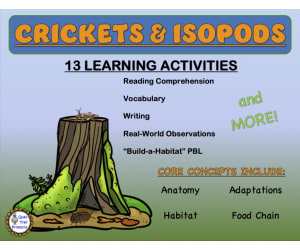
Crickets and Isopods Life Science Learning Activities
ELA, Writing, Science, Life Sciences, Biology, Grade 5, 6, 7, Activities
Here is a great addition to your life science curriculum! If your upper elementary or middle schoolers are delving into the world of crickets and isopods, then this is the product for you. The pages of this packet have everything you need for your learners to gain a deeper understanding of habitats, adaptations, and food chains. As a bonus, there is also a money budgeting activity where learners will work within the given parameters to create a suitable habitat for crickets or isopods. This product has something for all types of learners, and it will give you the peace of mind knowing that they are strengthening skills in nearly all academic domains. As they work their way through each page, learners will be given the opportunity to read, watch educational videos, write, draw, and use critical thinking skills. The best part is, they will also have the opportunity to create real-world connections by observing cricket and isopods in their natural habitats and finding the pros and cons of purchasing new items versus repurposing/upcycling. With the amount of information provided and the variety of activities included, you can use this as a stand-alone product or in conjunction with your science curriculum. The activities can be done individually or in a group setting. Below are the details of each page within this product. PAGES 1-2: Eight vocabulary terms found throughout the pages of the product. (color and b&w versions) PAGE 3: learners will identify a synonym for each vocabulary term. PAGE 4: learners will read about the various physical and behavioral adaptations of a cricket. PAGE 5: learners will read about the various physical and behavioral adaptations of an isopod. PAGE 6: learners will watch an educational video and list facts about a cricket’s appearance, behavior, and habitat. PAGE 7: learners will watch an educational video and list facts about an isopod’s appearance, behavior, and habitat. PAGE 8: learners will label the diagram of a cricket with the given physical adaptations/body parts. PAGE 9: learners will label the diagram of an isopod with the given physical adaptations/body parts. PAGE 10: learners will read clues and identify if the adaptations belong to the cricket or isopod. PAGE 11: learners will complete an observation of a cricket or isopod in their natural habitats. PAGE 12: learners will read two passages about the habitats and adaptations of crickets and isopods. PAGE 13: learners will read the instructions for the “Build-a-Habitat” PBL activity. PAGE 14: learners will list the items they’ll use to build a habitat and complete the corresponding budgetingform. PAGE 15: learners will use the purchasing guide in their PBL activity. PAGE 16: learners will use the upcycling guide in their PBL activity. PAGE 17: learners will use the guidelines to draw a complete habitat for a cricket. PAGE 18: learners will use the guidelines to draw a complete habitat for an isopod. PAGE 19: learners will answer questions as reflection of their PBL activity. PAGE 20: learners will use a Venn diagram to compare and contrast crickets and isopods. PAGE 21: learners will write a paragraph explaining whether or not crickets and isopods can co-exist in the same habitat. PAGE 22: learners will complete a search-and-find activity of animals found in the woodlands habitat. PAGE 23: learners will classify the woodland animals based on three different criteria. PAGE 24: learners will create three food chains (cricket, isopod, learner’s choice) ANSWER KEY
Author Quail Trail Products
Tags Crickets, Isopods, Adaptations, Habitat, Food Chains, PBL, Reading, Writing, Science, Vocabulary