



3,926 products added recently
Page 3 - Biology Quizzes
Chemistry Quizzes assess students' understanding of the composition, properties, and changes of matter. Questions may cover atomic structure, the periodic table, chemical bonding, stoichiometry, and acids and bases. These quizzes help students apply theoretical knowledge to practical problems and experiments. Incorporating Chemistry Quizzes supports the development of analytical skills essential for success in science.

 Show filters


Life Science Reading Comprehension Passage: Muscular System (Docs)
Science, ELA, Reading, Reading Comprehension, Strategies, Resources for Teachers, Life Sciences, Biology, Human Body, Grade 6, 7, 8, 9, 10, Writing Prompts, Worksheets & Printables, Centers, Activities, Teacher Tools, Assessments, Quizzes and Tests, Quizzes, Tests
Life Science Reading Comprehension Passage and Questions: Muscular System (Docs) This very engaging science reading passage is about the muscular system and how different types of muscles help the body move and function . It explains how skeletal muscles move bones, how smooth muscles work automatically inside organs and blood vessels, and how cardiac muscle pumps blood through the body. Students also learn how muscles work in pairs, how the nervous system sends signals that control contraction, and why exercise, protein, and rest are important for muscle strength and recovery. This passage is designed to bridge the gap between science and literacy by strengthening reading comprehension while sparking scientific curiosity in middle school students. It blends English Language Arts skills with accurate science content, helping students build background knowledge, understand key concepts, use evidence from the text, and explain scientific ideas clearly. This resource supports science classroom practice while also reinforcing important literacy skills such as main idea, vocabulary, comprehension, and summarizing. Ideal for interdisciplinary learning in ELA and Science. Suitable for Grade 9 review, too! Student Tasks for The Passage: 10 multiple-choice questions targeting main idea, key details, science concepts, comparison, and real-world applications 10 True/False statements to check understanding and address common misconceptions 5 text-based short-answer questions that require students to explain important ideas from the passage 5 vocabulary matching items with clear, student-friendly definitions 1 summary prompt that asks students to condense the central ideas accurately Full answer key for every section Available Formats for this Resource PDF Fillable PDF Word Docs FULL CATALOG OF DOWNLOADING LINKS HERE Product Details Length: 7 pages total Grades: 6–8, also suitable for Grade 9 review Use cases: close reading, stations, homework, intervention, test prep, and sub plans Standards support: Reinforces informational-text skills and supports NGSS-style sense-making by helping students read scientific explanations, connect evidence to key concepts, interpret real-world examples, and explain cause-and-effect relationships in science. Why Teachers Choose This Set Authentic science content paired with rigorous literacy practice Consistent task structure across all passages for easier planning and smoother student routines Clear, age-appropriate writing that builds confidence without oversimplifying Other Science Reading Collections and Topics You May Find in the Store: 1. Astronomy & Space Science 2. Volcanoes, Rocks, & Mountains 3. Rock Cycle, Soil, & Sinkholes 4. Mars, Glaciers, & Antarctica 5. Water Cycle, Acid Rain, & Wastewater 6. Insects, Animals, & Ecosystems 7. Bioluminescence & Insects 8. Animal Skin, Cats, & T. Rex 9. Human Body and Senses 10. Health & Applied Bioscience 11. Waves, Light, & Imaging 12. Electricity & Energy 13. Motion & Materials 14. Chemistry and Materials Science 15. Electromagnetism 16. Acids and Bases 17. Gas Laws 18. Biotechnology 19. Periodic Trends 20. Protists and Fungi 21. Microevolution 22. Blood 23. Chemical Bonding 24. Magnets 25. Muscles 26. Nuclear Chemistry 27. Electromagnetic Devices 28. Epigenetics 29. The Law of Conservation of Mass 30. Atomic Models 31. Isotopes and Ions 32. Light 33. Human-Environment Interaction 34. Theory of Evolution 35. Photosynthesis 36. Origins of Life and Early Earth 37. Gene Expression and Regulation 38. Thermochemistry 39. Allergies 40. Coevolution 41. Birth to Adulthood 42. Cells 43. Entropy and Free Energy 44. The Human Brain 45. Mixtures and Solutions 46. Invertebrates 47. Zoo Animals 48. Biochemistry 49. Animal Behavior 50. Population Ecology ...and many more engaging science reading passages that cover intriguing and important topics designed to spark curiosity and support student learning. Use this passage to reinforce ELA skills in science, to add literacy to your lessons, and to support independent work. The passages strengthen main idea, evidence use, vocabulary in context, inference, cause and effect, and summary writing. With ready-to-use assessments and complete answer keys, you can provide focused practice that is simple to run and fast to review.
Author Middle & High School - CORED Education
Rating
Tags Middle School, Reading Comprehension, Reading Strategies, ELA, Centers, Reading Passage, Assessments, Vocabulary, Muscular System, Life Science
Basics of DNA - Digital Quiz
Science, Life Sciences, Biology, Grade 6, 7, 8, Quizzes, Quizzes and Tests, Teacher Tools
Welcome to Basics of DNA - Digital Quiz This revolutionary tool is an ideal resource for middle school science educators and students who are navigating the world of distance learning. The quiz has been specifically designed to provide an engaging and seamless experience aligning with the concept of paperless, digital classrooms. The Google Form-based self-grading digital quiz eliminates countless hours spent on marking papers, allowing educators more time for teaching. It also provides instant feedback to students enabling them to track their progress and stay motivated. Fully Editable Resource with Multiple Applications: Serves as a thorough preparatory tool: The resource includes ten carefully framed questions covering lower-level information regarding genes and chromosomes in DNA. Versatile applications: Can be used for homework assignments or pre-tests or even within class-room settings like whole-group discussions or small-group activity sessions. Suitable for various learning environments: This tool is useful in both physical classrooms as well as distance learning models. Inclusive Design: Catering to diverse learner demographics—it's apt not only for regular middle-school learners but also a valuable addition if you have students mastering English or those under Individualized Education Programs (IEPs). Please note:This product comes as a downloadable PDF file that requires grading manually during evaluations, emphasizing its commitment towards reducing environmental concerns attached with paper usage. Note: This product is purely digital-only intended o be used via Google Docs—printing isn't possible; preserving its purpose to truly support our tech-driven educational landscape today. In Summary... Embracing the digital shift within our classrooms has never been easier with this convenient, efficient, and all-encompassing teaching resource—the Basics of DNA Digital Quiz .
Author Sheltered Language Resources
Tags DNA Basics, Digital Quiz, Distance Learning, Self-grading, Biology

Life Science Reading Comprehension Passage: Blood (PDF)
Science, ELA, Reading, Reading Comprehension, Strategies, Resources for Teachers, Life Sciences, Biology, Grade 6, 7, 8, 9, 10, Writing Prompts, Worksheets & Printables, Centers, Activities, Teacher Tools, Assessments, Quizzes and Tests, Quizzes, Tests
Life Science Reading Comprehension Passage and Questions: Blood (PDF) This very engaging science reading passage is about blood and the many essential jobs it performs throughout the human body . It explains how red blood cells and hemoglobin carry oxygen, how plasma transports nutrients, hormones, and wastes, how white blood cells help fight infection, and how platelets help stop bleeding. Students also learn how blood supports homeostasis, why blood types and safe transfusions matter, and how donated blood can help patients during surgery, after accidents, and during medical treatment. This passage is designed to bridge the gap between science and literacy by strengthening reading comprehension while sparking scientific curiosity in middle school students. It blends English Language Arts skills with accurate science content, helping students build background knowledge, understand key concepts, use evidence from the text, and explain scientific ideas clearly. This resource supports science classroom practice while also reinforcing important literacy skills such as main idea, vocabulary, comprehension, and summarizing. Ideal for interdisciplinary learning in ELA and Science. Suitable for Grade 9 review, too! Student Tasks for The Passage: 10 multiple-choice questions targeting main idea, key details, science concepts, comparison, and real-world applications 10 True/False statements to check understanding and address common misconceptions 5 text-based short-answer questions that require students to explain important ideas from the passage 5 vocabulary matching items with clear, student-friendly definitions 1 summary prompt that asks students to condense the central ideas accurately Full answer key for every section Available Formats for this Resource Fillable PDF Word Docs Google Docs FULL CATALOG OF DOWNLOADING LINKS HERE Product Details Length: 7 pages total Grades: 6–8, also suitable for Grade 9 review Use cases: close reading, stations, homework, intervention, test prep, and sub plans Standards support: Reinforces informational-text skills and supports NGSS-style sense-making by helping students read scientific explanations, connect evidence to key concepts, interpret real-world examples, and explain cause-and-effect relationships in science. Why Teachers Choose This Set Authentic science content paired with rigorous literacy practice Consistent task structure across all passages for easier planning and smoother student routines Clear, age-appropriate writing that builds confidence without oversimplifying Other Science Reading Collections and Topics You May Find in the Store: 1. Astronomy & Space Science 2. Volcanoes, Rocks, & Mountains 3. Rock Cycle, Soil, & Sinkholes 4. Mars, Glaciers, & Antarctica 5. Water Cycle, Acid Rain, & Wastewater 6. Insects, Animals, & Ecosystems 7. Bioluminescence & Insects 8. Animal Skin, Cats, & T. Rex 9. Human Body and Senses 10. Health & Applied Bioscience 11. Waves, Light, & Imaging 12. Electricity & Energy 13. Motion & Materials 14. Chemistry and Materials Science 15. Electromagnetism 16. Acids and Bases 17. Gas Laws 18. Biotechnology 19. Periodic Trends 20. Protists and Fungi 21. Microevolution 22. Blood 23. Chemical Bonding 24. Magnets 25. Muscles 26. Nuclear Chemistry 27. Electromagnetic Devices 28. Epigenetics 29. The Law of Conservation of Mass 30. Atomic Models 31. Isotopes and Ions 32. Light 33. Human-Environment Interaction 34. Theory of Evolution 35. Photosynthesis 36. Origins of Life and Early Earth 37. Gene Expression and Regulation 38. Thermochemistry 39. Allergies 40. Coevolution 41. Birth to Adulthood 42. Cells 43. Entropy and Free Energy 44. The Human Brain 45. Mixtures and Solutions 46. Invertebrates 47. Zoo Animals 48. Biochemistry 49. Animal Behavior 50. Population Ecology ...and many more engaging science reading passages that cover intriguing and important topics designed to spark curiosity and support student learning. Use this passage to reinforce ELA skills in science, to add literacy to your lessons, and to support independent work. The passages strengthen main idea, evidence use, vocabulary in context, inference, cause and effect, and summary writing. With ready-to-use assessments and complete answer keys, you can provide focused practice that is simple to run and fast to review.
Author Middle & High School - CORED Education
Rating
Tags Middle School, Reading Comprehension, Reading Strategies, ELA, Centers, Reading Passage, Assessments, Vocabulary, Biology, Life Science

Jacques Monod – Fact Sheet, Quiz & Interactive PDF incl. H5P
Life Sciences, Science, STEM, History, Social Studies, Biographies, Inventors, Basic Science, Physics, Biology, Grade 6, 7, 8, 9, 10, 11, 12, Worksheets, Worksheets & Printables, Quizzes, Quizzes and Tests, Teacher Tools, Projects, Activities
Scientist Jacques Monod - Fact Sheet, Quiz & Interactive Version (PDF & H5P) Jacques Monod – Gene Regulation and the Logic of Life Fact Sheet, Quiz & Interactive Exercises (PDF + H5P) 🧬⚙️ This 45-minute resource introduces students in grades 9–11 to Jacques Monod – a French molecular biologist whose work helped uncover how genes are turned on and off. In many biology classes, students learn what DNA is and how proteins are made. But the question of how cells know which genes to activate – and when – often stays abstract. Monod, together with François Jacob, studied this in bacteria and developed the model of the lac operon. It’s a great example of how cells respond to their environment, and it laid the groundwork for much of what we know about gene regulation today. To make this topic more tangible, I’ve created a compact, ready-to-use lesson that breaks it down into manageable parts. It includes an informational text, a fact sheet, quiz questions with answers, and a creative partner task. The material comes in color and black-and-white versions, plus there’s a digital H5P version. What’s included: A clear, student-friendly text about Jacques Monod and the lac operon A fact sheet to help students sort and retain key information Quiz questions with an answer key – good for review or independent work A task where students design and exchange their own questions in pairs Printable PDF and interactive H5P formats for flexible use 💻 Answer key included ✅ I’ve used this resource during our genetics unit, especially when moving from DNA basics to regulation and gene expression. It also fits well in discussions about how scientific models are developed and tested. The partner task works well in small groups or for homework – depending on your setup. 🚀 Download now and bring the legacy of Jacques Monod into your biology lessons today! 📍 Best wishes, Heike from Lernfitness Did You Know? I teach with a certified therapy dog, and together we create a positive and inspiring learning environment. 🐶✨
Author Lernfitness
Tags Science, Biology, Famous Scientists Lesson, H5P, Interactive Science Exercises, STEM, History, Scientists, Jacques Monod, Molecular Biology

Science Reading Passages on Plant Parts and Ecosystems (PPT)
Science, Life Sciences, Biology, Common Core, ELA, Reading Comprehension, Reading, Animals, Human Body, Grade 5, 6, 7, Teacher Tools, Presentations, Assessments, Quizzes, Quizzes and Tests
Reading Passages on Plant Parts & Ecosystems for Life Science Make science come alive with this engaging collection of reading passages focused on plant parts, ecosystems, and the world of life science! Each passage is written to spark curiosity while helping students build a deeper understanding of how living things grow, survive, and interact with their environment. Whether you're prepping for assessments or just looking to weave more science into your literacy block, this resource has you covered. Aligned with CCSS, it's a time-saver for teachers and a confidence booster for students—turning science lessons into meaningful learning moments. What's inside? Plant Parts & Ecosystems Reading Passage1: Classification of Organisms Reading Passage2: Function of Plant Parts Reading Passage3: Reproduction in Plants Reading Passage4: Invertebrates Reading Passage 5: Vertebrates Reading Passage6: Earth's Biomes Reading Passage7: Ecosystems PPT Version: This is the PPT version. It includes editable slides, boxes are fillable (when not in full screen mode). If you are looking for fillable resources, it may be better to look at the Google Drive version of this product. 268 Slides Science Reading Comprehension Outline: Introducing a comprehensive resource tailored for 5th and 6th graders, this product offers enriching reading passages supplemented with illustrative pictures and graphs to clarify key concepts. Aligned with the Common Core State Standards (CCSS), it offers a hassle-free approach to teaching, given that the bulk of the preparation is already done for you. The passages present a diverse set of questions – from multiple choice to data analysis and fill-in-the-blanks. This ensures a rich blend of high-interest content and fundamental curriculum-based science themes. With its versatility, you can seamlessly integrate these lessons into various classroom settings, whether it's whole class discussions, morning exercises, independent desk tasks, small group engagements, contingency plans for substitute teachers, regular homework assignments, or even themed activities for holidays. FULL CATALOG OF DOWNLOAD LINKS HERE Grade 5/6 Links: Physical Science Part 1 - Physical and Chemical Properties Google Docs/Slides/Forms PDF PPT Word Free Supplementary Pack Accompanying Videos Physical Science Part 2 - Motion and Energy Google Docs/Slides/Forms PDF PPT Word Free Supplementary Pack Accompanying Videos Physical Science Part 3 - Electricity and Magnets Google Docs/Slides/Forms PDF PPT Word Free Supplementary Pack Accompanying Videos Life Science Part 1 - Cells, Reproduction and Genetics Google Docs/Slides/Forms PDF PPT Word Free Supplementary Pack Accompanying Videos Life Science Part 2 - Human Body Systems Google Docs/Slides/Forms PDF PPT Word Free Supplementary Pack Accompanying Videos Life Science Part 3 - Plant Parts and Ecosystems Google Docs/Slides/Forms PDF PPT Word Free Supplementary Pack Accompanying Videos Earth Science Part 1 - Plate Tectonics and Rock Cycle Google Docs/Slides/Forms PDF PPT Word Free Supplementary Pack Accompanying Videos Earth Science Part 2 - Ocean Exploration and Natural Resources Google Docs/Slides/Forms PDF PPT Word Free Supplementary Pack Accompanying Videos Earth Science Part 3 - Weather and Solar System Google Docs/Slides/Forms PDF PPT Word Free Supplementary Pack Accompanying Videos For similar products and other frees, do check out Cored Group on TeachSimple .
Author Cored Education
Rating
Tags Science, Elementary, Reading, Comprehension, Vocabulary, Answers, Reading Comprehension Presentations, Biology, Life Science, Biology Presentations

Life Science Reading Comprehension Passage: Animal Skin (Fillable PDF)
Science, ELA, Reading, Reading Comprehension, Strategies, Resources for Teachers, Life Sciences, Animals, Biology, Grade 6, 7, 8, 9, Writing Prompts, Worksheets & Printables, Centers, Activities, Teacher Tools, Assessments, Quizzes and Tests, Quizzes, Tests
Life Science Reading Comprehension Passage and Questions: Animal Skin (Fillable PDF) This very engaging life science reading passage about how animal skin helps animals survive. It explains that skin is not just a body covering. It can protect animals from sunlight, germs, insects, and predators. The passage gives three main examples : Hippos: Their red-colored secretion works like sunscreen, discourages insects, and helps kill bacteria. Zebras: Their stripes act as camouflage and can confuse predators when the herd moves together. King snakes: Their colors imitate venomous coral snakes, which makes predators hesitate or back off. This passage is designed to bridge the gap between science and literacy through strengthening reading comprehension and sparking scientific curiosity in middle school students. The passage blends English Language Arts skills with accurate science content that supports NGSS classroom practice. Ideal for interdisciplinary learning in ELA and Science. Suitable for Grade 9 review, too! This passage is designed as a fillable PDF , which means students can type their answers directly into the document on any computer or tablet . Each page includes highlighted text fields that show them exactly where to type! Student Tasks for The Passage: 5 multiple-choice questions targeting main idea, key details, inference, vocabulary in context, and use of evidence 5 vocabulary matching items with clear, student-friendly definitions 5 text-based questions that require citing specific lines or facts 1 summary prompt that asks students to condense central ideas accurately Full answer key for every section Available Formats for this Resource PDF Word Docs Google Docs FULL CATALOG OF DOWNLOADING LINKS HERE Product Details Length: 4 pages total Grades: 6–8, also suitable for Grade 9 review Use cases: close reading, stations, homework, intervention, test prep, and sub plans Standards support: reinforces informational-text skills and supports NGSS-style sense making through observation, modeling, and clear use of claim, evidence, and reasoning Why Teachers Choose This Set Authentic science content paired with rigorous literacy practice Consistent task structure across all passages for easier planning and smoother student routines Clear, age-appropriate writing that builds confidence without oversimplifying Other Science Reading Collections you May find in the store: 1. Astronomy & Space Science 2. Volcanoes, Rocks, & Mountains 3. Rock Cycle, Soil, & Sinkholes 4. Mars, Glaciers, & Antarctica 5. Water Cycle, Acid Rain, & Wastewater 6. Insects, Animals, & Ecosystems 7. Bioluminescence & Insects 8. Animal Skin, Cats, & T. Rex 9. Human Body and Senses 10. Health & Applied Bioscience 11. Waves, Light, & Imaging 12. Electricity & Energy 13. Motion & Materials 14. Chemistry and Materials Science Use this set to reinforce ELA skills in science, to add literacy to your lessons, and to support independent work. The passages strengthen main idea, evidence use, vocabulary in context, inference, cause and effect, and summary writing. With ready-to-use assessments and complete answer keys, you can provide focused practice that is simple to run and fast to review.
Author Middle & High School - CORED Education
Rating
Tags Middle School, Reading Comprehension, Reading Strategies, ELA, Centers, Reading Passage, Assessments, Vocabulary, Life Science
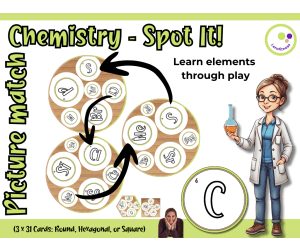
Find the Match – Chemistry Elements Matching Game
STEM, Science, Chemistry, Physics, Life Sciences, Special Education Needs (SEN), Special Resources, Research, Biology, Earth and Environmental Sciences, Homeschool Templates, Grade 7, 8, 9, 10, 11, Activities, Games, Worksheets & Printables, Task Cards, Quizzes and Tests, Teacher Tools, Quizzes, Word Problems, Word Searches, Worksheets
Find the Match – Chemistry Elements Matching Game A fast-paced visual review of atomic numbers and chemical symbols – inspired by the Spot It!™ game concept 🧪🧠 This printable chemistry card game offers a playful and challenging way for students to review the chemical elements. Designed to support symbol recognition, visual attention, and focus, it’s ideal for middle and high school science classes. Inspired by the Spot It!™ game concept (matching symbols) , the game is based on a simple idea: any two cards share exactly one matching chemical symbol – and players race to find it. Each card shows six element symbols (without names), so the game is especially suitable for students who already know the basics and want to strengthen their fluency. What’s included: 93 total cards (3 versions with 31 cards each) Card shapes: round, square (cut-friendly), and hexagonal Elements included: main group elements up to Period 5 + Cs Symbols and atomic numbers only – no element names Hand-drawn visuals created specifically for this resource Instructions included (PDF for print and laminate) How to use in class: This game works well as a review activity, brain break, or warm-up. I’ve used it at the end of a unit on the periodic table or to reinforce visual recall before a quiz. It can be played in pairs, small groups, or even as a whole-class team competition. To support deeper learning, you can also add color-coding tasks – for example, have students group elements by family or period after each round. The game naturally encourages cooperation, observation, and concentration. Because it’s printable and easy to prep, it’s also well-suited for substitute lessons or station work. Students enjoy the fast pace and competition – and they often don’t realize how much they’re reviewing in the process. A simple and flexible way to bring variety and engagement into chemistry class. 🐰 Print it, play it, and bring science to life! 📍 Best, Heike from Lernfitness Did You Know? I teach with a certified therapy dog, and together we focus on creating a positive and inspiring learning environment. 🐶✨
Author Lernfitness
Rating
Tags Game, Spot It, Educational Card Games, Picture Match, Chemistry, Physics, Chemical Elements, Gamified Learning Chemistry, Elements, Matching Game
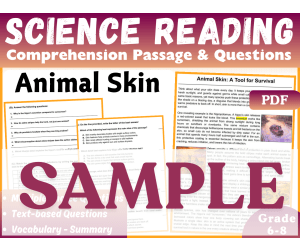
Life Science Reading Comprehension Passage: Animal Skin. SAMPLE
Science, ELA, Reading, Reading Comprehension, Strategies, Resources for Teachers, Life Sciences, Animals, Biology, Grade 6, 7, 8, 9, Writing Prompts, Worksheets & Printables, Centers, Activities, Teacher Tools, Assessments, Quizzes and Tests, Quizzes, Tests
This is a free passage sample from the complete resource. The full version includes everything needed for a complete reading comprehension activity: the passage, multiple-choice questions, short-answer questions, vocabulary matching, a summary-writing task, and a detailed answer key. Download the complete passage resource by clicking on the following links: PDF Fillable PDF Word Docs Google Docs Life Science Reading Comprehension Passage and Questions: Animal Skin (PDF) This very engaging life science reading passage about how animal skin helps animals survive. It explains that skin is not just a body covering. It can protect animals from sunlight, germs, insects, and predators. The passage gives three main examples : Hippos: Their red-colored secretion works like sunscreen, discourages insects, and helps kill bacteria. Zebras: Their stripes act as camouflage and can confuse predators when the herd moves together. King snakes: Their colors imitate venomous coral snakes, which makes predators hesitate or back off. This passage is designed to bridge the gap between science and literacy through strengthening reading comprehension and sparking scientific curiosity in middle school students. The passage blends English Language Arts skills with accurate science content that supports NGSS classroom practice. Ideal for interdisciplinary learning in ELA and Science. Suitable for Grade 9 review, too! Student Tasks for The Passage: 5 multiple-choice questions targeting main idea, key details, inference, vocabulary in context, and use of evidence 5 vocabulary matching items with clear, student-friendly definitions 5 text-based questions that require citing specific lines or facts 1 summary prompt that asks students to condense central ideas accurately Full answer key for every section FULL CATALOG OF DOWNLOADING LINKS HERE Product Details Length: 4 pages total Grades: 6–8, also suitable for Grade 9 review Use cases: close reading, stations, homework, intervention, test prep, and sub plans Standards support: reinforces informational-text skills and supports NGSS-style sense making through observation, modeling, and clear use of claim, evidence, and reasoning Why Teachers Choose This Set Authentic science content paired with rigorous literacy practice Consistent task structure across all passages for easier planning and smoother student routines Clear, age-appropriate writing that builds confidence without oversimplifying Other Science Reading Collections you May find in the store: 1. Astronomy & Space Science 2. Volcanoes, Rocks, & Mountains 3. Rock Cycle, Soil, & Sinkholes 4. Mars, Glaciers, & Antarctica 5. Water Cycle, Acid Rain, & Wastewater 6. Insects, Animals, & Ecosystems 7. Bioluminescence & Insects 8. Animal Skin, Cats, & T. Rex 9. Human Body and Senses 10. Health & Applied Bioscience 11. Waves, Light, & Imaging 12. Electricity & Energy 13. Motion & Materials 14. Chemistry and Materials Science Use this set to reinforce ELA skills in science, to add literacy to your lessons, and to support independent work. The passages strengthen main idea, evidence use, vocabulary in context, inference, cause and effect, and summary writing. With ready-to-use assessments and complete answer keys, you can provide focused practice that is simple to run and fast to review.
Author Middle & High School - CORED Education
Rating
Tags Middle School, Reading Comprehension, Reading Strategies, ELA, Centers, Reading Passage, Assessments, Vocabulary, Life Science
Scientist Thomas Henry Huxley Fact Sheet, Quiz + Exercises | PDF + H5P
Life Sciences, Science, Biology, STEM, History: World, History, Social Studies, Animals, Biographies, Grade 6, 7, 8, 9, Worksheets, Worksheets & Printables, Quizzes, Quizzes and Tests, Teacher Tools, Projects, Activities
Discover Thomas Henry Huxley – The Scientist Who Defended Evolution Did you know that Thomas Henry Huxley was one of the strongest supporters of Charles Darwin’s theory of evolution? Often called "Darwin’s Bulldog," he passionately defended the idea of natural selection and helped shape the way we understand science today. Huxley was not only a brilliant biologist but also a dedicated educator who believed that science should be accessible to everyone. This teaching resource introduces your grades 7–10 students to Huxley’s fascinating life and contributions. Designed for a 45-minute lesson, it includes engaging explanations, interactive exercises, and creative tasks to help students explore his impact on biology and science communication. What’s Included: Concise Informational Text: A clear and engaging overview of Thomas Henry Huxley’s role in science. Fact Sheet Activity: Encourages students to organize knowledge and work creatively. Quiz with Solutions: Promotes fun, interactive learning and self-assessment. Additional Exercises: Students can create their own questions and collaborate in pairs to deepen their understanding. Flexible Formats: Includes a color and black-and-white printable PDF, as well as interactive H5P tasks for digital learning. Why You’ll Love This Resource: Time-Saving: Perfect for teachers who need a ready-to-go, well-structured lesson. Versatile Use: Ideal for biology, history of science, or cross-curricular lessons in English and science classes. Promotes Independence: Solutions are included, allowing students to check their work and explore the topic at their own pace. Interactive and Engaging: Tasks are designed to keep students actively involved while learning about Thomas Henry Huxley’s legacy. Whether you use it for a regular lesson, substitute teaching, or as part of a digital learning activity, this resource will make Thomas Henry Huxley’s contributions come alive for your students. Bring Thomas Henry Huxley’s fascinating world of science into your classroom and inspire your students to see history and science in a whole new light! Have fun exploring the world of science with your students! Warmly, Lernfitness Did You Know? I teach with a certified therapy dog, and together we focus on creating a positive and inspiring learning environment.
Author Lernfitness
Tags Science, Biology, Famous Scientists Lesson, H5P, Interactive Science Exercises, STEM, History, Scientists, Evolution, Thomas Henry Huxley
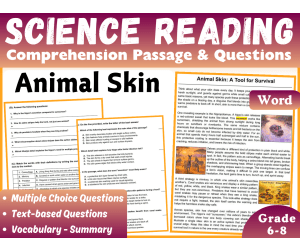
Life Science Reading Comprehension Passage: Animal Skin (Word)
Science, ELA, Reading, Reading Comprehension, Strategies, Resources for Teachers, Life Sciences, Animals, Biology, Grade 6, 7, 8, 9, Writing Prompts, Worksheets & Printables, Centers, Activities, Teacher Tools, Assessments, Quizzes and Tests, Quizzes, Tests
Life Science Reading Comprehension Passage and Questions: Animal Skin (Word) This very engaging life science reading passage about how animal skin helps animals survive. It explains that skin is not just a body covering. It can protect animals from sunlight, germs, insects, and predators. The passage gives three main examples : Hippos: Their red-colored secretion works like sunscreen, discourages insects, and helps kill bacteria. Zebras: Their stripes act as camouflage and can confuse predators when the herd moves together. King snakes: Their colors imitate venomous coral snakes, which makes predators hesitate or back off. This passage is designed to bridge the gap between science and literacy through strengthening reading comprehension and sparking scientific curiosity in middle school students. The passage blends English Language Arts skills with accurate science content that supports NGSS classroom practice. Ideal for interdisciplinary learning in ELA and Science. Suitable for Grade 9 review, too! Student Tasks for The Passage: 5 multiple-choice questions targeting main idea, key details, inference, vocabulary in context, and use of evidence 5 vocabulary matching items with clear, student-friendly definitions 5 text-based questions that require citing specific lines or facts 1 summary prompt that asks students to condense central ideas accurately Full answer key for every section Available Formats for this Resource PDF Fillable PDF Google Docs FULL CATALOG OF DOWNLOADING LINKS HERE Product Details Length: 4 pages total Grades: 6–8, also suitable for Grade 9 review Use cases: close reading, stations, homework, intervention, test prep, and sub plans Standards support: reinforces informational-text skills and supports NGSS-style sense making through observation, modeling, and clear use of claim, evidence, and reasoning Why Teachers Choose This Set Authentic science content paired with rigorous literacy practice Consistent task structure across all passages for easier planning and smoother student routines Clear, age-appropriate writing that builds confidence without oversimplifying Other Science Reading Collections you May find in the store: 1. Astronomy & Space Science 2. Volcanoes, Rocks, & Mountains 3. Rock Cycle, Soil, & Sinkholes 4. Mars, Glaciers, & Antarctica 5. Water Cycle, Acid Rain, & Wastewater 6. Insects, Animals, & Ecosystems 7. Bioluminescence & Insects 8. Animal Skin, Cats, & T. Rex 9. Human Body and Senses 10. Health & Applied Bioscience 11. Waves, Light, & Imaging 12. Electricity & Energy 13. Motion & Materials 14. Chemistry and Materials Science Use this set to reinforce ELA skills in science, to add literacy to your lessons, and to support independent work. The passages strengthen main idea, evidence use, vocabulary in context, inference, cause and effect, and summary writing. With ready-to-use assessments and complete answer keys, you can provide focused practice that is simple to run and fast to review.
Author Middle & High School - CORED Education
Rating
Tags Middle School, Reading Comprehension, Reading Strategies, ELA, Centers, Reading Passage, Assessments, Vocabulary, Life Science
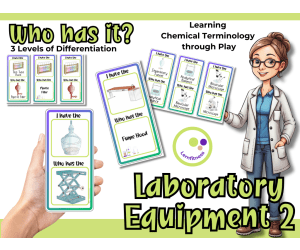
Who Has the Lab Equipment 2 ? – Interactive Science + Chemistry Game
STEM, Science, Chemistry, Physics, Life Sciences, Special Education Needs (SEN), Special Resources, Research, Biology, Homeschool Templates, Grade 6, 7, 8, 9, 10, 11, Activities, Games, Worksheets & Printables, Task Cards, Quizzes and Tests, Teacher Tools, Quizzes, Word Problems, Word Searches, Worksheets
Who Has the Lab Equipment 2 ? – A Fun & Engaging Science Game for the Classroom 🔬 Turn Science Learning into an Interactive Adventure! Helping students learn laboratory equipment doesn’t have to be tedious. With "Who Has the Lab Equipment?", you can bring hands-on engagement and excitement into your chemistry, physics, or biology classroom! This fast-paced call-and-response game is perfect for reinforcing lab tools and key scientific terminology while encouraging active participation and teamwork. 🎯 Why Teachers Love This Game ✅ Boosts Student Engagement – Keeps students actively involved instead of passively memorizing vocabulary. ✅ Encourages Collaboration – Supports teamwork, communication, and critical thinking. ✅ Differentiated Learning – Includes three levels to accommodate students of all abilities. ✅ Perfect for Science Lessons – A great addition to chemistry, physics, and biology classes. ✅ Low-Prep & Classroom-Friendly – Just print, cut, and play! 🧪 What’s Included? 🃏 90 Total Cards – 3 differentiated sets of 30 cards each: ✔ Level 1: Terms with visual aids – perfect for beginners. ✔ Level 2: A mix of terms and images – great for building recognition. ✔ Level 3: Visuals only – students must recall and name the equipment independently. 📌 How to Play 1️⃣ Distribute the Cards – Each student gets one or more cards. 2️⃣ Start the Game – The student with the first card reads aloud: "I have the test tube. Who has the test tube rack?" 3️⃣ Find the Answer – The student with the correct response answers and then reads the next prompt. 4️⃣ Keep Going! – Play continues until all cards have been matched. 💡 Bonus Challenge: Encourage students to use complete sentences when responding to reinforce scientific communication skills. 🌟 Why This Game is a Must-Have for Science Teachers ✔ Versatile Use – Works as a lesson starter, review activity, or quick filler for substitute plans. ✔ Supports Multiple Learning Styles – Helps visual, auditory, and kinesthetic learners grasp key concepts. ✔ Perfect for Science Centers – Ideal for small groups or whole-class activities. ✔ Durable & Reusable – Laminate the cards for long-lasting classroom use. 🔬 Make Science Learning Engaging and Memorable! If you're looking for a fun, effective, and interactive way to teach students about laboratory equipment, this game is the perfect resource for your science classroom. 🚀 Download now and bring interactive learning into your chemistry, physics, or biology lessons! 📍 Best wishes, Heike from Lernfitness Did You Know? I teach with a certified therapy dog, and together we create a positive and inspiring learning environment. 🐶✨
Author Lernfitness
Tags Game, Educational Card Games, Chemistry, Lab, Biology, Laboratory Equipment, Lab Tools, Physics, STEM Science Matching Game, Who Has It?

Homologous Series of Alcohols – Word Search Activity (Differentiated)
Life Sciences, Science, STEM, Basic Science, Physics, Chemistry, Biology, Earth and Environmental Sciences, Environmental Science, Grade 6, 7, 8, 9, 10, 11, Worksheets, Worksheets & Printables, Quizzes, Quizzes and Tests, Teacher Tools, Activities, Games, Task Cards, Crosswords Puzzles, Word Searches
Homologous Series of Alcohols – Word Search Activity (Differentiated) A flexible review task for organic chemistry lessons (Grades 8–11) 🧪🔍 Alkanols Alcanoles This set of word search puzzles offers a quiet but focused way for students to review the homologous series of alcohols in organic chemistry. Instead of asking for definitions or formulae, students engage with key terms through active searching – which can be a surprisingly effective way to reinforce terminology. The material includes 10 word search puzzles , each in two variants (A/B), with five levels of difficulty . These levels are marked with stars (1 to 5), so you can easily differentiate within your classroom. Puzzles vary by grid size and by the direction in which words are hidden – from simple (only forward) to more challenging (also backward and diagonal). The content covers terminology related to the alcohol functional group and homologous series, making it a suitable supplement to introductory or review units in organic chemistry. What’s included: 10 unique puzzles × 2 variants (A and B) 5 differentiation levels based on grid size and word direction Answer keys for all puzzles Color and black-and-white versions for easy printing Chemistry-themed clipart to add visual appeal Ideas for classroom use: I’ve used these word searches both as a quiet review tool and as a warm-up or cool-down at the beginning or end of a lesson. The A/B version is especially useful for classroom management – students working side by side aren’t tempted to copy but still complete equivalent tasks. Students often appreciate the variety, especially when switching between more structured exercises and creative, self-paced activities. Whether as an individual task, a group competition, or a calming option during busy weeks – this resource supports technical vocabulary in a format that feels low-pressure and accessible. A simple and effective addition to your chemistry toolkit. Have fun exploring the world of science with your students! Warmly, Lernfitness Did You Know? I teach with a certified therapy dog, and together we focus on creating a positive and inspiring learning environment.
Author Lernfitness
Rating
Tags Science, STEM, Chemistry, Homologous Series, Alcohols, Word Search Activity, Differentiated, Organic Chemistry, Alkanols, Alcanoles

Justus von Liebig – Chemistry Pioneer and Science Reformer
Life Sciences, Science, STEM, Social Studies, Biographies, Inventors, Basic Science, Physics, Chemistry, Biology, Grade 6, 7, 8, 9, 10, 11, Worksheets, Worksheets & Printables, Quizzes, Quizzes and Tests, Teacher Tools, Projects, Activities
Justus von Liebig – Chemistry Pioneer and Science Reformer A ready-to-use reading and activity set for grades 7–10 (PDF + H5P) ⚗️📄 A printable and digital resource for grades 7–10 science and cross-curricular teaching 🧪🧠 This resource introduces students to Justus von Liebig, one of the most influential chemists of the 19th century. Known for his work on agricultural chemistry, food science, and lab-based teaching, Liebig helped shape the way chemistry is studied and taught even today. His contributions go beyond formulas – they reach into education, nutrition, and everyday life. The resource includes a concise, accessible text paired with simple, structured tasks. It can be used in a chemistry unit, during a lesson on the history of science, or as part of a substitute plan where no specialized background is required. Included in this resource: Informational text on Justus von Liebig’s life and achievements Student worksheet for creating a scientist profile Quiz questions with a complete answer key Two extension tasks: – Students write their own questions based on the reading – Peer activity to exchange and answer each other’s questions File formats: – PDF for print or digital use – Editable DOCX (text only) – H5P version for use in digital classrooms (no images) How it’s used in the classroom: This kind of material works well as a quiet reading activity, a springboard for science-history discussions, or a way to highlight lesser-known scientists who had a big impact. I’ve used it during lessons on food chemistry and nutrient cycles to provide real-world context. The H5P version supports independent and self-paced work, especially in hybrid or online classrooms. With minimal prep and clear instructions, the material can be used flexibly across settings. A thoughtful and low-prep resource to bring historical depth and personal stories into science class. Have fun exploring the world of science with your students! Warmly, Lernfitness Did You Know? I teach with a certified therapy dog, and together we focus on creating a positive and inspiring learning environment.
Author Lernfitness
Rating
Tags Science, Famous Scientists Lesson, H5P, Interactive Science Exercises, STEM, Scientists, Chemistry, Justus Von Liebig, Biology, Plants
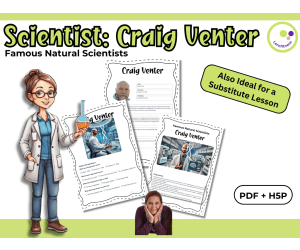
Craig Venter – Fact Sheet, Quiz & Interactive PDF incl. H5P
Life Sciences, Science, STEM, History, Social Studies, Biographies, Inventors, Basic Science, Biology, Human Body, Grade 6, 7, 8, 9, 10, 11, 12, Worksheets, Worksheets & Printables, Quizzes, Quizzes and Tests, Teacher Tools, Projects, Activities
Scientist Craig Venter - Fact Sheet, Quiz & Interactive Version (PDF & H5P) Craig Venter – Sequencing the Human Genome and the Future of Synthetic Biology Fact Sheet, Quiz & Interactive Exercises (PDF + H5P) 🧬🧪 This 45-minute resource introduces students in grades 9–12 to Craig Venter – a biologist and geneticist who played a major role in decoding the human genome and pushing the boundaries of synthetic biology. Most students know that DNA holds our genetic information, but they’re often surprised to learn how recently the full human genome was sequenced – and how intense the race to do so actually was. Venter took a different approach from public research teams and became one of the first to publish a full genome sequence. Later, he even worked on building synthetic cells – raising big questions about what defines life. To explore this complex but highly relevant topic, I’ve put together a compact and structured lesson. It includes an informational text, a fact sheet, quiz questions with answers, and a creative task for pairs. All materials are available in color and black-and-white, plus there’s an H5P version for digital classrooms. What’s included: A student-friendly overview of Craig Venter and the Human Genome Project A fact sheet to help students sort key information Quiz questions with answer key for review or independent work A creative task where students come up with their own questions and exchange them in pairs Available as printable PDF and interactive H5P 💻 Answer key included ✅ I’ve used this material in lessons on genetics, biotechnology, and current developments in biology. It also works well when discussing how science and society interact – for example, when ethical questions arise from new technologies. The flexible format fits both group work and individual tasks. 🚀 Download now and bring the legacy of Craig Venter into your biology lessons today! 📍 Best wishes, Heike from Lernfitness Did You Know? I teach with a certified therapy dog, and together we create a positive and inspiring learning environment. 🐶✨
Author Lernfitness
Tags Science, Biology, Famous Scientists Lesson, H5P, Interactive Science Exercises, STEM, History, Scientists, Craig Venter, Human Genome Project

Life Science Reading Passage: The Dinosaur Tyrannosaurus rex. SAMPLE
Science, ELA, Reading, Reading Comprehension, Strategies, Resources for Teachers, Life Sciences, Animals, Biology, Grade 6, 7, 8, 9, Writing Prompts, Worksheets & Printables, Centers, Activities, Teacher Tools, Assessments, Quizzes and Tests, Quizzes, Tests
This is a free passage sample from the complete resource. The full version includes everything needed for a complete reading comprehension activity: the passage, multiple-choice questions, short-answer questions, vocabulary matching, a summary-writing task, and a detailed answer key. Download the complete passage resource by clicking on the following links: PDF Fillable PDF Word Docs Google Docs Life Science Reading Comprehension Passage and Questions: The Dinosaur Tyrannosaurus rex (PDF) This very engaging science reading passage about Tyrannosaurus rex and how scientists use fossils to understand how it lived. It explains what fossils are, where and when T. rex lived, and what fossil evidence reveals about its size, teeth, skull, movement, speed, diet, hunting, and scavenging. It also shows how modern tools, such as CT scans, imaging, computer simulations, and coprolites , help paleontologists build a clearer picture of T. rex as a powerful predator from the late Cretaceous period. This passage is designed to bridge the gap between science and literacy through strengthening reading comprehension and sparking scientific curiosity in middle school students. The passage blends English Language Arts skills with accurate science content that supports NGSS classroom practice. Ideal for interdisciplinary learning in ELA and Science. Suitable for Grade 9 review, too! Student Tasks for The Passage: 5 multiple-choice questions targeting main idea, key details, inference, vocabulary in context, and use of evidence 5 vocabulary matching items with clear, student-friendly definitions 5 text-based questions that require citing specific lines or facts 1 summary prompt that asks students to condense central ideas accurately Full answer key for every section FULL CATALOG OF DOWNLOADING LINKS HERE Product Details Length: 5 pages total Grades: 6–8, also suitable for Grade 9 review Use cases: close reading, stations, homework, intervention, test prep, and sub plans Standards support: reinforces informational-text skills and supports NGSS-style sense making through observation, modeling, and clear use of claim, evidence, and reasoning Why Teachers Choose This Set Authentic science content paired with rigorous literacy practice Consistent task structure across all passages for easier planning and smoother student routines Clear, age-appropriate writing that builds confidence without oversimplifying Other Science Reading Collections you May find in the store: 1. Astronomy & Space Science 2. Volcanoes, Rocks, & Mountains 3. Rock Cycle, Soil, & Sinkholes 4. Mars, Glaciers, & Antarctica 5. Water Cycle, Acid Rain, & Wastewater 6. Insects, Animals, & Ecosystems 7. Bioluminescence & Insects 8. Animal Skin, Cats, & T. Rex 9. Human Body and Senses 10. Health & Applied Bioscience 11. Waves, Light, & Imaging 12. Electricity & Energy 13. Motion & Materials 14. Chemistry and Materials Science Use this set to reinforce ELA skills in science, to add literacy to your lessons, and to support independent work. The passages strengthen main idea, evidence use, vocabulary in context, inference, cause and effect, and summary writing. With ready-to-use assessments and complete answer keys, you can provide focused practice that is simple to run and fast to review.
Author Middle & High School - CORED Education
Rating
Tags Middle School, Reading Comprehension, Reading Strategies, ELA, Centers, Reading Passage, Assessments, Vocabulary, Life Science, The Dinosaur Tyrannosaurus Rex

Epigenetics: Middle School Life Science Reading Comprehension (Docs)
Science, ELA, Reading, Reading Comprehension, Strategies, Resources for Teachers, Common Core, Language Development, Life Sciences, Biology, Grade 6, 7, 8, 9, 10, Writing Prompts, Worksheets & Printables, Centers, Activities, Teacher Tools, Assessments, Quizzes and Tests, Quizzes, Tests, Literacy Readers
Life Science Reading Comprehension Passage and Questions for Middle School: Epigenetics (Google Document) The engaging passage is about how gene activity can change without changing the DNA sequence itself . It explains how chemical tags, including methyl groups, can affect whether genes are more or less active, and how factors such as diet, stress, exercise, sleep, pollution, and life experiences may influence epigenetic patterns. It also covers identical twins and differences in gene activity over time, possible epigenetic effects across generations, links between epigenetics and disease, and possible uses in personalized medicine. This passage is designed to bridge the gap between science and literacy by strengthening reading comprehension while sparking scientific curiosity in middle school students. It blends English Language Arts skills with accurate science content, helping students build background knowledge, understand key concepts, use evidence from the text, and explain scientific ideas clearly. This resource supports science classroom practice while also reinforcing important literacy skills such as main idea, vocabulary, comprehension, and summarizing. Ideal for interdisciplinary learning in ELA and Science. Suitable for Grade 9 review, too! Student Tasks for The Passage: 10 multiple-choice questions targeting main idea, key details, science concepts, comparison, and real-world applications 10 True/False statements to check understanding and address common misconceptions 5 text-based short-answer questions that require students to explain important ideas from the passage 5 vocabulary matching items with clear, student-friendly definitions 1 summary prompt that asks students to condense the central ideas accurately Full answer key for every section Available Formats for this Resource PDF Fillable PDF Word Docs Product Details Length: 7 pages total Grades: 6–8, also suitable for Grade 9 review Use cases: close reading, stations, homework, intervention, test prep, and sub plans Standards support: Reinforces informational-text skills and supports NGSS-style sense-making by helping students read scientific explanations, connect evidence to key concepts, interpret real-world examples, and explain cause-and-effect relationships in science. FULL CATALOG OF DOWNLOADING LINKS HERE Other Science Reading Collections and Topics You May Find in the Store: 1. Astronomy & Space Science 2. Volcanoes, Rocks, & Mountains 3. Rock Cycle, Soil, & Sinkholes 4. Mars, Glaciers, & Antarctica 5. Water Cycle, Acid Rain, & Wastewater 6. Insects, Animals, & Ecosystems 7. Bioluminescence & Insects 8. Animal Skin, Cats, & T. Rex 9. Human Body and Senses 10. Health & Applied Bioscience 11. Waves, Light, & Imaging 12. Electricity & Energy 13. Motion & Materials 14. Chemistry and Materials Science 15. Electromagnetism 16. Acids and Bases 17. Gas Laws 18. Biotechnology 19. Periodic Trends 20. Protists and Fungi 21. Microevolution 22. Blood 23. Chemical Bonding 24. Magnets 25. Muscles 26. Nuclear Chemistry 27. Electromagnetic Devices 28. Epigenetics 29. The Law of Conservation of Mass 30. Atomic Models 31. Isotopes and Ions 32. Light 33. Human-Environment Interaction 34. Theory of Evolution 35. Photosynthesis 36. Origins of Life and Early Earth 37. Gene Expression and Regulation 38. Thermochemistry 39. Allergies 40. Coevolution 41. Birth to Adulthood 42. Cells 43. Entropy and Free Energy 44. The Human Brain 45. Mixtures and Solutions 46. Invertebrates 47. Zoo Animals 48. Biochemistry 49. Animal Behavior 50. Population Ecology ...and many more engaging science reading passages that cover intriguing and important topics designed to spark curiosity and support student learning. Use this passage to reinforce ELA skills in science, to add literacy to your lessons, and to support independent work. The passages strengthen main idea, evidence use, vocabulary in context, inference, cause and effect, and summary writing. With ready-to-use assessments and complete answer keys, you can provide focused practice that is simple to run and fast to review.
Author Middle & High School - CORED Education
Rating
Tags Middle School, Reading Comprehension, Reading Strategies, ELA, Centers, Reading Passage, Assessments, Vocabulary, Life Science, Biology

Global Climate Policy Debates & Solution Brainstorm Worksheets
Science, Earth and Environmental Sciences, Life Sciences, Earth Sciences, Environmental Science, Geology, Space, Nature & Plants, Biology, STEM, Homeschool Curriculum, Homeschool Templates, Grade 8, 9, 10, 11, 12, Worksheets & Printables, Worksheets, Workbooks, Word Searches, Teacher Tools, Assessments, Lesson Plans, Quizzes and Tests, Quizzes, Tests
Provide your advanced high school students with this 42-page climate policy curriculum that focuses on advanced dialectical analysis rather than simplified activism. This curriculum will encourage active learning for your students by transforming passive learning into a deep intellectual engagement through multi-perspective debate, policy creation, and ethical reasoning. Students will explore: The transition from the Kyoto Protocol to the Paris Agreement and the principle of Common But Differentiated Responsibilities (CBDR) Carbon pricing mechanisms (Carbon Tax vs. Cap and Trade), as well as the Social Cost of Carbon The ethics of geoengineering (Stratospheric Aerosol Injection [SAI], moral hazard, risks associated with unilateral use of SAI) Environmental justice, climate debt, and the Cobalt Paradox in developing countries Youth climate lawsuits, climate refugees and international law, methane agricultural policies, financing urban adaptation, and accountability for greenwashing Includes 10 high-level student worksheets with conceptual fill-in-the-blank (using a unique 7-underscore system), real-world case studies and hypothetical case studies, critical debate prompts, and challenging policy creation assignments for students. Teacher answer keys, implementation guides, visual diagrams (Climate Policy Trilemma, Stakeholder Matrix, and Carbon Pricing Mind Map), and differentiation strategies are also included. Ideal for AP Environmental Science, AP Government, AP Economics, IB Global Politics, Honors Humanities, and Model UN/debate programs. Encourages real critical thinking, systems analysis, and nuanced understanding of the trade-offs between enhancing developing countries. The Key Reasons Why Parents and Schools Appreciate It: Facilitates unbiased critical thinking instead of dogmatic, ideologically-based, practical-thinking-by-proxy students making arguments for and against competing choices (e.g., Growth vs. Fossil-Fuel Abolition; Independent Sovereign Nation vs. World Government; Technology as Hope or as a Curse). Extensive preparation for taking Advanced Placement tests; writing college level essays, debating other humans, as well as the development of well-thought-out arguments using established policies, and ethical reasoning based on sound ethical reasoning standards. A balanced view of the world; an honest consideration of the challenges facing developing nations, "Just Transition", climate liabilities, and the risk of neo-colonial influence in creating green supply chains. Teacher support that is broad in scope and purpose; includes teacher-oriented teacher guides, "look-for" answers for the teachers, pacing guides and strategies for differentiating instruction, visual aids to illustrate concepts, and techniques for managing classroom conversations. An exceedingly entertaining way to teach about Climate Change, as well as Science, by creating opportunities for students to compete with each other on an intellectual level, as opposed to being preached at. Primary Audience & Classes: 9-12 (Secondary School) Advanced Students Advanced Placement Environmental Science Advanced Placement U.S. Government/Comparative Government Advanced Placement Macroeconomics/Microeconomics (on Carbon Pricing) IB Diploma Programme: Global Politics, Environmental Systems/Societies (ESS), and Economics Advanced Placement/honors world/history/contemporary issues Model United Nations, Debate and Mock Trial Teams Future Advanced 10-graders: Gifted/Track 11/12 grades -- Advanced Placement courses. Copyright/Use Policy: This book, written by "Syed Hammad Rizvi," is one-of-a-kind. You cannot change, give away or sell this product so long as you are using it as personal and for one classroom only. Therefore, you may NOT post any portion of this book/presentation on the internet for public access and download. Additional copies of this work may be purchased if you want to share with your colleagues, so please consider purchasing additional license(s) through Teachsimple. Your cooperation is greatly appreciated! A very special "thank you" from "Syed Hammad Rizvi".
Author Creative Book Store
Rating
Tags ClimatePolicy, APEnvironmentalScience, ClimateJustice, ClimateChangeEducation, EnvironmentalScience, Geoengineering, ClimatePolicyWorksheets, APEnvSci, JustTransition, CarbonPricing

Laboratory Equipment Domino 2 Science Game for Chemistry Physics & Bio
STEM, Science, Chemistry, Physics, Life Sciences, Special Education Needs (SEN), Special Resources, Research, Biology, Homeschool Templates, Grade 6, 7, 8, 9, 10, 11, Activities, Games, Worksheets & Printables, Task Cards, Quizzes and Tests, Teacher Tools, Quizzes, Word Problems, Word Searches, Worksheets
Laboratory Equipment Domino 2 A Fun & Engaging Science Game for Chemistry, Physics & Biology Classrooms 🔬 Make Science Learning Fun with Hands-On Play! Help your students master laboratory equipment vocabulary in a way that’s interactive, engaging, and memorable! With Laboratory Equipment Domino 2, students match images and terms of lab tools, reinforcing key scientific vocabulary while having fun. Whether you teach chemistry, physics, or biology, this game is a perfect addition to your lesson plans. 🎯 Why Teachers Love This Game ✅ Turns Vocabulary into Active Learning – Science terms become easier to remember through hands-on engagement. ✅ Boosts Visual Recognition – Helps students quickly identify and recall lab equipment. ✅ Encourages Collaboration – Supports teamwork and communication through pair or group play. ✅ Flexible & Easy to Use – Ideal for science centers, review lessons, or warm-up activities. ✅ Perfect for Any Science Class – Use it in chemistry, physics, and biology lessons to reinforce key lab tools. 🧪 What’s Included? 🃏 39 Domino Cards – Each featuring an image and term for common laboratory equipment, such as: ✔ Beakers ✔ Test Tubes ✔ Pipettes ✔ Flasks ✔ Centrifuges ✔ Burners …and more essential science tools! 📖 Pairs Perfectly with My Knowledge Card Set 2 – Laboratory Equipment Use this game alongside Knowledge Card Set 2 for extended learning opportunities and even deeper reinforcement of lab terminology. 📌 How to Play 1️⃣ Print & Cut the cards (laminate for durability if desired). 2️⃣ Distribute the domino cards among players. 3️⃣ Match the lab equipment image with its corresponding term to play. 4️⃣ The first player to place all their domino cards wins! 💡 Pro Tip: Make the game even more engaging by playing on the classroom floor or in the hallway—this adds movement and excitement to your lesson! 🌟 Why This Game is a Must-Have for Science Teachers ✔ Saves Prep Time – Just print, cut, and play! ✔ Great for All Science Subjects – Perfect for chemistry, physics, and biology classes. ✔ Supports Different Learning Styles – Helps visual, kinesthetic, and social learners. ✔ Engaging for All Levels – Works well for middle school, high school, and even college-level introductory science courses. 🔬 Make Science Lessons Interactive & Fun! Whether you're introducing lab equipment for the first time or reinforcing vocabulary in a play-based learning environment, this Laboratory Equipment Domino Game is the perfect tool for your classroom. 🚀 Download now and bring hands-on science learning into your classroom today! 📍 Best wishes, Heike from Lernfitness Did You Know? I teach with a certified therapy dog, and together we create a positive and inspiring learning environment. 🐶✨
Author Lernfitness
Tags Game, Educational Card Games, Chemistry, Lab, Biology, Laboratory Equipment, Lab Tools, Physics, STEM Science Matching Game, Domino
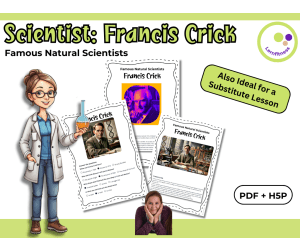
Scientist Francis Crick – Fact Sheet, Quiz & Interactive PDF incl. H5P
Life Sciences, Science, STEM, History, Social Studies, Biographies, Inventors, Basic Science, Physics, Biology, Grade 6, 7, 8, 9, 10, 11, 12, Worksheets, Worksheets & Printables, Quizzes, Quizzes and Tests, Teacher Tools, Projects, Activities
Scientist Francis Crick - Fact Sheet, Quiz & Interactive Version (PDF & H5P) Francis Crick – The DNA Double Helix and the Origins of Modern Genetics Fact Sheet, Quiz & Interactive Exercises (PDF + H5P) 🧬 This 45-minute resource introduces students in grades 7–10 to Francis Crick and his role in uncovering the structure of DNA – one of the most influential discoveries in modern biology. Many students are familiar with the term DNA, but only a few know the story behind how scientists first identified its double helix shape. Together with James Watson, and building on the work of Rosalind Franklin, Crick helped explain how genetic information is stored and passed on – a breakthrough that still shapes biology and medicine today. To make this complex topic easier to teach, I’ve put together a concise and structured lesson. It includes a short informational text, a fact sheet, quiz questions with answers, and a creative task where students come up with their own questions. All versions are included – both in color and black-and-white – and there’s also an interactive H5P version for digital use 💻. What’s included: A short, accessible text on Francis Crick and the discovery of DNA A fact sheet to help students sort and reflect on the key points Quiz questions (with solutions) to check understanding A creative task where students write and exchange their own questions Formats: Printable/digital PDF and interactive H5P version Answer key included ✅ I’ve used this during our genetics unit, but it also fits well in lessons on the history of science or how discoveries are made. It’s easy to integrate and works well for partner work, independent tasks, or short science projects. 🚀 Download now and bring the legacy of Francis Crick into your biology lessons today! 📍 Best wishes, Heike from Lernfitness Did You Know? I teach with a certified therapy dog, and together we create a positive and inspiring learning environment. 🐶✨
Author Lernfitness
Tags Science, Biology, Famous Scientists Lesson, H5P, Interactive Science Exercises, STEM, History, Scientists, Francis Crick, DNA

Who Has the Lab Equipment? – Interactive Science + Chemistry Game
STEM, Science, Chemistry, Physics, Life Sciences, Special Education Needs (SEN), Special Resources, Research, Biology, Homeschool Templates, Grade 6, 7, 8, 9, 10, 11, Activities, Games, Worksheets & Printables, Task Cards, Quizzes and Tests, Teacher Tools, Quizzes, Word Problems, Word Searches, Worksheets
Who Has the Lab Equipment? – A Fun & Engaging Science Game for the Classroom 🔬 Turn Science Learning into an Interactive Adventure! Helping students learn laboratory equipment doesn’t have to be tedious. With "Who Has the Lab Equipment?", you can bring hands-on engagement and excitement into your chemistry, physics, or biology classroom! This fast-paced call-and-response game is perfect for reinforcing lab tools and key scientific terminology while encouraging active participation and teamwork. 🎯 Why Teachers Love This Game ✅ Boosts Student Engagement – Keeps students actively involved instead of passively memorizing vocabulary. ✅ Encourages Collaboration – Supports teamwork, communication, and critical thinking. ✅ Differentiated Learning – Includes three levels to accommodate students of all abilities. ✅ Perfect for Science Lessons – A great addition to chemistry, physics, and biology classes. ✅ Low-Prep & Classroom-Friendly – Just print, cut, and play! 🧪 What’s Included? 🃏 90 Total Cards – 3 differentiated sets of 30 cards each: ✔ Level 1: Terms with visual aids – perfect for beginners. ✔ Level 2: A mix of terms and images – great for building recognition. ✔ Level 3: Visuals only – students must recall and name the equipment independently. 📌 How to Play 1️⃣ Distribute the Cards – Each student gets one or more cards. 2️⃣ Start the Game – The student with the first card reads aloud: "I have the test tube. Who has the test tube rack?" 3️⃣ Find the Answer – The student with the correct response answers and then reads the next prompt. 4️⃣ Keep Going! – Play continues until all cards have been matched. 💡 Bonus Challenge: Encourage students to use complete sentences when responding to reinforce scientific communication skills. 🌟 Why This Game is a Must-Have for Science Teachers ✔ Versatile Use – Works as a lesson starter, review activity, or quick filler for substitute plans. ✔ Supports Multiple Learning Styles – Helps visual, auditory, and kinesthetic learners grasp key concepts. ✔ Perfect for Science Centers – Ideal for small groups or whole-class activities. ✔ Durable & Reusable – Laminate the cards for long-lasting classroom use. 🔬 Make Science Learning Engaging and Memorable! If you're looking for a fun, effective, and interactive way to teach students about laboratory equipment, this game is the perfect resource for your science classroom. 🚀 Download now and bring interactive learning into your chemistry, physics, or biology lessons! 📍 Best wishes, Heike from Lernfitness Did You Know? I teach with a certified therapy dog, and together we create a positive and inspiring learning environment. 🐶✨
Author Lernfitness
Tags Game, Educational Card Games, Chemistry, Lab, Biology, Laboratory Equipment, Lab Tools, Physics, STEM Science Matching Game, Who Has It?
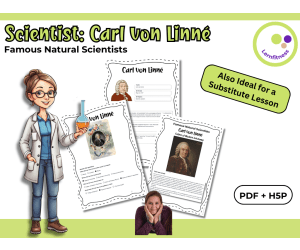
Scientist Carl von Linné – Fact Sheet, Quiz, and Interactive Exercises
Life Sciences, Science, Biology, STEM, History: World, History, Social Studies, Nature & Plants, Animals, Grade 7, 8, 9, 10, Worksheets, Worksheets & Printables, Quizzes, Quizzes and Tests, Teacher Tools, Projects, Activities
Discover Carl von Linné – The Father of Modern Taxonomy Carl von Linné, also known as Carolus Linnaeus, revolutionized the classification of living organisms and is widely regarded as the "Father of Modern Taxonomy". But did you know his work also laid the foundation for modern biology? This comprehensive teaching resource introduces your students in grades 7–10 to Linné’s groundbreaking contributions to the natural sciences. Designed for a 45-minute lesson, it combines engaging informational content with interactive and creative tasks to provide an inspiring and memorable learning experience. What’s Included: Concise Informational Text: A clear and engaging overview of Carl von Linné’s role in science. Fact Sheet Activity: Encourages students to organize knowledge and work creatively. Quiz with Solutions: Promotes fun, interactive learning and self-assessment. Additional Exercises: Students can create their own questions and collaborate in pairs to deepen their understanding. Flexible Formats: Includes a color and black-and-white printable PDF, as well as interactive H5P tasks for digital learning. Why You’ll Love This Resource: Time-Saving: Perfect for teachers who need a ready-to-go, well-structured lesson. Versatile Use: Ideal for biology, history of science, or cross-curricular lessons in English and science classes. Promotes Independence: Solutions are included, allowing students to check their work and explore the topic at their own pace. Interactive and Engaging: Tasks are designed to keep students actively involved while learning about Carl von Linné’s legacy. Whether you use it for a regular lesson, substitute teaching, or as part of a digital learning activity, this resource will make Carl von Linné’s contributions come alive for your students. Bring Carl von Linné’s fascinating world of science into your classroom and inspire your students to see history and science in a whole new light! Have fun exploring the world of science with your students! Warmly, Lernfitness Did You Know? I teach with a certified therapy dog, and together we focus on creating a positive and inspiring learning environment.
Author Lernfitness
Tags Science, Biology, Famous Scientists Lesson, H5P, Interactive Science Exercises, STEM, History, Scientists, Carl Von Linné, Taxonomy
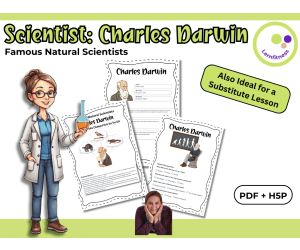
Scientist Charles Darwin Fact Sheet, Quiz + Exercises | PDF + H5P
Life Sciences, Science, Biology, STEM, History: World, History, Social Studies, Animals, Biographies, Grade 6, 7, 8, 9, Worksheets, Worksheets & Printables, Quizzes, Quizzes and Tests, Teacher Tools, Projects, Activities
Discover Charles Darwin – The Scientist Who Changed How We See Life Did you know that Charles Darwin’s ideas about evolution completely transformed the way we understand the natural world? His theory of natural selection explained how species change over time and adapt to their environments. Though controversial in his time, Darwin’s work laid the foundation for modern biology and continues to shape scientific thinking today. This teaching resource is designed to introduce your grades 7–10 students to Darwin’s revolutionary ideas in a way that’s engaging and easy to understand. Perfect for a 45-minute lesson, it combines clear explanations with interactive and creative activities to bring Darwin’s discoveries to life in the classroom. What’s Included: Concise Informational Text: A clear and engaging overview of Charles Darwin’s role in science. Fact Sheet Activity: Encourages students to organize knowledge and work creatively. Quiz with Solutions: Promotes fun, interactive learning and self-assessment. Additional Exercises: Students can create their own questions and collaborate in pairs to deepen their understanding. Flexible Formats: Includes a color and black-and-white printable PDF, as well as interactive H5P tasks for digital learning. Why You’ll Love This Resource: Time-Saving: Perfect for teachers who need a ready-to-go, well-structured lesson. Versatile Use: Ideal for biology, history of science, or cross-curricular lessons in English and science classes. Promotes Independence: Solutions are included, allowing students to check their work and explore the topic at their own pace. Interactive and Engaging: Tasks are designed to keep students actively involved while learning about Charles Darwin’s legacy. Whether you use it for a regular lesson, substitute teaching, or as part of a digital learning activity, this resource will make Charles Darwin’s contributions come alive for your students. Bring Charles Darwin’s fascinating world of science into your classroom and inspire your students to see history and science in a whole new light! Have fun exploring the world of science with your students! Warmly, Lernfitness Did You Know? I teach with a certified therapy dog, and together we focus on creating a positive and inspiring learning environment.
Author Lernfitness
Tags Science, Biology, Famous Scientists Lesson, H5P, Interactive Science Exercises, STEM, History, Scientists, Evolution, Darwin
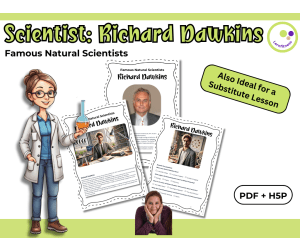
Richard Dawkins – Fact Sheet, Quiz & Interactive PDF incl. H5P
Life Sciences, Science, STEM, History, Social Studies, Biographies, Inventors, Basic Science, Physics, Biology, Grade 6, 7, 8, 9, 10, 11, 12, Worksheets, Worksheets & Printables, Quizzes, Quizzes and Tests, Teacher Tools, Projects, Activities
Scientist Richard Dawkins - Fact Sheet, Quiz & Interactive Version (PDF & H5P) Richard Dawkins – Genes, Evolution, and the “Selfish Gene” Fact Sheet, Quiz & Interactive Exercises (PDF + H5P) 🧬🐒 This 45-minute resource introduces students in grades 9–12 to Richard Dawkins – an evolutionary biologist best known for popularizing the idea of the “selfish gene.” By the time students reach upper secondary levels, they usually have a solid understanding of natural selection. Dawkins' perspective invites them to look one level deeper: not just at organisms competing for survival, but at genes as the driving force behind evolution . His work sparked a lot of discussion – not only in science, but also in philosophy and ethics. To help students engage with these more abstract ideas, I’ve put together a structured and accessible lesson. It includes a short informational text, a fact sheet, quiz questions with answers, and a creative partner task. The materials are available in color and black-and-white versions, plus there’s a digital H5P version for interactive use. What’s included: A student-friendly overview of Richard Dawkins and the core ideas of The Selfish Gene A fact sheet to help students organize key concepts Quiz questions with solutions for quick comprehension checks A partner task where students create and exchange questions Available as printable PDF and interactive H5P version 💻 Answer key included ✅ I’ve used this resource in upper-level biology and ethics courses – especially when discussing how scientific ideas evolve and how they influence thinking beyond the lab. The material also opens up interesting conversations about the role of science communication. Works well for individual tasks, pair work, or short discussion-based projects. 🚀 Download now and bring the legacy of Richard Dawkins into your biology lessons today! 📍 Best wishes, Heike from Lernfitness Did You Know? I teach with a certified therapy dog, and together we create a positive and inspiring learning environment. 🐶✨
Author Lernfitness
Tags Science, Biology, Famous Scientists Lesson, H5P, Interactive Science Exercises, STEM, History, Scientists, Richard Dawkins, The Selfish Gene
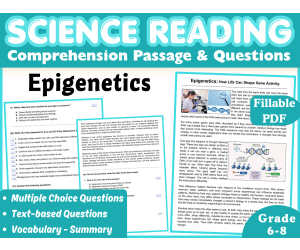
Epigenetics: Life Science Reading Comprehension Passage (Fillable PDF)
Science, ELA, Reading, Reading Comprehension, Strategies, Resources for Teachers, Common Core, Language Development, Life Sciences, Biology, Grade 6, 7, 8, 9, 10, Writing Prompts, Worksheets & Printables, Centers, Activities, Teacher Tools, Assessments, Quizzes and Tests, Quizzes, Tests, Literacy Readers
Life Science Reading Comprehension Passage and Questions for Middle School: Epigenetics (Fillable PDF) The engaging passage is about how gene activity can change without changing the DNA sequence itself . It explains how chemical tags, including methyl groups, can affect whether genes are more or less active, and how factors such as diet, stress, exercise, sleep, pollution, and life experiences may influence epigenetic patterns. It also covers identical twins and differences in gene activity over time, possible epigenetic effects across generations, links between epigenetics and disease, and possible uses in personalized medicine. This passage is designed to bridge the gap between science and literacy by strengthening reading comprehension while sparking scientific curiosity in middle school students. It blends English Language Arts skills with accurate science content, helping students build background knowledge, understand key concepts, use evidence from the text, and explain scientific ideas clearly. This resource supports science classroom practice while also reinforcing important literacy skills such as main idea, vocabulary, comprehension, and summarizing. Ideal for interdisciplinary learning in ELA and Science. Suitable for Grade 9 review, too! This passage is designed as a fillable PDF , which means students can type their answers directly into the document on any computer or tablet . Each page includes highlighted text fields that show them exactly where to type! Student Tasks for The Passage: 10 multiple-choice questions targeting main idea, key details, science concepts, comparison, and real-world applications 10 True/False statements to check understanding and address common misconceptions 5 text-based short-answer questions that require students to explain important ideas from the passage 5 vocabulary matching items with clear, student-friendly definitions 1 summary prompt that asks students to condense the central ideas accurately Full answer key for every section Available Formats for this Resource PDF Word Docs Google Docs Product Details Length: 7 pages total Grades: 6–8, also suitable for Grade 9 review Use cases: close reading, stations, homework, intervention, test prep, and sub plans Standards support: Reinforces informational-text skills and supports NGSS-style sense-making by helping students read scientific explanations, connect evidence to key concepts, interpret real-world examples, and explain cause-and-effect relationships in science. FULL CATALOG OF DOWNLOADING LINKS HERE Other Science Reading Collections and Topics You May Find in the Store: 1. Astronomy & Space Science 2. Volcanoes, Rocks, & Mountains 3. Rock Cycle, Soil, & Sinkholes 4. Mars, Glaciers, & Antarctica 5. Water Cycle, Acid Rain, & Wastewater 6. Insects, Animals, & Ecosystems 7. Bioluminescence & Insects 8. Animal Skin, Cats, & T. Rex 9. Human Body and Senses 10. Health & Applied Bioscience 11. Waves, Light, & Imaging 12. Electricity & Energy 13. Motion & Materials 14. Chemistry and Materials Science 15. Electromagnetism 16. Acids and Bases 17. Gas Laws 18. Biotechnology 19. Periodic Trends 20. Protists and Fungi 21. Microevolution 22. Blood 23. Chemical Bonding 24. Magnets 25. Muscles 26. Nuclear Chemistry 27. Electromagnetic Devices 28. Epigenetics 29. The Law of Conservation of Mass 30. Atomic Models 31. Isotopes and Ions 32. Light 33. Human-Environment Interaction 34. Theory of Evolution 35. Photosynthesis 36. Origins of Life and Early Earth 37. Gene Expression and Regulation 38. Thermochemistry 39. Allergies 40. Coevolution 41. Birth to Adulthood 42. Cells 43. Entropy and Free Energy 44. The Human Brain 45. Mixtures and Solutions 46. Invertebrates 47. Zoo Animals 48. Biochemistry 49. Animal Behavior 50. Population Ecology ...and many more engaging science reading passages that cover intriguing and important topics designed to spark curiosity and support student learning. Use this passage to reinforce ELA skills in science, to add literacy to your lessons, and to support independent work. The passages strengthen main idea, evidence use, vocabulary in context, inference, cause and effect, and summary writing. With ready-to-use assessments and complete answer keys, you can provide focused practice that is simple to run and fast to review.
Author Middle & High School - CORED Education
Rating
Tags Middle School, Reading Comprehension, Reading Strategies, ELA, Centers, Reading Passage, Assessments, Vocabulary, Life Science, Biology