How to Write an Essay: Drafting and Graphic Organizers
A chapter slice from a 'How to Write an Essay' workbook, based on a five-step writing model, that teaches students to draft essays using graphic organizers.




251 resources
Explore sub-categories
1 sub-categories · 251 resources
A chapter slice from a 'How to Write an Essay' workbook, based on a five-step writing model, that teaches students to draft essays using graphic organizers.

A chapter slice from a larger essay-writing workbook, covering prewriting and graphic-organizer strategies as part of a five-step writing model, with a critical-thinking (Bloom's Taxonomy) skills chart and an assessment rubric for evaluating student writing.

Reproducible chapter excerpt ("Chapter Slice") from the workbook "How to Write an Essay" (CCP1102), covering "Revising, Proofreading and Editing" (page 40 of the full 64-page workbook, per that workbook's table of contents), part of a resource built on a five-step writing model.
Cover title identifies this chapter slice as 'Writing a Descriptive Essay', part of the 'How to Write an Essay' 12-chapter workbook; front matter states the workbook is based on a five-step writing model for teaching essay composition and includes writing tasks to develop students' thinking skills and understanding.
Cover title identifies this chapter slice as 'Writing a Narrative Essay', part of the 'How to Write an Essay' 12-chapter workbook; front matter states the workbook is based on a five-step writing model for teaching essay composition and includes writing tasks to develop students' thinking skills and understanding.
Cover title identifies this chapter slice as 'Writing a Persuasive Essay', part of the 'How to Write an Essay' 12-chapter workbook; front matter states the workbook is based on a five-step writing model for teaching essay composition and includes writing tasks to develop students' thinking skills and understanding.

Cover title identifies this chapter slice as 'Writing an Informative Essay', part of the 'How to Write an Essay' 12-chapter workbook; front matter states the workbook is based on a five-step writing model for teaching essay composition and includes writing tasks to develop students' thinking skills and understanding.
A literary-terms vocabulary lesson package teaching 13 terms related to Points of View through a slide presentation, guided notes, a creative-writing application task, and multiple assessment options.
A set of print-and-pass poetry writing lessons designed to be run by a substitute teacher, each giving students a concept definition, drafting time, a peer-review step, and a rubric-scored final poem.
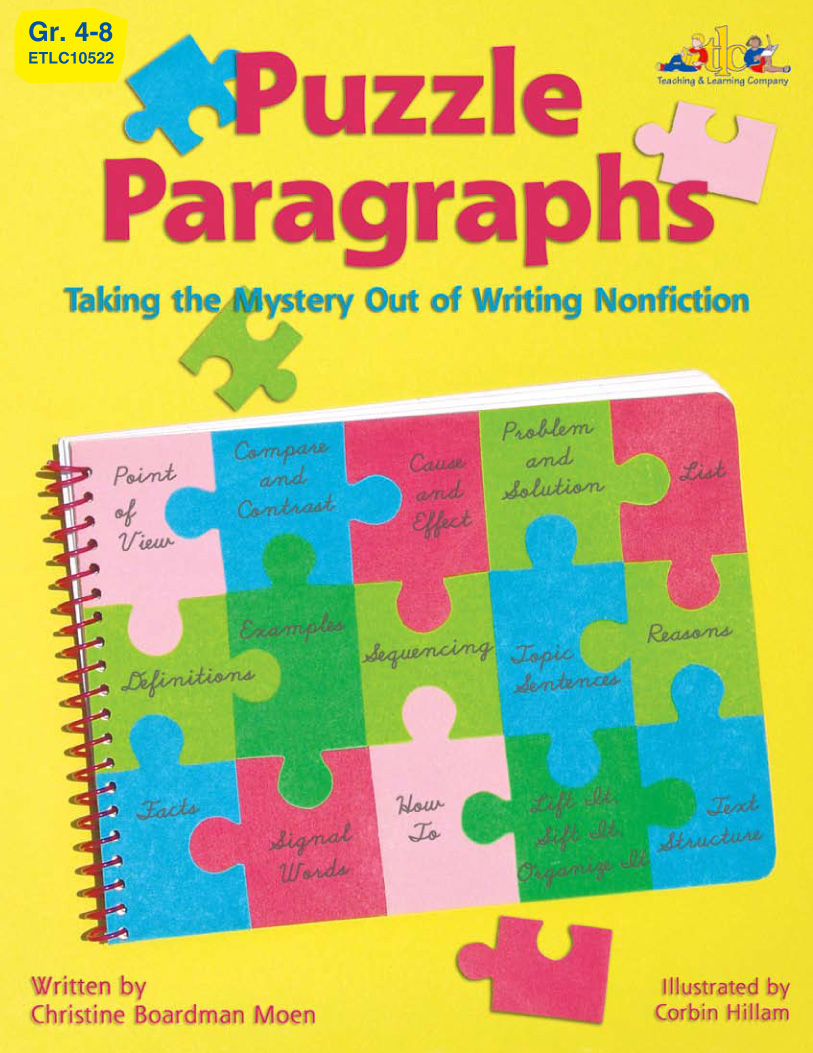
Teaches students to write informational/nonfiction paragraphs using distinct text structures (examples, facts, reasons, cause-effect, problem-solution, comparison-contrast, list, sequencing, how-to, definitions) via a 'puzzle paragraph' method.
 Free download
 A narrative writing assignment teaching literary symbolism: students write a personal narrative built around a symbolic object and an explanatory paragraph analyzing its meaning.