Misery Loves Company | Figurative Language Activity | Micro-Learning Deck
Teach students to understand the figurative language expression 'misery loves company' through a close-reading passage and comprehension activities.


16,389 resources
Explore sub-categories
13 sub-categories · 16,389 resources
Teach students to understand the figurative language expression 'misery loves company' through a close-reading passage and comprehension activities.
Teach middle/high school students to critically evaluate digital information and identify misinformation, disinformation, and malinformation using a structured verification methodology.

A book companion of print-and-go reading comprehension activities for the picture book "Miss Nelson is Back" by James Marshall.
Teach students to understand the figurative language/idiom 'miss the point' through a close-reading passage and comprehension activities.

Multi-day group project/activity plan for teaching about the planets and solar system through research and a hands-on straw-rocket launch relay.

A digital exit ticket/review activity (delivered as a Google Form) assessing student comprehension of mitosis and the cell cycle.

Teach advanced (CEFR C1) ESL/EFL grammar of mixed conditionals, combining present and past time frames within a single conditional sentence.

Teach upper-intermediate (CEFR B2) ESL/EFL grammar of mixed conditionals.

Mixed Media 3D Snowmen The Mixed Media 3D Snowmen is a meticulously designed teaching resource primed to immerse students into the captivating world of art.

This fully resourced lesson on mixtures for middle school includes an animated PowerPoint which: > explains why elements and compounds are pure substance and mixtures are not; > explains the terms solute, solvent, solution, soluble and…

Project selected slides before a research-writing lesson to discuss when a writer needs to credit a source. Examples show how summaries, paraphrases, and quotations connect to in-text citations and a Works Cited list. The deck uses older MLA formatting examples, so treat it as a legacy teaching resource when deciding which slides fit your course requirements.

Presenting our MLK Jr's "Letter from Birmingham Jail" Primary Source Analysis – an engaging and informative educational tool created for both teachers and students! Dive into the powerful words of civil rights icon Martin Luther King Jr.

This engaging and comprehensive lesson is designed to introduce or review the use of the Modal Perfect tense, specifically focusing on speculations and deductions.

This engaging and comprehensive lesson aims to introduce or reinforce the use of the Modal Perfect Infinitive for expressing regrets and disapproval.

This comprehensive lesson aims to introduce and reinforce the various uses of the versatile modal verb "CAN" in English, encompassing its application in the present, past, and future tenses, presented in affirmative, interrogative, and…

Teach pre-intermediate (CEFR A2) ESL/EFL use of the modal verb 'should' for giving advice, making recommendations, expressing obligation, and expressing uncertainty.

Can Could ESL and EFL lesson plan for A1 beginner English students. This TEFL resource is ready to go and comprises a range of teaching materials, such as flashcards, activities, conversation topics, and writing drills.

Modal Verbs: Can - Could | Pre-Intermediate Lesson Plan This effective Language Arts teaching resource designed for all older children and adults, specifically targets the Grammar subject area.

Teach intermediate (CEFR B1) ESL/EFL modal verbs 'may', 'might', 'will', and 'probably' for expressing degrees of possibility and probability.

This captivating lesson serves to introduce and review the usage of essential modals such as 'must,' 'had better,' 'have got,' and 'have to,' along with additional information on 'need' as a modal.
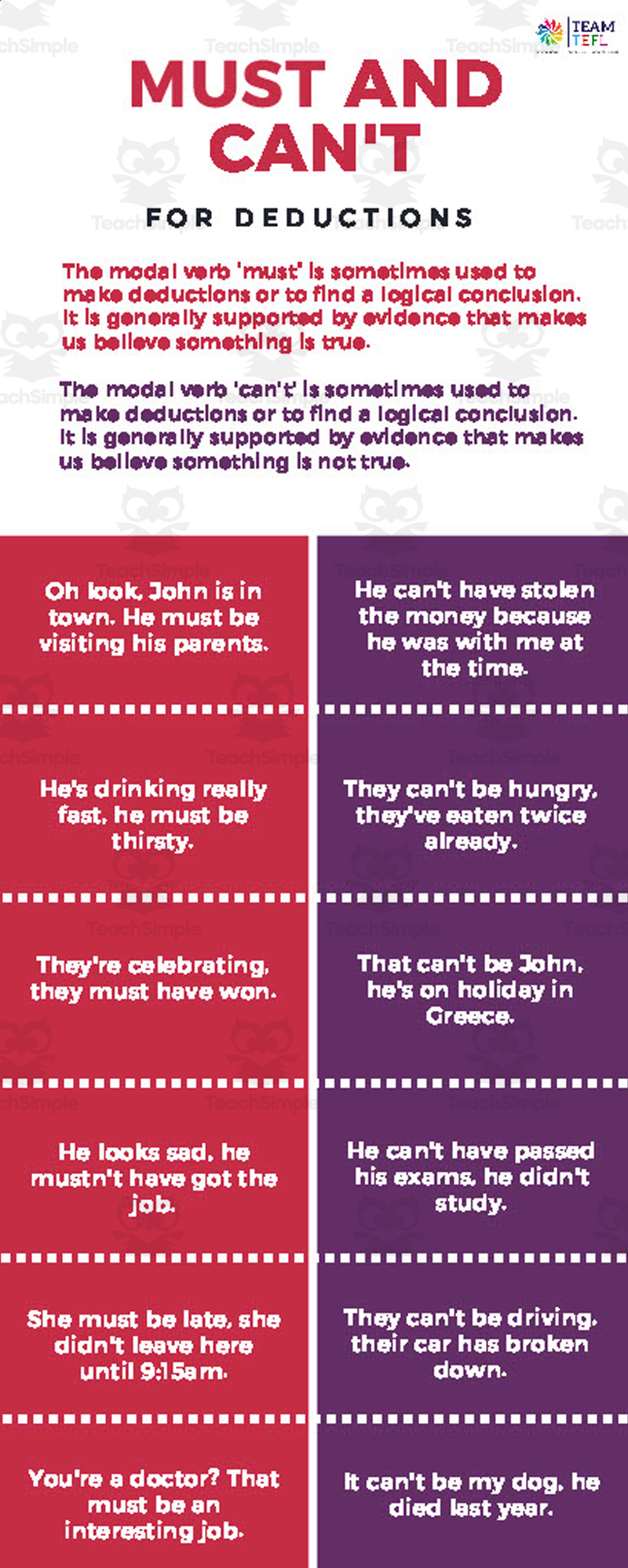
Teach intermediate (CEFR B1) ESL/EFL modal verbs 'must' and 'can't' for making logical deductions.

Teach the distinction between the English modal verb 'must' (emotional/personal obligation) and 'have to' (enforced obligation/necessity) at intermediate (B1) level, including affirmative, negative, and interrogative forms.

The Modal Verbs: Should have, could have, might have Intermediate Lesson Plan This is a stellar teaching resource that provides an engaging and deep comprehension approach for all intermediate ESL learners to learn about an essential…

A STEM/maker design challenge in which students design and build a model tiny home using provided or upcycled craft materials, applying constraints and specifications.